NURS 4341 OB Exam 2 Study Guide - University of Texas, Arlington HYPERTENSIVE DISORDERS
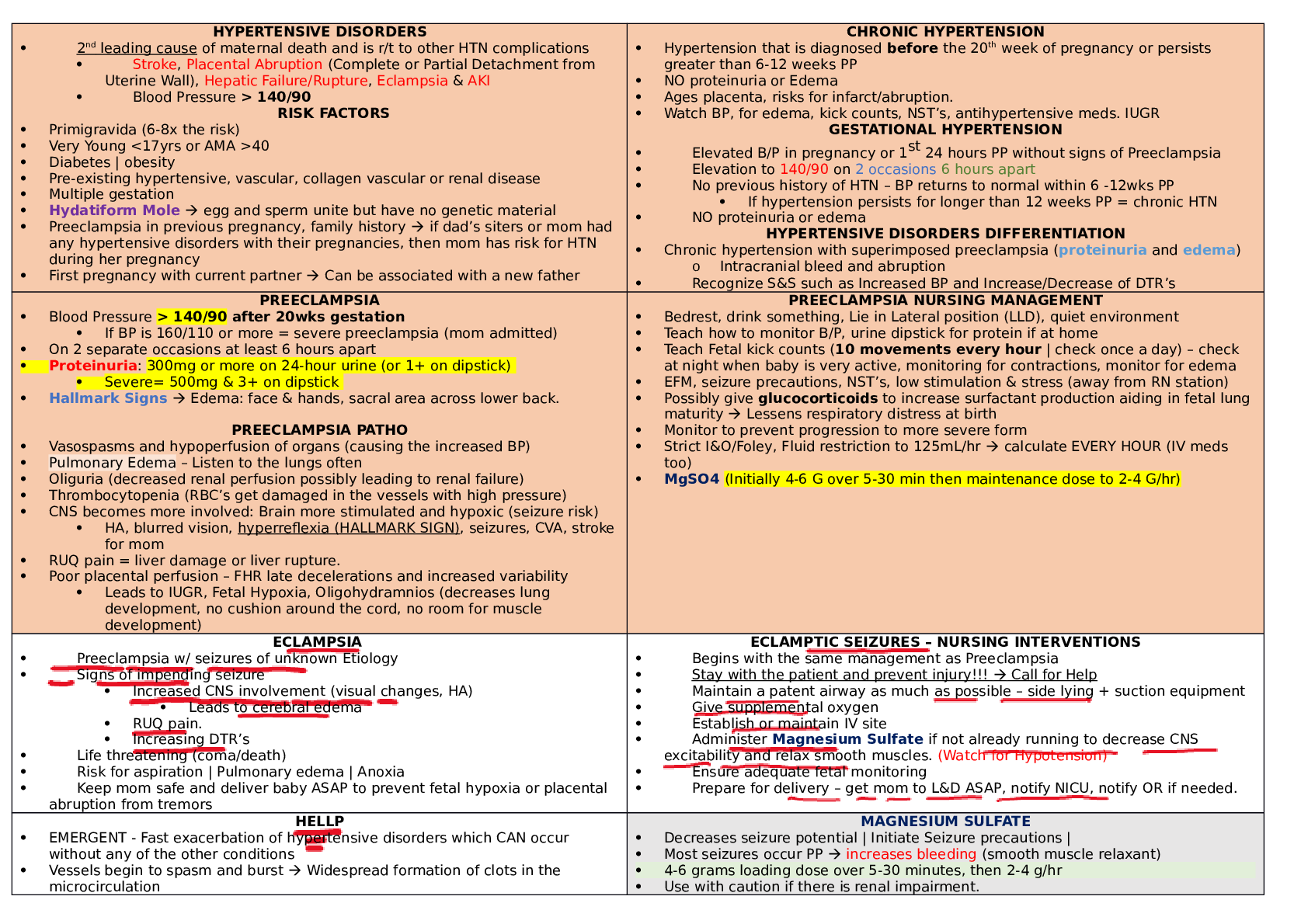
2nd leading cause of maternal death and is r/t to other HTN complications
Stroke, Placental Abruption (Complete or Partial De
...
NURS 4341 OB Exam 2 Study Guide - University of Texas, Arlington HYPERTENSIVE DISORDERS
2nd leading cause of maternal death and is r/t to other HTN complications
Stroke, Placental Abruption (Complete or Partial Detachment from
Uterine Wall), Hepatic Failure/Rupture, Eclampsia & AKI
Blood Pressure > 140/90
RISK FACTORS
Primigravida (6-8x the risk)
Very Young <17yrs or AMA >40
Diabetes | obesity
Pre-existing hypertensive, vascular, collagen vascular or renal disease
Multiple gestation
Hydatiform Mole egg and sperm unite but have no genetic material
Preeclampsia in previous pregnancy, family history if dad’s siters or mom had
any hypertensive disorders with their pregnancies, then mom has risk for HTN
during her pregnancy
First pregnancy with current partner Can be associated with a new father
CHRONIC HYPERTENSION
Hypertension that is diagnosed before the 20th week of pregnancy or persists
greater than 6-12 weeks PP
NO proteinuria or Edema
Ages placenta, risks for infarct/abruption.
Watch BP, for edema, kick counts, NST’s, antihypertensive meds. IUGR
GESTATIONAL HYPERTENSION
Elevated B/P in pregnancy or 1st 24 hours PP without signs of Preeclampsia
Elevation to 140/90 on 2 occasions 6 hours apart
No previous history of HTN – BP returns to normal within 6 -12wks PP
If hypertension persists for longer than 12 weeks PP = chronic HTN
NO proteinuria or edema
HYPERTENSIVE DISORDERS DIFFERENTIATION
Chronic hypertension with superimposed preeclampsia (proteinuria and edema)
o Intracranial bleed and abruption
Recognize S&S such as Increased BP and Increase/Decrease of DTR’s
PREECLAMPSIA
Blood Pressure > 140/90 after 20wks gestation
If BP is 160/110 or more = severe preeclampsia (mom admitted)
On 2 separate occasions at least 6 hours apart
Proteinuria: 300mg or more on 24-hour urine (or 1+ on dipstick)
Severe= 500mg & 3+ on dipstick
Hallmark Signs Edema: face & hands, sacral area across lower back.
PREECLAMPSIA PATHO
Vasospasms and hypoperfusion of organs (causing the increased BP)
Pulmonary Edema – Listen to the lungs often
Oliguria (decreased renal perfusion possibly leading to renal failure)
Thrombocytopenia (RBC’s get damaged in the vessels with high pressure)
CNS becomes more involved: Brain more stimulated and hypoxic (seizure risk)
HA, blurred vision, hyperreflexia (HALLMARK SIGN), seizures, CVA, stroke
for mom
RUQ pain = liver damage or liver rupture.
Poor placental perfusion – FHR late decelerations and increased variability
Leads to IUGR, Fetal Hypoxia, Oligohydramnios (decreases lung
development, no cushion around the cord, no room for muscle
development)
PREECLAMPSIA NURSING MANAGEMENT
Bedrest, drink something, Lie in Lateral position (LLD), quiet environment
Teach how to monitor B/P, urine dipstick for protein if at home
Teach Fetal kick counts (10 movements every hour | check once a day) – check
at night when baby is very active, monitoring for contractions, monitor for edema
EFM, seizure precautions, NST’s, low stimulation & stress (away from RN station)
Possibly give glucocorticoids to increase surfactant production aiding in fetal lung
maturity Lessens respiratory distress at birth
Monitor to prevent progression to more severe form
Strict I&O/Foley, Fluid restriction to 125mL/hr calculate EVERY HOUR (IV meds
too)
MgSO4 (Initially 4-6 G over 5-30 min then maintenance dose to 2-4 G/hr)
[Show More]