Airway/Breathing (Oxygenation) Pneumonia/Chronic
Obstructive Pulmonary Disease Clinical Reasoning
Case Study
STUDENT Worksheet
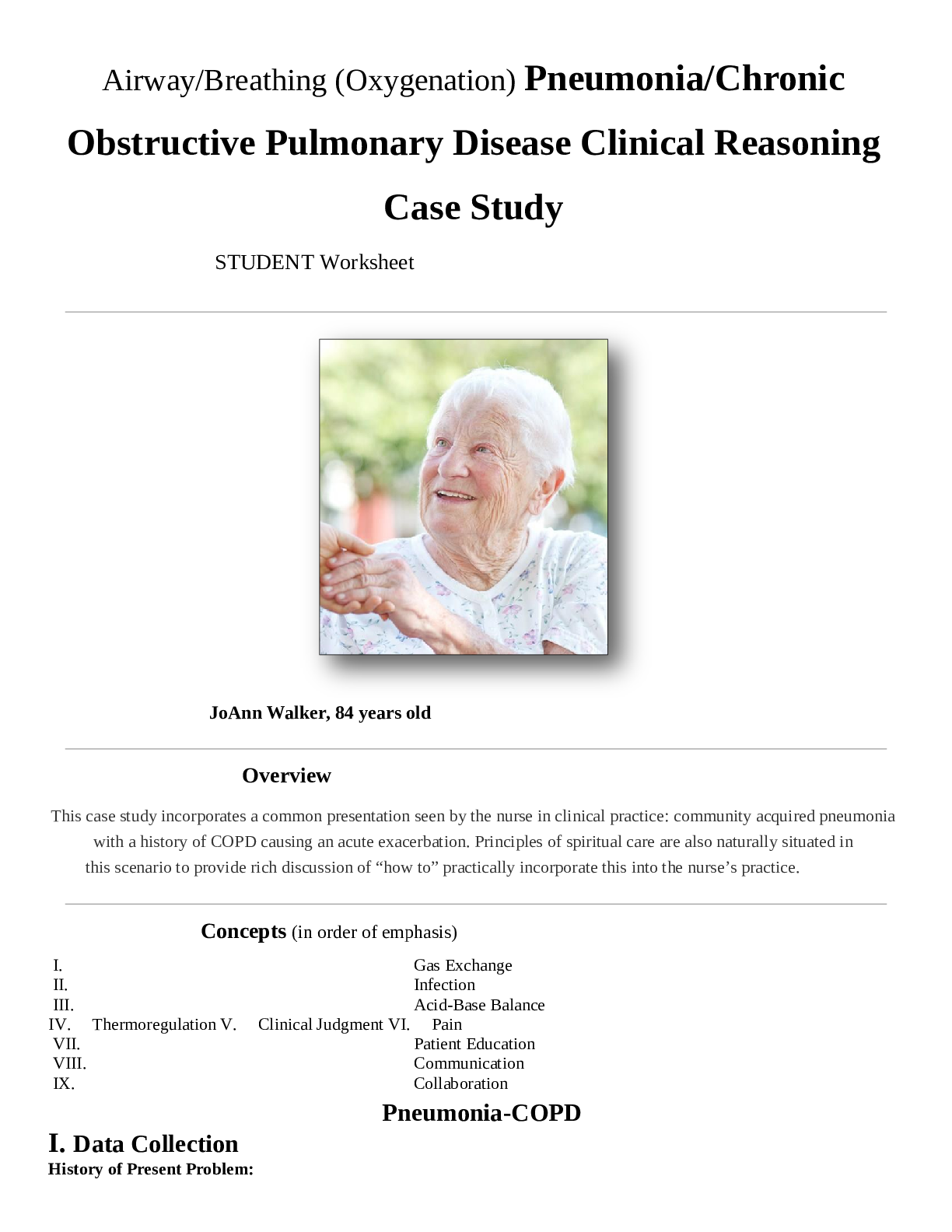
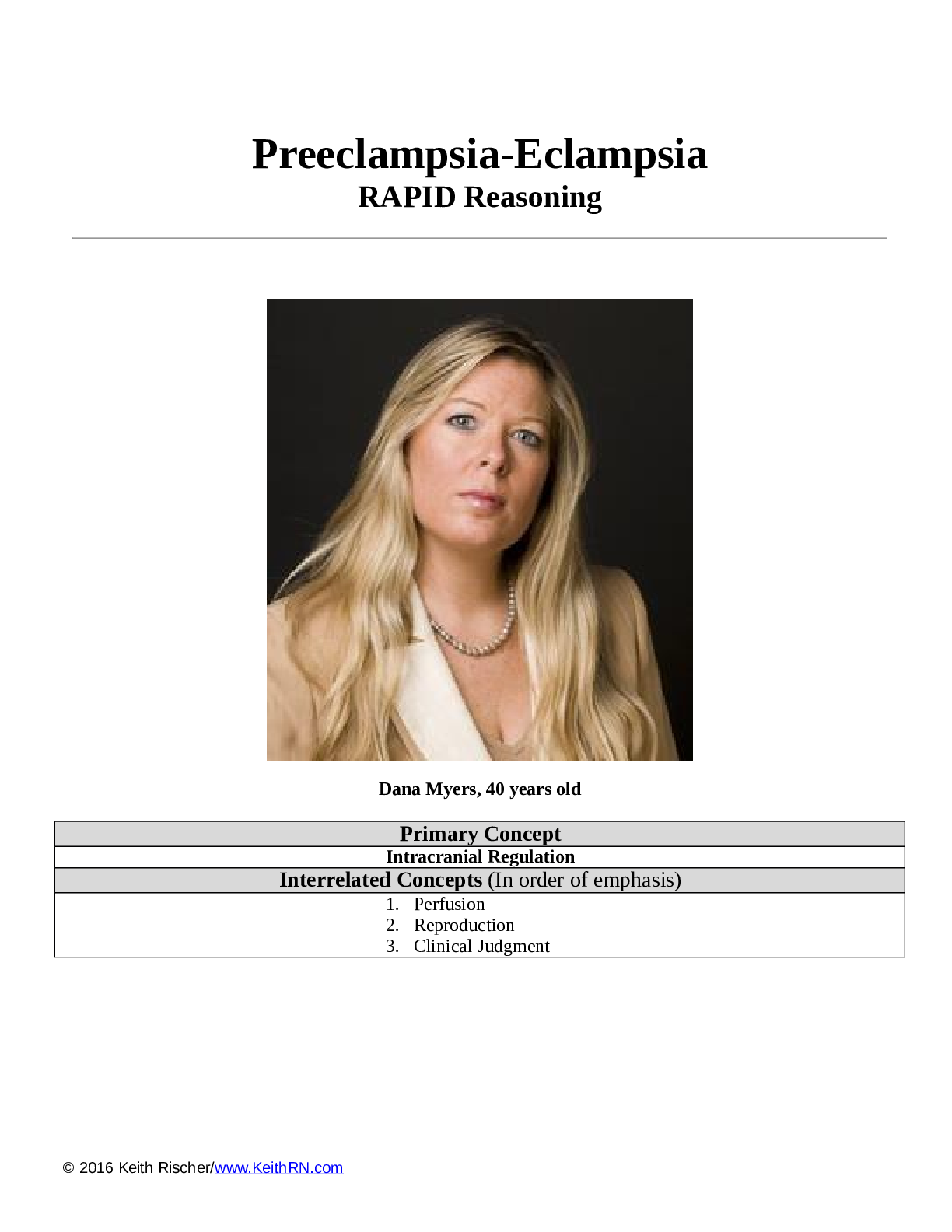
JoAnn Walker, 84 years old
Overview
This case study incorporates a common presentation
...
Airway/Breathing (Oxygenation) Pneumonia/Chronic
Obstructive Pulmonary Disease Clinical Reasoning
Case Study
STUDENT Worksheet
JoAnn Walker, 84 years old
Overview
This case study incorporates a common presentation seen by the nurse in clinical practice: community acquired pneumonia
with a history of COPD causing an acute exacerbation. Principles of spiritual care are also naturally situated in
this scenario to provide rich discussion of “how to” practically incorporate this into the nurse’s practice.
Concepts (in order of emphasis)
I. Gas Exchange
II. Infection
III. Acid-Base Balance
IV. Thermoregulation V. Clinical Judgment VI. Pain
VII. Patient Education
VIII. Communication
IX. Collaboration
I. Data Collection
History of Present Problem:
Pneumonia-COPD
JoAnn Walker is an 84-year-old female who has had a productive cough of green phlegm 4 days ago that continues to
persist. She was started 3 days ago on prednisone 60 mg po daily and azithromycin (Zithromax) 250 mg po x5 days by her
clinic physician. Though she has had intermittent chills, she first noticed a fever last night of 102.0. She has had more
difficulty breathing during the night and has been using her albuterol inhaler every 1-2 hours with no improvement.
Therefore she called 9-1-1 and arrives at the emergency department (ED) by emergency medical services (EMS) where
you are the nurse who will be responsible for her care.
Personal/Social History:
JoAnn was widowed 6 months ago after 64 years of marriage and resides in assisted living. She is a retired elementary
school teacher. She called her pastor and he has now arrived and came back with the patient. The nurse walked in the
room when the pastor asked Joan if she would like to pray. The patient said, “Yes, this may the beginning of the end for
me.”
What data from the histories is important & RELEVANT; therefore it has clinical significance to the nurse?
RELEVANT Data from Present Problem: Clinical Significance:
Green phlegm
Chills
Fever (102.0)
Difficulty Breathing (no improvement with
albuterol)
These vital signs clinically show signs of infection. With the
difficulty breathing I would think about possible respiratory infection
RELEVANT Data from Social History: Clinical Significance:
84 years old
Live in assisted living facility
Religious preference
Her social history is clinically significant because with her age and
being in close quarters with quite a few people could increase her
risk for the spread of infection. Also we need to keep in mind her
religious preference during her stay.
What is the RELATIONSHIP of your patient’s past medical history (PMH) and current meds?
(Which medication treats which condition? Draw lines to connect)
PMH: Home Meds: Pharm. Classification: Expected Outcome:
CO P D / a sth ma
Hypertension
Hyperlipidemia
Cor-pulmonale
Anxiety disorder
1ppd smoker x40 years.
Quit 10 years ago
1. Fluticasone/salmeterol
(Advair) diskus 1 puff every
12 hours
2. Albuterol (Ventolin) MDI
2 puffs every 4 hours prn
3. Lisinopril (Prinivil) 10 mg
po daily
4. Gemfribrozil (Lopid) 600
mg po bid
5. Diazepam (Valium) 2.5
mg po every 6 hours as
needed
6. Triamterene-HCTZ
(Dyazide) 1 tab daily
1. corticosteroid, beta 2
adrenergic agonist
2. Sympathomimetic
bronchodilator
3. ACE inhibitor
4. Peroxisome Proliferator
Receptor alpha Agonist
5. Benzodiazepine
6. Potassium Sparing
Diuretic
1. prevent symptoms of
asthma/COPD
2. treats asthma,
bronchodilator, allows for
better gas exchange
3. used to treat hypertension,
lowers blood pressure
4. helps treat hyperlipidemia,
lowers cholesterol and
triglycerides
5. Treats anxiety, little to no
anxiety
6. Increased urination without
affecting potassium
One disease process often influences the development of other illnesses. Based on your knowledge of
pathophysiology, (if applicable), which disease likely developed FIRST that then initiated a “domino effect” in
their life?
put in bold what PMH problem likely started FIRST
Underline what PMH problem(s) FOLLOWED as domino(s) (anxiety could have happened at any part of her
life span)
II. Patient Care Begins:
Current VS: WILDA Pain Scale (5th VS):
T: 103.2 (oral) Words: Ache
P: 110 (regular) Intensity: 3/10
R: 30 (labored) Location: Generalized over right side of chest with no radiation
BP: 178/96 Duration: Intermittent-lasting a few seconds
O2 sat: 86%
6 liters n/c
Aggreviate:
Alleviate:
Deep breath
Shallow breathing
What VS data is RELEVANT that must be recognized as clinically significant to the nurse?
RELEVANT VS Data: Clinical Significance:
RR
O2
BP
Temperature
Heart Rate
RR is increased which could be due to exacerbation of COPD/asthma and also possible
fluid on the lungs (I would listen to her lungs to confirm this)
With her O2 sat I would first ask her what her baseline is. With COPD her baseline
could run below normal. Then I would think that it is decreased even more due to the
COPD/asthma exacerbation and fluid on the lungs
Temperature is increased due to probable infection
Heart Rate is increased due to probable infection and also possible anxiety and or pain
Current Assessment:
GENERAL
APPEARANCE:
Appears anxious and in distress
RESP: Dyspnea with intercostal retractions, breath sounds very diminished bilaterally with
scattered expiratory wheezing
CARDIAC: Pale, hot & dry, no edema, heart sounds regular-S1S2, pulses strong, equal with
palpation at radial/pedal/post-tibial landmarks
NEURO: Alert & oriented to person, place, time, and situation (x4)
GI: Abdomen soft/non-tender, bowel sounds audible per auscultation in all 4 quadrants
GU: Voiding without difficulty, urine clear/yellow
SKIN: Skin integrity intact
What assessment data is RELEVANT that must be recognized as clinically significant to the nurse?
RELEVANT Assessment Data: Clinical Significance:
Appears to be in distress
Dyspnea with intercostals retractions
Diminished bilaterally with expiratory
wheezing
Hot
12 Lead EKG:
Interpretation:
Sinus Tachycardia
Clinical Significance:
III. Clinical Reasoning Begins…
1. What is the primary problem that your patient is most likely presenting with?
Respiratory infection with COPD/Asthma exacerbation
2. What is the underlying cause/pathophysiology of this problem?
40 years of smoking
3. What nursing priority(s) will guide your plan of care? (if more than o
[Show More]