BIOS 255 – Week 1 Lab Instructions
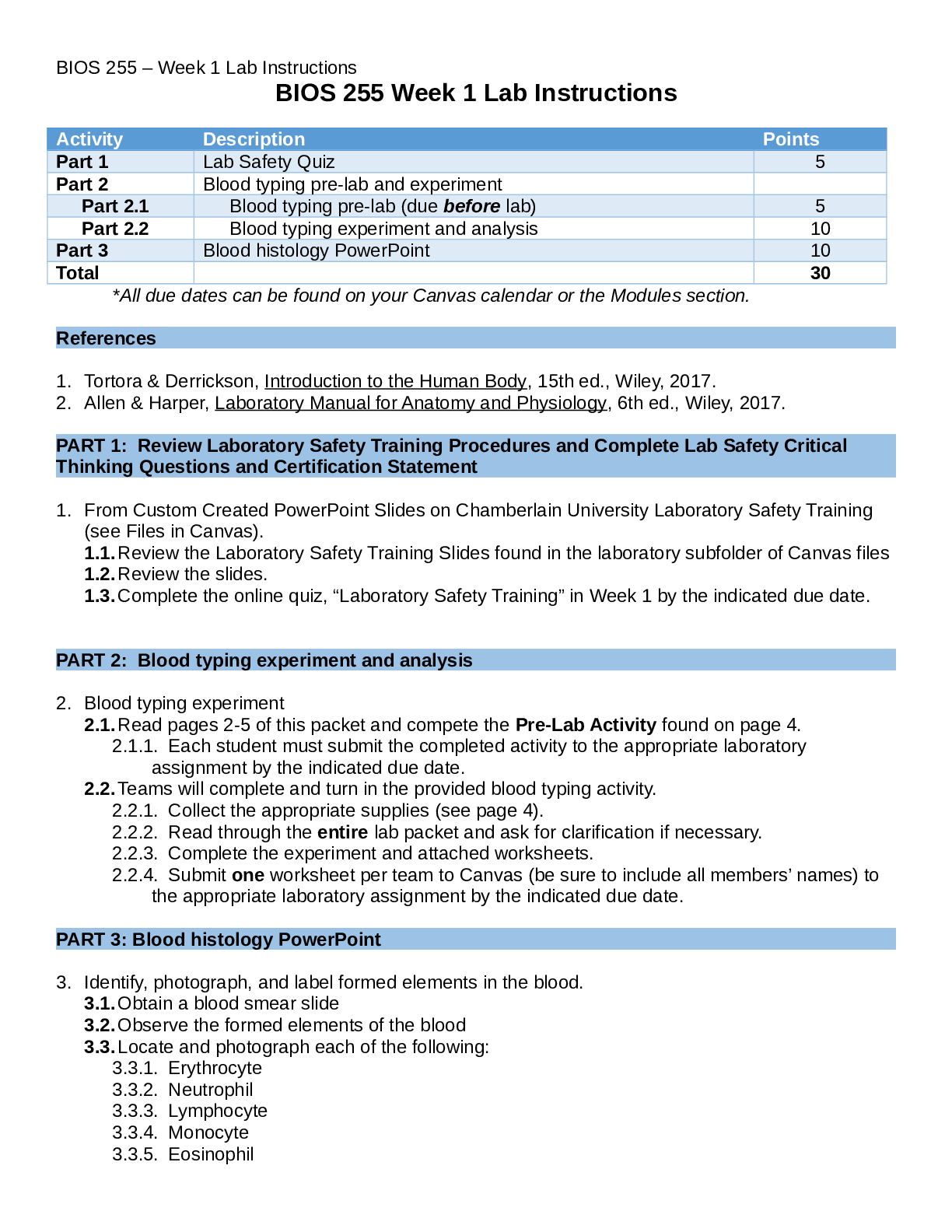
BIOS 255 Week 1 Lab Instructions
Activity Description Points
Part 1 Lab Safety Quiz 5
Part 2 Blood typing pre-lab and experiment
Part 2.1 Blood typing pre-lab (due before lab) 5
P
...
BIOS 255 – Week 1 Lab Instructions
BIOS 255 Week 1 Lab Instructions
Activity Description Points
Part 1 Lab Safety Quiz 5
Part 2 Blood typing pre-lab and experiment
Part 2.1 Blood typing pre-lab (due before lab) 5
Part 2.2 Blood typing experiment and analysis 10
Part 3 Blood histology PowerPoint 10
Total 30
*All due dates can be found on your Canvas calendar or the Modules section.
References
1. Tortora & Derrickson, Introduction to the Human Body, 15th ed., Wiley, 2017.
2. Allen & Harper, Laboratory Manual for Anatomy and Physiology, 6th ed., Wiley, 2017.
PART 1: Review Laboratory Safety Training Procedures and Complete Lab Safety Critical
Thinking Questions and Certification Statement
1. From Custom Created PowerPoint Slides on Chamberlain University Laboratory Safety Training
(see Files in Canvas).
1.1. Review the Laboratory Safety Training Slides found in the laboratory subfolder of Canvas files
1.2. Review the slides.
1.3. Complete the online quiz, “Laboratory Safety Training” in Week 1 by the indicated due date.
PART 2: Blood typing experiment and analysis
2. Blood typing experiment
2.1. Read pages 2-5 of this packet and compete the Pre-Lab Activity found on page 4.
2.1.1. Each student must submit the completed activity to the appropriate laboratory
assignment by the indicated due date.
2.2. Teams will complete and turn in the provided blood typing activity.
2.2.1. Collect the appropriate supplies (see page 4).
2.2.2. Read through the entire lab packet and ask for clarification if necessary.
2.2.3. Complete the experiment and attached worksheets.
2.2.4. Submit one worksheet per team to Canvas (be sure to include all members’ names) to
the appropriate laboratory assignment by the indicated due date.
PART 3: Blood histology PowerPoint
3. Identify, photograph, and label formed elements in the blood.
3.1. Obtain a blood smear slide
3.2. Observe the formed elements of the blood
3.3. Locate and photograph each of the following:
3.3.1. Erythrocyte
3.3.2. Neutrophil
3.3.3. Lymphocyte
3.3.4. Monocyte
3.3.5. Eosinophil
BIOS 255 – Week 1 Lab Instructions
3.3.6. Basophil – find an image online if you do not have a specific basophil slide - they are
very rare in healthy blood samples
3.3.7. Platelets (these will likely only appear as small purple dots but that is OK)
3.4. Create a PowerPoint with a slide for each formed element of the blood. Include your own
photograph (except for the basophil) with a short description of the formed element including:
3.4.1. Function
3.4.2. Concentration in normal blood
3.4.3. What common conditions would cause this formed element to A) increase and B)
decrease in concentration?
3.4.4. You must follow APA format (cite your sources) and Chamberlain Academic
Integrity Guidelines.
3.5. Submit this PowerPoint to Canvas to the appropriate laboratory assignment by the indicated
due date.
PART 2: Blood typing experiment and analysis
Blood typing background
Blood groups are critically important with respect to transfusions of whole blood used for patients that
have lost appreciable amounts of blood. If someone with type A blood receives a transfusion of type B
blood, then the two blood types will interact, agglutinate (clump not clot), and clog the
arteries/veins/capillaries of the recipient with extremely negative outcomes (death). Even in non-fatal
transfusion reactions, the risk of death or serious injury exists. Free hemoglobin is released into the
blood as the agglutinated cells are broken down, which can lead to acute renal failure.
Agglutination is caused by the interaction of the proteins on the surface of the red blood cells and the
antibodies present in the plasma. Antibodies are produced by B lymphocytes to help protect the body
from foreign invaders (pathogens) by recognizing the ‘name-tags’ (antigens) present. All cells have
antigens on their surface but your body is ‘blind’ to the normal antigens present on your own cells.
[Show More]