What is the correct code assigned for a patient with an abscess of the bladder?
N30.80
_____ is an abnormal, or unexpected, condition. Anomaly
Morning sickness is also known as: hyperemesis gravidarum.
What is the co
...
What is the correct code assigned for a patient with an abscess of the bladder?
N30.80
_____ is an abnormal, or unexpected, condition. Anomaly
Morning sickness is also known as: hyperemesis gravidarum.
What is the correct code for vesicoureteral reflux with nephropathy without
hydroureter, bilateral? N13.722
Bladder cancer is the __________ most frequently diagnosed cancer in men.
fourth
Smitty Smith is being seen today for Kaposi's sarcoma of the lymph nodes due to
AIDS. What codes are assigned? B20, C46.3
What is the correct code for a patient who is currently in her 20th week of
pregnancy who has gained an excessive amount of weight? O26.02
Which of the following parts of the urinary system is/are responsible for transporting
urine from the kidney to the urinary bladder? Ureters
What is the correct code for a patient with painful prostate syndrome? N42.81
Sally Salter, G1 P0, is being seen in the office today for a routine pregnancy visit.
Sally is only 14 years old, and the physician determines her pregnancy to be high
risk. Sally is currently at 16 weeks’ gestation and will be meeting with an adoption
agency about the possibility of placing the baby for adoption. What code is
assigned: O09.612
Which of the following glomerular filtration rates indicates stage 4 chronic kidney
disease? 15–29 mL/min
How many chromosomes does each oocyte contain? 23
What is the correct code for a patient with a malignant neoplasm of the lateral wall
of the bladder: C67.2
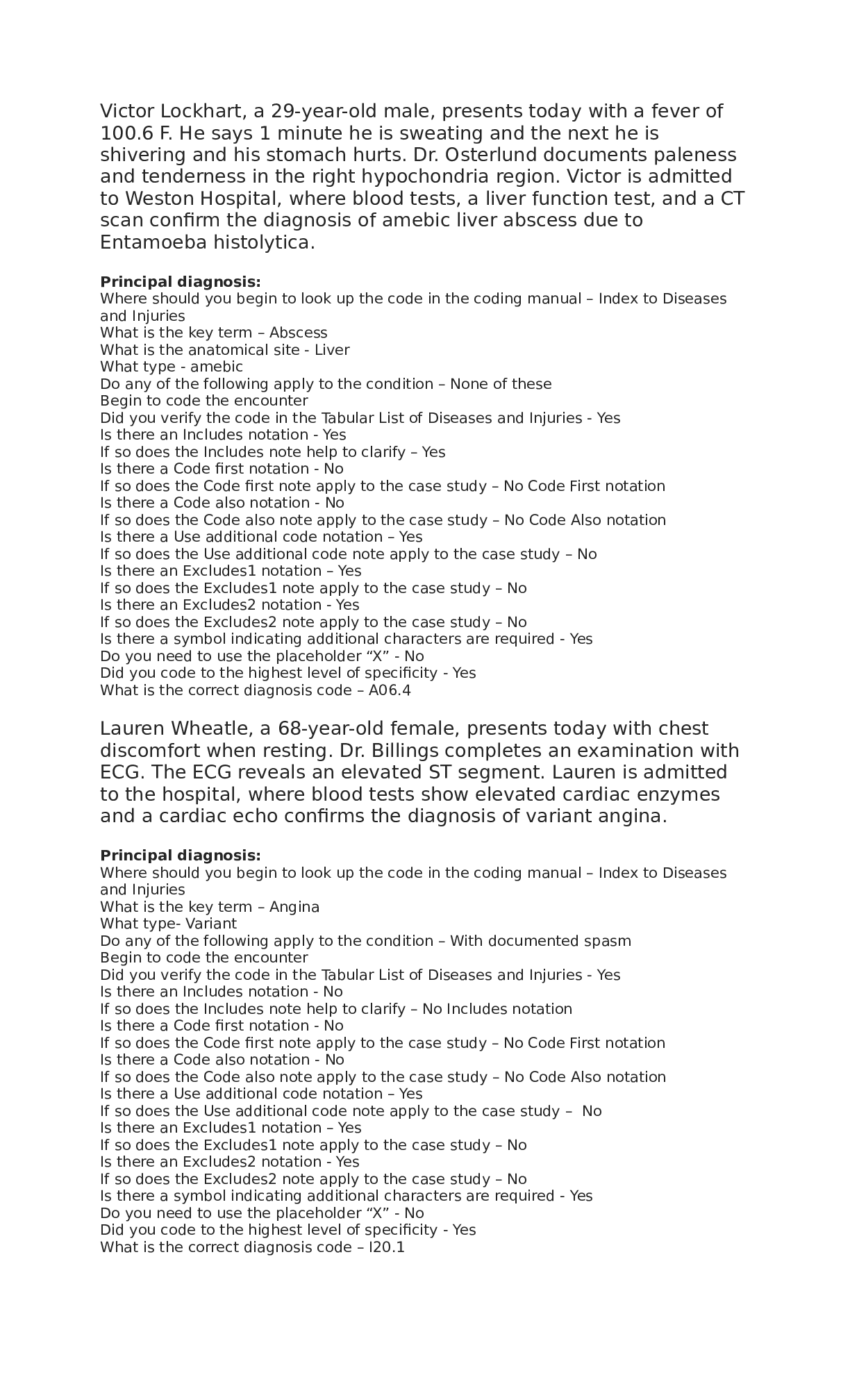
Murphy Jorganson, a 42-year-old male, presents with the complaint of frequent and
painful urination. Dr. Reddy completes a physical examination and notes swelling of
the testicles. Murphy admits to some soreness and a whitish discharge. Dr. Reddy
inserts a cotton swab approximately 3.5 cm into the urethra and rotates it once.
Microscopic examination confirmed the diagnosis of non-gonococcal urethritis due
to methicillin-resistant Staphylococcus aureus Jennifer Addis, a 23-year-old female, presents today with frequent urination and a
burning sensation. Jennifer is 25 weeks pregnant. Dr. Pizzuti completes an
examination and orders a culture, which reveals Escherichia coli. Jennifer is
diagnosed with a urinary bladder infection due to E. coli Karen Sprague went into labor, and her husband, Allen, was driving her to the
hospital when they got caught in a traffic jam. Karen gave birth in the car, and Allen
cut the umbilical cord with the utility knife he keeps in the trunk. Upon arrival at the
hospital, Dr. Parkerson performed a complete newborn examination and diagnosedthe baby with tetanus neonatorum caused by the use of the nonsterile instrument
during delivery. Code baby Sprague’s chart. Sean Dollarson, an 8-year-old male, is brought in by his parents to see Dr.
Greenburg, his pediatrician. Sean has not been feeling well and has had some
pinkish colored urine. Dr. Greenburg completed a physical exam noting elevated
blood pressure and periobrbital puffiness. Sean is admitted to the hospital. The
laboratory tests reveal azotemia, a BUN:Cr ratio of 18, proteinuria of 2.1 g/day, and
that RBCs are dysmorphic. After reviewing the results of the tests, Sean is
diagnosed with chronic nephritic syndrome with diffused mesangial proliferative
glomerulonephritis. This 52-year-old African American male was admitted to the hospital with a
palpable 2.25-cm nodule in the right breast in the superficial aspect of the
right breast in the 4 o’clock axis near the periphery.
Excision of the right breast mass with an intermediate wound closure of 3 cm
was accomplished. Patient tolerated the procedure well; however, some
respiratory complications were realized as a result of the general anesthesia
so the patient was kept in the facility for an extra day.
Patient is discharged home with his wife. Discharge orders instruct him to
make a follow-up appointment with Dr. Facci, the oncologist, to discuss
treatment. The patient is a 34-year-old white female with a long history of
schizoaffective disorder with numerous hospitalizations, brought in by
ambulance for increasing paranoia; increasing arguments with other people;
and, in general, an exacerbation of her psychotic symptoms, which had been
worsening over the previous 2 weeks.
She is now discharged to return to her home at the YMCA and also to return
to her weekly psychiatric appointments with Dr. Mulford. The patient also is
advised to follow up with her medical doctor for her hypertension.
The patient was advised during this admission to start on
hydrochlorothiazide 12.5 mg daily, but she refused. This is a 36–37-week-old female neonate delivered to a 25-year-old, gravida
2, para 1, who was a known breech presentation. Mother presented with
complaint of vaginal bleeding, rupture of membranes, and abdominal pain
and cramping. On exam found to be complete with large fecal impaction.
Fetal heart rate 120 by monitor. To c-section room for disimpaction and
cesarean section for breech. Delivered precipitously immediately after
impaction was removed, breech presentation. OB moved baby to warmer.
She was pale with no respiratory effort or heart rate. Ambu bagged with
[Show More]