Jarvis: Physical Examination & Health Assessment, 7th Edition 1.Which statement is true
regarding the arterial system?
The arterial system is a high-pressure system.
The nurse is reviewing the blood supply to the arm.
...
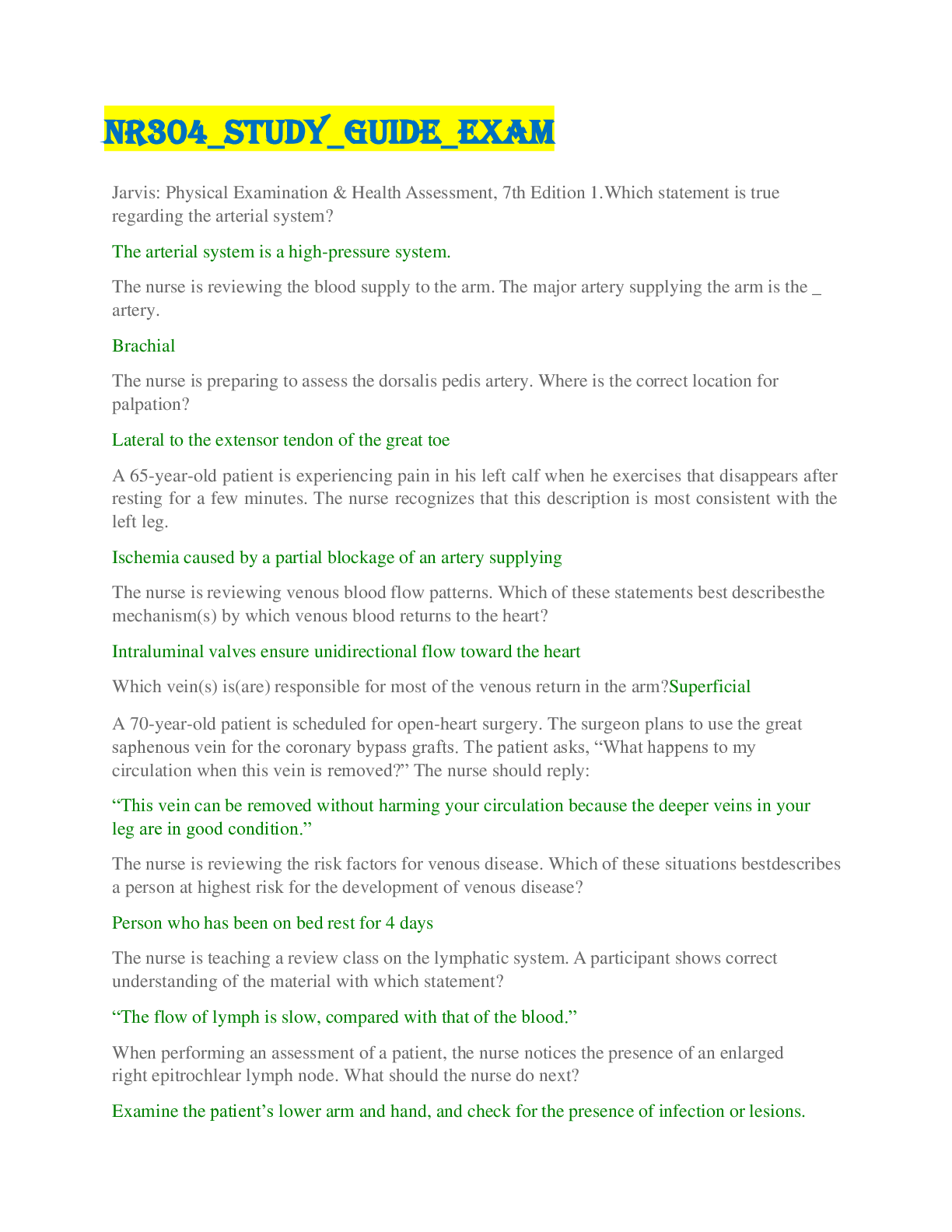
Jarvis: Physical Examination & Health Assessment, 7th Edition 1.Which statement is true
regarding the arterial system?
The arterial system is a high-pressure system.
The nurse is reviewing the blood supply to the arm. The major artery supplying the arm is the _
artery.
Brachial
The nurse is preparing to assess the dorsalis pedis artery. Where is the correct location for
palpation?
Lateral to the extensor tendon of the great toe
A 65-year-old patient is experiencing pain in his left calf when he exercises that disappears after
resting for a few minutes. The nurse recognizes that this description is most consistent with ___
the left leg.
Ischemia caused by a partial blockage of an artery supplying
The nurse is reviewing venous blood flow patterns. Which of these statements best describes
the mechanism(s) by which venous blood returns to the heart?
Intraluminal valves ensure unidirectional flow toward the heart
Which vein(s) is(are) responsible for most of the venous return in the arm?
Superficial
A 70-year-old patient is scheduled for open-heart surgery. The surgeon plans to use the great
saphenous vein for the coronary bypass grafts. The patient asks, “What happens to my
circulation when this vein is removed?” The nurse should reply:
“This vein can be removed without harming your circulation because the deeper veins in your
leg are in good condition.”
The nurse is reviewing the risk factors for venous disease. Which of these situations best
describes a person at highest risk for the development of venous disease?
Person who has been on bed rest for 4 days
The nurse is teaching a review class on the lymphatic system. A participant shows correct
understanding of the material with which statement?
“The flow of lymph is slow, compared with that of the blood.”
When performing an assessment of a patient, the nurse notices the presence of an enlarged
right epitrochlear lymph node. What should the nurse do next?
Examine the patient’s lower arm and hand, and check for the presence of infection or lesions.
nursing
A 35-year-old man is seen in the clinic for an infection in his left foot. Which of these findings
should the nurse expect to see during an assessment of this patient?
Enlarged and tender inguinal nodes
The nurse is examining the lymphatic system of a healthy 3-year-old child. Which finding should
the nurse expect?
Presence of palpable lymph nodes
During an assessment of an older adult, the nurse should expect to notice which finding as a
normal physiologic change associated with the aging process?
Peripheral blood vessels growing more rigid with age, producing a rise in systolic blood
pressure
A 67-year-old patient states that he recently began to have pain in his left calf when climbing the
10 stairs to his apartment. This pain is relieved by sitting for approximately 2 minutes; then he is
able to resume his activities. The nurse interprets that this patient is most likely experiencing:
Claudication.
A patient complains of leg pain that wakes him at night. He states that he “has been having
problems” with his legs. He has pain in his legs when they are elevated that disappears when
he dangles them. He recently noticed “a sore” on the inner aspect of the right ankle. On the
basis of this health history information, the nurse interprets that the patient is most likely
experiencing:
Problems related to arterial insufficiency.
During an assessment, the nurse uses the profile sign to detect:
Early clubbing.
The nurse is performing an assessment on an adult. The adult’s vital signs are normal, and
capillary refill time is 5 seconds. What should the nurse do next?
Consider this a delayed capillary refill time, and investigate further.
When assessing a patient, the nurse notes that the left femoral pulse as diminished, 1+/4+.
What should the nurse do next?
Auscultate the site for a bruit.
When performing a peripheral vascular assessment on a patient, the nurse is unable to palpate
the ulnar pulses. The patient’s skin is warm and capillary refill time is normal. Next, the nurse
should:
Consider this finding as normal, and proceed with the peripheral vascular evaluation.
The nurse is assessing the pulses of a patient who has been admitted for untreated
hyperthyroidism. The nurse should expect to find a(n) ___ pulse.
Bounding
[Show More]