Integrated General Biology
Math In Science Application
Name | Date
Instructor
CELLULAR BIOLOGY
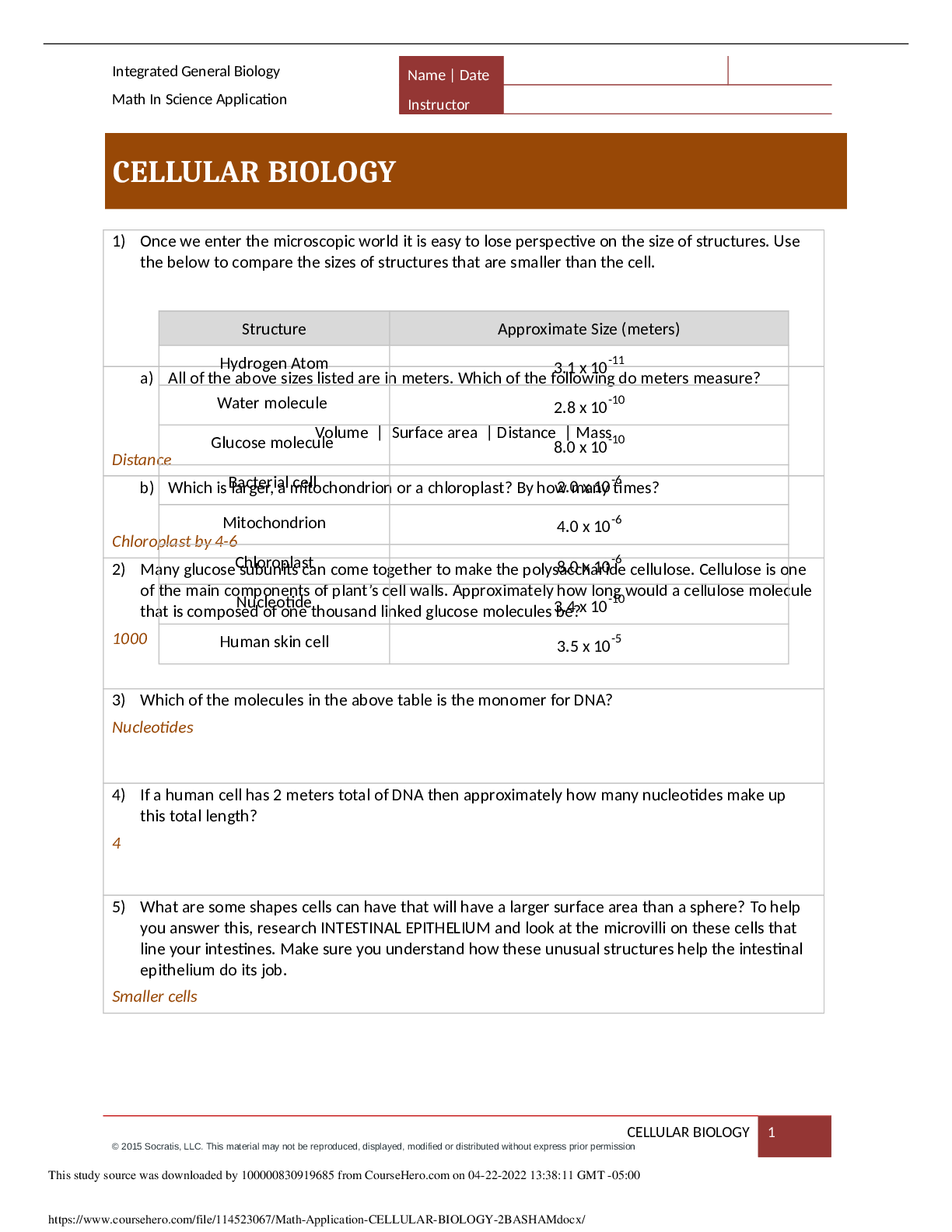
1) Once we enter the microscopic world it is easy to lose perspective on the size of structures. Use
the below to compa
...
Integrated General Biology
Math In Science Application
Name | Date
Instructor
CELLULAR BIOLOGY
1) Once we enter the microscopic world it is easy to lose perspective on the size of structures. Use
the below to compare the sizes of structures that are smaller than the cell.
a) All of the above sizes listed are in meters. Which of the following do meters measure?
Volume | Surface area | Distance | Mass
Distance
b) Which is larger, a mitochondrion or a chloroplast? By how many times?
Chloroplast by 4-6
2) Many glucose subunits can come together to make the polysaccharide cellulose. Cellulose is one
of the main components of plant’s cell walls. Approximately how long would a cellulose molecule
that is composed of one thousand linked glucose molecules be?
1000
3) Which of the molecules in the above table is the monomer for DNA?
Nucleotides
4) If a human cell has 2 meters total of DNA then approximately how many nucleotides make up
this total length?
4
5) What are some shapes cells can have that will have a larger surface area than a sphere? To help
you answer this, research INTESTINAL EPITHELIUM and look at the microvilli on these cells that
line your intestines. Make sure you understand how these unusual structures help the intestinal
epithelium do its job.
Smaller cells
CELLULAR BIOLOGY
. This material may not be reproduced, displayed, modified or distributed without express prior permission
1
Structure Approximate Size (meters)
Hydrogen Atom 3.1 x 10⁻¹¹
Water molecule 2.8 x 10⁻¹⁰
Glucose molecule 8.0 x 10⁻¹⁰
Bacterial cell 2.0 x 10⁻⁶
Mitochondrion 4.0 x 10⁻⁶
Chloroplast 8.0 x 10⁻⁶
Nucleotide 3.4 x 10⁻¹⁰
Human skin cell 3.5 x 10⁻⁵
Integrated General Biology
Math In Science Application
Name | Date
Instructor
6) Within the cell there are several structures that create surface area by having layers of folded
membrane. Which structures (like organelles) within the cell have large amounts of surface area?
Mitochondria+
7) Glucose is a chemical that is fulfills a wide range of functions within organisms. The story of
glucose begins with a series or reactions collectively known as photosynthesis. Carbon dioxide,
water and energy from light are the inputs required for photosynthesis. How many carbon
dioxide molecules are required to produce one glucose molecule?
6
8) After glucose is constructed in the cells of plants there is a few different directions that it may go.
Glucose can be strung together to make starch, a polysaccharide used by the plant to store
energy, or another polysaccharide called cellulose, which is one of the major structural
components of plants cell walls.
[Show More]