Week 5 APEA Predictor Assignment Part 2
NR 603: Advanced Clinical Diagnosis and Practice Across Life Span
TB is a 50-year-old Caucasian male that presents to the primary care office with the chief
complaint of dysuria
...
Week 5 APEA Predictor Assignment Part 2
NR 603: Advanced Clinical Diagnosis and Practice Across Life Span
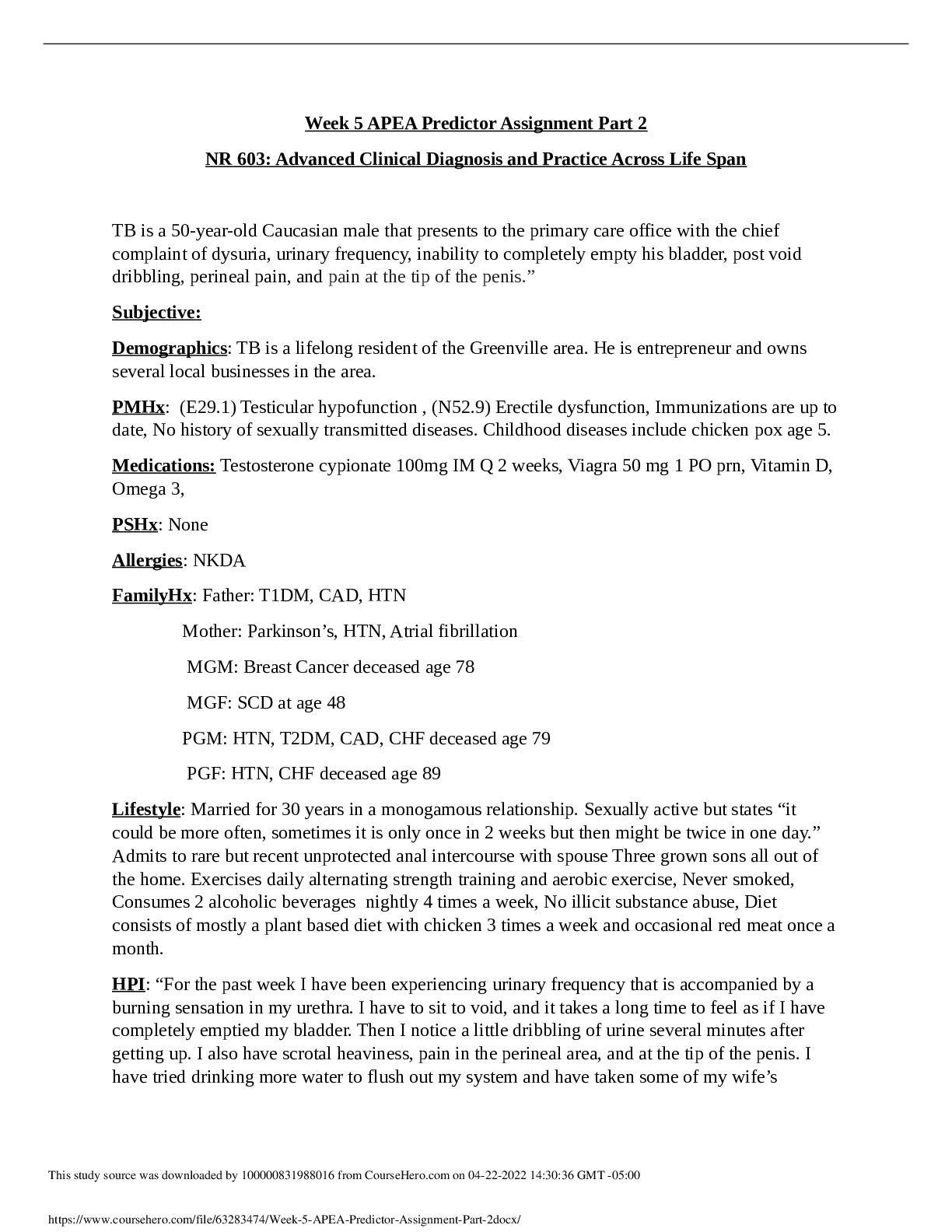
TB is a 50-year-old Caucasian male that presents to the primary care office with the chief
complaint of dysuria, urinary frequency, inability to completely empty his bladder, post void
dribbling, perineal pain, and pain at the tip of the penis.”
Subjective:
Demographics: TB is a lifelong resident of the Greenville area. He is entrepreneur and owns
several local businesses in the area.
PMHx: (E29.1) Testicular hypofunction , (N52.9) Erectile dysfunction, Immunizations are up to
date, No history of sexually transmitted diseases. Childhood diseases include chicken pox age 5.
Medications: Testosterone cypionate 100mg IM Q 2 weeks, Viagra 50 mg 1 PO prn, Vitamin D,
Omega 3,
PSHx: None
Allergies: NKDA
FamilyHx: Father: T1DM, CAD, HTN
Mother: Parkinson’s, HTN, Atrial fibrillation
MGM: Breast Cancer deceased age 78
MGF: SCD at age 48
PGM: HTN, T2DM, CAD, CHF deceased age 79
PGF: HTN, CHF deceased age 89
Lifestyle: Married for 30 years in a monogamous relationship. Sexually active but states “it
could be more often, sometimes it is only once in 2 weeks but then might be twice in one day.”
Admits to rare but recent unprotected anal intercourse with spouse Three grown sons all out of
the home. Exercises daily alternating strength training and aerobic exercise, Never smoked,
Consumes 2 alcoholic beverages nightly 4 times a week, No illicit substance abuse, Diet
consists of mostly a plant based diet with chicken 3 times a week and occasional red meat once a
month.
HPI: “For the past week I have been experiencing urinary frequency that is accompanied by a
burning sensation in my urethra. I have to sit to void, and it takes a long time to feel as if I have
completely emptied my bladder. Then I notice a little dribbling of urine several minutes after
getting up. I also have scrotal heaviness, pain in the perineal area, and at the tip of the penis. I
have tried drinking more water to flush out my system and have taken some of my wife’s
This study source was downloaded by 100000831988016 from CourseHero.com on 04-22-2022 14:30:36 GMT -05:00
https://www.coursehero.com/file/63283474/Week-5-APEA-Predictor-Assignment-Part-2docx/
cranberry pills that she uses to keep urinary tract infections away. That has not helped any. The
overall discomfort is a 3 to 4 on the pain scale, but when I void the burning nears a 10.”
ROS: Patient admits to low grade fever. There is the presence of dysuria, urinary frequency,
sensation of not fully emptying bladder, post void dribbling, scrotal heaviness, accompanied by
perineal pain and pain at the tip of penis. Patient denies penile discharge, low back pain but does
report mild suprapubic pain. Denies hematuria. Denies extramarital sexual encounters. Denies
chills, night sweats or general malaise. Denies loss of appetite or weight loss. Denies changes in
bowels habits, no diarrhea or constipation, 1 to 2 BM’s daily. Denies feelings of depression or
anxiety. Reports being very happy with his life, family, and friends.
Objective:
PE: Ht: 5’ 11’’ (180.34cm) Wt: 163 lbs (73.93 kg) BMI: 22.7%
BP: 122/68 P: 72 R: 16 T: 99.9 O2sat 99% on room air
Constitution: TB is a 50-year-old Caucasian male that appears younger than his stated age. He is
well developed, and physical fit. A&O x 4, NAD, and is well groomed. Good historian.
Cardio: S1S2 heard with no gallops, rubs, or murmurs appreciated
Pulm: BBS clear and equal in all lobes, no s/sx of rep distress noted
Abd: Symmetrical, no lesions or scars, flat, soft, and nondistended. Tympany noted in all lobes,
no palpable masses are identified upon light and deep palpation. No guarding or rebound
tenderness appreciated. Suprapubic tenderness was appreciated upon palpation 3 out of 10
Ano/Genital: Upon DRE adequate sphincter tone noted, the prostate is boggy, enlarged, and
exquisitely tender with no nodules palpated. Circumcised male. No penile discharge or lesions.
No scrotal swelling or discoloration. Testes descended bilaterally, smooth, no masses.
Epididymis nontender. No inguinal or femoral hernias. Cremasteric reflex intact.
Psych: Appropriate mood and affect
Diagnostics:
Complete blood count CBC: CPT- (85004)
Component Patient Value Standard Range
WBC 12 x10E3/uL 3.4 - 10.8 x10E3/uL
RBC 4.21 x10E6/uL 3.77 - 5.28 x10E6/uL
HGB 14.4 g/dL 11.1 - 15.9 g/dL
HCT 45.5 % 34.0 - 46.6 %
MCV 99 fL 79 - 97 fL
MCH 34.2 pg 26.6 - 33.0 pg
MCHC 34.7 g/dL 31.5 - 35.7 g/dL
RDW 14.0 % 12.3 - 15.4 %
This study source was downloaded by 100000831988016 from CourseHero.com on 04-22-2022 14:30:36 GMT -05:00
https://www.coursehero.com/file/63283474/Week-5-APEA-Predictor-Assignment-Part-2docx/
Component Patient Value Standard Range
WBC 12 x10E3/uL 3.4 - 10.8 x10E3/uL
RBC 4.21 x10E6/uL 3.77 - 5.28 x10E6/uL
HGB 14.4 g/dL 11.1 - 15.9 g/dL
HCT 45.5 % 34.0 - 46.6 %
MCV 99 fL 79 - 97 fL
MCH 34.2 pg 26.6 - 33.0 pg
MCHC 34.7 g/dL 31.5 - 35.7 g/dL
RDW 14.0 % 12.3 - 15.4 %
PLATELET 276 x10E3/uL 150 - 450 x10E3/uL
NEUTROPHILS 70 % Not Estab. %
Lymphocytes 53 % Not Estab. %
MONOCYTES 5 % Not Estab. %
EOSINOPHILS 2 % Not Estab. %
BASOPHILS 1 % Not Estab. %
Urinalysis: CPT- (8100)
Color Pt. Value STRAW
Appearance Pt. Value CLOUDY
Specific gravity Pt. Value1.010 Standard Range1.001 - 1.023
pH (UA) Pt. Value7.0 Standard Range5.0 - 9.0
Protein Pt. Value NEGATIVE MG/DL Standard RangeNEGATIVE MG/DL
Glucose Pt. Value NEGATIVE MG/DL Standard RangeNEGATIVE MG/DL
Ketone Pt. Value NEGATIVE MG/DL Standard RangeNEGATIVE MG/DL
Bilirubin Pt. Value NEGATIVE Standard RangeNEGATIVE
Blood Pt. Value TRACE Standard RangeNEGATIVE
Urobilinogen Pt. Value 0.2 EU/DL Standard Range0.2 - 1.0 EU/DL
Nitrites Pt. Value POSITIVE Standard RangeNEGATIVE
Leukocyte Esterase Pt. Value POSITIVE Standard RangeNEGATIVE
Urine Culture and Sensitivity: CPT- (87086)
Urine Culture, Routine Results pending
Assessment:
Diagnosis: Acute Bacterial Prostatitis (N41.0):
ABP is a bacterial infection involving the prostate gland and Escherichia coli is the most
frequently identified causative pathogen it causes painful inflammation within the prostate. The
hallmark finding with ABP is a sudden onset of lower urinary symptoms of dysuria, frequency,
and perineal pain, as well as complaint of pain at the tip of the penis (Chappel et al., 2020). TB
presents with these signs and symptoms. Additionally, he reports risk factors that associated with
the development of ABP. These risk factors include unprotected vaginal and sexual abstinence
secondary to erectile dysfunction (Davis et al., 2019). Upon digital rectal exam the prostate will
be enlarged, boggy, extremely tender to palpation, and potentially warm with ABP (Hollier,
[Show More]



 F21.png)








.png)

.png)

