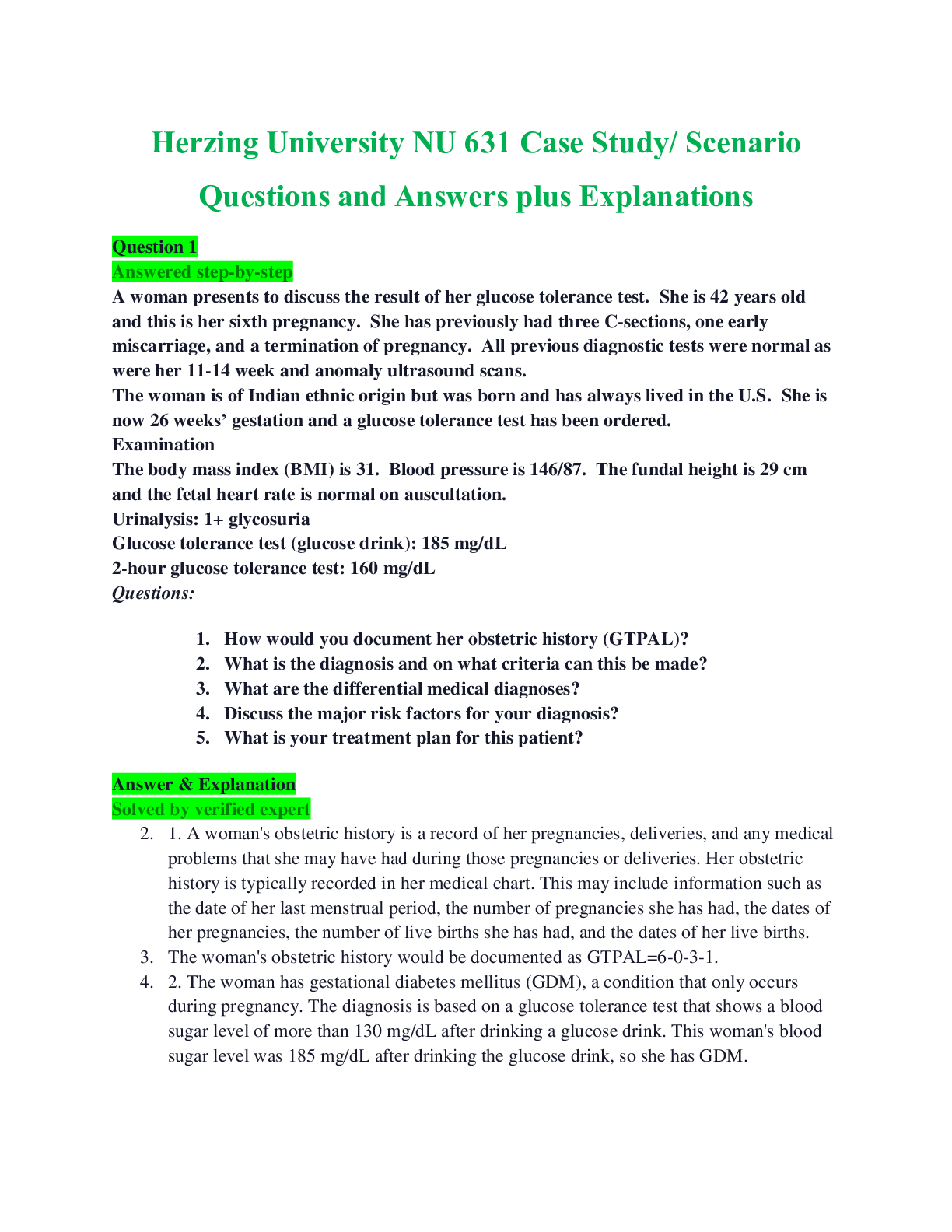
Herzing University NU 631 Case Study/ Scenario Questions and Answers plus Explanations
Question 1
Answered step-by-step
A woman presents to discuss the result of her glucose tolerance test. She is 42 years old and th
...
Herzing University NU 631 Case Study/ Scenario Questions and Answers plus Explanations
Question 1
Answered step-by-step
A woman presents to discuss the result of her glucose tolerance test. She is 42 years old and this is her sixth pregnancy. She has previously had three C-sections, one early miscarriage, and a termination of pregnancy. All previous diagnostic tests were normal as were her 11-14 week and anomaly ultrasound scans.
The woman is of Indian ethnic origin but was born and has always lived in the U.S. She is now 26 weeks’ gestation and a glucose tolerance test has been ordered.
Examination
The body mass index (BMI) is 31. Blood pressure is 146/87. The fundal height is 29 cm and the fetal heart rate is normal on auscultation.
Urinalysis: 1+ glycosuria
Glucose tolerance test (glucose drink): 185 mg/dL
2-hour glucose tolerance test: 160 mg/dL
Questions:
1. How would you document her obstetric history (GTPAL)?
2. What is the diagnosis and on what criteria can this be made?
3. What are the differential medical diagnoses?
4. Discuss the major risk factors for your diagnosis?
5. What is your treatment plan for this patient?
Question 2
Answered step-by-step
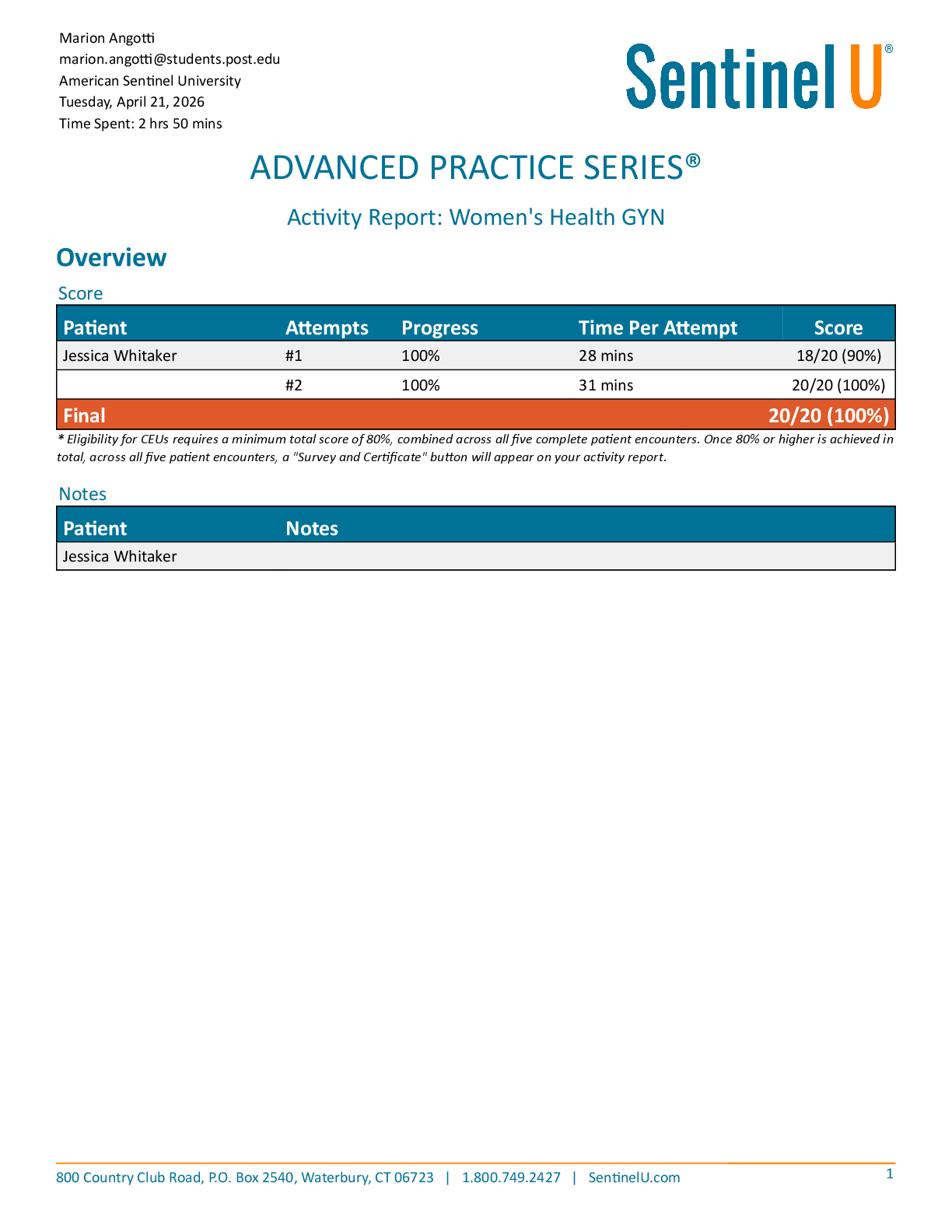
Jessica, a 38-year-old white female, has had three term births and one first-trimester spontaneous abortion (G4P3013). Her third child was delivered via cesarean section and she underwent tubal sterilization at that time.
She presents complaining of a 6-month history of fatigue. She reports no other symptoms, no recent illness or change to her physical or emotional health, including no depression or significant stress that might account for her fatigue. She does not smoke and uses alcohol only in social situations.
You order a complete blood count (CBC) with platelets, which reveals a hemoglobin level of 10.1 g/dL and hematocrit of 29.8; other RBC indices are consistent with iron deficiency. WBCs and platelets are within normal ranges. You also check her thyroid-stimulating hormone level, which, at 1.8 mIU/L, is within normal limits.
You inquired about her menstrual periods, she reports that they are regular, with bleeding lasting 7 to 9 days. She typically uses super-absorbent tampons, changing them approximately every two hours in the first couple of days of her period. She also relies on pads for backup during her days of heavier flow. She has noticed that she sometimes passes quarter-sized clots. While discussing these details, it becomes clear that Jessica has had heavy periods throughout her reproductive life, but she had never sought medical help because she had accepted her periods as a normal aspect of her life.
Jessica's medical history is remarkable for hypertension and she currently takes 25 mg a day of hydrochlorothiazide. Her only other medication is a daily multivitamin. Her surgical history includes a tubal ligation. She reports no allergies.
She reports no intermenstrual or postcoital bleeding and is sexually active with only her husband. There is no family history of breast, ovarian, colon, or uterine/endometrial cancers and no history of abnormal Pap tests or positive screens for sexually transmitted infections.
On physical examination, Jessica is a well-developed, obese white female in no apparent distress. Blood pressure is 138/87, pulse 78, temperature 98.9°F, height 5'6"; weight 267 pounds, BMI 43.09 kg/m2. Aside from the obesity, there are no other relevant nonpelvic physical findings.
Her pelvic exam reveals no vulvar or vaginal lesions; a small amount of dark blood is present in the vault. There is no cervical motion tenderness or cervical lesions. Her uterus and adnexal structures are difficult to palpate because of her abdominal girth, though the uterus does not appear to be enlarged and there are no pelvic masses palpated.
Questions:
1. What is your assessment (diagnosis) of this patient?
2. What are your thoughts on the treatment plan of this patient?
3. Is there any other information that you would obtain to assist you in determining treatment options?
4. Which guidelines would you consult?
1. Question 2. What are your thoughts on the treatment plan of this patient?
1. Question 3.. Is there any other information that you would obtain to assist you in determining treatment options?
1. Question 4. Which guidelines would you consult?
Question 1. What is your assessment (diagnosis) of this patient?
Question 2. What are your thoughts on the treatment plan of this patient?
Question 3. Is there any other information that you would obtain to assist you in determining treatment options?
Question 4. Which guidelines would you consult?
Question 3
Answered step-by-step
Case Study:
Geri is a 18-year-old high school student in your clinic today because of vaginal discharge. You have seen Geri three times this past year for the same complaint and have diagnosed chlamydial cervicitis two of the three times. The other time Geri had bacterial vaginosis.
Chief Complaint: "Lots of yellow vaginal discharge"
HPI: yellow discharge X3 weeks with odor especially after sex; started burning with urination 2 days ago; denies vaginal/vulvar sores or irritation; says has noticed some itching on the outside.
PMH: allergy to PCN and sulfa; OCP's x 2 years for birth control; no other meds
OB/GYN: no pregnancies, LMP 1 week ago; Paps UTD and WNL; Hx chlamydia cervicitis treated with doxycycline.
FH: Mother with HTN (smoker)
SH: Lives with mother and sister (parents divorced); currently in apartment with mother's sister and her boyfriend because her mother is out of work; smokes 1/2 ppd x 2 years; 4-6 beers every week-end; marijuana every week-end; denies other recreational drugs; junior in high school and works at Hardees.
Exam:
Abdomen soft non tender
inguinal lymph without adenopathy
perineum normal hair distribution; no lesion or discharge
vagina rugated, slightly erythematous, large amount yellow green discharge; no lesion
cervix; nullip, erythematous; no exudate at os, mobile, slightly tender, with palpation
uterus firm, mobile, non-tender
adnexae without palpable mass or tenderness bilateral
rectovag confirms findings
Lab
urine dip-neg blood, neg leuks, neg nitrates
KOH wet prep neg hyphae, spores
NaCl wet prep pos trichomonads, neg clue, pos whiff, pos WBC,s neg RBC's rare lactobacilli
Questions
1. Would you perform a pelvic exam and/or a pap smear?
2. What is your Diagnosis (Assessment)?
3. What is your Plan, including treatment and education?
4. Would you prescribe treatment for her partner(s)?
5. What contraceptive care/counseling would you offer Geri?
6. List 2 community resources in your area that you could utilize.
Question 4
Answered step-by-step
Case Study:
C.S. is a 19-year-old female client who presents to the clinic with an acute upper respiratory infection. She is 15 weeks pregnant and has not established prenatal care. This is her second pregnancy. To date she has had no weight gain and takes phenytoin for a seizure disorder.
History
C.S. is a single mother. She has a 16-month old son at home. She has a high school diploma. She is not working. The father of her son is not involved nor is the father of the baby. She does not have a great support network in place. Ms. S is a 1 ppd smoker and has a poor diet. She drinks several cups of coffee and cola per day. She sleeps an average of 4 - 5 hours per night. Her stress level is high as result of financial struggles and single parenting. She denies any other complications or prolonged illnesses or injuries. She denies any alcohol or illicit drug use.
Questions
1. What would be included in the review of systems?
2. Discuss the elements of an abbreviated physical examination.
1. What would be included in the review of systems?
2. Discuss the elements of an abbreviated physical examination.
Question 5
Answered step-by-step
J.S. is a 54-year-old Hispanic woman who presents to her primary-care clinician for follow-up regarding elevated blood pressure. She was last seen 2 weeks prior with a blood pressure of 162/94 mmHg. She has no significant medical history, she is a 1 ppd tobacco user with a history of 25 pack-years, and she has a family history of premature cardiac death.
Evaluation:
Her vital signs are as follows: height, 5 ft 4 in.; weight, 188 lb.; pulse, 84 beats/min; blood pressure, 168/98 mmHg; and body mass index, 32.3. As J.S. has been found to be hypertensive (>149/90) on two consecutive office visits, starting an antihypertensive medication is indicated.
Questions:
1. What is your initial choice for an antihypertensive medication in this patient? (Support your treatment plan with a discussion of the evidence based guideline you utilized)
2. Which therapeutic lifestyle change is a priority in helping J.S. achieve blood pressure control?
3. Which of the following diagnostic tests would you order for J.S. to establish a baseline before starting an anti-hypertensive?
Question 6
1. Detail your approach to care and management for the following case scenario:
2. What is the accepted name of the condition with which the child will be born?
3. What are the peri-natal risks to the infant?
Peri-natal risks to the infant include the following:
4. What are the post-natal risks to the infant?
5. What are the post-natal risks to the mother?
6. Is there any evidence on the long-term risk to the child?
Second/Alternative Step-by-step explanation
1. Detail your approach to care and management for the following case scenario:
2. What is the accepted name of the condition with which the child will be born?
3. What are the peri-natal risks to the infant?
4. What are the post-natal risks to the infant?
5. What are the post-natal risks to the mother?
6. Is there any evidence on the long-term risk to the child?
Question 7
Answered step-by-step
An 83-year-old woman complains of a dragging sensation in the lower abdomen and lower back pain when standing or walking. It has been present for some years but she can now only stand for a short time before feeling uncomfortable. It is not noticeable at night. She has had four vaginal deliveries. She had her menopause at 52 years and took hormone replacement therapy for several years for vasomotor symptoms. She has not had any postmenopausal bleeding and has not had a pap smear for several years.
She is generally constipated and sometimes finds she can only defecate by placing her fingers into the vagina and compressing a "bulge" she can feel. She has mild frequency and gets up twice most nights to pass urine. There is not dysuria or hematuria. Occasionally she does not get to the toilet in time and leaks a small amount of urine, but this does not worry her unduly.
Medically she is very well and does not take any medications regularly. She lives alone and does her own shopping and housework
Examination - on exam she appears well. Blood pressure and heart rate are normal. She is of average build. The abdomen is soft and non-tender. There is a loss of vulval anatomy consistent with atrophic changes. On examination in the supine position there is a mild prolapse. On standing, the cervix is felt at the level of the introitus. There is a large posterior wall prolapse and a minimal anterior wall prolapse.
Questions:
1. What is the diagnosis for her discomfort and pain?
2. How would you manage this patient?
1. What is the diagnosis for her discomfort and pain?
The diagnosis is PELVIC ORGAN PROLAPSE.
How would you manage this patient?
Reference:
Comprehensive Gynecology, 7th edition.
Question 8
Answered step-by-step
Case Study: Martha Miller is a 32-year-old, African American single...
Case Study:
Martha Miller is a 32-year-old, African American single mother living in a midsize city. She has three children from previous relationships. Her partner is Mick, a 38-year-old White man who lives with her, and who is unemployed. Although he is actively looking for a job, he has not worked in more than a year. Her oldest child is 8 years of age, she has a 4-year-old, and her youngest is 17 months. She works as a hotel housekeeper from 7:30 a.m. to 3:30 p.m. and at a fast-food restaurant from 6 p.m. to 11:30 p.m. She has limited time home with her children, only seeing them briefly after her first job, and then again in the morning before work. Her partner helps with the cooking and childcare. She is overweight with a body mass index of 32, has mild hypertension, and had a second A1c level of 6.4 for which you prescribed Metformin 500 mg twice a day during her last clinic visit 6 months ago. At that visit, she saw a dietitian for dietary counseling, and you spoke with her about developing a plan to get 150 minutes of exercise weekly.
She has not been back to see you despite repeated calls to her cell phone, a number that changes about every 8 to 10 months. She finally came into clinic last week, and you have determined that she is 20 weeks pregnant. You are concerned about the effectiveness of her medication, her very stressful life, and lack of follow-up as problems that can affect her health and that of her baby.
Questions
Select one of the options below and discuss the ways in which this condition/social problem might increase her health risks?
1. The effects of income inequality on her health and ability to be an active participant in her care.
2. Racial discrimination she may experience related to her romantic relationship.
3. Health disparities she may experience related to her pregnancy, such as the risk for preterm labor and the high rate of infant mortality in low-income women.
Question 9
Answer & Explanation
Susan is a 39-year-old (G2P2) married white female with menstrual cycle changes. She tells you, "My bleeding varies in how heavy or light it is—sometimes I am 5 to 7 days late and only have light spotting". She reports that she has become much more irritable and moody prior to the onset of her menses, and is experiencing hot flashes and night sweats that wake her up two to three times a night. She is fatigued and finds herself dozing off throughout her work day. Her boss has commented on fatigue and has suggested she see her health care provider.
Questions
1. What is the definition of premature ovarian failure?
2. On an average, what is the length of a normal menstrual cycle?
3. A deficit in which hormone can lead to heavy menstrual bleeding and hot flashes?
4. What laboratory abnormalities would you anticipate, given her menopausal symptoms?
Question 10
Answered step-by-step
A 32-year-old woman presents to the clinic for an acute visit 6 days following a vaginal delivery at 39 weeks’ gestation. The pregnancy and labor had been unremarkable and the placenta was delivered by controlled cord traction.
Following delivery, the woman had been discharged home after 48 hours. She reported that the lochia had been heavy for the first 2 days but that it had settled to less than a period. However, today she had suddenly felt crampy abdominal pain and felt a gush of fluid, followed by very heavy bleeding. The blood soaked through clothes and she had passed large clots, which she describes as the size of her fist. She feels dizzy when she stands up and is nauseated.
Examination
She is pale with cool and clammy extremities. She is also drowsy. Her blood pressure is 105/50 and heart rate is 112/min. On abdominal palpation there is minimal tenderness but the uterus is palpable approximately 6 cm above the symphysis pubis.
Speculum examination reveals large clots of blood in the vagina. When these are removed, the cervix is seen to be open.
Questions:
1. What is the diagnosis?
2. What is your immediate management plan?
3. What is your subsequent management plan?
4. Should an ultrasound be ordered?
Questions:
1. What issues are important in determining how this situation should be managed?
2. How would you further investigate (diagnostics), advise and manage this patient?
Answer & Explanation
Solved by verified expert
What issues are important in determining how this situation should be managed?
How would you further investigate (diagnostics), advise and manage this patient?
Question 12
Answered step-by-step
What are the clinical indicators of fetal well-being (normal findings) and what steps would you take if findings are not reassuring?
[Show More]