In general, microeconomic theory assumes that firms attempt to maximize the difference
between
a. total revenue and accounting costs.
b. price and marginal cost.
c. total revenues and economic costs.
d. economic cos
...
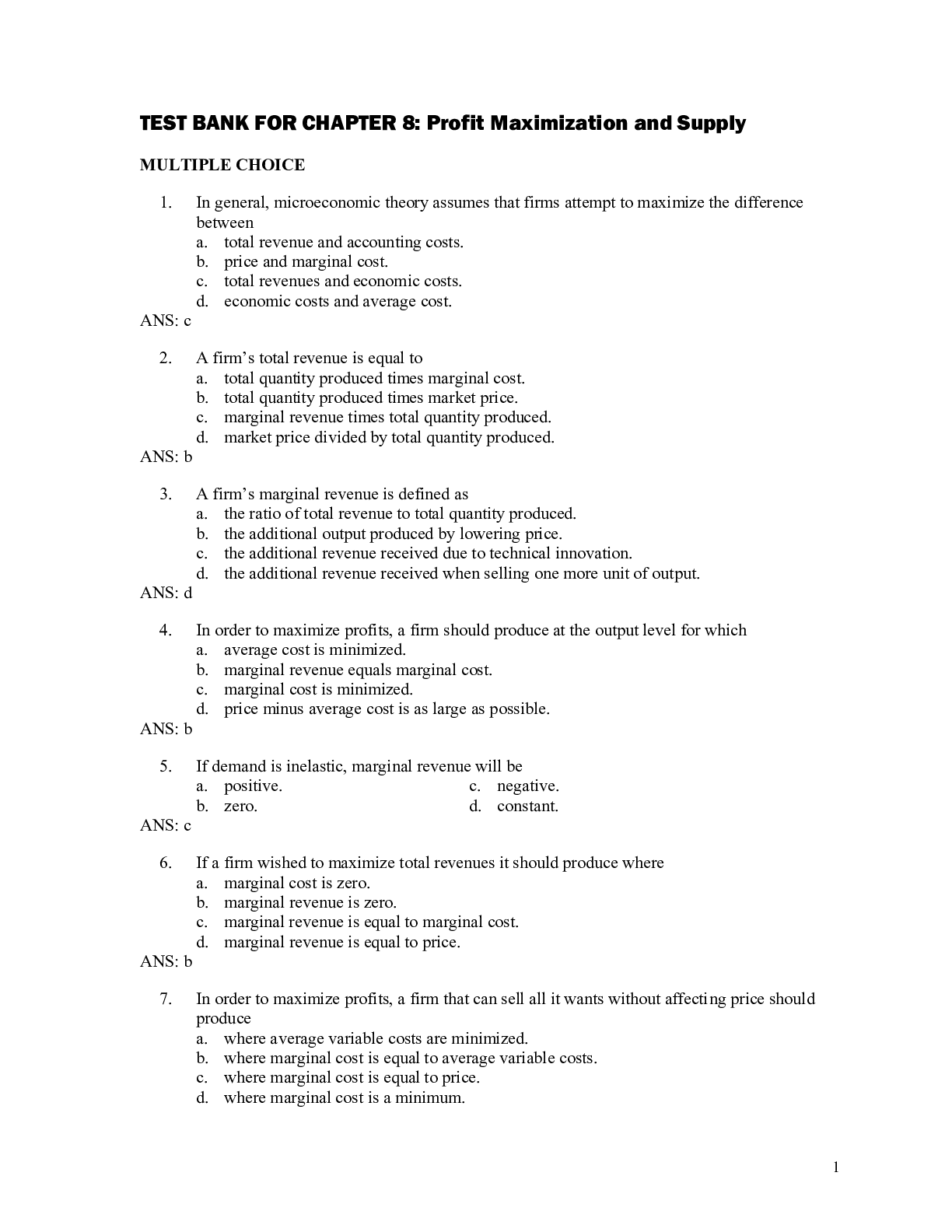
In general, microeconomic theory assumes that firms attempt to maximize the difference
between
a. total revenue and accounting costs.
b. price and marginal cost.
c. total revenues and economic costs.
d. economic costs and average cost.
ANS: c
2. A firm’s total revenue is equal to
a. total quantity produced times marginal cost.
b. total quantity produced times market price.
c. marginal revenue times total quantity produced.
d. market price divided by total quantity produced.
ANS: b
3. A firm’s marginal revenue is defined as
a. the ratio of total revenue to total quantity produced.
b. the additional output produced by lowering price.
c. the additional revenue received due to technical innovation.
d. the additional revenue received when selling one more unit of output.
ANS: d
4. In order to maximize profits, a firm should produce at the output level for which
a. average cost is minimized.
b. marginal revenue equals marginal cost.
c. marginal cost is minimized.
d. price minus average cost is as large as possible.
ANS: b
5. If demand is inelastic, marginal revenue will be
a. positive. c. negative.
b. zero. d. constant.
ANS: c
6. If a firm wished to maximize total revenues it should produce where
a. marginal cost is zero.
b. marginal revenue is zero.
c. marginal revenue is equal to marginal cost.
d. marginal revenue is equal to price.
ANS: b
7. In order to maximize profits, a firm that can sell all it wants without affecting price should
produce
a. where average variable costs are minimized.
b. where marginal cost is equal to average variable costs.
c. where marginal cost is equal to price.
d. where marginal cost is a minimum.
2 Chapter 8: Profit Maximization and Supply
ANS: c
8. If a firm is a price taker, its marginal revenue is
a. equal to market price.
b. less than market price.
c. greater than market price.
d. a multiple of market price that may be either greater than or less than one.
ANS: a
9. If a firm’s marginal revenue is below its marginal cost, an increase in production will usually
a. increase profits.
b. leave profits unchanged.
c. decrease profits.
d. increase marginal revenue.
ANS: c
10. If the demand faced by a firm is inelastic, selling one more unit of output will
a. increase revenues.
b. decrease revenues.
c. keep revenues constant.
d. increase profits.
ANS: b
[Show More]



.png)
.png)