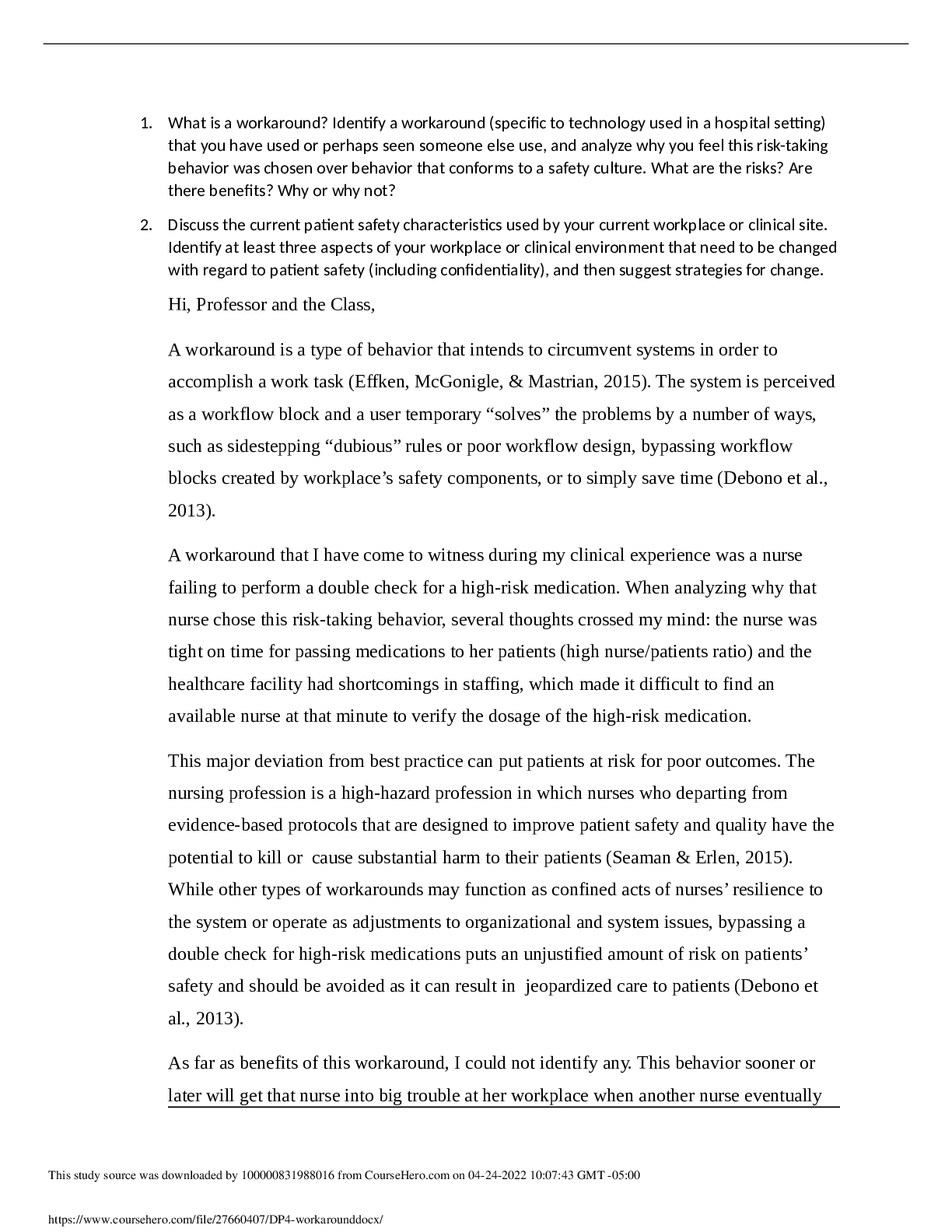
1. What is a workaround? Identify a workaround (specific to technology used in a hospital setting)
that you have used or perhaps seen someone else use, and analyze why you feel this risk-taking
behavior was chosen over
...
1. What is a workaround? Identify a workaround (specific to technology used in a hospital setting)
that you have used or perhaps seen someone else use, and analyze why you feel this risk-taking
behavior was chosen over behavior that conforms to a safety culture. What are the risks? Are
there benefits? Why or why not?
2. Discuss the current patient safety characteristics used by your current workplace or clinical site.
Identify at least three aspects of your workplace or clinical environment that need to be changed
with regard to patient safety (including confidentiality), and then suggest strategies for change.
Hi, Professor and the Class,
A workaround is a type of behavior that intends to circumvent systems in order to
accomplish a work task (Effken, McGonigle, & Mastrian, 2015). The system is perceived
as a workflow block and a user temporary “solves” the problems by a number of ways,
such as sidestepping “dubious” rules or poor workflow design, bypassing workflow
blocks created by workplace’s safety components, or to simply save time (Debono et al.,
2013).
A workaround that I have come to witness during my clinical experience was a nurse
failing to perform a double check for a high-risk medication. When analyzing why that
nurse chose this risk-taking behavior, several thoughts crossed my mind: the nurse was
tight on time for passing medications to her patients (high nurse/patients ratio) and the
healthcare facility had shortcomings in staffing, which made it difficult to find an
available nurse at that minute to verify the dosage of the high-risk medication.
This major deviation from best practice can put patients at risk for poor outcomes. The
nursing profession is a high-hazard profession in which nurses who departing from
evidence-based protocols that are designed to improve patient safety and quality have the
potential to kill or cause substantial harm to their patients (Seaman & Erlen, 2015).
While other types of workarounds may function as confined acts of nurses’ resilience to
the system or operate as adjustments to organizational and system issues, bypassing a
double check for high-risk medications puts an unjustified amount of risk on patients’
safety and should be avoided as it can result in jeopardized care to patients (Debono et
al., 2013).
As far as benefits of this workaround, I could not identify any. This behavior sooner or
later will get that nurse into big trouble at her workplace when another nurse eventually
This study source was downloaded by 100000831988016 from CourseHero.com on 04-24-2022 10:07:43 GMT -05:00
https://www.coursehero.com/file/27660407/DP4-workarounddocx/
catches it and reports it to the charge nurse or she will make an error in drawing a correct
dose of medication which might harm a patient.
Debono, D. S., Greenfield, D., Travaglia, J. F., Long, J. C., Black, D., Johnson, J., &
Braithwaite, J. (2013). Nurses' workarounds in acute healthcare settings: a scoping
review. BMC Health Services Research, 13(1), 1-16. doi:10.1186/1472-6963-13-175
Effken, J., McGonigle, D. & Mastrian, K. (2015). Nursing Informatics and the
Foundation of Knowledge, 3rd Edition. [Bookshelf Online]. Retrieved from
https://bookshelf.vitalsource.com/#/books/9781284063691/
Seaman, J. B., & Erlen, J. A. (2015). CE. Workarounds in the Workplace. Orthopaedic
Nursing, 34(4), 235. doi:10.1097/NOR.0000000000000161
Hi, Geralynn,
Thank you for your post. I agree with you that some procedures are designed in such a way
that nurses end up trying to bypass the system because it functions inefficiently. During my
clinical I was told by a nurse that it was better to tell a patient the name and purpose of each
medication about to be given before getting all of the pills out of their packages and putting
them all in one cup only to have a patient refuse to take some or all of them. Otherwise, a
workaround such as placing all the patient’s pills in one cup for convenience and speedy
medication administration, may cause waste or errors, negatively affecting a patient’s care.
In regards to patients’ safety, one aspect of my clinical environment that needs to be changed
is inconsistencies in timely assessment of a patient’s skin status while on DVT compression
treatment. In the unit where I was on clinical rotation, there were incidences when each nurse
assumed that a patient’s skin beneath compression devices had been assessed for skin
breakdown when in reality it hadn’t, and the compression sleeves were left on for too long on
the patient’s legs. The patient developed second stage pressure ulcers from consistent
pressure of the DVT prophylactic sleeves. A strategy to implement this change could be a
computerized or written log with times when the patient began the prophylactic treatment,
“off times,” and status of condition of the extremities skin post-treatment.
Another aspect of my clinical environment that needs to be changed with regard to patient
safety is usage of Accu-Chek devices for patients with contact precautions. Although guidelines
for prevention of hospital acquired infections suggest that patient care reusable equipment
can be used for the care of another patient after appropriate cleaning, I think a designation of
a separate Accu- Chek machine to each patient with contact precautions for at least the
duration of their hospital stay can significantly reduce the possibility of the disease
transmission to another patients, thus, reducing the rates of hospital-acquired infections
(Mehta et al., 2014).
This study source was downloaded by 100000831988016 from CourseHero.com on 04-24-2022 10:07:43 GMT -05:00
https://www.coursehero.com/file/27660407/DP4-workarounddocx/
The last element to consider for a change in my recent clinical experience is the discharge
informational documentation delivery method. During my clinical day, I had a patient assigned
to me who was ready for discharge. His nurse brought to him a thick folder full of discharge
paperwork, teaching points printouts and numerous brochures like “Falls and patient safety,”
“Healthy diet,”” Living with PAD” etc. The patient was technology literal, he actively used his
email and other application on his smartphone. This type of patient would benefit from the
discharge paperwork and other useful information on how to manage his disease sent to his
email or access through some kind of “hospital web-application” for patients for ease of use
and access.
Mehta, Y., Gupta, A., Todi, S., Myatra, S., Samaddar, D. P., Patil, V., … Ramasubban, S. (2014).
Guidelines for prevention of hospital acquired infections. Indian Journal of Critical Care
Medicine : Peer-Reviewed, Official Publication of Indian Society of Critical Care
Medicine, 18(3), 149–163. http://doi.org/10.4103/0972-5229.128705
[Show More]












.png)

.png)

