Med-Surg: Fluid & Electrolyte
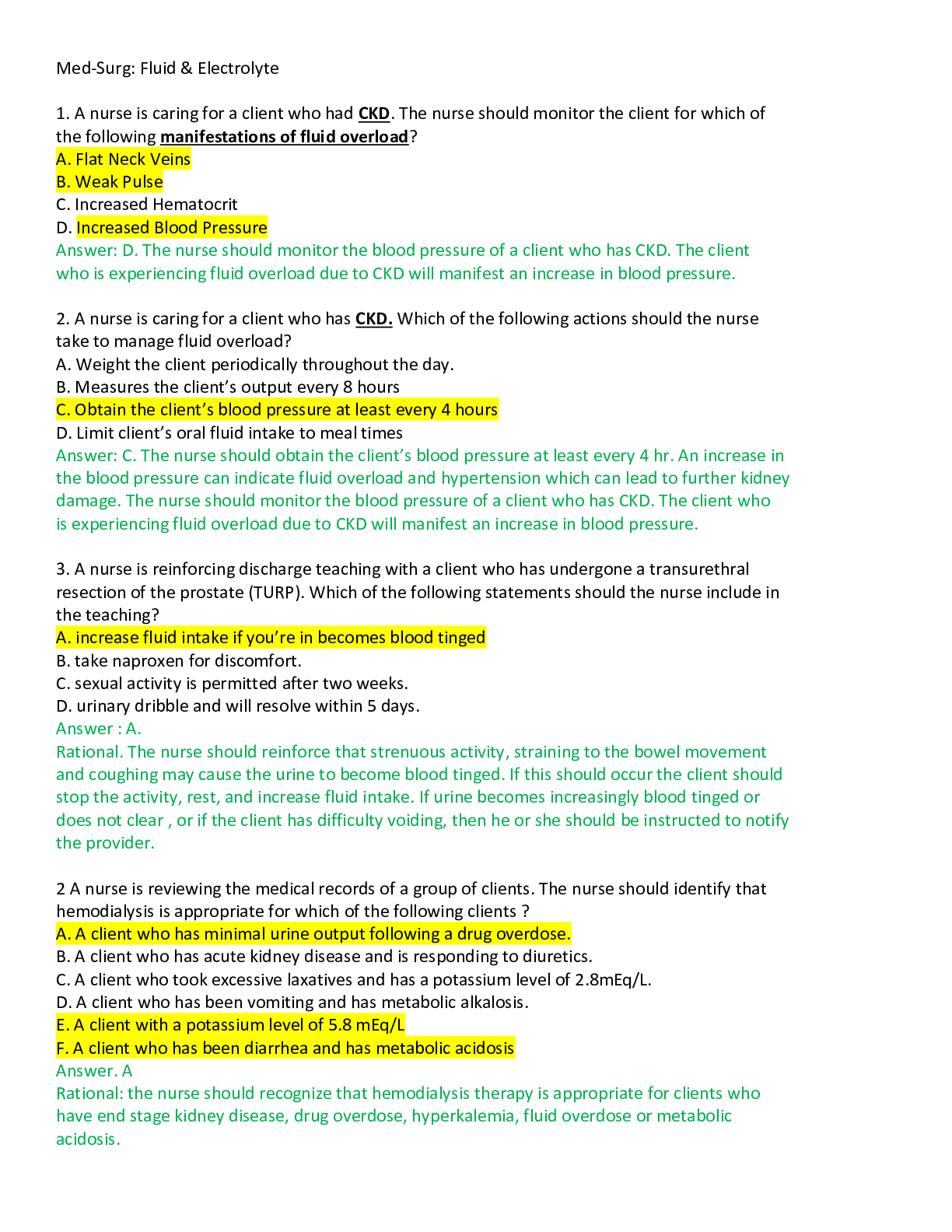
1. A nurse is caring for a client who had CKD. The nurse should monitor the client for which of
the following manifestations of fluid overload?
A. Flat Neck Veins
B. Weak Pulse
C.
...
Med-Surg: Fluid & Electrolyte
1. A nurse is caring for a client who had CKD. The nurse should monitor the client for which of
the following manifestations of fluid overload?
A. Flat Neck Veins
B. Weak Pulse
C. Increased Hematocrit
D. Increased Blood Pressure
Answer: D. The nurse should monitor the blood pressure of a client who has CKD. The client
who is experiencing fluid overload due to CKD will manifest an increase in blood pressure.
2. A nurse is caring for a client who has CKD. Which of the following actions should the nurse
take to manage fluid overload?
A. Weight the client periodically throughout the day.
B. Measures the client’s output every 8 hours
C. Obtain the client’s blood pressure at least every 4 hours
D. Limit client’s oral fluid intake to meal times
Answer: C. The nurse should obtain the client’s blood pressure at least every 4 hr. An increase in
the blood pressure can indicate fluid overload and hypertension which can lead to further kidney
damage. The nurse should monitor the blood pressure of a client who has CKD. The client who
is experiencing fluid overload due to CKD will manifest an increase in blood pressure.
3. A nurse is reinforcing discharge teaching with a client who has undergone a transurethral
resection of the prostate (TURP). Which of the following statements should the nurse include in
the teaching?
A. increase fluid intake if you’re in becomes blood tinged
B. take naproxen for discomfort.
C. sexual activity is permitted after two weeks.
D. urinary dribble and will resolve within 5 days.
Answer : A.
Rational. The nurse should reinforce that strenuous activity, straining to the bowel movement
and coughing may cause the urine to become blood tinged. If this should occur the client should
stop the activity, rest, and increase fluid intake. If urine becomes increasingly blood tinged or
does not clear , or if the client has difficulty voiding, then he or she should be instructed to notify
the provider.
2 A nurse is reviewing the medical records of a group of clients. The nurse should identify that
hemodialysis is appropriate for which of the following clients ?
A. A client who has minimal urine output following a drug overdose.
B. A client who has acute kidney disease and is responding to diuretics.
C. A client who took excessive laxatives and has a potassium level of 2.8mEq/L.
D. A client who has been vomiting and has metabolic alkalosis.
E. A client with a potassium level of 5.8 mEq/L
F. A client who has been diarrhea and has metabolic acidosis
Answer. A
Rational: the nurse should recognize that hemodialysis therapy is appropriate for clients who
have end stage kidney disease, drug overdose, hyperkalemia, fluid overdose or metabolic
acidosis.
3. A nurse is observing a client who has acute alcohol intoxication. The nurse should identify
that the client is at risk for which of the following acid-base imbalances?
A. Respiratory acidosis
B. Respiratory alkalosis
C. Metabolic acidosis
D. Metabolic alkalosis
Answer: C. Common causes of metabolic acidosis include alcohol or ethanol intoxication,
diabetic ketoacidosis, hypoxia, kidney failure, diarrhea, and pancreatitis.
4. A nurse is reviewing the laboratory results of a client who has metabolic alkalosis. Which of
the following laboratory values should the nurse expect?
A. pH 7.31, HCO3- 22 mEq/L, PaCO2 50 mmHg
[Show More]