Purpose of Assignment
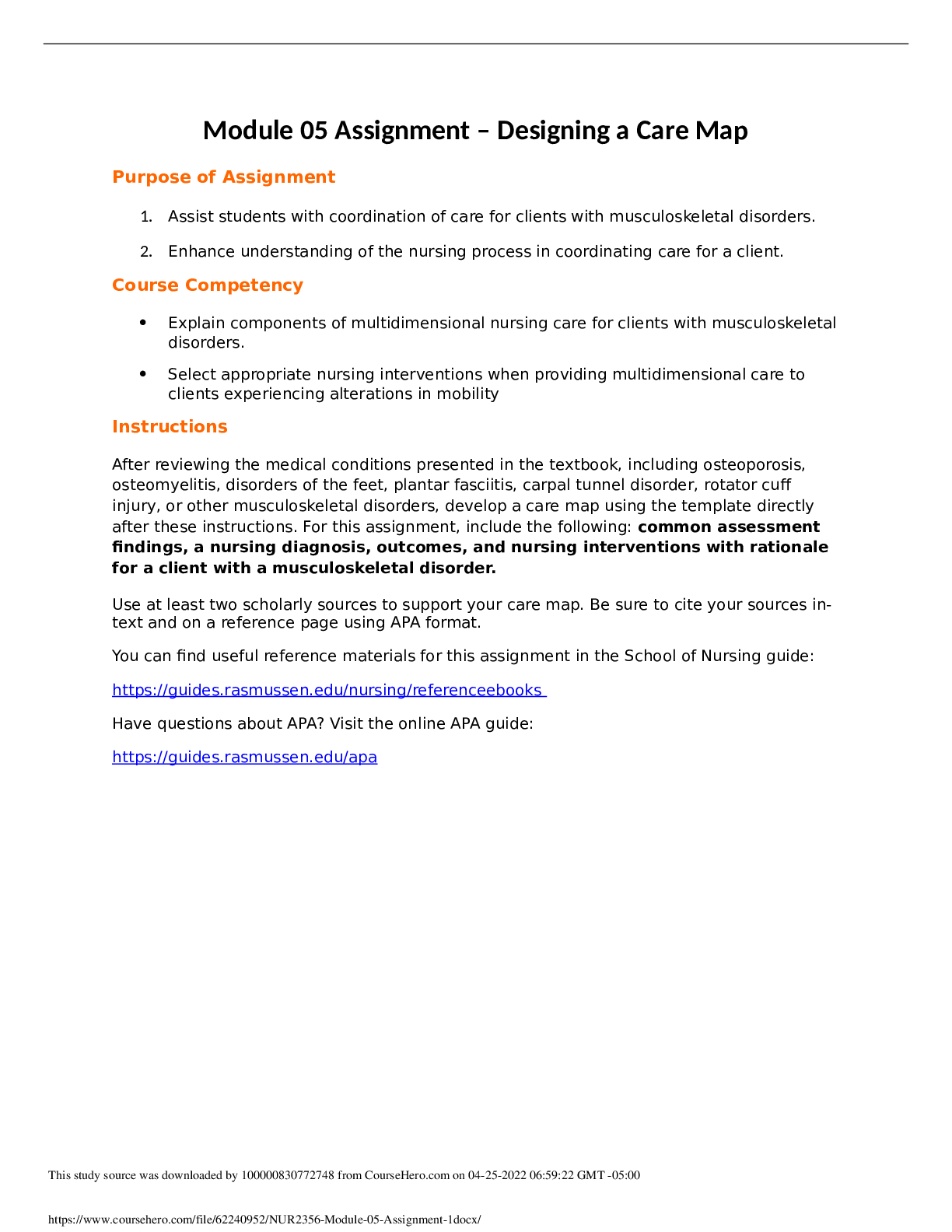
1. Assist students with coordination of care for clients with musculoskeletal disorders.
2. Enhance understanding of the nursing process in coordinating care for a client.
Course Competency
Ex
...
Purpose of Assignment
1. Assist students with coordination of care for clients with musculoskeletal disorders.
2. Enhance understanding of the nursing process in coordinating care for a client.
Course Competency
Explain components of multidimensional nursing care for clients with musculoskeletal
disorders.
Select appropriate nursing interventions when providing multidimensional care to
clients experiencing alterations in mobility
Instructions
After reviewing the medical conditions presented in the textbook, including osteoporosis,
osteomyelitis, disorders of the feet, plantar fasciitis, carpal tunnel disorder, rotator cuff
injury, or other musculoskeletal disorders, develop a care map using the template directly
after these instructions. For this assignment, include the following: common assessment
findings, a nursing diagnosis, outcomes, and nursing interventions with rationale
for a client with a musculoskeletal disorder.
Use at least two scholarly sources to support your care map. Be sure to cite your sources intext and on a reference page using APA format.
You can find useful reference materials for this assignment in the School of Nursing guide:
https://guides.rasmussen.edu/nursing/referenceebooks
Have questions about APA? Visit the online APA guide:
https://guides.rasmussen.edu/apa
This study source was downloaded by 100000830772748 from CourseHero.com on 04-25-2022 06:59:22 GMT -05:00
https://www.coursehero.com/file/62240952/NUR2356-Module-05-Assignment-1docx/
Rheumatoid Arthritis
Subjective
Muscle weakness, muscle
cramp.
Rheumatoid Arthritis
Subjective
Pt. denies help with
ambulation.
Rheumatoid Arthritis
Subjective
Pain in both ankles
joint stiffness.
Objective
Decreased ROM, unable to
bear weight on left leg.
Objective
Unsteady gait, uses of
assistive device (cane).
Objective
Presence of edema in left
feet.
Diagnostic Diagnostic Diagnostic
Impaired physical mobility
(Doenges, Moorhouse, &
Murr 2019).
Risk for Fall (Makic,
Ladwig, & Ackley 2017)
Acute pain (Doenges,
Moorhouse, & Murr 2019).
Nursing Diagnosis Nursing Diagnosis Nursing Diagnosis
Impaired physical mobility r/t
use of assistive device as
evidence by muscle weakness
in left lower extremities.
Risk for fall r/t uses of
assistive device.
Acute pain r/t swelling of
tissues by the inflammation
buildup in the joint as
evidence by joint stiffness
with pain.
SMART Goal SMART Goal SMART Goal
Pt will maintain ability to
move purposefully in his
environment independently
through the activities of
daily living such as getting
dressed, brush hair, brush
teeth, eat food, every
morning during my shift.
Pt will remain free of fall
while using cane in a correct
way, eliminating clutters,
spill, use save transfer
technique daily during
hospital stay.
Pt will report there is relieved
from pain and able to control
pain at the end of shift.
Nursing Interventions Nursing Interventions Nursing Interventions
Evaluate the need for
assistive devices every
Complete a fall risk
assessment every week using
Evaluate the location,
This study source was downloaded by 100000830772748 from CourseHero.com on 04-25-2022 06:59:22 GMT -05:00
https://www.coursehero.com/file/62240952/NUR2356-Module-05-Assignment-1docx/
morning, using assistive
device such as cane,
wheelchairs will promote
activities.
Perform passive ROM in
upper and lower extremities
every 3 hours to maintain
mobility and prevent injury.
Support affected part and
joint using pillow while the
patient is on bed to reduce the
risk of pressure ulcer and also
maintain position.
Reposition the client every 2
hours to prevent skin
breakdown.
Assist with patient daily care
and allow the patient to
perform as tolerated every
morning. It will improve
patient health.
Hendrich II Fall Risk Model.
It determines the risk of fall.
Assist patient with
ambulation every time patient
call for assistance, also check
on patient every 2 hours to
monitoring. This will prevent
patient from falling.
Follow up with the patient lab
value every day to indicate
which value may cause fall.
Provide the patient with
supportive footwear
whenever ambulation is
needed. It will prevent the
patient from fall.
Maintain a regular exercise
such as walking routine every
3 days, to improve patient
health.
intensity and rate of the pain
using pain scale (1-10), to
understand the ways pain can
be managed.
Assist with the use of pillows
to support the affected area
every time, this maintains a
comfort position. Use of
pillow can decrease pain and
ease damage to joint.
Assist the patient to
reposition in bed, by
supporting the affected joints
whenever call light is on,
preventing rough movements
prevents joint stiffness.
Offer gentle massage once
during each shift. It promotes
relaxation and will
diminishes muscle tension.
Apply ice or cold packs as
needed. Cold may alleviate
pain and swelling during
acute occurrences.
[Show More]