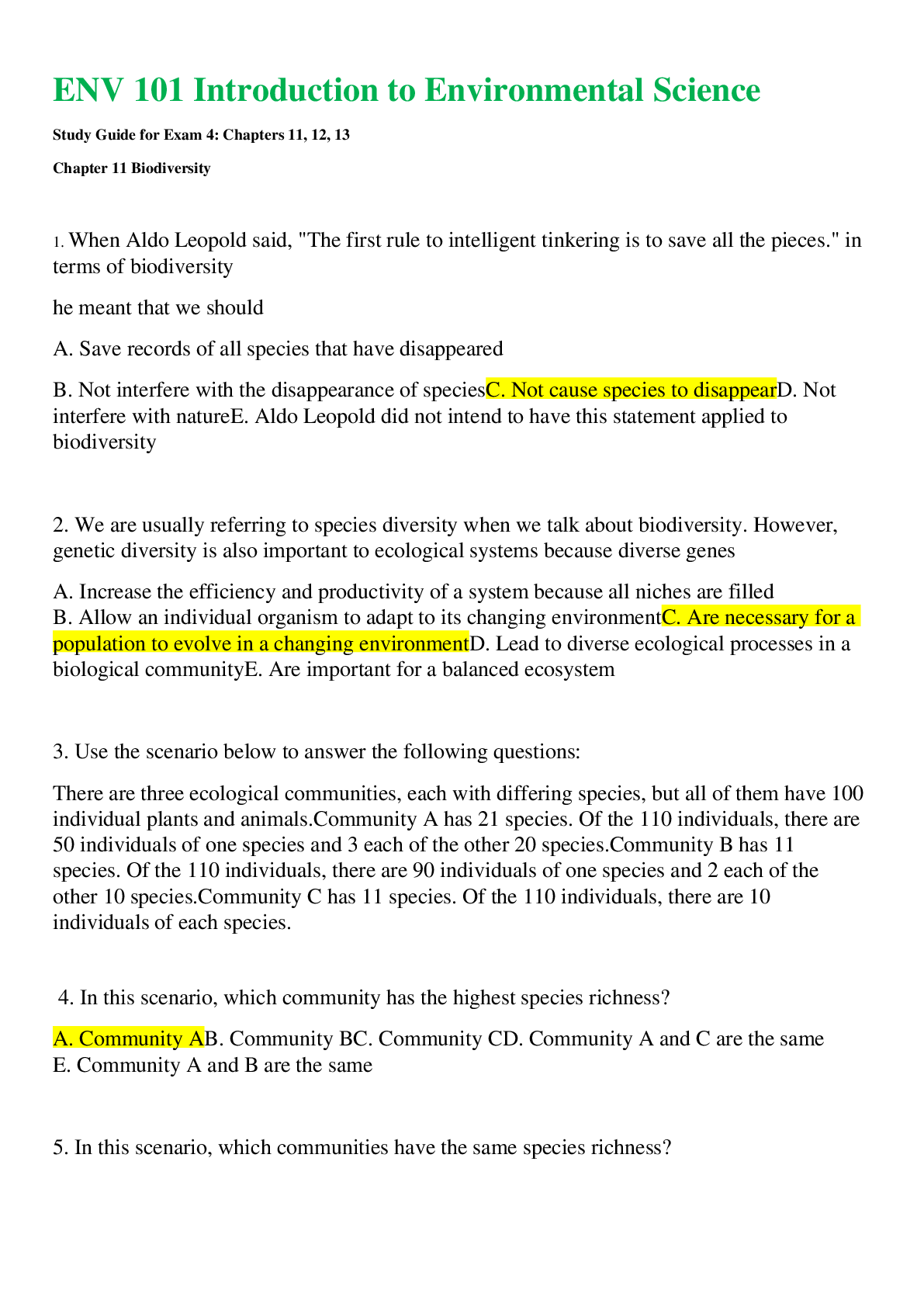
Study Guide for Exam 4: Chapters 11, 12, 13
Chapter 11 Biodiversity
1. When Aldo Leopold said, "The first rule to intelligent tinkering is to save all the pieces." in terms of biodiversity
he meant that we should
...
Study Guide for Exam 4: Chapters 11, 12, 13
Chapter 11 Biodiversity
1. When Aldo Leopold said, "The first rule to intelligent tinkering is to save all the pieces." in terms of biodiversity
he meant that we should
A. Save records of all species that have disappeared
B. Not interfere with the disappearance of species
C. Not cause species to disappear
D. Not interfere with nature
E. Aldo Leopold did not intend to have this statement applied to biodiversity
2. We are usually referring to species diversity when we talk about biodiversity. However, genetic diversity is also important to ecological systems because diverse genes
A. Increase the efficiency and productivity of a system because all niches are filled
B. Allow an individual organism to adapt to its changing environment
C. Are necessary for a population to evolve in a changing environment
D. Lead to diverse ecological processes in a biological community
E. Are important for a balanced ecosystem
3. Use the scenario below to answer the following questions:
There are three ecological communities, each with differing species, but all of them have 100 individual plants and animals.Community A has 21 species. Of the 110 individuals, there are 50 individuals of one species and 3 each of the other 20 species.Community B has 11 species. Of the 110 individuals, there are 90 individuals of one species and 2 each of the other 10 species.Community C has 11 species. Of the 110 individuals, there are 10 individuals of each species.
4. In this scenario, which community has the highest species richness?
A. Community A
B. Community B
C. Community C
D. Community A and C are the same
E. Community A and B are the same
5. In this scenario, which communities have the same species richness?
A. Community A and B
B. Community A and C
C. Community B and C
D. All three communities have the same species richness
E. None of the communities has the same species richness
Use the following scenario:
Your friend is upset because his conception of what a species is has been challenged. His professor told him that there are some problems associated with the common way that a species is identified. Your friend learned what a species was while in high school and it was reinforced during his first year in college. He also refers to the third chapter in your environmental science book for this definition. Your friend wonders if this professor knows what she is talking about. You explain to him that there really are some problems associated with the common way that a species is defined and you think that this professor is correct.
6. The common way that a species is defined in biology (the way it is defined in Chapter 3) is in terms of reproductive isolation. This means that all organisms that are similar enough to
A. Produce fertile offspring in nature
B. Look alike
C. Fill the same niche
D. Occupy the same community
E. Live together
7. You also mentioned to your friend that a new tool, DNA sequencing technology is radically changing the way species are identified. In fact, some groups that were originally thought to be far apart now seem to be closely related. Which of the following statements does not reflect the implications of using this new tool?
A. This tool will end the debate of what is or is not a species
B. This tool allows us to see how closely related species are in terms of their genetics
C. This tool helps us better understand molecular evolution
D. This tool helps us better understand how species actually originate
E. This tool helps us judge genetic diversity
8. Approximately how many species have been identified on Earth?
A. About 500,000
B. A little less than 1 million
C. A little more than 1.5 million
D. A little more than 3 million
E. About 30 million
9. The total number of living species is probably
A. About 450,000
B. Between 500,000 and 1 million
C. Between 3 million and 50 million
D. Between 75 and 95 million
E. At least 300 million
10. One of the reasons humans rely heavily on only a few food crops is because
A. We have not explored the cultivation of thousands of edible wild species
B. There are few edible wild species
C. We have already focused on the best tasting species for domestication and cultivation
D. It would be difficult for small farmers to cultivate the fragile wild species
E. All of these factors contribute to a heavy reliance on only a few species
11. Which of the following drugs is not derived from a naturally occurring organism?
A. Penicillin
B. Aspirin
C. Cortisone
D. Morphine
E. Tetracycline
12. Which of the following is not a benefit of biodiversity for humans?
A. Aesthetics
B. Ecological services
C. Food
D. Drugs and medicines
E. All of these are benefits of biodiversity
13. The pharmaceutical industry has an interest in preventing species extinction because
A. People are healthier in a healthy environment
B. Undiscovered species may provide lucrative new drugs
C. Most taxonomists are drug makers
D. It wants to increase diversity in North America
E. They see the benefits of eco-design
14. Soil formation and water purification are examples of _________ based on the biodiversity that benefit humans.
A. Aesthetic benefits
B. Geological cycles
C. Availability of food
D. Health benefits
E. Ecological services
15. Which of the following statements is true?
A. Humans may have been causing extinctions thousands of years ago, but our impact has recently increased
B. Humans are responsible for many of the mass extinctions in the geologic record
C. Humans only began causing extinctions in the past 150 years
D. Humans have never had significant impact on species extinctions until the past four decades
E. Humans have been causing extinctions for thousands of years and we are still causing extinctions at about the same rate
16. The main reason for the current high rate of animal extinctions is
A. Uncontrolled sport hunting in the developed world
B. Commercial harvesting of wildlife in Africa
C. Drought conditions caused by the greenhouse effect
D. Habitat destruction worldwide
E. None of these by themselves cause high rates of animal extinctions, but together they combine to cause high rates
17. The acronym that stands for habitat destruction, invasive species, pollution, human population and over harvesting is
AA. Tropical
B. Foreign
C. Rare
D. Beautiful
E. Desirable
18. Which of the following would be a characteristic of an exotic plant species?
A. Produces a few seeds after many years to reach maturity
B. Is a specialist, for example, has a low range of tolerance for soil acidity
C. Is an opportunist that is desired by humans for food or ornamental value
D. Has many predators and diseases
E. Is a secondary consumer (trophic levels)
19. Habitat fragmentation usually leads to a(n)
A. Decrease in biodiversity
B. Reduction in the number of introduced species
C. Increase in biodiversity due to the isolated populations
D. Increase in the number of introduced species
E. More stable environment
20. Introduced (exotic) species tend to __________ the balance of ecosystems and ______ biodiversity.
A. Increase; decrease
B. Increase; enhance
C. Maintain; enhance
D. Upset; decrease
E. Upset; increase
21. The zebra mussel was introduced to the Great Lakes
A. As a food source
B. Accidentally in ocean-going ship ballast
C. Intentionally by recreational anglers
D. From the Mississippi River
E. Intentionally by professional anglers
22. Introduced disease organisms are especially dangerous to new environments because they can destroy the non-native host. This happens because the disease organisms
A. Have not evolved with this host to achieve the normal balance for long-term success
B. Are opportunists and in order to survive must out compete all other species
C. Are specialists and destroy the individual organisms that have not developed resistance
D. Do not have natural predators
E. Are generalists and highly competitive
23. It is clear that a heavy dose of pesticides or other toxic pollutants can kill species. However, chronic exposure to pollutants seems to cause recent high mortality in marine mammals by
A. Decreasing the plants that are normally in their environment, such as kelp, that they use for shelter
B. Killing off the prey species that they depend on for food
C. Direct bioaccumulation of the chemicals, such as lead, in their tissues
D. Causing weakened immune systems and increased vulnerability to infection
E. Eventually killing them
24. The U.S. Army participated in extermination of the American bison because
A. The Army desperately needed meat
B. The United States wanted the Great Plains free for agriculture
C. The Army needed leather for shoes
D. Native peoples depended on the bison for food and shelter
E. None of these, the U.S. Army did not participate in extermination of the American bison
25. The main reason for continued trade in endangered species is
A. A surplus of these species in their home countries
B. Ruthless traders and collectors in tropical countries
C. The need for international capital exchange in developing countries
D. Pet lovers and collectors who like exotic species
E. The presence of poachers in tropical countries
26. Which of the following statements about trade in endangered species is false?
A. The principal importers of endangered species are developed countries
B. Coral reefs are not affected by the endangered species trade
C. People who say they are animal lovers are the main contributors to the trade
D. The principal exporters of endangered species are developing countries
E. Up to 60 percent of birds die before reaching market
27. Which of the following fish is safe and environmentally friendly to eat?
A. Swordfish
B. Wild salmon
C. Albacore tuna
D. Yellowfin tuna
E. Haddock
28. If you have an aquarium with saltwater fish, 75 percent of your fish probably came from
A. Captive breeding programs in the United States
B. Captive breeding programs in Indonesia or the Philippines
C. Wild fish populations caught with cyanide or nets
D. Aquaculture programs in South Pacific countries
E. Hybrid crosses of native U.S. fish
29. A species in imminent danger of extinction is classified by the U.S. Endangered Species Act as
A. Vulnerable
B. Threatened
C. Valuable
D. Endangered
E. At risk
30. The main reason that there are relatively few invertebrates categorized as endangered species is because
A. We consider other groups, such as mammals, to be more interesting and desirable
B. Worldwide there are relatively few invertebrates when compared to plants
C. It is extremely difficult to identify and count invertebrates
D. Since there are 532 invertebrates considered endangered, none of these is true
E. Invertebrates are more numerous and the relative percentages are similar
31. The objective of a species recovery plan is to
A. Interbreed threatened species with common species
B. Increase an endangered species population until it is no longer endangered
C. Invest corporate capital in species maintenance
D. Study the species for a better understanding of its role in the biological community
E. Protect the species to aid other organisms and resources in the ecosystem
32. The U.S. Endangered Species Act officially expired in
A. 1973
B. 1950
C. 1988
D. 1905
E. 1992
33. Conservationists and wildlife managers use gap analysis to
A. Predict the next evolutionary change an organism will undergo
B. Find unprotected landscapes that are rich in species
C. Bring different managing agencies into closer accord
D. Isolate and contain populations
E. Establish connecting corridors
34. Which of the following is false regarding CITES?
A. When implemented properly it has provided foolproof protections of endangered species
B. It is an international organization
C. It lists more than 700 species as threatened with extinction
D. It was formed in 1975
E. All of these are true
35. Most of the tallgrass prairies in the U.S. remain untouched.
True False
36. Kudzu vine was originally brought to the U.S. to control soil erosion.
True False
37. Island ecosystems are extremely susceptible to invasive species.
True False
38. Zoo animals in the U.S. today come mainly from the wild.
True False
Chapter 12 Biodiversity: Preserving Landscapes
39. "Closed canopy" forests are those in which tree crowns
A. Include all sizes of trees
B. Crowd out smaller vegetation
C. Cover about 20 percent of the ground surface
D. Cover most of the ground
E. Cover less than 10 percent of the ground surface
40. _________, ___________ and ___________ are the largest producers of both paper pulp and industrial wood.
A. Costa Rica; Ecuador; Mexico
B. Canada; Europe; the United Kingdom
C. Brazil; Africa; Southeast Asia
D. Russia; Canada; the United States
E. Europe; Russia; Central Africa
41. Which of the following statements about old-growth forests is true?
A. Humans do not reside in old-growth forests
B. Old-growth forests have been without disturbance of any kind for at least 100 years
C. The largest remaining areas of old growth forests are in North America
D. They include temperate rainforests, tropical rainforests, boreal forests and deciduous forests
E. None of the above is true
42. Developed countries produce __________ of all industrial wood and account for ________ of its consumption.
A. More than half; less than half
B. Less than half; about 80 percent
C. More than half; about 80 percent
D. Less than half; about half
E. Less than half; about 20 percent
43. Fuelwood harvests
A. Make up about half of all wood harvests
B. Make up only 1 percent of industrial timber harvests
C. Are far greater than industrial timber harvests
D. Make up about 10 percent of all wood harvests
E. Are mainly in developed countries
44. Although most of the world's forests are shrinking, biologists are especially concerned about tropical forest loss because
A. They contain such high biodiversity
B. Tropical trees are the biggest trees in the world
C. They contain irreplaceable wood resources
D. There are fewer remaining tropical forests than any other forest type
E. All of these are reasons that biologists are especially concerned about tropical forest loss
45. Economically, monoculture forestry is advantageous because
A. It produces large quantities of a single type of tree for a particular use, such as building timber or paper
B. pulp
C. It is labor-intensive and thus increases job opportunities for local people
D. High levels of pesticides and herbicides may be needed, therefore more money is spent and is in the system
E. The increase in wildlife diversity is beneficial to the tourism industry
F. A mix of the different trees leads to a good resource base if the market for one type of timber falls
46. "Forest management" means planning for
A. Gaining maximum, quick profit from trees
B. Sustainable harvests and forest regeneration
C. A continual increase in forest complexity
D. Building the maximum biodiversity in a forest
E. Old-growth status in the managed forests
47. After losing nearly all its trees in World War II, South Korea is now
A. Beginning to plan replanting
B. Nearly 10 percent reforested
C. About 70 percent reforested
D. An eroded wasteland
E. Under tremendous pressure for fuelwood harvests
48. A disadvantage of monoculture forestry is that it is
A. Difficult to harvest with clear-cut methods
B. Deficient in providing ecological services
C. Difficult to replant
D. Economically inefficient
E. More time-consuming to replant
49. Which nation currently has the highest deforestation rate?
A. Brazil
B. Russia
C. Japan
D. India
E. Canada
50. A promising approach to encourage conservation and preservation in developing countries is
A. Utilitarian conservation
B. Biocentric preservation
C. Debt-for-nature swaps
D. Ecosystem management
E. Pastoralism
51. Milpa farming is an alternative term for
A. Slash and burn
B. Single-crop agriculture
C. Monoculture agroforestry
D. Conservation tillage
E. Mixed perennial polyculture
52. Satyagraha movements in India work to achieve social and environmental goals
A. By controlling national politics
B. By force
C. Using large amounts of money
D. Through passive, peaceful methods
E. Any way that they can, depending on the context of the situation
53. India's ChipkoAndolan movement
A. Saved a large portion of forests in watersheds
B. Failed to actually save any forests
C. Used children to plant trees in a reforestation project
D. Is now no longer active
E. Emphasized force to save forests in watersheds
54. International lending institutions are willing to cooperate in debt-for-nature swaps because
A. They want to encourage indigenous lifestyles
B. They do not really expect to recover much of their loans
C. They are concerned about the greenhouse effect
D. The size of the loans is negligible
E. They are attempting to support green business
55. Debt-for-nature swaps are beneficial mainly to
A. Lending institutions
B. Governments of developing countries
C. Environmental Groups
D. All of these are correct
E. None of these are correct
56. Of all the old growth forests that stood in the United States before European settlement, how much remains today?
A. About 50 percent
B. About 35 percent
C. Slightly over 25 percent
D. About 15 percent
E. Less than 10 percent
57. Economic studies show that the loss of logging jobs in Washington and Oregon resulted from
A. Industry mechanization and raw log exports rather than spotted owls
B. Low quality work in timber communities rather than spotted owls
C. The disappearance of the spotted owls
D. Legal limits on timber harvests rather than spotted owls
E. The decreased amount of logging that was ordered to save the spotted owls
58. The profits from a year's harvest of salmon in a British Columbia river
A. Can exceed the value of nonrenewable old-growth trees
B. Are negligible compared to timber values
C. Benefit fewer people than do logging proceeds
D. Can be gained only through sport fishing
E. Is significantly lower in value than harvesting old-growth trees, but is more sustainable
59. Most commercial loggers prefer "clear-cut" harvesting because it
A. Is the most environmentally sustainable type of harvest
B. Is the most efficient way to get valuable small timber without disturbing the larger early successional trees
C. Is the most efficient, cheapest harvest method using large, fast machinery instead of costly labor
D. Is the most effective way to refresh soil with sun and rain
E. Does not waste any trees
60. Why is there a need to reeducate people about the role of fire in natural systems?
A. People are still throwing away cigarette butts that can start forest fires
B. People who camp are not putting their campfires out causing fires in inaccessible areas
C. People do not understand that fire is a natural part of many biological ecosystems
D. People are well educated about fire and do not need to be reeducated
E. People are starting fires in wilderness areas to make the area available for logging
61. Which of the following perspectives is not a principle of ecosystem management?
A. Managing across a region over ecological time
B. Maintaining biodiversity
C. Using scientific knowledge as the basis for management since science is free from bias
D. Utilizing cooperative institutional arrangements
E. Adapting management over time as needed
62. In criticizing ecosystem management, one of your classmates says that it is arrogant for us to think that we can manage nature. You respond that you think she probably has a(n) ______________ worldview.
A. Biocentric
B. Anthropocentric
C. Expansionist
D. Anthropomorphic
E. Stewardship
63. What conclusions can you make from examining the graph?
A. Ecosystem "a" has the most biodiversity
B. Ecosystem "a" has the most threatened plant species
C. Humans use ecosystem "a" much more than ecosystem "b"
D. Ecosystem "c" is used by humans about twice as much as ecosystem "d"
E. None of these conclusions is supported by the data
64. Given what you know about land use, what ecosystem do you think ecosystem "a" represents?
A. Rangeland
B. Forest
C. Barren
D. Wetland
E. Aquatic
65. Places most susceptible to desertification are
A. Jungle clearings
B. Desert margins
C. Temperate deciduous forests
D. Boreal landscapes
E. Open woodlands
66. Most public rangelands are in poor condition due to
A. Excessive populations of wild ungulates
B. Overcrowding of private livestock
C. Too many publicly owned animals on public lands
D. Excessive urban settlement in the West
E. The lack of water
67. Grazing fees on public lands have changed little because
A. Political pressures ensure they remain low
B. They remain at market value, so there is no reason to change them
C. The public feels that the price is right
D. Livestock owners cannot afford higher fees
E. Political pressures ensure they remain high
68. Poor people in developing countries often threaten wildlife preserves because
A. They dislike unsettled territory
B. They need the resources to survive
C. They enjoy sport hunting
D. Vandalism is a popular use of spare time
E. Their religion often emphasizes the action of dominating wildlife
69. If managed carefully, ecotourism benefits natural areas by giving economic value to land and water resources
A. That have no other value
B. That no one is interested in
C. That never existed before
D. Without destroying them
E. All of these are economic benefits of carefully managed ecotourism
70. One possible solution to the problem of insufficient land area for preserves is to use ____________ to link smaller habitat areas.
A. Highways
B. Eco-bridges
C. Edge effects
D. Corridors
E. None of these is correct
71. Corridors have the potential to effectively enlarge which of the following?
A. Preserve areas
B. Genetic pools
C. Feeding ranges
D. Areas of refuge against natural disasters (e.g., fire)
E. All of the above are correct
72. Which of the preserve shapes shown has the greatest interior area relative to perimeter area?
A. A
B. B
C. C
D. D
E. All of the shapes have about the same interior/perimeter measurements
73. Which of the preserve shapes shown would support the most species that require a core area?
A. A
B. B
C. C
D. D
E. All of the shapes have about the same measurements
74. The amount of interior area in a preserve is important because
A. Humans and other hardy species encroach on preserve margins
B. It is more economical to buy large land areas
C. Many threatened species cannot survive environmental conditions on preserve margins
D. Humans and other hardy species encroach on preserve margins AND many threatened species cannot survive environmental conditions on preserve margins
E. Humans and other hardy species encroach on preserve margins AND it is more economical to buy large land areas AND many threatened species cannot survive environmental conditions on preserve margins
75. The Menominee tribe in Wisconsin manage their trees using shelterwood harvesting.
True False
Chapter 13 Restoration Ecology
76. The majority of coastal wetland loss in the United States is due to
A. Loss of estuaries in the northeast
B. Levees that guide the Mississippi River out into the Gulf of Mexico
C. Evaporation due to global warming
D. Development
E. Draining and filling to provide storm barricades
77. Efforts to repair or reconstruct ecosystems are known as
A. Land stewardship
B. Conservation reserve programs
C. Landscape ecology
D. Restoration ecology
E. Mitigation
78. The word "mitigation" has come to mean to
A. Let nature heal itself
B. Partially restore an ecosystem
C. Restore or create an ecosystem in exchange for a similar damaged one
D. Move to a new environment when one has been damaged
E. Use natural processes to treat sewage water
79. ________________ uses chemical, physical or biological methods to remove pollution.
A. Remediation
B. Reclamation
C. Mitigation
D. Restoration
E. Rehabilitation
80. Restoration draws on which of the following fields of science the most?
A. Ecology
B. Hydrology
C. Soil science
D. Ecology and hydrology
E. All of these are correct
81. Which of the following is not a main component of restoration of any ecosystem?
A. Replanting
B. Monitoring
C. Controlling invasive species
D. Removing physical stressors
E. Removal of indigenous peoples
82. A pioneer in restoration ecology who planted as many as 6000 trees every year was
A. Gifford Pinchot
B. Theodore Roosevelt
C. Eli Whitney
D. Aldo Leopold
E. John Wesley Powell
83. The first wildlife refuge established in the United States was
A. Pelican Island
B. Arctic National
C. Yellowstone
D. Rocky Flats
E. Baskett Slough
84. In the United States, most reforestation projects result in
A. Huge amounts of biomass, which is then burned to produce energy
B. Large old-growth forests
C. Monoculture forests
D. Small deciduous forests with a large variety of tree types
E. None of these is correct
85. The largest reforestation project in history is now taking place in
A. China
B. Pakistan
C. The United States
D. Canada
E. Russia
86. Some of the advantages of planting trees in cities include
A. Acting as noise barriers
B. Providing shade
C. Improving air quality
D. Improving the aesthetics
E. All of these are correct
87. All of the following are things that can be done toward ecological restoration except
A. Pick up litter
B. Replant native species
C. Remove native species
D. Grow a garden
E. Burn unwanted vegetation
88. One of the reasons that it is difficult to restore an oak savanna is that
A. Too many weedy species take over the oak saplings
B. There are no natural fires to control vegetation
C. Too many trees are cut down illegally for their timber value
D. Too many wild animals destroy the bark of the trees
E. There is not enough suitable land remaining
89. Protection of our forests relies on all of the following except
A. Allowing natural fires to burn
B. Removal of dense undergrowth
C. Using prescribed fires where necessary
D. Cutting down the largest trees in fire-prone areas
E. None of these is correct
90. The majority of the mixed grass section of the Great Plains has been converted to
A. Oak savanna
B. Tall grass prairie
C. Crop lands
D. Grazing lands
E. Wetlands
91. Wetlands control flooding by
A. Temporarily storing water
B. Diverting water to other drainage basins
C. Evaporating most of the water
D. Helping rain flow faster into rivers
E. All of these methods
92. Problems encountered in the Florida Everglades due to modification of the natural flow of water include
A. Loss of 90 percent of wading bird populations in Everglades National Park
B. Water shortages in many cities during the dry season
C. Increased numbers of hurricanes
D. Loss of 90 percent of wading bird populations in Everglades National Park and water shortages in many cities during the dry season
E. All of these are correct
93. Which of the following is false regarding Chesapeake Bay?
A. It is the largest estuary in the United States
B. Pollution has reduced its fish and shellfish harvest substantially
C. Sturgeon populations have increased in recent years
D. Dredging and filling-in have destroyed huge regions of salt marsh
E. More than sixty major industrial facilities discharge wastes into the bay
94. Stream restoration techniques include all of the following except
A. Using small amounts of dynamite to unclog waterways
B. Creating fish habitat
C. Planting ground cover on uplands to reduce erosion
D. Placing dams in streams to deflect current away from the banks
E. Narrowing a stream to increase its speed
95. Stabilizing banks is an important component of stream restoration. Which of the following is not a method of bank stabilization?
A. Using mulch
B. Using rocks
C. Supporting with rock walls
D. Supporting with tree trunks
E. Adding soil so that the slope is at least 45 degrees
96. Radioactive materials have been successfully removed from the soil near the Chernobyl nuclear power plant using
A. Sunflowers
B. Poplar trees
C. Expensive soil removal and extraction methods
D. Mustard greens
E. None of these, there is no way to remove radioactive materials safely from soil
97. "Brown fields" is another name for
A. Tall grass prairies
B. Degraded wetlands
C. Prairies converted into croplands
D. Abandoned contaminated industrial sites
E. Abandoned, contaminated surface mines
98. The most influential American forester was Aldo Leopold.
True False
99. In Vermont, most of the land is currently being used for sheep farming.
True False
100. According to your instructor, which of the following statements would be most accurate regarding the role of environmental science?
A. understanding how nature works and how best to protect it
B. preserving Earth’s physical and biological diversity
C. finding sustainable relationships between environments and people
D. discovering our proper role in the stewardship of the Earth
E. making people aware around the world that plants and animals have feelings too
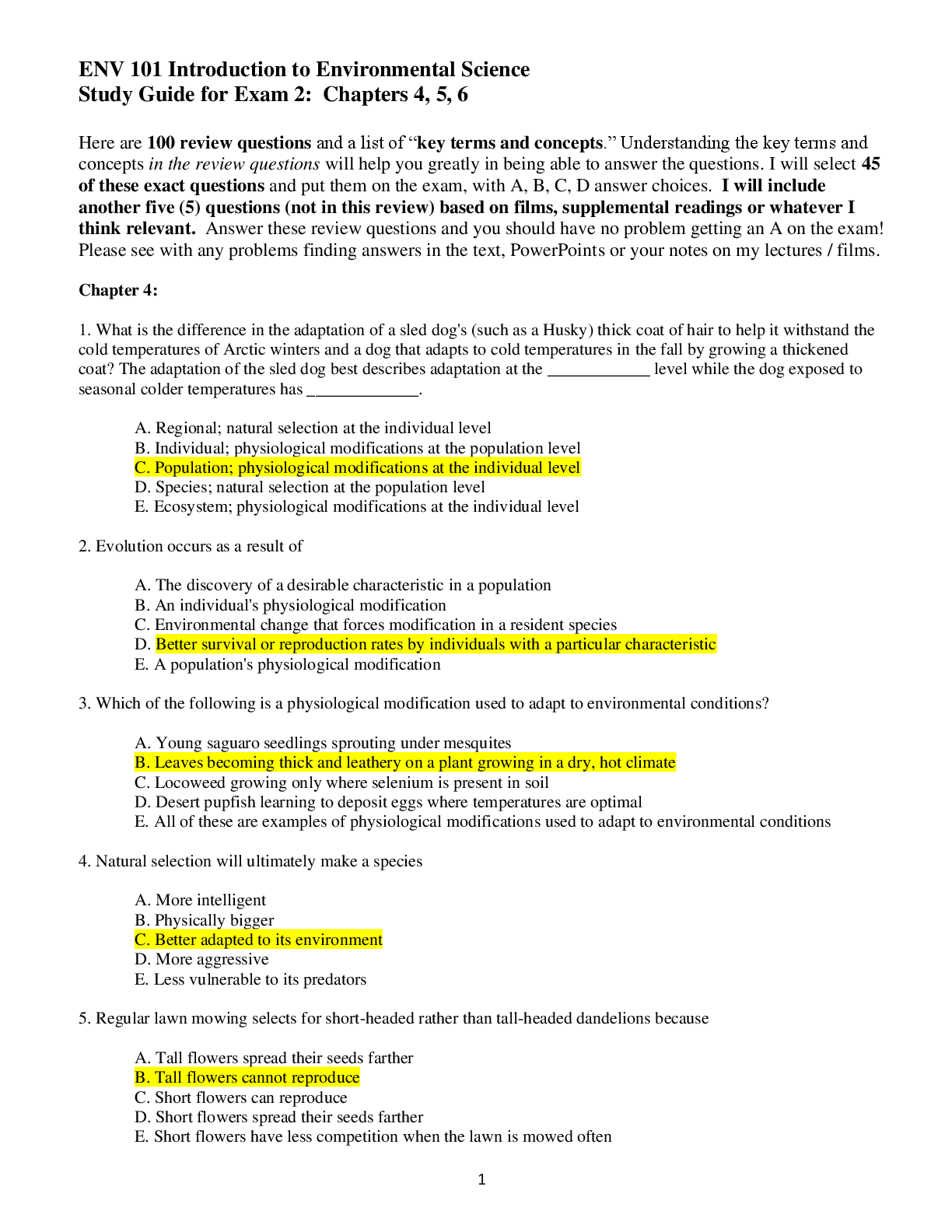
ENV 101 Chapters 11, 12, 13
Key Terms and Concepts
Biodiversity – genetic, species, and ecological variety
genetic diversity – a measure of the variety of different versions of the same genes within individual species
species diversity – describes the number of different kinds of organisms within individual communities or ecosystems
ecological diversity – assesses the richness and complexity of a biological community, including the number of niches, trophic levels, and ecological process that capture energy, sustain food webs, and recycle materials within the system
species – ability to breed and produce fertile offspring in nature
ESC – evolutionary species concept; defines species in evolutionary and historic terms rather than by reproductive potential
how many species? – 1.7 million identified, 3-50 million different species possibly alive today
biodiversity hotspots – greatest concentration of different organisms; tropics – tropical rainforest and coral reefs
biodiversity benefits – food supply, medicine, ecological services, aesthetic and cultural
threats to biodiversity – extinction rates, habitat destruction, climate change, invasive species, pollution, human population growth, overharvesting
extinction – the elimination of a species
HIPPO – habitat destruction, invasive species, pollution, human population growth, overharvesting
habitat destruction
invasive species – organisms that readily invade new territory free of predators, disease and resource limitations
exotic species
introduced species
alien species
endangered species – those considered to be in imminent danger of extinction
threatened species – those that are likely to become endangered, at least locally, in the foreseeable future
vulnerable species – naturally rare or have been locally depleted by human activities to a level that puts the at risk
endangered species management
recovery plans – details how populations will be rebuilt to sustainable levels
HCP – habitat conservation plans; landowners are allowed to harvest resources or build on part of their land as long as the species benefits overall
gap analysis – look for unprotected landscapes that are rich in species
protection controversy
international wildlife treaties
captive breeding
world forests – any area where trees cover more than 10 percent of the land
savannas – tree cover less than 20 percent of the ground
closed-canopy forests – tree crowns overlap to cover most of the ground
old-growth forests – large enough and free enough areas from human modification that native species can live out a natural life cycle, and ecological relationships play out in a relatively normal
forest products
monoculture forestry
deforestation
causes of deforestation
forest protection
debt-for-nature-swaps
temperate forest competing uses
clear-cutting
shelterwood harvesting
strip-cutting
selective cutting
subsided logging
fire management
ecosystem management
forest thinning and salvage logging
grasslands and human use
desertification
overgrazing
rotational grazing
parks and preserves
IUCN
IUCN categories
world conservation strategy
marine ecosystem protection
ecotourism
biosphere preserves
MAB program
core habitat
edge effects
ecological restoration
restoration glossary:
restoration-- broad/strict
rehabilitation
intervention
reallocation
remediation
reclamation
re-creation
mitigation
restoration projects common elements
nature’s resiliency
benefits of restoring forests
restoring prairies
buffalo commons
restoring wetlands and streams
re-plumbing of the Everglades
rehabilitation of Chesapeake Bay
wetlands mitigation
[Show More]


.png)








.png)