Exam 4Annual Editions Articles Review
1. As described in “The End of a Myth,” in the twentieth century scientists discovered underwater rivers in the ocean that draw warmth from equatorial waters to the high latitudes
...
Exam 4Annual Editions Articles Review
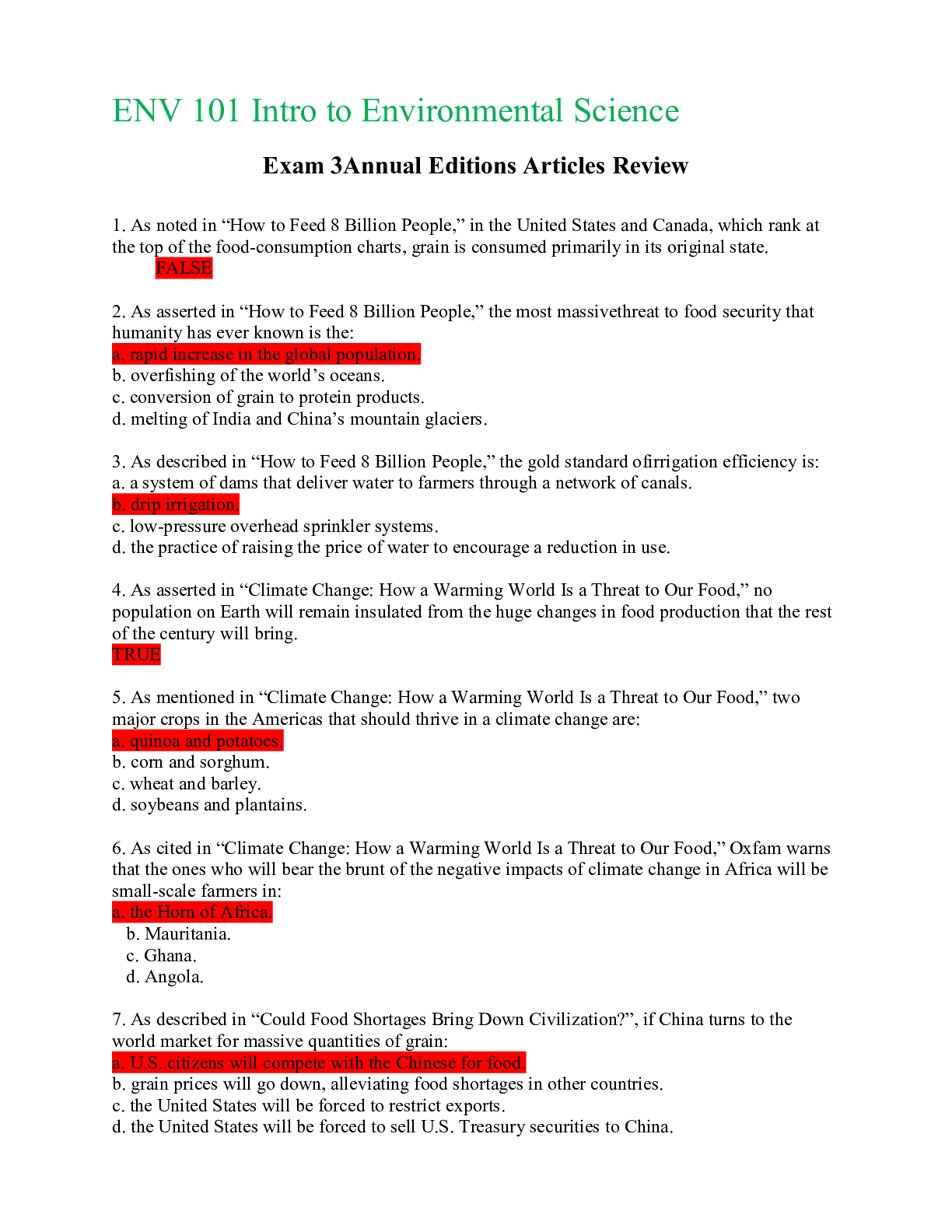
1. As described in “The End of a Myth,” in the twentieth century scientists discovered underwater rivers in the ocean that draw warmth from equatorial waters to the high latitudes, a system that became known as the:
a. global thermostat.
b. ocean conveyor.
c. subsurface current.
d. oceanic rivers.
2. As detailed in “The End of a Myth,” one current threat to oceans that may also have been a primary factor in the “Great Dying” 252 million years ago is:
a. loss of phytoplankton.
b. desalinization.
c. climate change.
d. acidification.
3. Recently, as described in “Rich Countries Launch Great Land Grab to Safeguard Food Supply,” deals for leases and purchases of large tracts of arable land have accelerated because of:
a. rapidly increasing populations in buyer countries.
b. a surge in world food prices.
c. the effects of climate change.
d. political pressure backed up by military threats.
4. As related in “Rich Countries Launch Great Land Grab to Safeguard Food Supply,” there is a fear in Africa that immense land deals will:
a. bring foreign control to some countries.
b. result in national economies being pegged to food prices.
c. lead to poor nations producing food for rich countries at the expense of their own hungry
people.
d. cause civil wars.
5. As explained in “Global Urbanization,” the Clean Development Mechanism (CDM) created by the Kyoto Protocol allows:
a. new sources of oil such as oil shales to become economically viable in order to increase
global oil security.
b. cities to surpass the ability of natural ecosystems to successfully absorb pollutants without
becoming degraded.
c. a country that has exceeded its quota of greenhouse-gas emissions to purchase carbon
credits from a developing country that has reduced its emissions.
d. heating and cooling of homes either directly powered by fossilfuels or by electricity from
power plants that burn fossil fuels.
6. As presented in “Global Urbanization,” payment for ecosystem service (PES) means that:
a. developed countries will pay developing countries for more sustainable development.
b. developing countries will create environmental externalities for which they will have to pay.
c. policy responses such as zoning and tax regimes will be decided at a local level.
d. the dispersed nature of future urbanization must be aimed at increasing sustainability.
7. As profiled in “The New Land Rush,” a report noting that food security concerns are “extremely significant” and that the “acquisition of land internationally is one possible strategic choice to address the challenge,” was released in 2009 by the:
a. United Nations.
b. Hollywood Coalition of Global Activism.
c. Colombian government.
d. U.S. Department of Agriculture.
8. As pointed out in “The New Land Rush,” it is ironic that key targets of foreign agro-investment include the world’s most:
a. frequently flooded areas.
b. malnourished countries.
c. dangerous places.
d. isolationist regimes.
9. As defined in “Development at the Urban Fringe and Beyond,” the term for strategies used by states to direct transportation, infrastructure and other resources in order to channel growth into appropriate areas is:
a. smart growth.
b. urban sprawl.
c. new urbanism.
d. low-density development.
10. As described in “Development at the Urban Fringe and Beyond,” one effective means for protecting rural land from development, currently used in 19 states, is:
a. use-value assessment.
b. federal agri-environmental payments.
c. Rural Business Opportunity Grant (RBOG) programs.
d. state-level PDR (purchase of development rights) programs
11. As stated in “Development at the Urban Fringe and Beyond,” policymakers at the federal level are increasingly urged to respond to growth and development concerns because:
a. national land-use policy legislation failed in the 1970s, andsince then the ill-controlled
growth of urban areas has more than doubled.
b. there are no restrictions on federal roles in managing growth.
c. federal rural development and economic development programs have become entrenched
and balkanized.
d. federal funding for major infrastructure projects has been identified as a major driver in
growth and development.
12. As disclosed in “Backyard Battlefields,” the practice of compellingholdout landowners to join gas-leasing agreements with their neighborsis known as:
a. the friendly nudge.
b. forced pooling.
c. sign on or lose out.
d. between shale rock and a hard place.
13. As described in “Backyard Battlefields,” the fracking that goes onwhere Keith Wilson lives disrupts his sleep with disturbing flashbackdreams of his time in:
a. a POW camp.
b. a collapsed mineshaft.
c. Iraq.
d. a plane crash.
[Show More]





.png)