Chapter 101: Basic Principles of Cancer Chemotherapy Test Bank
MULTIPLE CHOICE
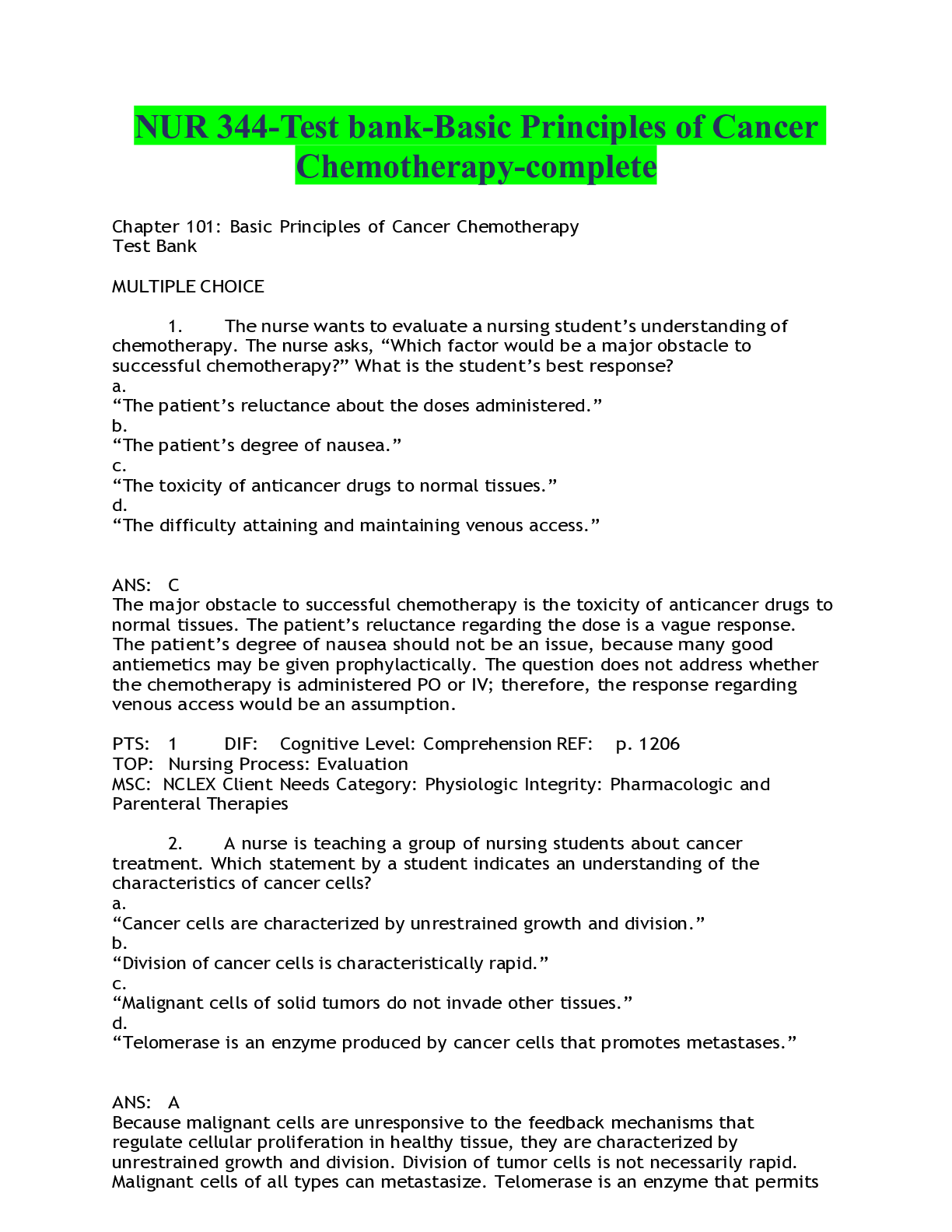
1. The nurse wants to evaluate a nursing student’s understanding of chemotherapy. The nurse asks, “Which factor would be a major obstac
...
Chapter 101: Basic Principles of Cancer Chemotherapy Test Bank
MULTIPLE CHOICE
1. The nurse wants to evaluate a nursing student’s understanding of chemotherapy. The nurse asks, “Which factor would be a major obstacle to successful chemotherapy?” What is the student’s best response?
a.
“The patient’s reluctance about the doses administered.” b.
“The patient’s degree of nausea.” c.
“The toxicity of anticancer drugs to normal tissues.” d.
“The difficulty attaining and maintaining venous access.”
ANS: C
The major obstacle to successful chemotherapy is the toxicity of anticancer drugs to normal tissues. The patient’s reluctance regarding the dose is a vague response.
The patient’s degree of nausea should not be an issue, because many good antiemetics may be given prophylactically. The question does not address whether the chemotherapy is administered PO or IV; therefore, the response regarding venous access would be an assumption.
PTS: 1 DIF: Cognitive Level: Comprehension REF: p. 1206 TOP: Nursing Process: Evaluation
MSC: NCLEX Client Needs Category: Physiologic Integrity: Pharmacologic and Parenteral Therapies
2. A nurse is teaching a group of nursing students about cancer treatment. Which statement by a student indicates an understanding of the characteristics of cancer cells?
a.
“Cancer cells are characterized by unrestrained growth and division.” b.
“Division of cancer cells is characteristically rapid.” c.
“Malignant cells of solid tumors do not invade other tissues.” d.
“Telomerase is an enzyme produced by cancer cells that promotes metastases.”
ANS: A
Because malignant cells are unresponsive to the feedback mechanisms that regulate cellular proliferation in healthy tissue, they are characterized by unrestrained growth and division. Division of tumor cells is not necessarily rapid. Malignant cells of all types can metastasize. Telomerase is an enzyme that permits repeated division of cancer cells.
PTS: 1 DIF: Cognitive Level: Analysis REF: pp. 1207-1208 TOP: Nursing Process: Evaluation
MSC: NCLEX Client Needs Category: Physiologic Integrity: Physiologic Adaptation
3. A patient is receiving chemotherapy. Seven days after a dose, the patient’s neutrophil count is 1000 cells/mm3. The nurse will tell this patient:
a.
that hospitalization is necessary to provide infection prophylaxis. b.
that the provider will probably repeat the lab work in 3 to 5 days. c.
to ask the provider about skipping the next dose of chemotherapy. d.
to report any symptoms such as pus, abscesses, or cough.
ANS: B
Normal neutrophil counts range from 2500 to 7000 cells/mm3. The lowest neutrophil count, or nadir, usually occurs 10 to 14 days after dosing, so this patient’s neutrophil count should be repeated at that time. Hospitalization is controversial because of the risk of exposure to serious infections. The next dose should not be skipped unless the neutrophil count is below 500/mm3. Patients with neutropenia may not have symptoms of pus, abscess, or cough and should be instructed to report any fever.
PTS: 1 DIF: Cognitive Level: Application REF: pp. 1214-1215 TOP: Nursing Process: Assessment
MSC: NCLEX Client Needs Category: Physiologic Integrity: Physiologic Adaptation
CONTINUED...........
[Show More]