NCLEX PRACTICE QUESTIONS » URINARY DISORDERS NCLEX PRACTICE QUIZ (150
QUESTIONS)
Urinary Disorders NCLEX Practice Quiz (150 Questions UPDATED ON MARCH 19, 2022 BY MATT
VERA, BSN, R.N.
1. Question
Which of the follow
...
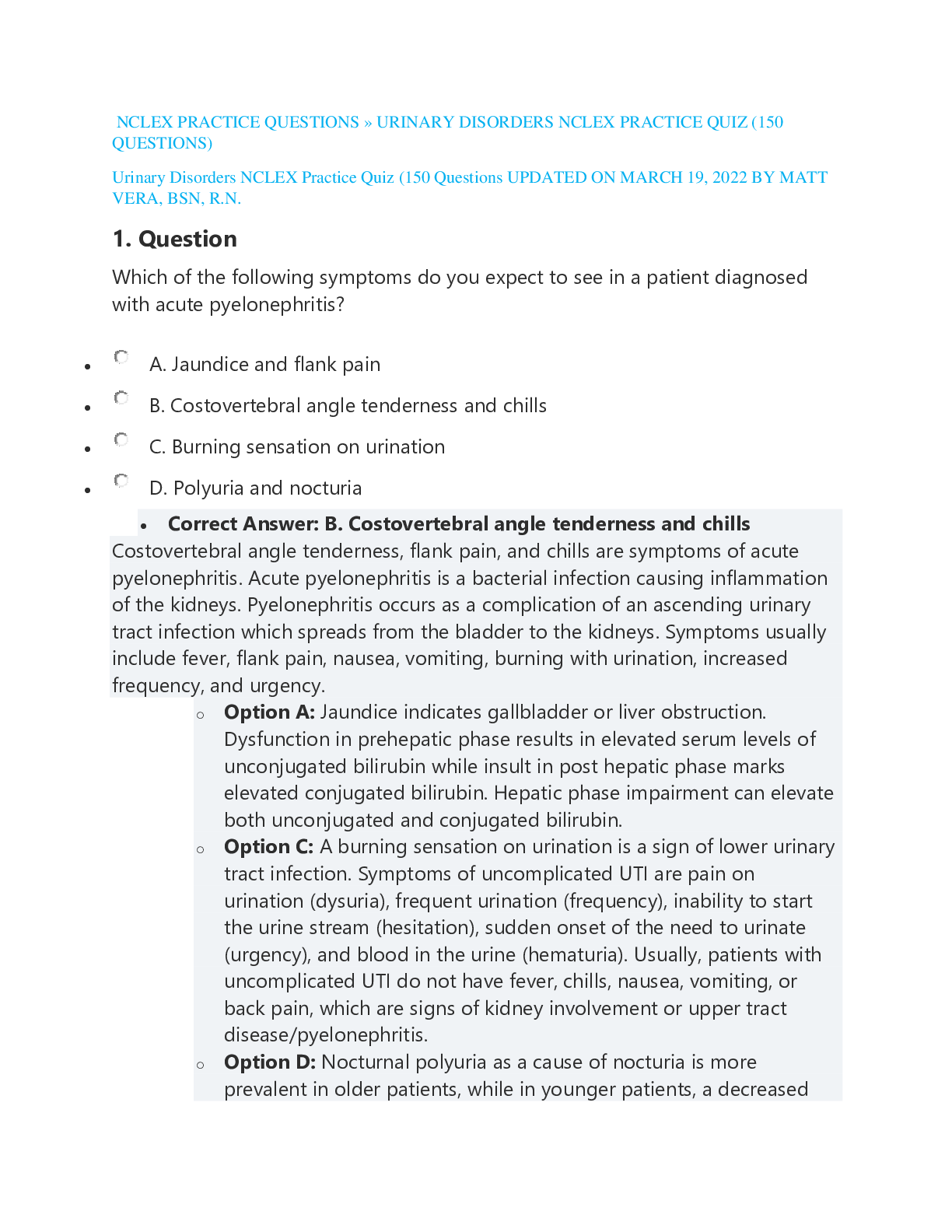
NCLEX PRACTICE QUESTIONS » URINARY DISORDERS NCLEX PRACTICE QUIZ (150
QUESTIONS)
Urinary Disorders NCLEX Practice Quiz (150 Questions UPDATED ON MARCH 19, 2022 BY MATT
VERA, BSN, R.N.
1. Question
Which of the following symptoms do you expect to see in a patient diagnosed
with acute pyelonephritis?
A. Jaundice and flank pain
B. Costovertebral angle tenderness and chills
C. Burning sensation on urination
D. Polyuria and nocturia
Correct Answer: B. Costovertebral angle tenderness and chills
Costovertebral angle tenderness, flank pain, and chills are symptoms of acute
pyelonephritis. Acute pyelonephritis is a bacterial infection causing inflammation
of the kidneys. Pyelonephritis occurs as a complication of an ascending urinary
tract infection which spreads from the bladder to the kidneys. Symptoms usually
include fever, flank pain, nausea, vomiting, burning with urination, increased
frequency, and urgency.
o Option A: Jaundice indicates gallbladder or liver obstruction.
Dysfunction in prehepatic phase results in elevated serum levels of
unconjugated bilirubin while insult in post hepatic phase marks
elevated conjugated bilirubin. Hepatic phase impairment can elevate
both unconjugated and conjugated bilirubin.
o Option C: A burning sensation on urination is a sign of lower urinary
tract infection. Symptoms of uncomplicated UTI are pain on
urination (dysuria), frequent urination (frequency), inability to start
the urine stream (hesitation), sudden onset of the need to urinate
(urgency), and blood in the urine (hematuria). Usually, patients with
uncomplicated UTI do not have fever, chills, nausea, vomiting, or
back pain, which are signs of kidney involvement or upper tract
disease/pyelonephritis.
o Option D: Nocturnal polyuria as a cause of nocturia is more
prevalent in older patients, while in younger patients, a decreasednocturnal bladder capacity is the more common etiology. Caffeine
and excessive oral fluid intake in the evenings, as well as alcoholism,
can contribute significantly to this disorder. It is also associated with
congestive heart failure, obstructive sleep apnea, evening use of
diuretics, peripheral edema, high dietary salt intake, and chronic
venous insufficiency of the lower extremities.
2. Question
You have a patient that might have a urinary tract infection (UTI). Which
statement by the patient suggests that a UTI is likely?
o A. “I pee a lot.”
o B. “It burns when I pee.”
o C. “I go hours without the urge to pee.”
o D. “My pee smells sweet.”
Correct Answer: B. “It burns when I pee.”
A common symptom of a UTI is dysuria. A patient with a UTI often reports
frequent voiding of small amounts and the urgency to void. Symptoms of
uncomplicated UTI are pain on urination (dysuria), frequent urination (frequency),
inability to start the urine stream (hesitation), sudden onset of the need to urinate
(urgency), and blood in the urine (hematuria). Usually, patients with
uncomplicated UTI do not have fever, chills, nausea, vomiting, or back pain, which
are signs of kidney involvement or upper tract disease/pyelonephritis.
o Option A: High amounts of solutes within the renal tubules cause a
passive osmotic diuresis (solute diuresis) and thus an increase in
urine volume. The classic example of this process is the glucoseinduced osmotic diuresis in uncontrolled diabetes mellitus, when
high urinary glucose levels (> 250 mg/dL [13.88 mmol/L]) exceed
tubular reabsorption capacity, leading to high glucose levels in the
renal tubules; water follows passively, resulting in glucosuria and
increased urine volume.
o Option C: Oliguria can be the result of various causes that can be
apparent or subclinical. Oliguria can arise as a result of the normal
physiological response of the body or due to an underlying
pathology affecting the kidney or urinary tract. The most commonprerenal cause is reduced blood flow to the kidney secondary to
intravascular volume depletion, heart failure, sepsis, or as a side
effect of medication.
o Option D: Urine that smells sweet is often associated with diabetic
ketoacidosis. Commonly accepted criteria for diabetic ketoacidosis
are blood glucose greater than 250 mg/dl, arterial pH less than 7.3,
serum bicarbonate less than 15 mEq/l, and the presence of
ketonemia or ketonuria.
3. Question
Which instructions do you include in the teaching care plan for a patient with
cystitis receiving phenazopyridine (Pyridium)?
o A. If the urine turns orange-red, call the doctor.
o B. Take phenazopyridine just before urination to relieve pain.
o C. Once painful urination is relieved, discontinue prescribed
antibiotics.
o D. After painful urination is relieved, stop taking
phenazopyridine.
Correct Answer: D. After painful urination is relieved, stop taking
phenazopyridine.
Pyridium is taken to relieve dysuria because it provides an analgesic and
anesthetic effect on the urinary tract mucosa. The patient can stop taking it after
the dysuria is relieved. Symptomatic treatment with analgesics may be used in
patients who present with severe dysuria. Phenazopyridine is a urinary analgesic
used in short-term treatment of urinary dysuria or discomfort.
o Option A: The urine may temporarily turn red or orange due to the
dye in the drug. Patients should be informed that Phenazopyridine
HCl produces a reddish-orange discoloration of the urine and may
stain fabric. Staining of contact lenses has been reported.
o Option B: The drug isn’t taken before voiding, and is usually taken 3
times a day for 2 days. Treatment of a urinary tract infection with
Phenazopyridine HCl should not exceed two days because there is a
lack of evidence that the combined administration ofPhenazopyridine HCl and an antibacterial provides greater benefit
than administration of the antibacterial alone after two days.
o Option C: Antibiotics should not be discontinued without indication
from the physician. The analgesic action may reduce or eliminate the
need for systemic analgesics or narcotics. It is, however, compatible
with antibacterial therapy and can help to relieve pain and
discomfort during the interval before antibacterial therapy controls
the infection.
4. Question
Which patient is at greatest risk for developing a urinary tract infection (UTI)?
o A. A 35 y.o. woman with a fractured wrist
o B. A 20 y.o. woman with asthma
o C. A 50 y.o. postmenopausal woman
o D. A 28 y.o. with angina
Correct Answer: C. A 50 y.o. postmenopausal woman
Women are more prone to UTIs after menopause due to reduced estrogen levels.
Reduced estrogen levels lead to reduced levels of vaginal Lactobacilli bacteria,
which protect against infection. Premenopausal women have large
concentrations of lactobacilli in the vagina and prevent the colonization of
uropathogens. However, the use of antibiotics can erase this protective effect.
o Option A: An uncomplicated UTI usually only involves the bladder.
When the bacteria invade the bladder mucosal wall, cystitis is
produced. The majority of organisms causing a UTI are enteric
coliforms that usually inhabit the periurethral vaginal introitus. These
organisms ascend into the bladder and cause a UTI.
o Option B: Sexual intercourse is a common cause of a UTI as it
promotes the migration of bacteria into the bladder. People who
frequently void and empty the bladder have a much lower risk of a
UTI. Pathogenic bacteria ascend from the perineum, causing UTI.
Women have shorter urethras than men and therefore are more
susceptible to UTI. Very few uncomplicated UTIs are caused by
blood-borne bacteria. Escherichia coli is the most common organism
in uncomplicated UTI by a large margin.
[Show More]



















.png)


