Questions and rationale » SELECT ALL THAT APPLY NCLEX PRACTICE QUESTIONS AND TIPS (100
ITEMS) PDATED ON MARCH 19, 2022 BY BSN, R.N.
NURSESLABS-SATA-1-001
A patient is admitted to the same-day surgery unit for liver bi
...
Questions and rationale » SELECT ALL THAT APPLY NCLEX PRACTICE QUESTIONS AND TIPS (100
ITEMS) PDATED ON MARCH 19, 2022 BY BSN, R.N.
NURSESLABS-SATA-1-001
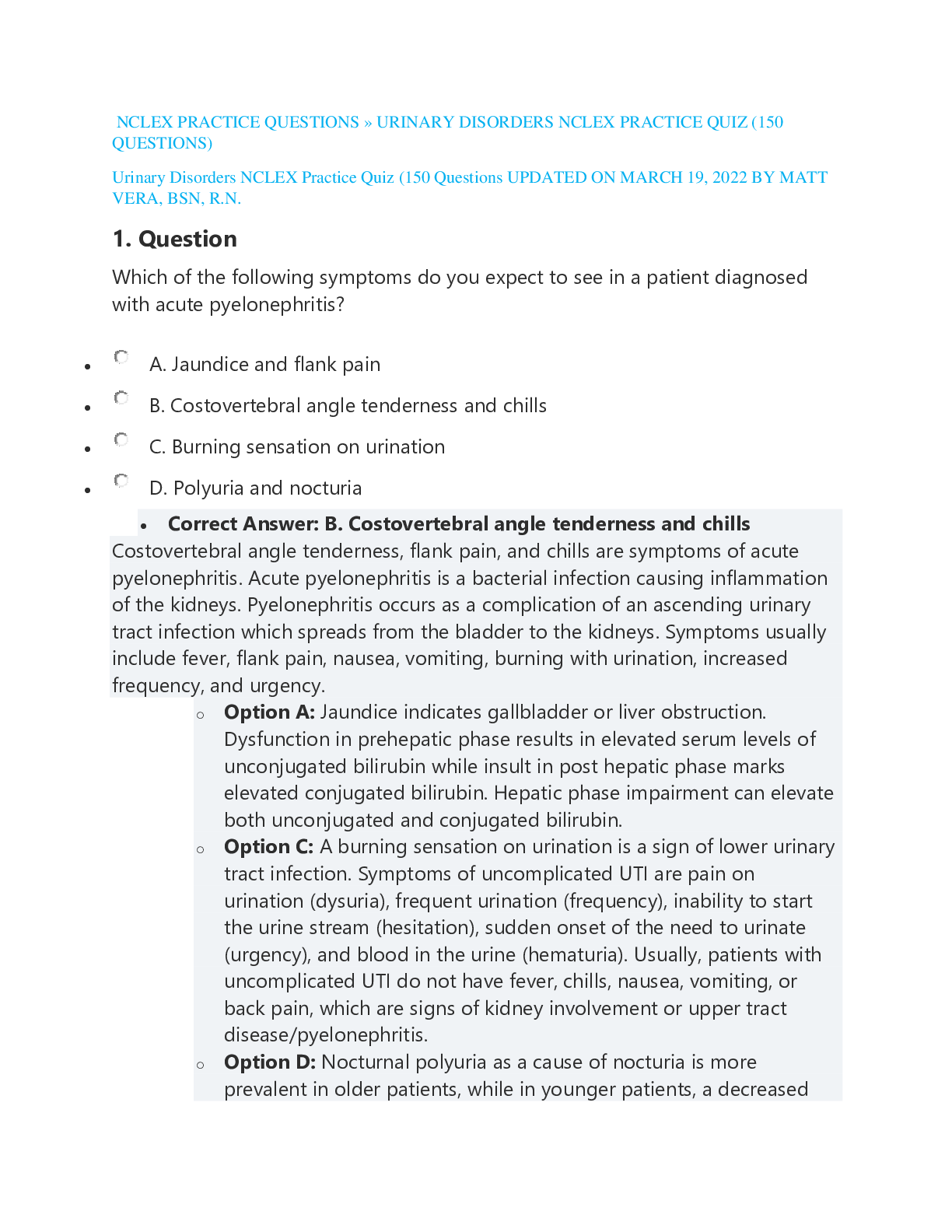
A patient is admitted to the same-day surgery unit for liver biopsy. Which of the following
laboratory tests assesses coagulation? Select all that apply.
A. Partial thromboplastin time.
B. Prothrombin time.
C. Platelet count.
D. Hemoglobin
E. Complete Blood Count
F. White Blood Cell Count
Correct Answer: A, B, and C.
Prothrombin time, partial thromboplastin time, and platelet count are all included in
coagulation studies. The hemoglobin level, though important information prior to an invasive
procedure like liver biopsy, does not assess coagulation.
Option A: Partial thromboplastin time (PTT) is the time it takes for a patient’s blood to
form a clot as measured in seconds. It is used to measure the activity of the intrinsic
pathway of the clotting cascade. PTT tests the function of all clotting factors except
factor VII (tissue factor) and factor XIII (fibrin stabilizing factor).
Option B: Prothrombin time (PT) is one of several blood tests routinely used in clinical
practice to evaluate the coagulation status of patients. More specifically, PT is used to
evaluate the extrinsic and common pathways of coagulation, which would detect
deficiencies of factors II, V, VII, and X, and low fibrinogen concentrations.
Option C: Platelet count is being assessed to determine the number of platelets in a
sample of the blood as part of a health exam; to screen for, diagnose, or monitor
conditions that affect the number of platelets, such as a bleeding disorder, a bone
marrow disease, or other underlying conditions.
Option D: Hemoglobin is used to evaluate the hemoglobin content of your blood as part
of a general health checkup; to screen for and help diagnose conditions that affect red
blood cells (RBCs); if there is anemia (low hemoglobin) or polycythemia (high
hemoglobin), and to assess the severity of these conditions and to monitor response to
treatment.
Option E: The complete blood count (CBC) is a group of tests that evaluate the cells that
circulate in blood, including red blood cells (RBCs), white blood cells (WBCs), and
platelets (PLTs). The CBC can evaluate your overall health and detect a variety of
diseases and conditions, such as infections, anemia and leukemia.
Option F: WBC count is used to screen for or diagnose a variety of conditions that can
affect the number of white blood cells (WBCs), such as an infection, inflammation or adisease that affects WBCs; to monitor treatment of a disorder or to monitor therapy
that is known to affect WBCs.
NURSESLABS-SATA-1-002
A patient is admitted to the hospital with suspected polycythemia vera. Which of the following
symptoms is consistent with the diagnosis? Select all that apply.
A. Weight loss.
B. Prolonged clotting time.
C. Hypertension.
D. Headaches.
E. Polyphagia.
F. Pruritus.
Correct Answer: B, C, D, and F.
Polycythemia vera is a condition in which the bone marrow produces too many red blood cells.
This causes an increase in hematocrit and viscosity of the blood. Patients can experience
headaches, dizziness, and visual disturbances. Bleeding is also a complication, possibly because
the platelets are often very large and somewhat dysfunctional. The bleeding can be significant
and can occur in the form of nosebleeds, ulcers, frank GI bleeding, hematuria, and
intracranial hemorrhage.
Option A: Weight loss is not a manifestation of polycythemia vera. Weight loss may
result from early satiety or from the increased myeloproliferative activity of the
abnormal clone.
Option B: Patients with polycythemia vera are at increased risk for thrombosis that may
result in CVAs (strokes, brain attacks) or myocardial infarctions (MIs); thrombotic
complications are the most common cause of death.
Option C: Cardiovascular effects include increased blood pressure and delayed clotting
time. Thrombotic complications (1%) include venous thrombosis or thromboembolism
and an increased prevalence of stroke and other arterial thrombosis.
Option D: Physical complaints can include fatigue, headache, dizziness, tinnitus, vision
changes, insomnia, claudication, pruritus, gastritis, and early satiety. Subsequent
sludging of blood flow and thrombosis lead to poor oxygen delivery, with symptoms that
include headache.
Option E: Early satiety can occur in patients with splenomegaly, because of gastric filling
being impaired by the enlarged spleen or, rarely, as a symptom of splenic infarction.
Option F: Generalized pruritus is caused by histamine release due to an increased
number of basophils. Aquagenic pruritus, which occurs during or after a hot shower, is a
complaint in 40% of patients. The mechanism is likely from mast cell and basophil
degranulation, causing a histamine surge.
NURSESLABS-SATA-1-003The nurse is teaching the client how to use a metered-dose inhaler (MDI) to administer a
Corticosteroid drug. Which of the following client actions indicates that he is using the MDI
correctly? Select all that apply.
A. The inhaler is held upright.
B. Head is tilted down while inhaling the medication.
C. Client waits 5 minutes between puffs.
D. Mouth is rinsed with water following administration.
E. Client lies supine for 15 minutes following administration.
Correct Answer: A & D.
In using a corticosteroid MDI, remove the cap and hold the inhaler upright, stand or sit up
straight, shake the inhaler, tilt your head back slightly, put the inhaler in the mouth, press down
on the inhaler quickly, breathe in slowly for 3 to 5 seconds, hold the breath for 10 seconds,
breathe out slowly, repeat puffs as prescribed, rinse the mouth, and gargle using water or
mouthwash after each use.
Option A: Keep the chin up and the inhaler upright (not aimed at the roof of the mouth
or the tongue). Use a spacer/valve-holding chamber (the best way, useful for all
patients) by putting the inhaler into the end with the hole and the mouthpiece end in
the mouth. If there is no spacer, hold the inhaler 1 to 2 inches (or two-finger widths) in
front of an open mouth.
Option B: Head is tilted up during inhalation of the medication. Start breathing in slowly
through the mouth and press down on the inhaler one time. If using a spacer or valvedholding chamber, press down on the inhaler before starting to breathe in. Breathe in
slowly.
Option C: For inhaled quick-relief medicine (like albuterol), wait about 1 minute
between puffs. There is no need to wait between puffs for other medicines.
Option D: If the client is using this inhaler for a corticosteroid preventer medication,
with or without a spacer, rinse the mouth with water and spit after inhaling the last
dose to reduce the risk of side effects.
Option E: There is no need to lie supine after administration of the medication. If more
than one dose is needed, repeat all the steps.
NURSESLABS-SATA-1-004
The nurse is teaching a client with polycythemia vera about potential complications from this
disease. Which manifestations would the nurse include in the client’s teaching plan? Select all
that apply.
A. Hearing loss
B. Visual disturbance
C. Headache
D. Orthopnea
[Show More]


 UPDATED ON MARCH 19, 2022, BSN, R.png)



 (1).png)
.png)













.png)