Learning Objectives – coverage by question
True/
False
Multiple
Choice Exercises Problems Questions Essay
LO1 Describe
and illustrate
the accounting
for capitalized
leases.
LO2 Describe
and illustrate
the a
...
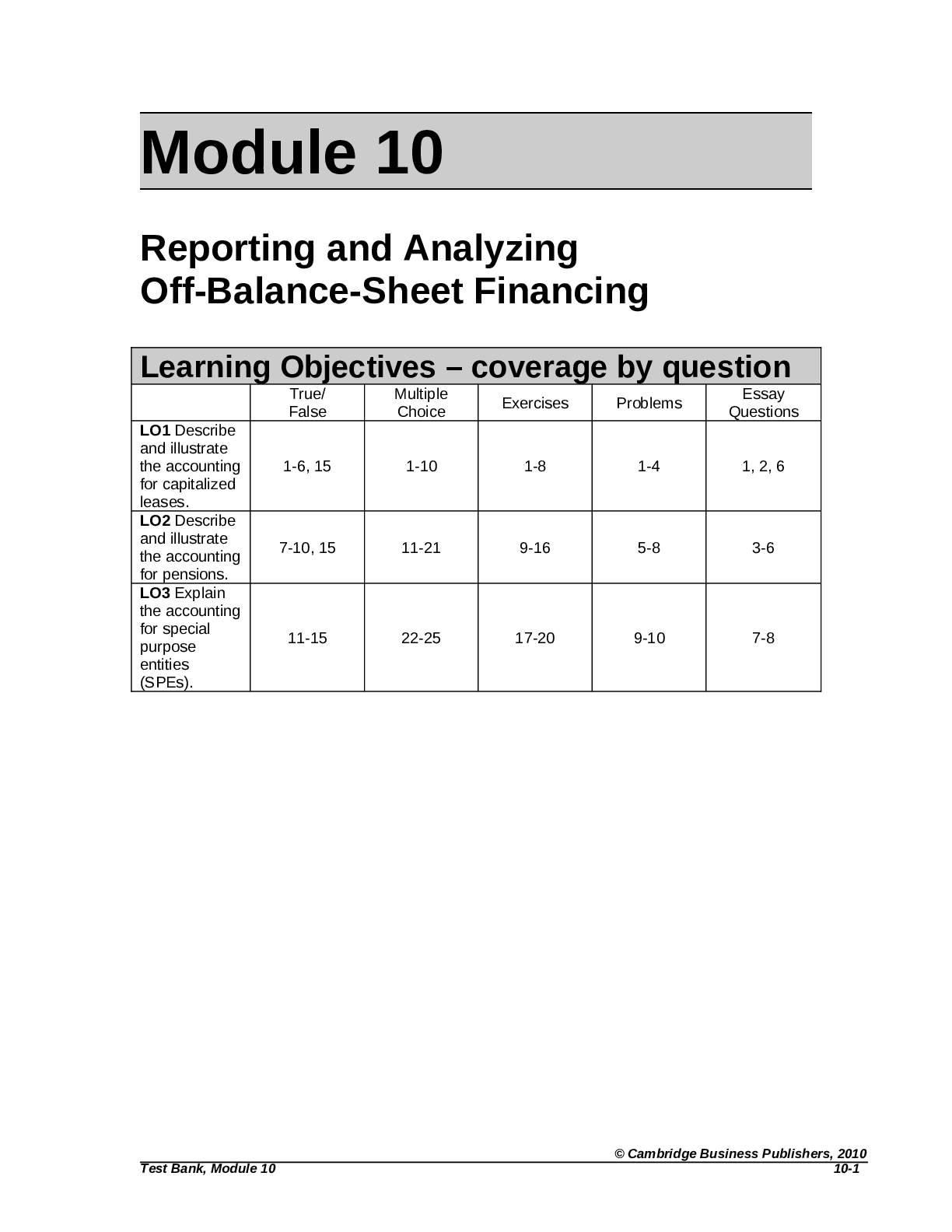
Learning Objectives – coverage by question
True/
False
Multiple
Choice Exercises Problems Questions Essay
LO1 Describe
and illustrate
the accounting
for capitalized
leases.
LO2 Describe
and illustrate
the accounting
for pensions.
LO3 Explain
the accounting
for special
purpose
entities
(SPEs).
Module 10: Reporting and Analyzing Off-Balance-Sheet Financing
True/False
Topic: Operating leases
LO: 1
1. Operating leases appear as liabilities on the lessee’s balance sheet.
Answer: False
Rationale: Operating leases do not appear on the lessee’s balance sheet. An operating lease is
considered a form of off-balance sheet financing for the lessee. The company merely footnotes
their existence and key details in the annual report. Lease payments are reported as rent
expense on the lessee’s income statement.
Topic: Lease capitalization
LO: 1
2. Capitalizing leases have little effect on a company’s return on equity (ROE) ratio.
Answer: True
Rationale: ROE is largely unaffected since net income and stockholders’ equity are largely
unaffected. However, capitalizing leases does affect the components of ROE such as FLEV and
NOAT and RNOA.
Topic: Leases as a financing source
LO: 1
3. Leases can be a better financing vehicle because leases often require less equity investment
than traditional bank financing.
Answer: True
Rationale: Leases generally require less up-front investment than does bank financing.
Topic: Financial statements of non-capitalization
LO: 1
4. Failure to recognize lease assets and liabilities results in understated financial leverage and
understated net operating profit (NOPAT).
Answer: False
Rationale: Failure to recognize lease assets and liabilities does understate because liabilities are
lower the FLEV numerator. However, failure to recognize lease assets and liabilities usually
overstates NOPAT because the entire lease payment is deducted from NOPAT instead of just the
depreciation portion.
Topic: Expenses and cash flows relating to operating leases
LO: 1
5. Operating leases increase interest expense in the income statement, while decreasing net
cash flows in the cash flow statement, compared with capital leases.
Answer: False
Rationale: Operating leases record rent expense, rather than interest and depreciation. Further,
the lease payments (e.g., cash outflows) are the same, whether or not the lease is capitalized.
Cambridge Business Publishers, ©2010
10-2 Financial Accounting for MBAs, 4th EditionTopic: Financial statement effects of capital leases
LO: 1
6. Using the capital lease method requires that both the lease asset and lease liability be
reported off the balance sheet.
Answer: False
Rationale: The capital lease method requires that both the lease asset and lease liability be
reported on the balance sheet. The leased asset is depreciated like any other long-term asset.
The lease liability is amortized like a note, with lease payments separated into interest and
principal repayment.
Topic: Actual vs. expected returns on pension investments
LO: 2
7. GAAP permits companies to choose to report pension income based either on actual
investment returns of pension investments or on expected returns. However, once a company
makes the choice, it cannot switch methods.
Answer: False
Rationale: GAAP allows companies to report pension income based on the expected return of
the pension investment. The aim is to stabilize long-term returns versus seeing annual or
quarterly swings due to the fluctuation in the market.
Topic: Reporting of pension investments and liabilities
LO: 2
8. Companies are required to report total pension assets and pension liabilities on their balance
sheets.
Answer: False
Rationale: Companies are required to report only the funded status (that is, the net pension asset
or liability) on their balance sheets.
Topic: Pension plans
LO: 2
9. The defined contribution plan and the defined benefit plan are the two general types of
pension plans offered by companies.
Answer: True
Rationale: For defined contribution plans, the company records the expense at the time the
liability is accrued. For defined benefit plans, the obligation is not satisfied until paid; companies
are only required to report the net pension liability on the balance sheet.
Topic: Service cost
LO: 2
10. The increase in pension obligation due to an employee working an additional year for the
employer will cause the net pension liability on the balance sheet to increase.
Answer: True
Rationale: The increase in the pension obligation arises from increases in service and interest
costs.
© Cambridge Business Publishers, 2010
Test Bank, Module 10 10-3Topic: Financing using VIEs
LO: 3
11. Financially savvy companies use VIEs as a last source of financing, due to the significantly
higher cost associated with VIEs compared to traditional debt instruments.
Answer: False
Rationale: VIEs can provide a lower cost financing alternative than borrowing from the traditional
debt markets. This is because the activities of the VIEs are limited, and the cash flows are well
secured. The risk to the lender is, therefore, reduced. Reduced risk requires less of a risk
premium than if the parent company borrows directly from the debt market.
Topic: Financial statement effects of using VIES as a financing source
LO: 3
12. By using VIEs, the sponsoring company realizes an increase in reported assets.
Answer: False
Rationale: One of the reasons for creating VIEs is to remove assets from the balance sheet,
together with their related liabilities.
Topic: Financial reporting of VIEs under FIN 46R
LO: 3
13. FIN 46R makes it less difficult for companies to maintain VIEs as an off-balance sheet
financing source.
Answer: False
Rationale: FIN 46R identifies conditions that will require VIEs be consolidated with the
sponsoring company’s balance sheet, making it more difficult for companies to keep special
purpose entities off of the balance sheet.
Topic: Off-balance sheet financing
LO: 3
14. Off-balance-sheet financing is not reported on the financial statements or the footnotes to
those statements.
Answer: False
Rationale: Although not reported on the face of the financial statements, GAAP requires detailed
footnote disclosures for off-balance-sheet financing.
Topic: Off-balance-sheet financing
LO: 1, 2, & 3
15. Off-balance-sheet financing is the financing of investing activities where both the financing
and investing accounts are not reported in the financial reports.
Answer: False
Rationale: The off-balance-sheet financing means that the assets and the liabilities are both not
reported on the balance sheet. However, these are reported in the footnotes to the financial
statements.
Cambridge Business Publishers, ©2010
10-4 Financial Accounting for MBAs, 4th EditionMultiple Choice
Topic: Operating lease
LO: 1
1. This type of lease is considered a form of off-balance-sheet financing.
a. Capital lease
b. Special purpose lease
c. Operating lease
d. Variable interest lease
e. None of the above.
Answer: c
Rationale: Under operating leases, neither the leased asset nor the lease liability appear on the
lessee’s balance sheet. Therefore, operating leases are a form of off-balance-sheet financing.
Topic: Reporting of operating leases
LO: 1
2. How are operating leases reported in the lessee’s balance sheet?
a. As an asset that is depreciated, similar to the company’s other assets.
b. As either a short-term or long-term liability, depending on the length of the lease
c. At the present value of the future minimum lease payments.
d. Operating leases are not disclosed in the lessee’s balance sheet or annual report.
e. None of the above
Answer: e
Rationale: Operating leases are not reported on a company’s balance sheet. However,
operating leases are noted in the footnotes to the financial statements, which provide key details
regarding the company’s current and future lease payment obligations.
© Cambridge Business Publishers, 2010
Test Bank, Module 10 10-5Topic: Present value of operating lease payments – Numerical calculations required
LO: 1
3. Wickersham Global disclosed the following minimum rental commitments under noncancelable operating leases in its 2009 annual report:
Minimum operating
lease payments
Amount
(in millions)
2008 $ 43
2009 28
2010 22
2011 18
2012 16
Thereafter 15
Total $142
What is the present value of these operating lease payments, assuming a 6% discount rate?
a. $121 million
b. $142 million
c. $134 million
d. $100 million
e. None of the above
Answer: a
Rationale: The following chart shows the calculation used to determine the present value of
operating leases at Wickersham Global (amounts are in millions):
[Show More]


.png)




.png)