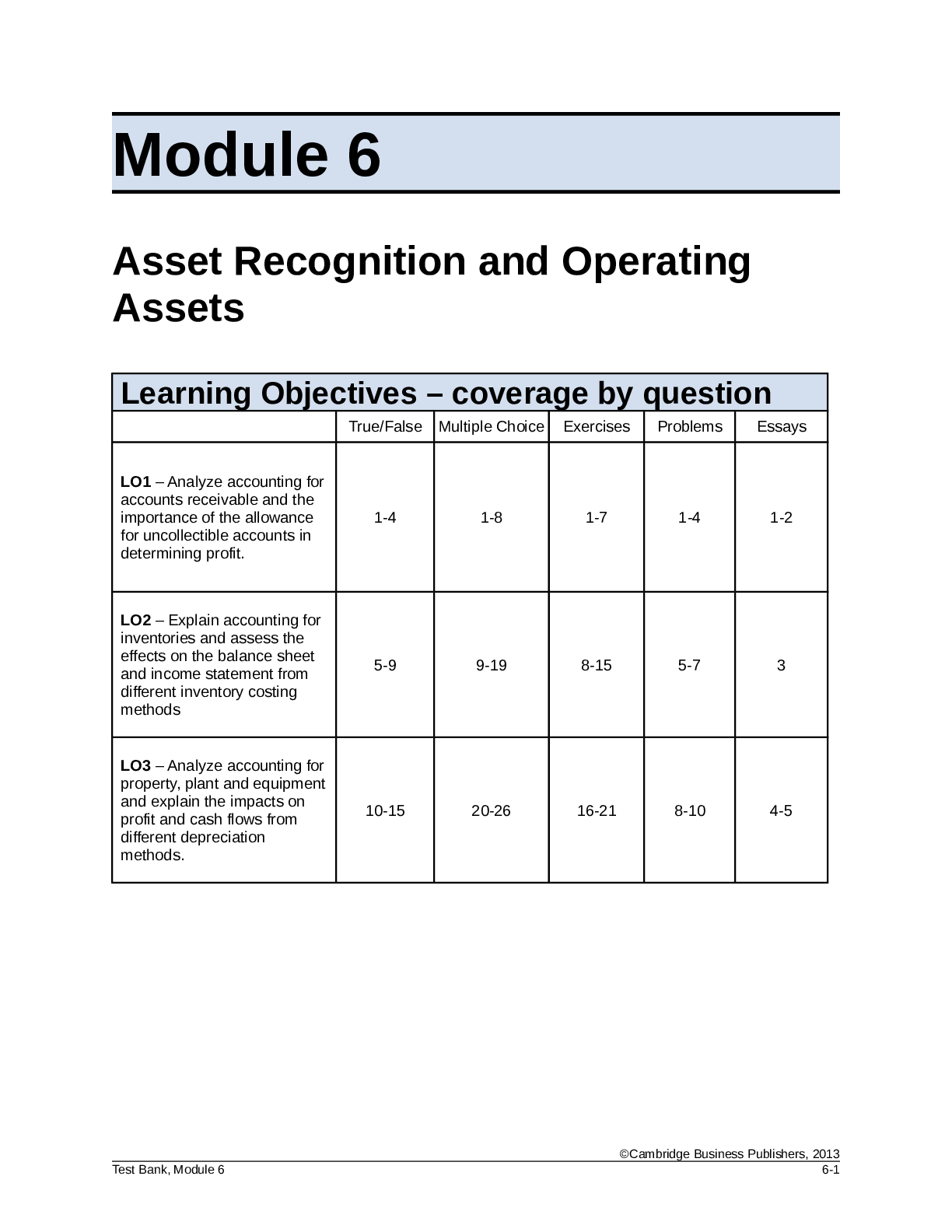
Learning Objectives – coverage by question
True/False Multiple Choice Exercises Problems Essays
LO1 – Analyze accounting for
accounts receivable and the
importance of the allowance
for uncollectible accounts in
det
...
Learning Objectives – coverage by question
True/False Multiple Choice Exercises Problems Essays
LO1 – Analyze accounting for
accounts receivable and the
importance of the allowance
for uncollectible accounts in
determining profit.
LO2 – Explain accounting for
inventories and assess the
effects on the balance sheet
and income statement from
different inventory costing
methods
LO3 – Analyze accounting for
property, plant and equipment
and explain the impacts on
profit and cash flows from
different depreciation
methods
Module 6: Asset Recognition and Operating Assets
True/False
Topic: Accounts Receivable
LO: 1
1. Accounts receivables (net) reported in the current asset section of a company’s balance sheet
represents the total amount owed by customers within the next year.
Answer: False
Rationale: A company makes two representations when reporting A/R in the balance sheet. The first
being that it expects to collect the amount reported on the balance sheet. The second is that it
expects to collect within the next year. The company may not expect to collect the total amount owed
by customers, thus, the statement is incorrect.
Topic: Collectibility of Accounts Receivable
LO: 1
2. In order to report accounts receivable, net, companies estimate the amount they do not expect to
collect from their credit customers.
Answer: True
Rationale: Companies must report the amount of accounts receivable that they expect to collect. To
do this, they estimate the amount they expect to not collect.
Topic: Income Shifting
LO: 1
3. Overestimating the allowance for uncollectible accounts receivable can shift income from the current
period into one or more future periods.
Answer: True
Rationale: By overestimating current accounts receivable provisions, current income decreases
because expenses are increased. However, due to the overestimation, future year provisions will
need to decrease to compensate, thus increasing future profitability. Income has been shifted to
future periods from the present.
Topic: Bad Debt Expense
LO: 1
4. The financial statement effects for uncollectible accounts occur when the company writes off the
account because that is when all the uncertainty is resolved.
Answer: False
Rationale: Under GAAP, costs relating to anticipated bad debts expense are matched with sales in
the period that the sales are recognized. Upon write-off, both the receivable and the allowance
account are reduced, leaving net receivables unchanged.
©Cambridge Business Publishers, 2013
6-2 Financial Statement Analysis & Valuation, 3rd EditionTopic: Manufacturing Costs in Inventory
LO: 2
5. The three components of manufacturing costs are direct materials, direct labor, and manufacturing
overhead.
Answer: True
Rationale: These three components make up the manufacturing cost for manufacturing companies.
Topic: Inventory Costing and the Balance Sheet
LO: 2
6. LIFO inventory costing yields more accurate reporting of the inventory balance on the balance sheet.
Answer: False
Rationale: LIFO assumes that the most recently purchased goods are sold, thus the cost of the oldest
items remain in the inventory balance. Hence, the balance sheet reports inventories at less current
costs.
Topic: LIFO and FIFO Disclosures
LO: 2
7. Companies using LIFO are required to disclose the amount at which inventory would have been
reported had it used FIFO. Similarly, companies using FIFO are required to disclose what their
inventory would have been if the company had used LIFO.
Answer: False
Rationale: Only the first sentence is true. The disclosure of the LIFO reserve is required for those
companies using LIFO inventory costing. This disclosure allows analysts to adjust the balance sheet
and income statement for LIFO effects when comparing LIFO and FIFO companies.
Topic: FIFO Inventory Costing and Profit
LO: 2
8. In general, in a period of falling prices, LIFO produces higher gross profits than FIFO.
Answer: True
Rationale: Gross profit is affected by the choice of inventory costing method. Specifically, in periods
of rising costs and prices, FIFO produces higher gross profits then LIFO because lower- cost
inventories (i.e., first inventories bought are first out) are matched against sales revenues at current
market prices. The converse holds true in periods of falling prices.
Topic: Inventory Turnover
LO: 2
9. Increasing inventory turnover rate will improve profitability.
Answer: False
Rationale: Profitability depends on both turnover and profit margin on the inventory. A company could
increase turnover by dropping prices to zero. Items would fly off the shelves, but that would mean no
[Show More]