Module6 MCQ
1. Aiello, Inc. had the following inventory in fiscal 2016. The company uses the FIFO method of accounting
for inventory.
Beginning Inventory, January 1, 2016: 130 units @ $15.00
Purchase 200 units @ $18.
...
Module6 MCQ
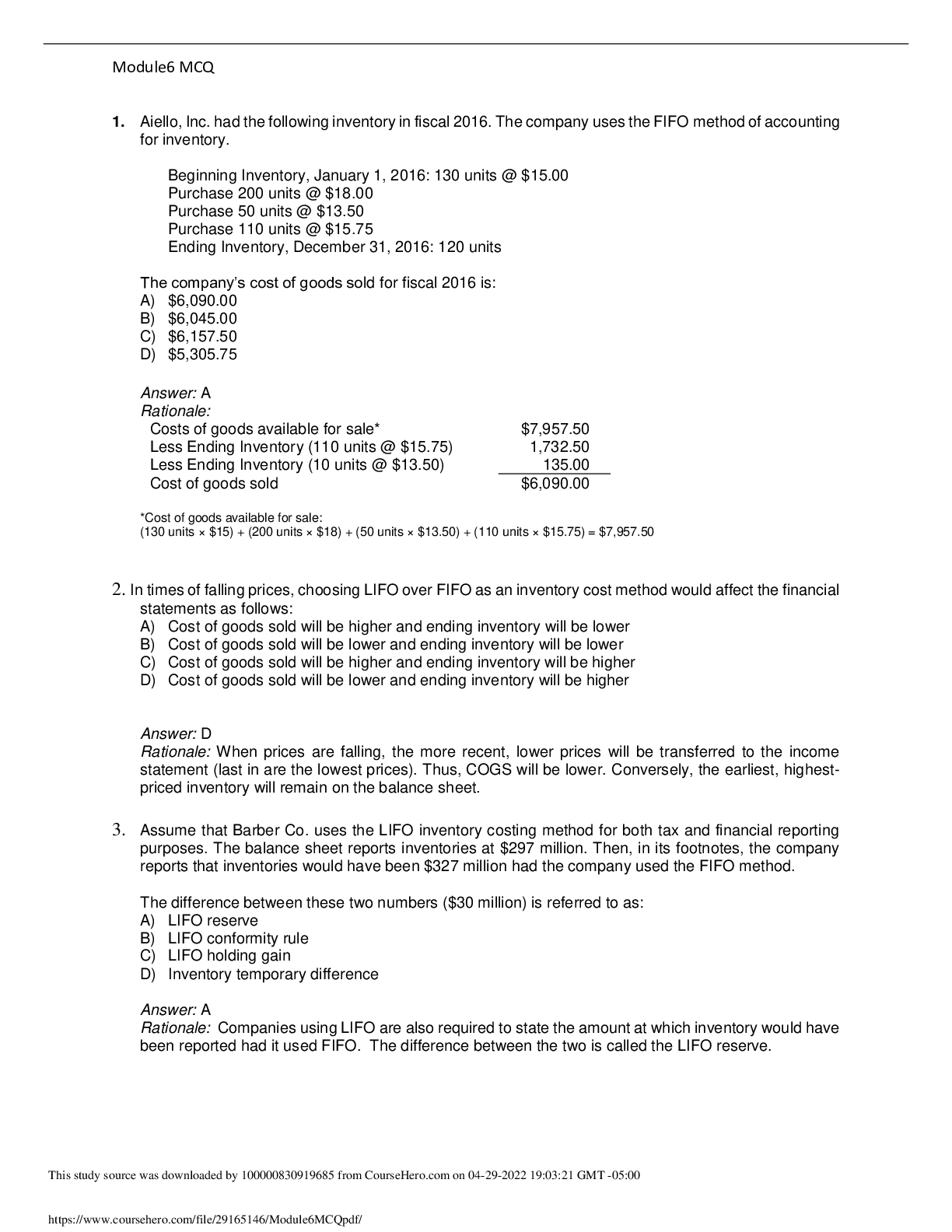
1. Aiello, Inc. had the following inventory in fiscal 2016. The company uses the FIFO method of accounting
for inventory.
Beginning Inventory, January 1, 2016: 130 units @ $15.00
Purchase 200 units @ $18.00
Purchase 50 units @ $13.50
Purchase 110 units @ $15.75
Ending Inventory, December 31, 2016: 120 units
The company’s cost of goods sold for fiscal 2016 is:
A) $6,090.00
B) $6,045.00
C) $6,157.50
D) $5,305.75
2. In times of falling prices, choosing LIFO over FIFO as an inventory cost method would affect the financial
statements as follows:
A) Cost of goods sold will be higher and ending inventory will be lower
B) Cost of goods sold will be lower and ending inventory will be lower
C) Cost of goods sold will be higher and ending inventory will be higher
D) Cost of goods sold will be lower and ending inventory will be higher
3. Assume that Barber Co. uses the LIFO inventory costing method for both tax and financial reporting
purposes. The balance sheet reports inventories at $297 million. Then, in its footnotes, the company
reports that inventories would have been $327 million had the company used the FIFO method.
The difference between these two numbers ($30 million) is referred to as:
A) LIFO reserve
B) LIFO conformity rule
C) LIFO holding gain
D) Inventory temporary difference
Module6 MCQ
4. The January 28, 2017 (fiscal year 2016) financial statements of Caleres, Inc. reported the following
information (in thousands).
2016 2015
Cost of sales $1,517,397 $1,529,527
Inventories, net 585,764 546,745
LIFO reserve 4,345 4,094
If Caleres had used the FIFO method of inventory costing, 2016 inventory would have been:
A) $506,852 million
B) $590,109 million
C) $504,752 million
D) $581,419 million
5. The January 28, 2017 (fiscal year 2016) financial statements of Caleres, Inc. reported the following
information (in thousands).
2016 2015
Cost of sales $1,517,397 $1,529,527
Inventories, net 585,764 546,745
LIFO reserve 4,345 4,094
If Caleres had used the FIFO method of inventory costing, 2016 COGS would have been:
A) $1,517,648 thousand
B) $1,551,301 thousand
C) $1,553,198 thousand
D) $1,517,146 thousand
6. The 2016 financial statement of Willamette Valley Vineyards reported Net revenues of $19,425,412 and
Cost of goods sold of $7,204,884. Note 3 to the financial statements reported that Inventories consisted
of:
2016 2015
Winemaking and packaging materials $ 817,836 $ 690,292
Work-in-process 6,634,014 6,058,701
Finished goods 4,518,806 3,883,469
Total inventories $11,970,656 $10,632,462
The inventory turnover for 2016 was:
Module6 MCQ
A) 0.57
B) 0.64
C) 0.59
D) 1.71
7. The January 28, 2017 (fiscal year 2016) financial statements of Caleres, Inc. reported the following
information (in thousands):
2016 2015
Cost of sales $1,517,397 $1,529,527
Inventories, net 585,764 546,745
LIFO reserve 4,345 4,094
The 2016 average days inventory outstanding is:
A) 136.2 days
B) 133.9 days
C) 121.5 days
D) 49.6 days
8. Hauser Corporation has the following metrics for 2016.
Amount in days 2016
Days sales outstanding 36.5
Days payables outstanding 24.8
Days inventory outstanding 59.1
The cash conversion cycle for 2016 is:
A) 2.2 days
B) 61.3 days
C) 47.4 days
D) 70.8 days
Module6 MCQ
9. An asset is impaired when the asset’s carrying value is:
A) Greater than the sum of discounted expected cash flows.
B) Less than the sum of discounted expected cash flows.
C) Less than the sum of undiscounted expected cash flows.
D) Greater than the sum of undiscounted expected cash flows.
10. Dow Chemical Corporation plans to build a laboratory dedicated to a special project. The company will
not use the laboratory after the project is finished. Under GAAP, this laboratory should be:
A) Capitalized and depreciated.
B) Expensed in the current year.
C) Depreciated and expensed.
D) Capitalized only.
11. InterTech Corporation recorded pretax restructuring charges of $1,033.5 million in 2017. The charges
consisted of asset write-downs of $681 million, costs associated with exit or disposal activities of $99
million, and employee severance costs of $253.5 million. The company paid $108 million cash to settle
these restructuring charges during the year (2017).
At year end, the restructuring accrual associated with these charges was:
A) $1,033.5 million
B) $ 326.0 million
C) $ 253.5 million
D) $ 244.5 million
12. The 2016 financial statements for BNSF Railway report the following information:
Year ended December 31,
(In millions) 2016 2015
Revenues $19,829 $21,967
Property and equipment, net 61,250 59,510
Total assets 84,122 81,703
The 2016 property, plant and equipment turnover is:
A) 0.39
B) 2.38
C) 0.33
D) 0.70
13. The 2016 financial statements for Leggett & Platt, Inc., report the following information:
Year ended December 31,
(In millions) 2016 2015
Depreciation expense $86.8 $83.5
Property and equipment, net 565.5 540.8
Land 37.7 40.0
Accumulated depreciation 1,165.4 1,146.5
Which of the following estimates the property and equipment’s percent-used-up at December 31, 2016?
A) 68.8%
B) 45.4%
C) 16.9%
D) 42.3%
14. The 2016 financial statements of Willamette Valley Vineyards, Inc. include the following footnote:
Note 4. Property and Equipment December 31, 2016 December 31, 2015
Construction in progress $ 449,409 $ 482,284
Land 8,063,716 5,089,472
Winery buildings and hospitality center 14,458,309 13,756,320
Equipment 10,122,593 9,055,987
33,094,027 28,384,063
Less accumulated depreciation (12,897,082) (11,654,901)
$20,196,945 16,729,162
Depreciation expense $ 1,254,455 $ 1,194,191
The average useful life of Willamette’s depreciable assets at the end of fiscal 2016 is:
A) 14.2 years
B) 19.6 years
C) 2.4 years
D) 21.7 years
[Show More]