PN HESI V4 EXIT EXAM Latest
Solutions
2022 HESI PN V4 EXIT EXAM 110
QUESTION AND ANSWER(S)
1.
Assessment by the home health nurse of an older client who lives alone indicates that
clienthas chronic constipations. D
...
PN HESI V4 EXIT EXAM Latest
Solutions
2022 HESI PN V4 EXIT EXAM 110
QUESTION AND ANSWER(S)
1.
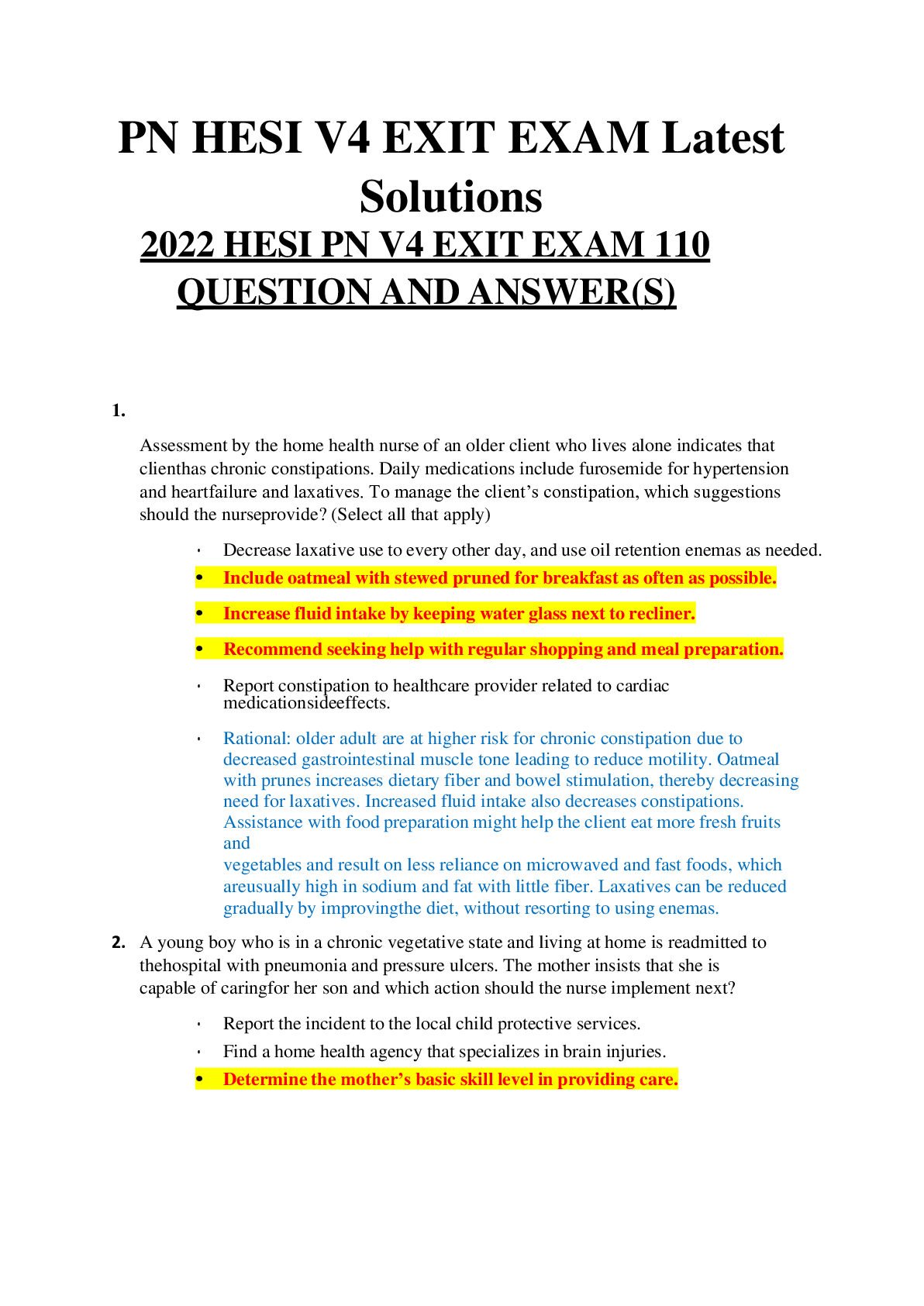
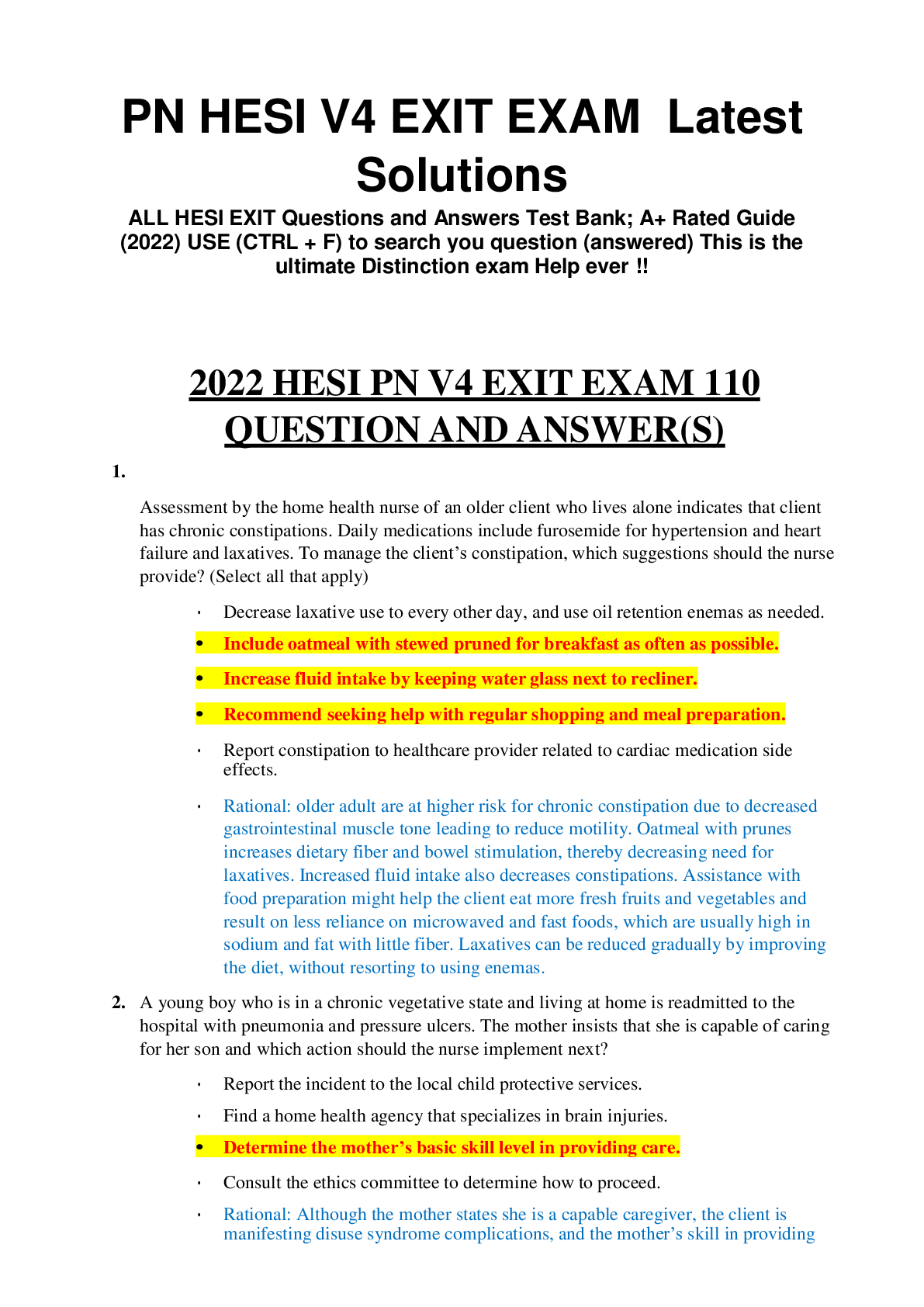
Assessment by the home health nurse of an older client who lives alone indicates that
clienthas chronic constipations. Daily medications include furosemide for hypertension
and heartfailure and laxatives. To manage the client’s constipation, which suggestions
should the nurseprovide? (Select all that apply)
• Decrease laxative use to every other day, and use oil retention enemas as needed.
• Include oatmeal with stewed pruned for breakfast as often as possible.
• Increase fluid intake by keeping water glass next to recliner.
• Recommend seeking help with regular shopping and meal preparation.
• Report constipation to healthcare provider related to cardiac
medicationsideeffects.
• Rational: older adult are at higher risk for chronic constipation due to
decreased gastrointestinal muscle tone leading to reduce motility. Oatmeal
with prunes increases dietary fiber and bowel stimulation, thereby decreasing
need for laxatives. Increased fluid intake also decreases constipations.
Assistance with food preparation might help the client eat more fresh fruits
and
vegetables and result on less reliance on microwaved and fast foods, which
areusually high in sodium and fat with little fiber. Laxatives can be reduced
gradually by improvingthe diet, without resorting to using enemas.
2. A young boy who is in a chronic vegetative state and living at home is readmitted to
thehospital with pneumonia and pressure ulcers. The mother insists that she is
capable of caringfor her son and which action should the nurse implement next?
• Report the incident to the local child protective services.
• Find a home health agency that specializes in brain injuries.
• Determine the mother’s basic skill level in providing care.
basic care should be determined. Further assessment is
neededbeforeimplementing other nursing actions.
2. After the risk and benefits of having a cardiac catheterization are reviewed by the
healthcareprovider, an older adult with unstable angina is scheduled for the procedure.
When the nursepresents the consent form for signature, the client asks how the wires
willkeep a heart heating during the procedure. What action should the nurse take?
• Explain the procedure again in detail and clarify any misconceptions.
• Notify the healthcare provider of the client’s lack of understanding.
• Call the client’s next of kin and have them provide verbal consent.
• Postpone the procedure until the client understands the risk and benefits.
• Rational: the nurse is only witnessing the signature, and is not responsible for
theclient’s understanding of the procedure. The healthcare provider needs to
clarify any questions and misconceptions. Explaining the procedure again is
thehealthcare provider’s legal responsibility. The other options are not
indicated.
3. In assessing a client at 34-weeks’ gestation, the nurse notes that she has a slightly
elevatedtotal T4 with a slightly enlarged thyroid, a hematocrit of 28%, a heart rate of
92beats per minute, and a systolic murmur. Which finding requires follow-up?
• Elevated thyroid hormone level.
• Hematocrit of 28%.
• Heart rate of 92 beats per minute.
• Systolic murmur.
• Rational: although physiologic anemia is expected in pregnancy, a
hematocritof28% is below pregnant norms and could signify irondeficiency anemia. Other options are normal finding pregnancy
4. A client with osteoporosis related to long-term corticosteroid therapy receives a
prescriptionfor calcium carbonate. Which client’s serum laboratory values
requiresintervention by the nurse?
• Total calcium 9 mg/dl (2.25 mmol/L SI)
• Creatinine 4 mg/dl (354 micromol/L SI)
• Phosphate 4 mg/dl (1.293 mmol/L SI)
• Fasting glucose 95 mg/dl (5.3 mmol/L SI)
5. A clinical trial is recommended for a client with metastatic breast cancer, but she refuses
toparticipate and tells her family that she does not wish to have further treatments. The
client’s
son and daughter ask the nurse to try and convince their mother to reconsider this
decision.How should the nurse respond?
• Ask the client with her children present if she fully understands the
decisionshehas made.
• Discuss success of clinical trials and ask the client to consider participating
forone month.
• Explain to the family that they must accept their mother’s decision.
• Explore the client’s decision to refuse treatment and offer support
• Rationale: as long as the client is alert, oriented and aware of the disease
prognosis, the healthcare team must abide by her decisions. Exploring the
decision with the client and offering support provides a therapeutic
interactionandallows the client to express her fears and concerns about her
quality of life.
Other options are essentially arguing with the client’s decisions regarding
herend of lifetreatment or diminish the opportunity for the client to discuss
her feelings
3. An adult client with severe depression was admitted to the psychiatric unit yesterday
evening. Although the client ran one year ago, his spouse states that the client no
longerruns, bur sits and watches television most of the day. Which is most important
for the nurseto include in this client’s plan of care for today?
• Assist client in identifying goals for the day.
• Encourage client to participate for one hour in a team sport.
• Schedule client for a group that focuses on self-esteem.
• Help client to develop a list of daily affirmations.
• Rationale: clients with severe depression have low energy and benefit from
structured activities because concentration is decreased. The client
participateincare by identifying goals for the day is the most important
intervention for the client’s first day at the unit. Other options can be
implemented over time, as thedepression decreases.
4. An adult who is 5 feet 5 inches (165.1 cm) tall and weighs 90 lb. (40.8 Kg) is admitted
with adiagnosis of chronic anorexia. The client receives a regular diet for 2 days, and the
client’s medical records indicates that 100% of the diet provided has been consumed.
However theclient’s weight on the third day morning after admission is 89 lb. (40.4 Kg).
What action should the nurse implement?
• Examine the client’s room for hidden food.
• Assign staff to monitor what the client eats.
• Ask the client if the food provided is being eaten or discarded.
• Provide the client with a high calorie diet.
• Rationale: clients with an eating disorder have an unhealthy obsession with
food.The client’s continued weight loss, despites indication that the client
hasconsumed 100% of the diet, should raise questions about the client’s
intake ofthefood provided, so the client should be observed during meals to
prevent
hiding orthrowing away food. Other options may be accurate but
ineffectiveand unnecessary.
2. A client exposed to tuberculosis is scheduled to begin prophylactic treatment with
isoniazid.Which information is most important for the nurse to note before
administeringthe initial dose?
• Conversion of the client’s PPD test from negative to positive.
• Length of time of the exposure to tuberculosis.
• Current diagnosis of hepatitis B.
• History of intravenous drug abuse.
• Rationale: prophylactic treatment of tuberculosis with isoniazid is
contraindicatedfor persons with liver disease because it may cause liver
damage. The nurse should withhold the prescribed dose and contact the
healthcare provider. Other options do not provide data indicating the need
toquestion or withhold the prescribed treatment.
3. The nurse walks into a client’s room and notices bright red blood on the sheets and
onthefloor by the IV pole. Which action should the nurse take first?
• Clean up the spilled blood to reduce infection transmission.
• Notify the healthcare provider that the client appears to be bleeding.
• Apply direct pressure to the client’s IV site.
• Identify the source and amount of bleeding.
• Rationale: the nursed should first assess the client to determine the
actionthatshould be taken. Patient safety is the priority; other options are
not priority.
4. During a routine clinic visit, an older female adult tells the nurse that she is concerned
that the flu season is coming soon, but is reluctant to obtain the vaccination. What
actionshouldthe nurse take first?
• Determine when the client last had an influenza vaccination.
• Discuss the concerns expressed by the client about the vaccination.
• Ask about any recent exposure to persons with the flu or other viruses.
• Review the informed consent form for the vaccination with the client.
• Rationale: the nurse should first address the concerns identified by the
client,before taking other actions, such as obtaining information about past
vaccinations,exposure to the flu, or reviewing the informed consent form.
2. A client is admitted with acute pancreatitis. The client admits to drinking a pint of
bourbondaily. The nurse medicates the client for pain and monitors vital signs q2
hours.Which finding should the nurse report immediately to the healthcare provider?
• Confusion and tremors
• Yellowing and itching of skin.
• Abdominal pain and vomiting
• Anorexia and abdominal distention
• Rationale: daily alcohol is the likely etiology for the client’s pancreatitis.
Abruptcessation of alcohol can result in delirium tremens (DT) causing
confusion and tremors, which can precipitate cardiovascular complications
and should be reported immediately to avoid life-threatening complications.
The other options are expected findings in those with liver dysfunction or
pancreatitis,
but do not require immediate action.
3. The nurse is teaching a mother of a newborn with a cleft lip how to bottle feed her
baby using medela haberman feeder, which has a valve to control the release of milk
and a slitnipple opening. The nurse discusses placing the nipple’s elongated tip in the
back of the oralcavity. What instructions should the nurse provide the mother about
feedings?
• Squeeze the nipple base to introduce milk into the mouth
• Position the baby in the left lateral position after feeding
• Alternate milk with water during feeding
• Hold the newborn in an upright position
• Rationale: the mother should be instructed to hold the infant during feedings
ina sitting or upright position to prevent aspiration. Impaired sucking is
compensatedby the use of special feeding appliances and nipples such as the
haberman feeder that prevents aspiration by adjusting the flow of mild
according to the effort of theneonate. Squeezing the nipple base may
introduce
a volume that is greater than the neonate can coordinate swallowing. The
preferred positon of an infant after feeding is on the right side to facilitate
stomach emptying. Sucking difficulty impedes the neonate’s intake of
adequate nutrient needed for weight gain and water should be provided after
the feedingto cleanse the oral cavity and not fill up the neonate’s stomach.
2. Following and gunshot wound, an adult client a hemoglobin level of 4 grams/dl (40
mmol/LSI). The nurse prepares to administer a unit of blood for an emergency
transfusion. The clienthas AB negative blood type and the blood bank sends a unit of
type A Rh negative, reportingthat there is not type AB negative blood currently available.
Which intervention should the nurse implement?
• Transfuse Type A negative blood until type AB negative is available.
• Recheck the client’s hemoglobin, blood type and Rh factor.
• Administer normal saline solution until type AB negative is available
• Obtain additional consent for administration of type A negative blood
• Rationale: those who have type AB blood are considered universal
recipients using A or B blood types that is the same Rh factor. The client’s
hemoglobin iscritically low and the client should receive a unit of blood
that is type A, whichmust be Rh negative blood. Other options are not
indicated in this situation.
3. A young adult female college student visits the health clinic in early winter to obtain
birth control pills. The clinic nurse asks if the student has received an influenza
vaccination. Thestudent stated she did not receive vaccination because she has asthma.
How should the nurserespond?
• Offer to provide the influenza vaccination to the student while she is at
theclinic
• Encourage the student to obtain a vaccination prior to the next influenza season.
• Confirm that a history of asthma can increase risks associated with the vaccine.
• Advise the student that the nasal spray vaccine reduces side effects
forpeoplewith asthma.
• Rationale: person with asthma are at increased risk related to influenza and
shouldreceive the influenza vaccination prior to or during influenza season.
Waiting untilthe start of the next season places the student at risk for the
current season. The vaccination does not increase risk for persons with asthma
but the nasal spray may result in increased wheezing after receiving that form
ofthe vaccination.
4. A client with eczema is experiencing severe pruritus. Which PRN prescriptions should
thenurse administer? (Select all that apply)
• Topical corticosteroid.
• Topical scabicide.
• Topical alcohol rub.
• Transdermal analgesic.
• Oral antihistamine
• Rationale: anti-inflammatory actions of topical corticosteroids and oral
antihistamines provide relief from severe pruritus (itching). Other options are
notindicated.
2. The nurse is using a straight urinary catheter kit to collect a sterile urine specimen from a
female client. After positioning am prepping this client, rank the actions in the sequence
theyshould be implemented. (Place to first action on the top on the last action on the
bottom.)
• Correct : ODCP
• 1. Open the sterile catheter kit close to the client’s perineum.
• 2. Don sterile gloves and prepare to sterile field
• 3. Cleanse the urinary meatus using the solution, swabs, and
forcepsprovided
• 4. Place distal end of the catheter in sterile specimen cup and insert
catheterinto meatus
• Rationale: First the kit should be open near the clients to minimize the risk of
contamination during the collection of the sterile specimen. Once the kit is
opened, sterile gloves should be donned to prepare the sterile field. Then the
clients’ meatus should be cleansed, and the catheter inserted while to distal endofthe
catheter drains urine into the sterile specimen cup or receptacle.
3. An adult male was diagnosed with stage IV lung cancer three weeks ago. His wife
approaches the nurse and asks how she will know that her husband's death is imminent
because their two adult children want to be there when he dies. What is the best response
bythe nurse?
• Explain that the client will start to lose consciousness and his body
systemwill slow down
• As soon as the clinician suspects a problem
• Only when a client presents with an unexplained injury
• As a routine part of each healthcare encounter
• Once the clinician confirms a history of abuse
• Rationale: Universal screening for IPV is a vital means to identify victims of
abuse in relationship. The suspicious of different clinicians vary greatly, so
screening would not be implemented consistently. The client should be
screenedregardless of the presence of injury. Although history of abuse is
difficult to confirm, screening should occur regardless, and this incident may
know may beinitial case of abuse.
5. A child newly diagnosed with sickle cell anemia (SCA) is being discharged from the
hospital.Which information is most important for the nurse to provide the parents prior to
discharge?
• Instructions about how much fluid the child should drink daily
• information about non-pharmaceutical pain reliever measures
• Referral for social services for the child and family
• Signs of addiction to opioid and medications
• Rationale: It is essential that the child and family understands the importance
of adequate hydration in preventing the stasis-thrombosis-ischemia cycle of a
crisisthat has a specific plan for hydration is developed so that a crisis can be
delayed.Other choices listed are not the most important topics to include in
the dischargeteaching.
6. What action should the school nurse implement to provide secondary prevention to a
school-age children?
• Collaborate with a science teacher to prepare a health lesson
• Prepare a presentation on how to prevent the spread of lice
• Initiate a hearing and vision screening program for first-graders
• Observe a person with type 1 diabetes self-administer a dose of insulin
• Rationale: Community care occurs at primary, secondary, and tertiary levels of
prevention. Primary prevention involves interventions to reduce the incidence of
disease. Secondary prevention includes screening programs to detect disease.
Tertiary prevention provides treatment directed toward clinically apparent
disease.Secondary prevention focuses on screaming children for a specific
disease processes such as hearing and vision screening. The other options are
not examples of secondary prevention.
2. While assisting a client who recently had a hip replacement into a bed pan, the
nursenoticesthat there is a small amount of bloody drainage on the surgical
dressing, the
client’s skin is warm to the touch, and there is a strong odor from the urine. Which
actionshould the nurse take?
• Obtain a urine sample from the bed pan
• Remove dressing and assess surgical site
• Insert an indwelling urinary catheter
• Measure the client’s oral temperature
• Rationale: The strong odor from the urine and skin that is warm to the touch
mayindicate that the client has a urinary tract infection. Assessing the client’s
temperature provides objective information regarding infection that can be
reported to the healthcare provider. Urine should be obtained via a clean
catch,
not the bed pan where it has been contaminated. The drainage on the dressing
is normal and does not require direct conservation at this time. An indwelling
catheter should be avoided if possible because it increases the risk of
infection.
3. While making rounds, the charge nurse notices that a young adult client with asthma
whowas admitted yesterday is sitting on the side of the bed and leaning over the bedside- table. The client is currently receiving at 2 litters/minute via nasal cannula. The
client is wheezingand is using pursed-lip breathing. Which intervention should the
nurse implement?
• Assist the client to lie back in bed
• Call for an Ambu resuscitating bag
• Increase oxygen to 6 litters/minute
• Administer a nebulizer Treatment
• Rationale: The client needs an immediate medicated nebulizer treatment.
Sitting in an upright position with head and arms resting on the over-bed
tableis an idealposition to promote breathing because it promotes lung
expansion. Other actions me be accurate but not yet indicated.
4. A client with emphysema is being discharged from the hospital. The nurse enters the
client’s room to complete discharge teaching. The client reports feeling a little short of
breath and isanxious about going home. What is the best course of action?
• Postpone discharge instructions at this time and offer to contact the
clientbyphone in a few days
• Invite the client to return to the unit for discharge teaching in a few
days,whenthere is less anxiety
• Provide only necessary information in short, simple explanations
withwritten instructions to take home
• Give detailed instructions speaking slowly and clearly while looking directly
atthe client when speaking
• Rationale: Simple, short explanations should be provided. Information is not
retained when the recipient is anxious, and too much information can
increaseworry. Ethically, discharge instructions may not be postponed.
7. An older adult male who had an abdominal cholecystectomy has become increasingly
confused and disoriented over the past 24 hours. He is found wandering into another
client’sroom and is return to his room by the unlicensed assistive personnel (UAP). What
actions should the nurse take? (Select all that apply).
• Apply soft upper limb restrains and raise all four bed rails
• Report mental status change to the healthcare provider
• Assess the client’s breath sounds and oxygen saturation
• Assign the UAP to re-assess the client’s risk for falls
• Review the client’s most recent serum electrolyte values
• Rationale: The healthcare provider should be informed of changes in the
client’scondition (B) because this behavior may indicate a postoperative
complication. Diminished oxygenation (C) and electrolyte imbalance (E) may
cause increasedconfusion in the older adult. Raising all four bed rails (A) may
lead to further injury if the client climbs over the rails and falls and restrains
should not be applied until other measures such as re-orientation are
implemented. The nurse should assess the client’s increased risk for falls,
rather than assigning this to theUAP (D).
8. A client is admitted to a medical unit with the diagnosis of gastritis and chronic heavy
alcohol abuse. What should the nurse administered to prevent the development of
Wernicke'ssyndrome?
• Lorazepam (Ativan)
• Famotidine (Pepcid)
• Thiamine (Vitamin B1)
• Atenolol (Tenormin)
• Rationale: Thiamine replacement is critical in preventing the onset of
Wernickesencephalopathy, an acute triad of confusion, ataxia, and abnormal
extraocular movements, such as nystagmus related to excessive alcohol abuse.
Other medications are not indicated.
9. When conducting diet teaching for a client who was diagnosed with nutritional anemia in
pregnancy, which foods should the nurse encourage the client to eat? (Select all that
apply)
• Seeds, spices, lettuce
• Consomme, celery, carrot
• Oranges, orange juice, bananas
• Fortified whole wheat cereals, whole-grain pasta, brown rice
• Spinach, kale, dried raisins and apricots
• Rationale: Nutritional anemia in pregnancy should be supplemented with
additional iron in the diet. Foods that are high in iron content are often protein
based, whole grains (D), green leafy vegetables and dried fruits (E). (A, B, and
C)are not iron rich sources
10. A client with type 2 diabetes mellitus is admitted for antibiotic treatment for a leg ulcer.
Tomonitor the client for the onset of hyperosmolar hyperglycemic nonketotic syndrome
(HHNS), what actions should the nurse take? (Select all that apply)
• Check urine for ketones
• Measure blood glucose
• Monitor vital signs
• Assessed level of consciousness
• Obtain culture of wound
• Rationale: Blood glucose greater than 600 mg/dl (33.3 mmol/L SI), vital sign
changes in mental awareness are indicators of possible HHNS. Urine ketones
aremonitored in diabetic ketoacidosis. Wound culture is performed prior to
treating the wound infection but is not useful in monitoring for HHNS.
11. An infant is receiving penicillin G procaine 220,000 units IM. The drug is supplied as
600,000 units/ml. How many ml should the nurse administer? (Enter numeric value only.
Ifrounding is required, round to the nearest tenth)
• 0.4
• Rationale: Calsulate using the formula, desired dose (220,000 units) over dose
on hand (600,000 units) x the volume of the available dose (1 ml). 220,000 /
600,000x 1 ml = 0.36 = 0.4 ml
12. After receiving report, the nurse can most safely plan to assess which client last? The
clientwith…
• A rectal tube draining clear, pale red liquid drainage
• A distended abdomen and no drainage from the nasogastric tube
• No postoperative drainage in the Jackson-Pratt drain with the
bulbcompressed
• Dark red drainage on a postoperative dressing, but no drainage in the Hemovac®.
• Rationale: The most stable client is the one with a functioning drainage
deviceand no drainage. This client can most safely be assesses last. Other
clients are either actively bleeding, have an obstruction in the nasogastric
tube which mayresult in vomiting, or may be bleeding and / or may have a
malfunction in the Hemovac® drain.
13. The nurse instructs an unlicensed assistive personnel (UAP) to turn an immobilized elderly
client with an indwelling urinary catheter every two hours. What additional action should
thenurse instruct the UAP to take each time the client is turned?
• Empty the urinary drainage bag
• Feed the client a snack
• Offer the client oral fluids
• Assess the breath sounds
• Rationale: Increasing oral fluid intake reduces the risk of problems associated
with immobility, so the UAP should be instructed to offer the client oral fluids
every two hours, or whenever turning he client. It is not necessary to empty the
urinary bag or feed the client every two hours. Assessment is a nursing
function,and UAPs do not have the expertise to perform assessment of breath
sounds.
14. The nurse is preparing a client who had a below-the-knee (BKA) amputation for discharge
tohome. Which recommendations should the nurse provide this client? (Select all that
apply)
• Inspect skin for redness
• Use a residual limb shrinker
• Apply alcohol to the stump after bathing
• Wash the stump with soap and water
• Avoid range of motion exercises
• Rationale: Several actions are recommended for home care following an
amputation. The skin should be inspected regularly for abnormalities such as
redness, blistering, or abrasions. A residual limb shrinker should be applied over
the stump to protect it and reduce edema. The stump should be washed daily
witha mild soap and carefully rinse and dried. The client should avoid cleansing
with
alcohol because it can dry and crack the skin. Range of motion should be
donedaily.
15. When assessing the surgical dressing of a client who had abdominal surgery the previous day,
the nurse observes that a small amount of drainage is present on the dressing and the wound’s
Hemovac suction device is empty with the plug open. How should the nurse respond?
• Replace the dressing and remove the drainage device
• Reposition the drainage device and keep the plug open
• Notify the healthcare provider that the drain is not working
• Recompress the wound suction device and secure to plug
• Rationale: The plug of a wound suction device, such as a Hemovac, should be
closed after compressing the device to apply gentle suction in a closed
surgicalwound to facilitate the evacuation of subcutaneous fluids into the
device. Compressing the device and securing the plug should restore function
of the closed wound device. A small amount of drainage should be marked
on the dressing, but replacing the dressing is not necessary and the nurse
should not remove the device. Other options are not indicated.
16. A mother brings her 4-month-old son to the clinic with a quarter taped over his
umbilicus,and tells the nurse the quarter is supposed to fix her child’s hernia. Which
explanations should the nurse provide?
• This hernia is a normal variation that resolves without treatment.
• Restrictive clothing will be adequate to help the hernia go away.
• An abdominal binder can be worn daily to reduce the protrusion.
• The quarter should be secured with an elastic bandage wrap.
• Rational: an umbilical hernia is a normal variation in infants that occurs due to
anincomplete fusion of the abdominal musculature through the umbilical ring
that usually resolves spontaneously as the child learns to walk. Other choices
are ineffective and unnecessary.
17. A client who is admitted to the intensive care unit with syndrome of inappropriate
antidiuretic hormone (SIADH) has developed osmotic demyelination. Which
interventionshould the nurse implement first?
• Patch one eye.
• Reorient often.
• Range of motion.
• Evaluate swallow
• Rational: Osmotic demyelination, also known as central pontine myelinolysis, is
nerve damage caused by the destruction of the myelin sheath covering nerve
cells in the brainstem. The most common cause is a rapid, drastic change in
sodium levels when a client is being treated for hyponatremia, a common
occurrence in SIADH. Difficulty swallowing due to brainstem nerve damage
should be care, butdetermining the client’s risk for aspiration is most important.
18. A client with possible acute kidney injury (AKI) is admitted to the hospital and mannitol
isprescribed as a fluid challenge. Prior to carrying out this prescription, what intervention
should the nurse implement?
• Collect a clean catch urine specimen.
• Instruct the client to empty the bladder.
• Obtain vital signs and breath sounds.
• No specific nursing action is required
• Rational: the client’s baseline cardiovascular status should be determined
beforeconducting the fluid challenge. If the client manifests changes in the
vital signs and breath sounds associated with pulmonary edema, the
administration of the fluid challenge should be terminate. Other options
would not assure a safe administration of the medication.
19. A male client with COPD smokes two packs of cigarettes per day and is admitted to the
hospital for a respiratory infection. He complains that he has trouble controlling
respiratorydistress at home when using his rescue inhaler. Which comment from the
client indicates tothe nurse that he is not using his inhaler properly?
• “I have a hard time inhaling and holding my breath after I squeeze the inhaler,
butI do my best”
• “ I never use the inhaler unless I am feeling really short of breath”
• I always shake the inhaler several times before I start”
• “After I squeeze the inhaler and swallow, I always feel a slight wave
ofnausea, bit it goes away”
20. A nurse is planning to teach infant care and preventive measures for sudden infant death
syndrome (SIDS) to a group of new parents. What information is most important for
thenurse to include?
• Ensure that the infant’s crib mattress is firm
21. A 6 -years-old who has asthma is demonstrating a prolonged expiratory phase and
wheezing,and has 35% personal best peak expiratory flow rate (PEFR). Based on these
finding, which action should the nurse implement first?
• Administer a prescribed bronchodilator.
• Report finding to the healthcare provider.
• Encourage the child to cough and deep breath
• Determine what trigger precipitated this attack.
• Rationale: If the PEFR is below 50% in as asthmatic child, there is
severenarrowing of the airway, and a bronchodilator should be
administered immediately. Be should be implemented after A. C will not
alleviate thesymptoms and D is not a priority.
22. A client is receiving lactulose (Portalac) for signs of hepatic encephalopathy. To evaluate the
client’s therapeutic response to this medication, which assessment should the nurse obtain?
• Level of consciousness
• Percussion of abdomen
• Serum electrolytes
• Blood glucose.
• Rationale: Colonic bacteria digest lactulose to create a drug-induces acidic and
hyperosmotic environment that draws water and blood ammonia into the colon
and coverts ammonia to ammonium, which is trapped in the intestines and
cannotbe reabsorbed into the systemic circulation. This therapeutic action of
lactulose isto reduce serum ammonia levels, which improves the client’s level of
consciousness and metal status.
23. When administering an immunization in an adult client, the nurse palpates and administer
theinjection one inch below the acromion process into the center of the muscle mass. The
nurse should document that the vaccine was administered at what site?
• Rectus femenis
• Ventrogluteous
• Vastuslateralis
• Deltoid
• Rationale: The acromion process is a parameter identified for the deltoid site.
24. A primigravida a 40-weeks gestation with preeclampsia is admitted after having a seizure
inthe hot tub at a midwife’s birthing center. Based on documentation in the medical
record, which action should the nurse implement? (Click on each chart tab for additional
information. Please be sure to scroll to the bottom right corner of each tab to view all
information contained in the client’s medical record.)
• Continue to monitor the client’s blood pressure hourly
25.
• Since treatment is completed, assign the nurse to the route RN responsibilities
• Ask to meet with impaired nurse’s therapist before allowing her back on the unit.
• Allow the impaired nurse to return to work and monitor
medicationadministration
• Meet with staff to assess their feelings about the impaired nurse’s return to
theunit.
• Rationale: provides essential monitoring and helps ensure nurse compliance
andpromote client safety.
26. In making client care assignment, which client is best to assign to the practical
nurse(PN) working on the unit with the nurse?
• An immobile client receiving low molecular weight heparin q12 h.
• A client who is receiving a continuous infusion of heparin and gets out of
bedBID
• A client who is being titrated off heparin infusion and started on PO
warfarin(Coumadin)
• An ambulatory client receiving warfarin (Coumadin) with INR of 5 second.
• Rationale: A describe the most stable client. The other ones are at high risk
forbleeding problems and require the assessment skills.
27. A client who is admitted to the intensive care unit with a right chest tube attached to a
THORA-SEAL chest drainage unit becomes increasingly anxious and complain of
difficulty breathing. The nurse determine the client is tachypneic with absent breath sounds
in the client’s right lungs fields. Which additional finding indicates that the client has
developed atension pneumothorax?
• Continuous bubbling in the water seal chamber
• Decrease bright red blood drainage
• Tachypnea and difficulty breathing
• Tracheal deviation toward the left lung.
A female nurse who took drugs from the unit for personal use was temporarily released
fromduty. After completion of mandatory counseling, the nurse has asked administration
to allowher to return to work. When the nurse administrator approaches the charge nurse
with the impaired nurse request, which action is best for the charge nurse to take?
• Rationale: Tracheal deviation toward the unaffected left lung with absent
breathsounds over the affected right lung are classic late signs of a tension
pneumothorax.
28. A low-risk primigravida at 28-weeks gestation arrives for her regular antepartal clinic visit.
Which assessment finding should the nurse consider within normal limits for this client?
• Pulse increase of 10 beats/minute
• Proteinuria
• Glucosuria
• Fundal height 0f 22 centimeters
29. The nurse discovers that an elderly client with no history of cardiac or renal disease has
anelevated serum magnesium level. To further investigate the cause of this electrolyte
imbalance, what information is most important for the nurse to obtain from the client’s
medical history?
• Frequency of laxative use for chronic constipation
30. Which action should the nurse implement with auscultating anterior breath sounds?
(Placethe first action on top and last action on the bottom)
• Correct order: (PADD)
1. Place stethoscope in suprasternal area to auscultate
forbronchial sounds
2. Auscultate bronchovesicular sounds from side to side the
firstand second intercostal spaces
3. Displace female breast tissue and apply stethoscope directly
onchest wall to hear vesicular sounds
4. Document normal breath sounds and location of
adventitiousbreath sounds
31. A client with chronic alcoholism is admitted with a decreased serum magnesium
level.Which snack option should the nurse recommend to this client?
• Cheddar cheese and crackers.
• Carrot and celery sticks.
• Beef bologna sausage slices.
• Dry roasted almonds.
• Rational: alcoholism promotes inadequate food intake and gastrointestinal loss of
magnesium include green leafy vegetables and nuts and seeds. Other snacks
listedprovide much lower amounts of magnesium per serving.
32. The nurse is preparing a teaching plan for an older female client diagnosed with
osteoporosis.What expected outcome has the highest priority for this client?
• Identifies 2 treatments for constipation due to immobility.
• Names 3 home safety hazards to be resolve immediately.
• State 4 risk factors for the development of osteoporosis.
• Lists 5 calcium-rich foods to be added to her daily diet.
• Rational: a major teaching goal for an elderly client with osteoporosis is
maintenance of safety to prevent falls. Injury due to a fall, usually resulting in a
hip fracture, can result in reduced mobility and associated complications. Other
goals are also important when teaching clients who have osteoporosis, but they
donot have the priority of preventing falls, which relates to safety.
33. The nurse is teaching a male adolescent recently diagnosed with type 1diabetes mellitus
(DM) about self-injecting insulin. Which approach is best for the nurse to use to evaluate
doyou effectiveness of the teaching?
• Ask the adolescent to describe his level of comfort with injecting himself
withinsulin.
• Observe him as he demonstrates self-injection technique in another
diabeticadolescent
• Have the adolescent list the procedural steps for safe insulin administration.
• Review his glycosylated hemoglobin level 3 months after the teaching session.
• Rational: watching the adolescent perform the procedure with another
adolescentprovides peer support the most information regarding his skill with
self-injection.Other options do not provide information about the effectiveness
of nurse’s teaching.
34. A young adult woman visits the clinic and learns that she is positive for
BRCA1 genemutation and asks the nurse what to expect next. How should the
nurse respond?
• Explain that counseling will be provided to give her information about
hercancer risk
• Gather additional information about the client’s family history for all types
ofcancer.
• Offer assurance that there are a variety of effective treatments for breast cancer.
• Provide information about survival rates for women who have this
geneticmutation.
• Rational: BRACA1or BRACA2 genetic mutation indicates an increased risk for
developing breast or ovarian cancer and genetic counseling should be provided
toexplain the increased risk (A)to the client along with options for increased
screening or preventative measures. (B) Is completed by the genetic counselor
before the client undergoes genetic testing. a positive BRACA1test is not an
indicator of the presence of cancer and (C and D) are not appropriate responses
prior to genetic counseling.
35. A mother runs into the emergency department with s toddler in her arms and tells the nurse
that her child got into some cleaning products. The child smells of chemicals on hands,
face,and on the front of the child's clothes. After ensuring the airway is patent, whataction
shouldthe nurse implement first?
• Call poison control emergency number.
• Determine type of chemical exposure.
• Obtain equipment for gastric lavage.
• Assess child for altered sensorium.
• Rational: once the type of chemical is determined, poison control should be
calledeven if the chemical is unknown. If lavage is recommended by poison
control, intubation and nasogastric tube may be needed as directed by poison
control. Altered sensorium, such as lethargy, may occur if hydrocarbons are
ingested
36. The nurse assigned unlicensed assistive personnel (UAP) to apply antiembolism stockings to
a client. The nurse and UAP enters the room, the nurse observes the stockings that were
applying by the UAP. The UAP states that the client requested application of the stockings
asseen on the picture, for increased comfort. What action should the nurse take?
• Ask the client if the stocking feel comfortable.
• Supervise the UAP in the removal of the stockings.
• Place a cover over the client’s toes to keep them warm.
• Discussed effective use of the stockings with the client on UAP
• Rational: antiembolism stockings are designed to fit securely and should be
applied so that there are no bands of the fabric constricting venous return. The
nurse should discuss the need for correct and effective use of the stockings
with both the client and UAP to improve compliance. Other options do notcorrect
theincorrect application of the stockings.
37. Nurses working on a surgical unit are concerned about the physicians treatment of
clients during invasive procedures, such as dressing changes and insertion of IV lines.
Clients are
often crying during the procedures, and the physician is usually unconcerned or annoyed by
the client’s response. To resolve this problem, what actions should the nurses take?
(Arrangefrom the first action on the top of the list on the bottom)
1. Talk to the physician as a group in a non-confrontational manner.
2. Document concerns and report them to the charge nurse.
3. Submit a written report to the director of nursing.
4. Contact the hospital’s chief of medical services.
5. File a formal complaint with the state medical board.
• Rational: nurses have both an ethical and legal responsibility to advocate for
clients’ physical and emotional safety. Talking with the physician in a nonconfrontational manner is the first step in conflict resolution. If this is not
effective, the organizational chain of ineffective, a formal complaint with the
statemedical board should be implemented.
38. While changing a client’s chest tube dressing, the nurse notes a crackling sensation when
gentle pressure is applied to the skin at the insertion site. What is the best action for the
nurseto take?
• Apply a pressure dressing around the chest tube insertion site.
• Assess the client for allergies to topical cleaning agents.
• Measure the area of swelling and crackling.
• Administer an oral antihistamine per PRN protocol.
• Rational: a crackling sensation, or crepitus, indicates subcutaneous
emphysema,or air leaking into the skin. This area should be measured and the
finding documented. Other options are not indicated for crepitus.
39.
multipleburns, which intervention is most important for the nurse to implement?
• Dress each wound separately.
• Avoid sharing equipment between multiple clients.
• Use gown, mask and gloves with dressing change.
• Implement protective isolation.
• Rational: each wound should be dressed separately using a new pair of sterile
glove to avoid auto contamination (the transfer of microorganisms form one
infected wound to a non-infected wound). The other choices do not prevent
autocontamination.
[Show More]



 Questions, Answers & Rationale, A+ Guide.png)





 LATEST QUESTIONS AND COMPLETE SOLUTIONS.png)


