2018 HESI PN V4 EXIT EXAM 110
QUESTION AND ANSWER(S)
1.
Assessment by the home health nurse of an older client who lives alone indicates that client
has chronic constipations. Daily medications include furosemide fo
...
2018 HESI PN V4 EXIT EXAM 110
QUESTION AND ANSWER(S)
1.
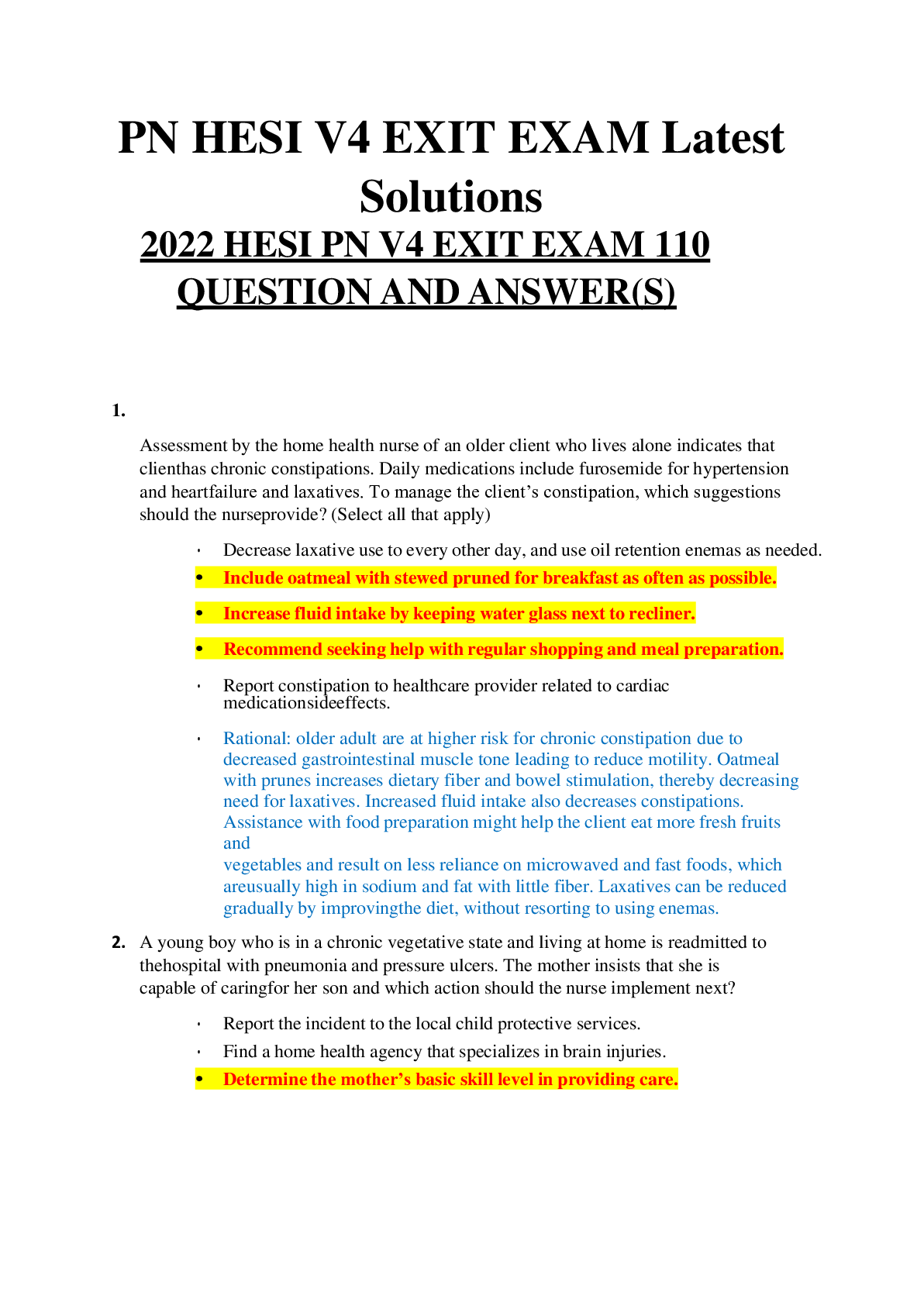
Assessment by the home health nurse of an older client who lives alone indicates that client
has chronic constipations. Daily medications include furosemide for hypertension and heart
failure and laxatives. To manage the client’s constipation, which suggestions should the nurse
provide? (Select all that apply)
Decrease laxative use to every other day, and use oil retention enemas as needed.
Include oatmeal with stewed pruned for breakfast as often as possible.
Increase fluid intake by keeping water glass next to recliner.
Recommend seeking help with regular shopping and meal preparation.
Report constipation to healthcare provider related to cardiac medication side
effects.
Rational: older adult are at higher risk for chronic constipation due to decreased
gastrointestinal muscle tone leading to reduce motility. Oatmeal with prunes
increases dietary fiber and bowel stimulation, thereby decreasing need for
laxatives. Increased fluid intake also decreases constipations. Assistance with
food preparation might help the client eat more fresh fruits and vegetables and
result on less reliance on microwaved and fast foods, which are usually high in
sodium and fat with little fiber. Laxatives can be reduced gradually by improving
the diet, without resorting to using enemas.
2. A young boy who is in a chronic vegetative state and living at home is readmitted to the
hospital with pneumonia and pressure ulcers. The mother insists that she is capable of caring
for her son and which action should the nurse implement next?
Report the incident to the local child protective services.
Find a home health agency that specializes in brain injuries.
Determine the mother’s basic skill level in providing care.
Consult the ethics committee to determine how to proceed.
Rational: Although the mother states she is a capable caregiver, the client is
manifesting disuse syndrome complications, and the mother’s skill in providing basic care should be determined. Further assessment is needed before
implementing other nursing actions.
3. After the risk and benefits of having a cardiac catheterization are reviewed by the healthcare
provider, an older adult with unstable angina is scheduled for the procedure. When the nurse
presents the consent form for signature, the client asks how the wires will keep a heart
heating during the procedure. What action should the nurse take?
Explain the procedure again in detail and clarify any misconceptions.
Notify the healthcare provider of the client’s lack of understanding.
Call the client’s next of kin and have them provide verbal consent.
Postpone the procedure until the client understands the risk and benefits.
Rational: the nurse is only witnessing the signature, and is not responsible for the
client’s understanding of the procedure. The healthcare provider needs to clarify
any questions and misconceptions. Explaining the procedure again is the
healthcare provider’s legal responsibility. The other options are not indicated.
4. In assessing a client at 34-weeks’ gestation, the nurse notes that she has a slightly elevated
total T4 with a slightly enlarged thyroid, a hematocrit of 28%, a heart rate of 92 beats per
minute, and a systolic murmur. Which finding requires follow-up?
Elevated thyroid hormone level.
Hematocrit of 28%.
Heart rate of 92 beats per minute.
Systolic murmur.
Rational: although physiologic anemia is expected in pregnancy, a hematocrit of
28% is below pregnant norms and could signify iron-deficiency anemia. Other
options are normal finding pregnancy
5. A client with osteoporosis related to long-term corticosteroid therapy receives a prescription
for calcium carbonate. Which client’s serum laboratory values requires intervention by the
nurse?
Total calcium 9 mg/dl (2.25 mmol/L SI)
Creatinine 4 mg/dl (354 micromol/L SI)
Phosphate 4 mg/dl (1.293 mmol/L SI)
Fasting glucose 95 mg/dl (5.3 mmol/L SI)
6. A clinical trial is recommended for a client with metastatic breast cancer, but she refuses to
participate and tells her family that she does not wish to have further treatments. The client’s son and daughter ask the nurse to try and convince their mother to reconsider this decision.
How should the nurse respond?
Ask the client with her children present if she fully understands the decision she
has made.
Discuss success of clinical trials and ask the client to consider participating for
one month.
Explain to the family that they must accept their mother’s decision.
Explore the client’s decision to refuse treatment and offer support
Rationale: as long as the client is alert, oriented and aware of the disease
prognosis, the healthcare team must abide by her decisions. Exploring the
decision with the client and offering support provides a therapeutic interaction and
allows the client to express her fears and concerns about her quality of life. Other
options are essentially arguing with the client’s decisions regarding her end of life
treatment or diminish the opportunity for the client to discuss her feelings
7. An adult client with severe depression was admitted to the psychiatric unit yesterday
evening. Although the client ran one year ago, his spouse states that the client no longer
runs, bur sits and watches television most of the day. Which is most important for the nurse
to include in this client’s plan of care for today?
Assist client in identifying goals for the day.
Encourage client to participate for one hour in a team sport.
Schedule client for a group that focuses on self-esteem.
Help client to develop a list of daily affirmations.
Rationale: clients with severe depression have low energy and benefit from
structured activities because concentration is decreased. The client participate in
care by identifying goals for the day is the most important intervention for the
client’s first day at the unit. Other options can be implemented over time, as the
depression decreases.
8. An adult who is 5 feet 5 inches (165.1 cm) tall and weighs 90 lb. (40.8 Kg) is admitted with a
diagnosis of chronic anorexia. The client receives a regular diet for 2 days, and the client’s
medical records indicates that 100% of the diet provided has been consumed. However the
client’s weight on the third day morning after admission is 89 lb. (40.4 Kg). What action
should the nurse implement?
Examine the client’s room for hidden food.
Assign staff to monitor what the client eats.
Ask the client if the food provided is being eaten or discarded. Provide the client with a high calorie diet.
Rationale: clients with an eating disorder have an unhealthy obsession with food.
The client’s continued weight loss, despites indication that the client has
consumed 100% of the diet, should raise questions about the client’s intake of the
food provided, so the client should be observed during meals to prevent hiding or
throwing away food. Other options may be accurate but ineffective and
unnecessary.
9. A client exposed to tuberculosis is scheduled to begin prophylactic treatment with isoniazid.
Which information is most important for the nurse to note before administering the initial
dose?
Conversion of the client’s PPD test from negative to positive.
Length of time of the exposure to tuberculosis.
Current diagnosis of hepatitis B.
History of intravenous drug abuse.
Rationale: prophylactic treatment of tuberculosis with isoniazid is contraindicated
for persons with liver disease because it may cause liver damage. The nurse
should withhold the prescribed dose and contact the healthcare provider. Other
options do not provide data indicating the need to question or withhold the
prescribed treatment.
10. The nurse walks into a client’s room and notices bright red blood on the sheets and on the
floor by the IV pole. Which action should the nurse take first?
Clean up the spilled blood to reduce infection transmission.
Notify the healthcare provider that the client appears to be bleeding.
Apply direct pressure to the client’s IV site.
Identify the source and amount of bleeding.
Rationale: the nursed should first assess the client to determine the action that
should be taken. Patient safety is the priority; other options are not priority.
11. During a routine clinic visit, an older female adult tells the nurse that she is concerned that
the flu season is coming soon, but is reluctant to obtain the vaccination. What action should
the nurse take first?
Determine when the client last had an influenza vaccination.
Discuss the concerns expressed by the client about the vaccination.
Ask about any recent exposure to persons with the flu or other viruses.
[Show More]