Pathophysiology > QUESTIONS & ANSWERS > Pathophysiology Exam #2 Topics study guide 2021/2022 (All)
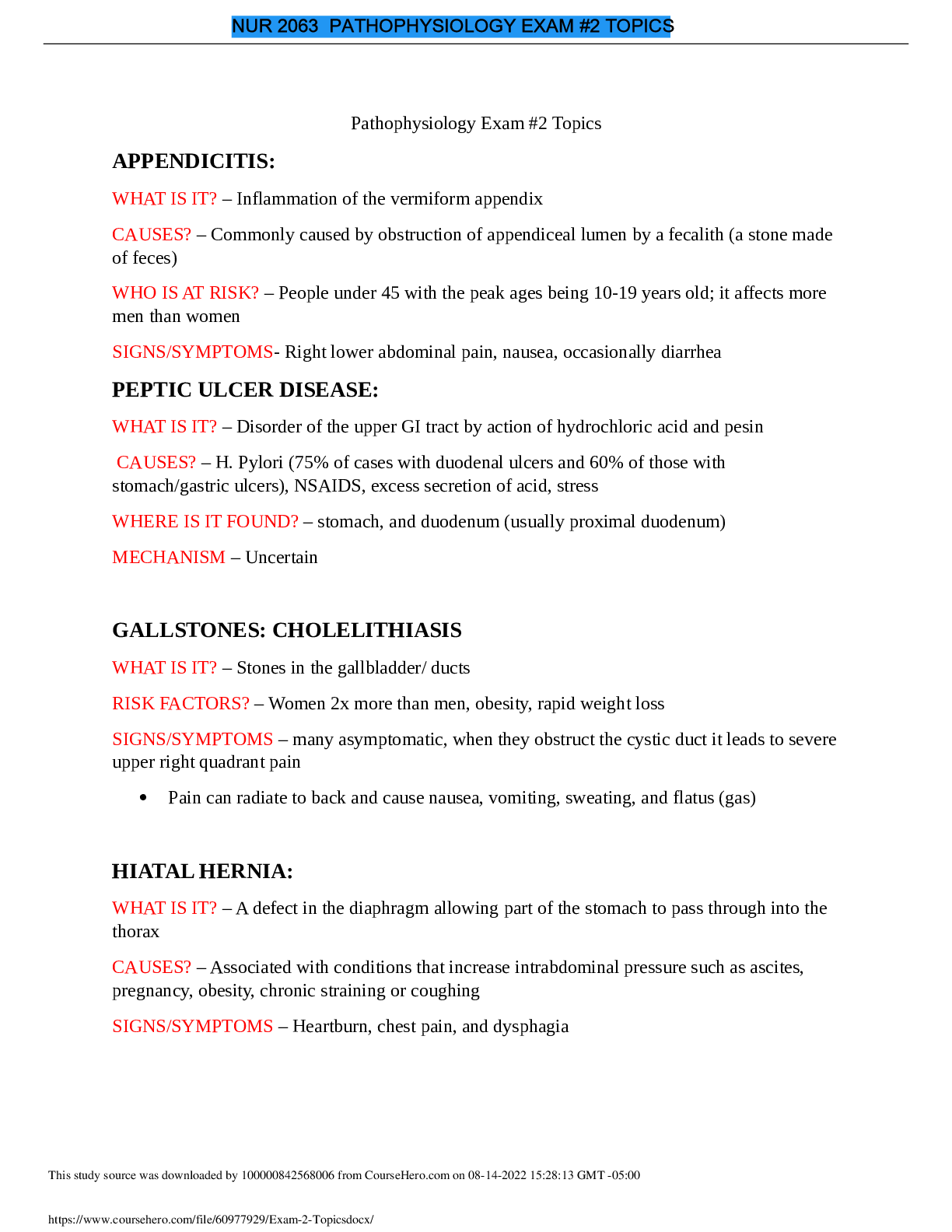
WHAT IS IT? – Inflammation of the vermiform appendix CAUSES? – Commonly caused by obstruction of appendiceal lumen by a fecalith (a stone made of feces) WHO IS AT RISK? – People under 45 with ... the peak ages being 10-19 years old; it affects more men than women SIGNS/SYMPTOMS- Right lower abdominal pain, nausea, occasionally diarrhea PEPTIC ULCER DISEASE: WHAT IS IT? – Disorder of the upper GI tract by action of hydrochloric acid and pesin CAUSES? – H. Pylori (75% of cases with duodenal ulcers and 60% of those with stomach/gastric ulcers), NSAIDS, excess secretion of acid, stress WHERE IS IT FOUND? – stomach, and duodenum (usually proximal duodenum) MECHANISM – Uncertain GALLSTONES: CHOLELITHIASIS WHAT IS IT? – Stones in the gallbladder/ ducts RISK FACTORS? – Women 2x more than men, obesity, rapid weight loss SIGNS/SYMPTOMS – many asymptomatic, when they obstruct the cystic duct it leads to severe upper right quadrant pain Pain can radiate to back and cause nausea, vomiting, sweating, and flatus (gas) HIATAL HERNIA: WHAT IS IT? – A defect in the diaphragm allowing part of the stomach to pass through into the thorax CAUSES? – Associated with conditions that increase intrabdominal pressure such as ascites, pregnancy, obesity, chronic straining or coughing SIGNS/SYMPTOMS – Heartburn, chest pain, and dysphagia This study source was downloaded by 100000830772748 from CourseHero.com on 04-30-2022 02:11:50 GMT -05:00 https://www.coursehero.com/file/60977929/Exam-2-Topicsdocx/ PANCREATITIS: WHAT IS IT? – inflammation of the pancreas CAUSES? – Biliary tract disease, hypertriglyceridemia, ethanol associated (drink, drank, drunk) 66% of all first cases are caused by alcoholism SIGNS/SYMPTOMS/MANIFESTATIONS- Steady boring pain in epigastrium or left upper right quadrant which gradually intensifies May radiate or penetrate to back, nausea, vomiting, fever, decreased bowel sounds TREATMENT? – NPO, Nasogastric tube to suction, IV fluids, and analgesics, Avoid alcohol PSEUDOMEMBRANOUS COLITIS: WHAT IS IT? – Acute inflammation and necrosis of large intestine; it affects the mucosa and sometimes other layers CAUSES? – Exposure to antibiotics, patients with cancer, or post abdominal surgery susceptible, mediated by bacterial toxins SIGNS/SYMPTOMS/MANIFESTATIONS – Diarrhea (often bloody), abdominal pain, fever, leukocytosis TREATMENTS – Antibiotics, fecal transplant, or colectomy HEPATITIS: WHAT IS IT? – Inflammation of the liver 3 MAJOR TYPES: Hep A – spread by fecal oral route; most adults develop jaundice o SIGNS/SYMPTOMS: malaise, anorexia, nausea, low grade fever, and right upper quadrant pain Hep B – Spread by parental contact with infected body fluids o SIGNS/SYMPTOMS – can have no symptoms to moderate illness to fulminant hepatitis; major risk factor for hepatocellular cancer Hep C – spread through blood and blood product; major risk factor for hepatocellular cancer [Show More]
Last updated: 3 years ago
Preview 1 out of 7 pages
Buy this document to get the full access instantly
Instant Download Access after purchase
Buy NowInstant download
We Accept:
Can't find what you want? Try our AI powered Search
Connected school, study & course
About the document
Uploaded On
Apr 30, 2022
Number of pages
7
Written in
All
This document has been written for:
Uploaded
Apr 30, 2022
Downloads
0
Views
56
Scholarfriends.com Online Platform by Browsegrades Inc. 651N South Broad St, Middletown DE. United States.
We're available through e-mail, Twitter, Facebook, and live chat.
FAQ
Questions? Leave a message!
Copyright © Scholarfriends · High quality services·