ate of Completion
Jun 30, 2020 11:51 PM
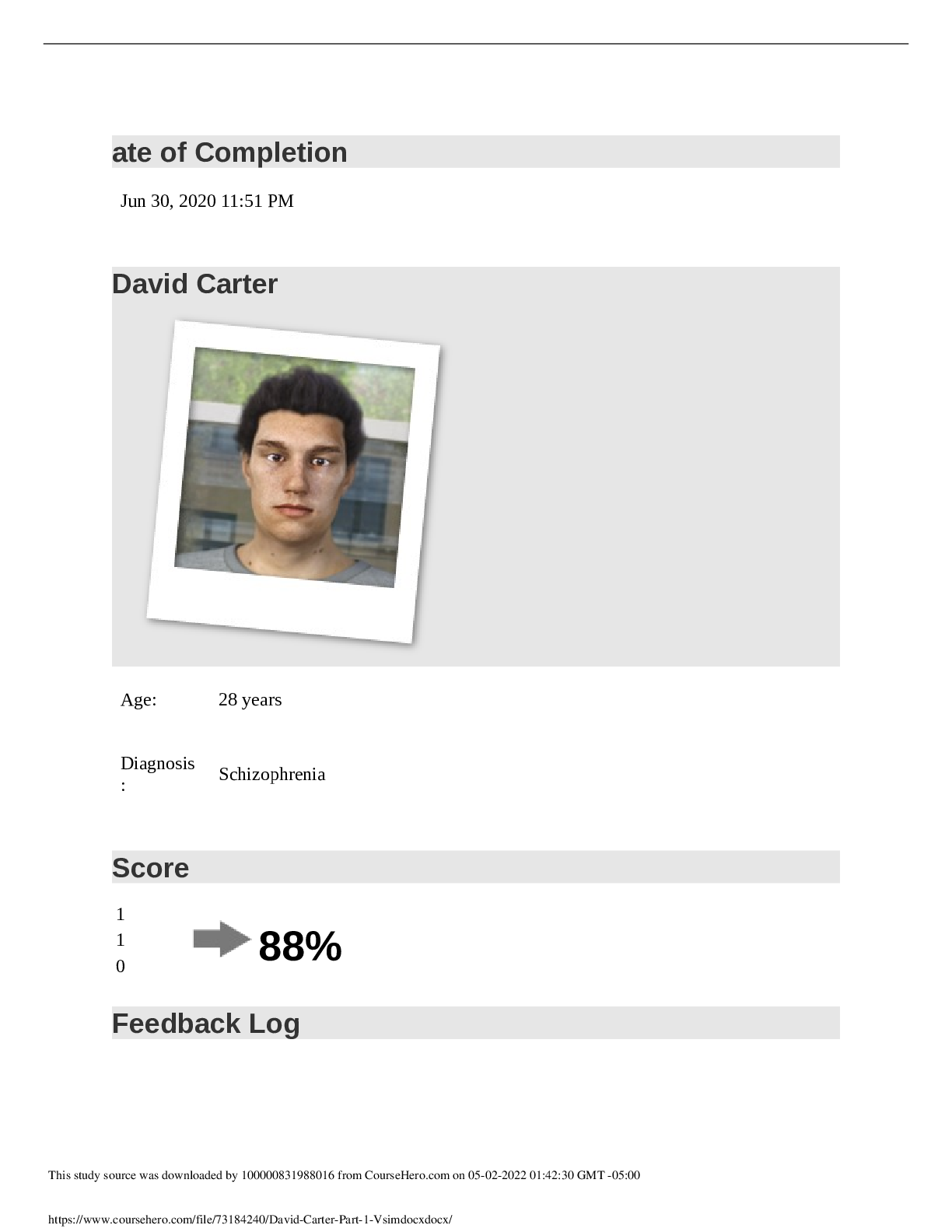
David Carter
Age: 28 years
Diagnosis
:
Schizophrenia
Score
1
1
0 88%
Feedback Log
This study source was downloaded by 100000831988016 from CourseHero.com on 05-02-2022
...
ate of Completion
Jun 30, 2020 11:51 PM
David Carter
Age: 28 years
Diagnosis
:
Schizophrenia
Score
1
1
0 88%
Feedback Log
This study source was downloaded by 100000831988016 from CourseHero.com on 05-02-2022 01:42:30 GMT -05:00
https://www.coursehero.com/file/73184240/David-Carter-Part-1-Vsimdocxdocx/
0:00 Patient
0:00 You checked scene safety. It was correct to check scene safety in order to
maintain your own safety.
0:05 You introduced yourself.
0:25 You identified the patient.
0:38 You washed your hands.
0:43 You asked if the patient had any known allergies.
0:54 You asked the patient: Is it OK for your family to be here, while we talk? The
patient said: No.
1:03 You asked the patient: Can you tell me a little bit more about what's going on
with you today? It was appropriate to ask the patient what was going on with him
to get an understanding of this.
1:22 The patient said: They came and got me and forced me into this poison prison.
It's your fault for keeping us here to rot of poison!\nYou answered: My purpose
for being here today is to help you and complete your nursing assessment. \nYou
used the therapeutic technique of giving information.
1:23 You assessed the respiration.
1:33 You checked the pulse oximetry.
1:49 You checked the radial pulse.
1:59 You measured the blood pressure.
2:14 You measured the temperature.
2:31 You asked the patient: Please tell me your name. The patient said: David Carter.
2:47 You asked the patient: Have you taken your medication?
2:58 The patient said: I'm not going to eat; no one can make me eat poison.\nYou
answered: Have you had similar experiences? \nYou used the therapeutic
technique of encouraging comparison.
This study source was downloaded by 100000831988016 from CourseHero.com on 05-02-2022 01:42:30 GMT -05:00
https://www.coursehero.com/file/73184240/David-Carter-Part-1-Vsimdocxdocx/
3:00 You asked the patient: Can you tell me where we are? The patient said: Is this a
hospital?
3:06 You asked the patient: I would like to ask you a series of questions about how
you are feeling to help me better understand how together we can start to plan
your care. These are questions I ask all of the patients I see. May I ask you these
questions? The patient said: I guess.
3:21 You asked the patient: Please tell me what today's date is. The patient said: (No
response)
3:27 You asked the patient: How would you describe your mood?
3:38 The patient said: I'm drowning.\nYou answered: Are you suggesting that you feel
overwhelmed? \nYou used the therapeutic technique of translating into feelings.
3:57 You asked the patient: Are you frightened of anything?
4:08 The patient said: All of you are part of it, aren't you? You are all in it
together!\nYou answered: I notice that you appear uncomfortable. \nYou used the
therapeutic technique of making observations.
4:15 You asked the patient: Have you ever tried to harm or kill yourself? The patient
said: No.
4:20 You asked the patient: Have you ever tried to harm or kill somebody else? The
patient said: No.
4:36 You asked the patient: Do you have any thoughts or wishes to harm anybody
else? The patient said: The voices tell me I have to stop the spies who are
listening to my thoughts and poisoning my food.
4:47 You asked the patient: Do you have any thoughts or wishes to harm anybody
else? The patient said: The voices tell me I have to stop the spies who are
listening to my thoughts and poisoning my food.
4:56 You asked the patient: Have you ever tried to harm or kill somebody else? The
patient said: No.
5:04 You asked the patient: Do you think it would be better if you were not alive? The
patient said: No.
5:12 You asked the patient: Name an activity that you enjoy. The patient said: I don't
know.
5:22 You observed the appearance.
5:45 You assessed the attention.
This study source was downloaded by 100000831988016 from CourseHero.com on 05-02-2022 01:42:30 GMT -05:00
https://www.coursehero.com/file/73184240/David-Carter-Part-1-Vsimdocxdocx/
6:09 You observed the motor activity.
6:20 You assessed the thought processes.
6:25 You assessed the speech.
9:14 You submitted the Mental Status Examination form. Some of your assessment
answers were incorrect.Regarding the indicator "2. Psychomotor behavior.
Abnormal movements or gestures": You should have indicated "No."Regarding
the indicator "8. Thought process. Indicate thought process": You should have
indicated "Tangential" and "Looseness of associations."Regarding the indicator
"10. Level of interest. Anhedonia": You should have indicated "Yes."
9:44 You administered lorazepam.
9:57 You educated about discharge.
10:18 You educated about the psychiatric diagnosis.
10:38 You educated about medications.
11:04 You educated about daily living.
11:19 You performed medication reconciliation.
11:49 You supported the patient about safe environment.
11:55 You supported the patient about hearing voices.
12:00 You supported the patient about getting help from the health care team.
12:22 You supported the patient by taking time to sit and talk.
12:43 You supported the patient about reality of voices.
12:51 You supported the patient about food and drink.
13:21 You asked the patient: Over the past year, when did you feel your best? It was
appropriate to ask the patient about when he felt his best.
13:36 The patient said: Are you one of those spies too? The other ones tried to poison
me with their poison trays.\nYou answered: Mr. Carter. I am your nurse. I'm here
to take care of you today. \nYou used the therapeutic technique of giving
information.
13:54 You asked the patient: Do you have energy to do the normal activities necessary
to get through the day? The patient said: I feel tired all the time.
This study source was downloaded by 100000831988016 from CourseHero.com on 05-02-2022 01:42:30 GMT -05:00
https://www.coursehero.com/file/73184240/David-Carter-Part-1-Vsimdocxdocx/
14:09 You asked the patient: Have you had any changes in your appetite over the past
month? The patient said: Those meds make me eat more. I feel hungry all the
time. But I haven't eaten anything today because they have poisoned it.
14:23 You asked the patient: Have you lost or gained weight over the past month? The
patient said: Gained about 20 pounds. Started about a year ago when they gave
me new meds.
You should have asked about any changes in sleep.
14:39 You asked the patient: Would you like a prepacked sandwich to eat? The patient
said: I might, if it is well packed....
14:55 You called the charge nurse. This is reasonable at this point.
15:11 You called the provider.
Schizophrenia is a mental disorder often characterized by abnormal social
behavior and disordered thinking. In the acute phase, there is typically a loss of
emotion and motivation and decreased social interaction. People experiencing an
acute episode may have hallucinations, delusions, disordered and disorganized
thinking, and emotional lability. David was initially on a first-generation typical
antipsychotic, haloperidol.lt;/p>lt;p>First-generation, or typical, antipsychotics
with high potency—such as fluphenazine, haloperidol, and trifluoperazine—tend
to have a higher incidence of extrapyramidal side effects. First-generation
antipsychotics with low potency—such as chlorpromazine and thioridazine—
have more sedation and orthostatic hypotension side effects.lt;/p>lt;p>Secondgeneration, or atypical, antipsychotics—such as olanzapine, asenapine,
lurasidone, clozapine, quetiapine, and risperidone—tend to have a higher
incidence of weight gain, increased blood cholesterol and glucose levels
(metabolic syndrome), and sedation side effects. Patients who suddenly stop
taking olanzapine often have muscle aches and stomach flu–like
symptoms.lt;/p>lt;p>Third-generation antipsychotics, such as aripiprazole,
preserve or enhance dopaminergic transmission. The side effects associated with
these medications—headache, anxiety, and nausea—tend to be better tolerated
than those associated with other types of antipsychotics.lt;/p>lt;p>It is important
to consider the physiological implications of patients who have paranoid
delusions involving food. Their nutritional status is a priority. Specific
interventions that may be helpful include offering packaged foods and opening
cans of food in front of the patient.lt;/p>lt;p>People with schizophrenia can
experience symptoms that may be grouped under the following
categories:lt;/p>lt;p>lt;ol>lt;li>Positive symptoms: hearing voices,
suspiciousness, feeling under constant surveillance, delusions, or making up
words that have no meaning (neologisms)lt;/li>lt;li>Negative (or deficit)
symptoms: social withdrawal, difficulty in expressing emotions (in extreme
cases, called blunted affect), difficulty in taking care of themselves, inability to
This study source was downloaded by 100000831988016 from CourseHero.com on 05-02-2022 01:42:30 GMT -05:00
https://www.coursehero.com/file/73184240/David-Carter-Part-1-Vsimdocxdocx/
feel pleasure (these symptoms cause severe impairment and are often mistaken
for laziness)lt;/li>lt;li>Cognitive symptoms: difficulties in attending to and
processing information, understanding the environment, and remembering simple
taskslt;/li>lt;li>Affective (or mood) symptoms: most notably depression,
accounting for a very high rate of attempted suicide in people suffering from
schizophrenialt;/li>lt;/ol>lt;/p>lt;p>Early intervention in the treatment of
schizophrenia yields better outcomes in terms of functioning. As with any
chronic illness, the greater the number of acute episodes experienced by the
patient with schizophrenia, the more likely the patient is to experience an
exacerbation of symptoms and impairment of function. There is a noted
correlation between overall impairment with sustained periods of psychosis and
functional brain changes.lt;/p>lt;p>Students need to be aware that aggressive
behavior in patients with schizophrenia is generally prompted by their psychosis
and associated fearfulness.lt;/p>
You got 88%
[Show More]












.png)