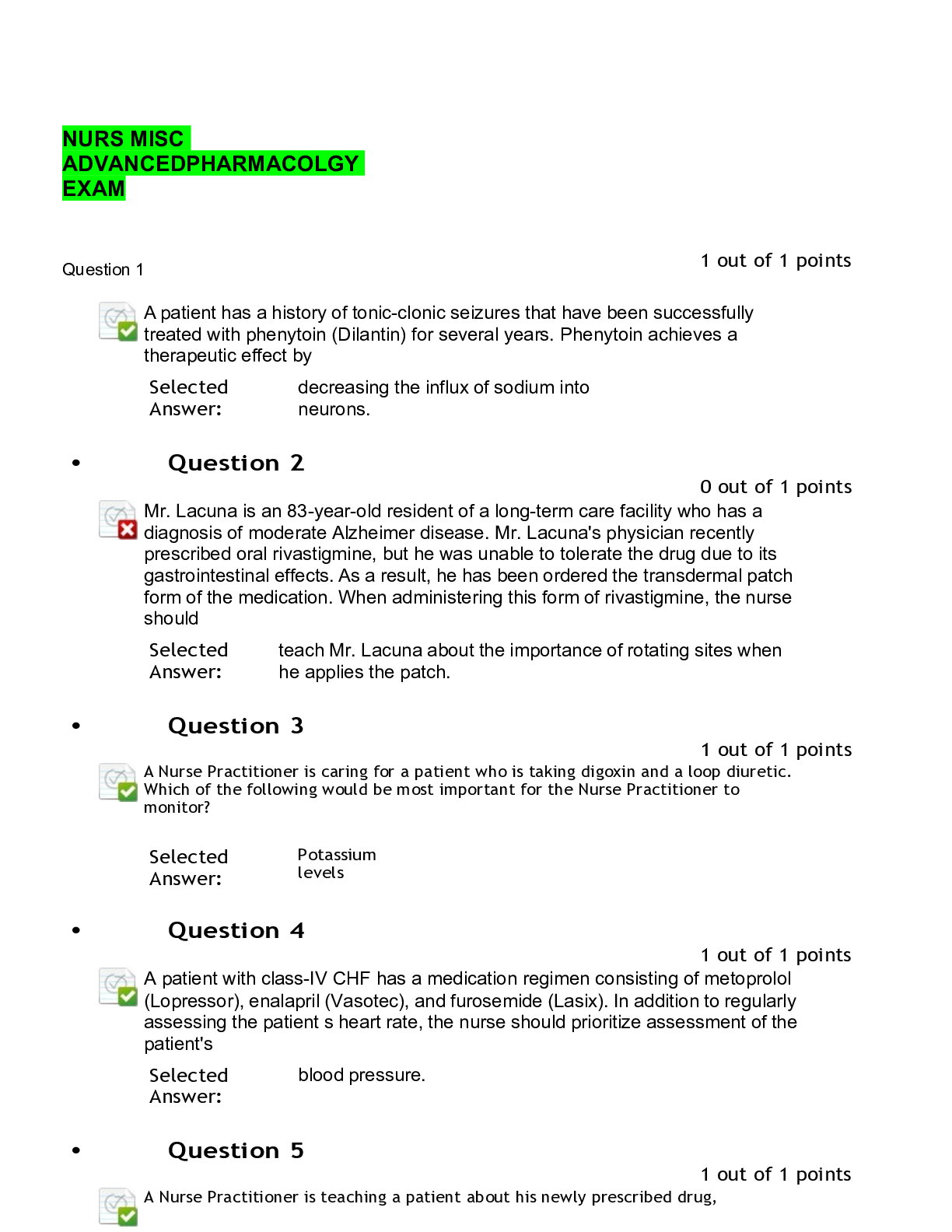
Question 1
1 out of 1 points
A patient has a history of tonic-clonic seizures that have been successfully treated with phenytoin (Dilantin) for several years. Phenytoin achieves a therapeutic effect
...
Question 1
1 out of 1 points
A patient has a history of tonic-clonic seizures that have been successfully treated with phenytoin (Dilantin) for several years. Phenytoin achieves a therapeutic effect by
Selected Answer:
decreasing the influx of sodium into neurons.
• Question 2
0 out of 1 points
Mr. Lacuna is an 83-year-old resident of a long-term care facility who has a diagnosis of moderate Alzheimer disease. Mr. Lacuna's physician recently prescribed oral rivastigmine, but he was unable to tolerate the drug due to its gastrointestinal effects. As a result, he has been ordered the transdermal patch form of the medication. When administering this form of rivastigmine, the nurse should
Selected Answer:
teach Mr. Lacuna about the importance of rotating sites when he applies the patch.
• Question 3
1 out of 1 points
A Nurse Practitioner is caring for a patient who is taking digoxin and a loop diuretic. Which of the following would be most important for the Nurse Practitioner to monitor?
Selected Answer:
Potassium levels
• Question 4
1 out of 1 points
A patient with class-IV CHF has a medication regimen consisting of metoprolol (Lopressor), enalapril (Vasotec), and furosemide (Lasix). In addition to regularly assessing the patient s heart rate, the nurse should prioritize assessment of the patient's
Selected Answer:
blood pressure.
• Question 5
1 out of 1 points
A Nurse Practitioner is teaching a patient about his newly prescribed drug, colchicine, for gout. The Nurse Practitioner will instruct the patient to avoid which of the following foods?
Selected Answer:
Shrim p
• Question 6
1 out of 1 points
The lower respiratory system utilizes a number of different mechanisms that confer protection and maintain homeostasis. Which of the following physiological processes protects the lower respiratory system?
Selected Answer:
Cilia sweep foreign material and mucus upward toward the trachea and larynx where they can then be swallowed.
CONTINUED.......
[Show More]