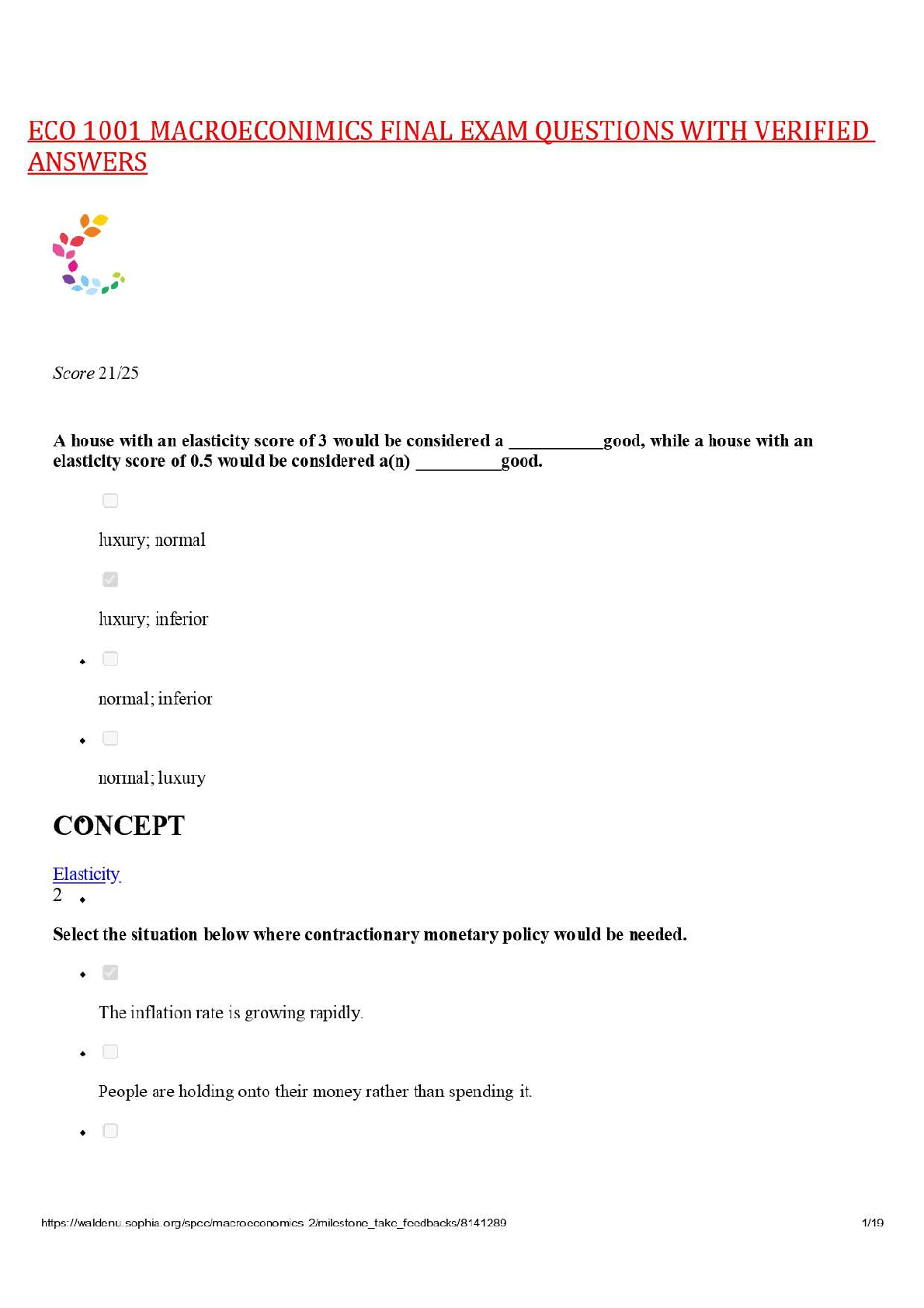
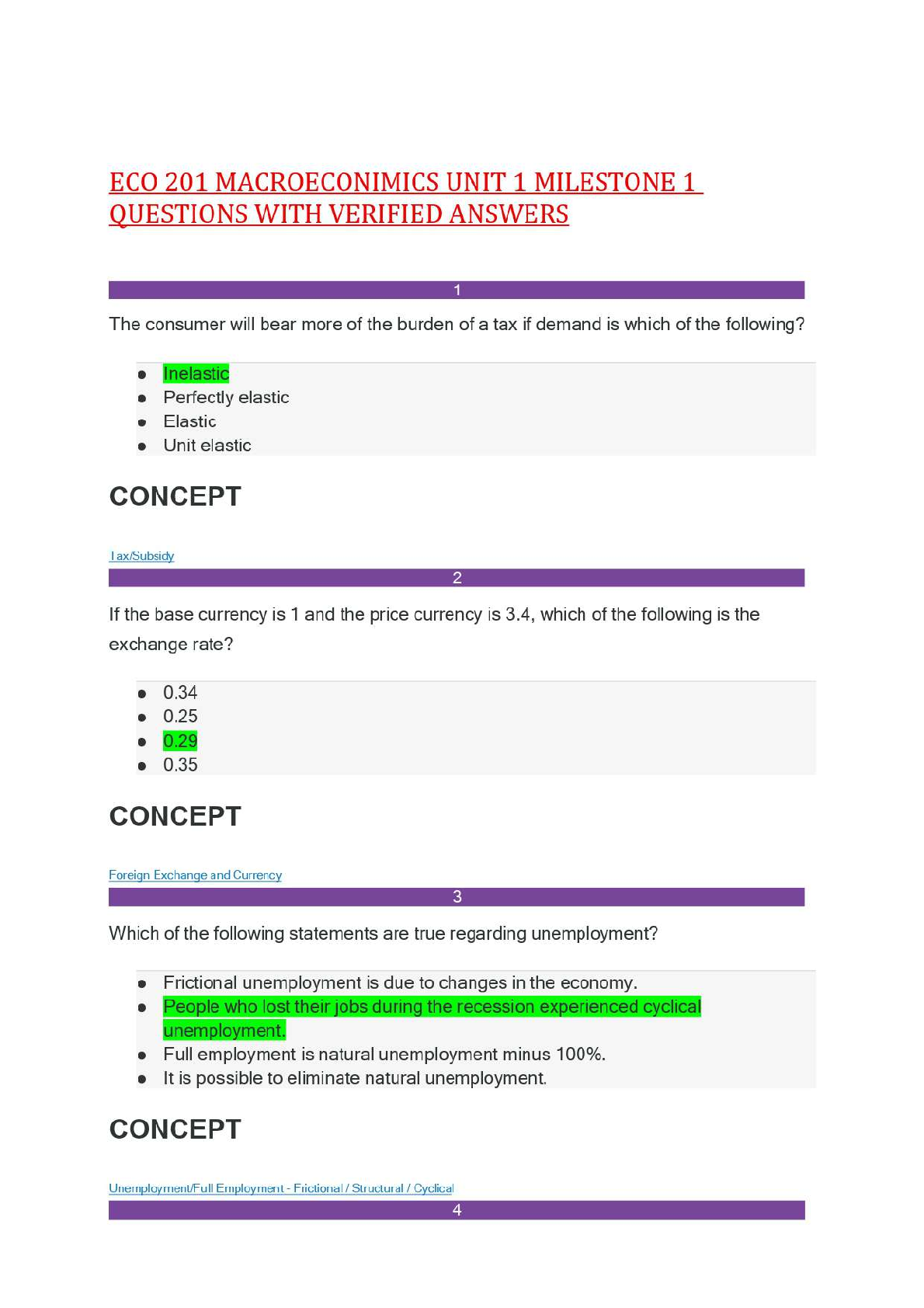
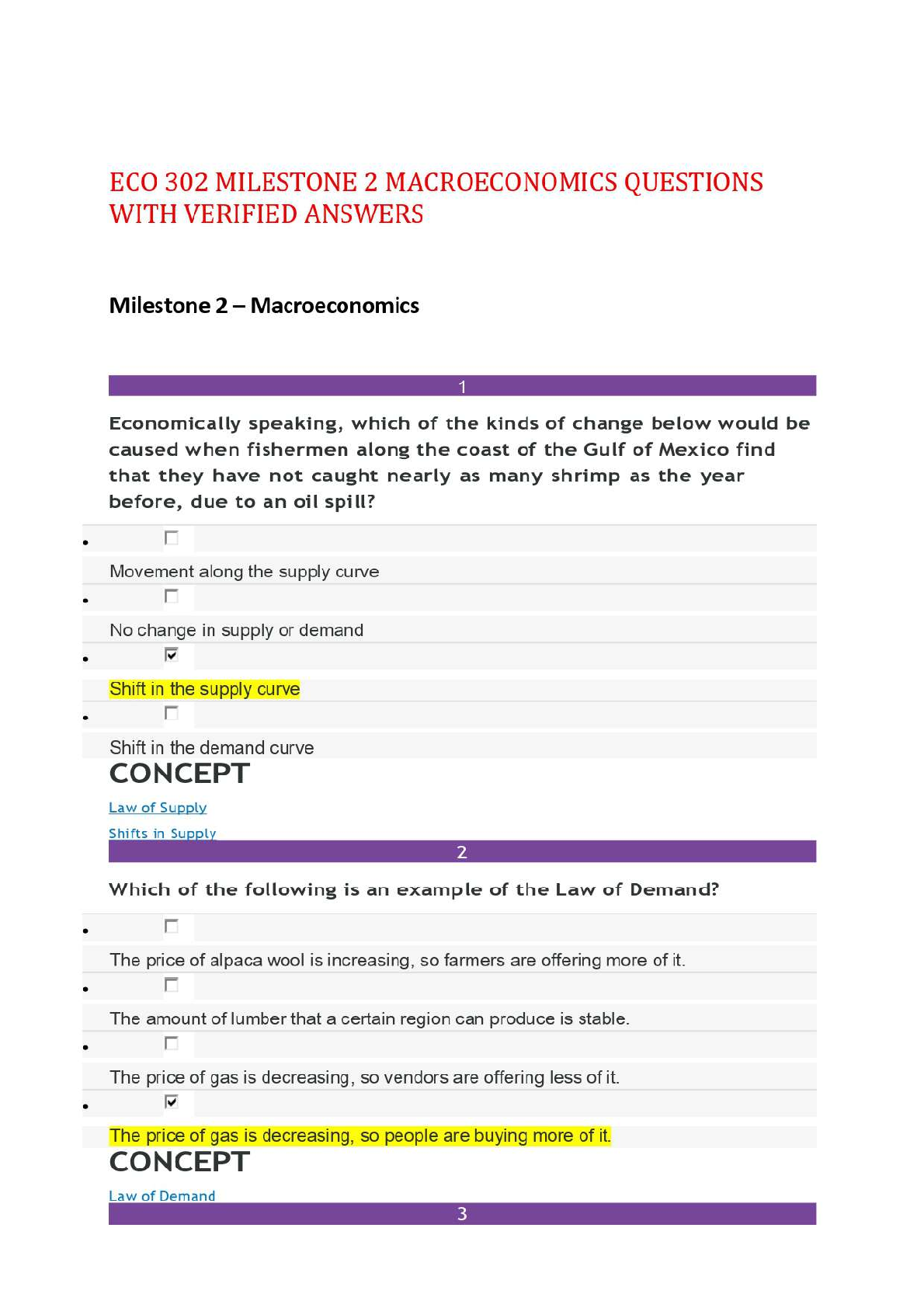
1. When a firm sells a good or a service, the sale contributes to the nation’s income
a. only if the buyer of the good or service is a household.
b. only if the buyer of the good or service is a household or another
...
1. When a firm sells a good or a service, the sale contributes to the nation’s income
a. only if the buyer of the good or service is a household.
b. only if the buyer of the good or service is a household or another firm.
c. whether the buyer of the good or a service is a household, another firm, or the government.
d. We have to know whether the item being sold is a good or a service in order to answer the question.
2. Estimates of the values of which of the following non-market goods or services are included in GDP?
a. the value of unpaid housework
b. the value of vegetables and other foods that people grow in their gardens
c. the estimated rental value of owner-occupied homes
d. All of the above are included.
3. Ralph pays someone to mow his lawn, while Mike mows his own lawn. Regarding these two practices, which of the following statements is correct?
a. Only Ralph’s payments are included in GDP.
b. Ralph’s payments as well as the estimated value of Mike’s mowing services are included in GDP.
c. Neither Ralph’s payments nor the estimated value of Mike's mowing services is included in GDP.
d. Ralph’s payments are definitely included in GDP, while the estimated value of Mike’s mowing services is included in GDP only if Mike voluntarily provides his estimate of that value to the government.
4. During the third quarter of 2006, a firm produces consumer goods and adds some of those goods to its inventory. During the fourth quarter of that year, the firm sells the goods at a retail outlet, with the result that the value of its inventory at the end of the fourth quarter is smaller than the value of its inventory at the end of the third quarter. These actions affect which component(s) of fourth-quarter GDP?
a. These actions affect only consumption, and they affect consumption positively.
b. These actions affect only investment, and they affect investment positively.
c. These actions affect consumption positively and investment negatively.
d. These actions affect both consumption and investment positively.
5. To encourage formation of small businesses, the government could provide subsidies; these subsidies
a. would not be included in GDP because they are transfer payments.
b. would be included in GDP because they are part of government expenditures.
c. would be included in GDP because they are part of investment expenditures.
d. would not be included in GDP because the government raises taxes to pay for them.
6. For an economy as a whole,
a. income is greater than expenditure
b. expenditure is greater than income.
c. income is equal to expenditure.
d. GDP measures income more precisely than it measures expenditure.
7. Gross domestic product is defined as
a. the market value of all final goods and services produced within a country in a given period of time.
b. the market value of all tangible goods produced within a country in a given period of time.
c. the quantity of all final goods and services supplied within a country in a given period of time.
d. the quantity of all final goods and services demanded within a country in a given period of time.
8. If a government made a previously-illegal activity such as gambling or prostitution legal, then, other things equal, GDP
a. necessarily decreases.
b. necessarily increases.
c. doesn't change because both legal and illegal production is included in GDP.
d. doesn't change because these activities are never included in GDP.
9. Unemployment compensation is
a. part of GDP because it represents income.
b. part of GDP because the recipients must have worked in the past to qualify.
c. not part of GDP because it is a transfer payment.
d. not part of GDP because the payments reduce business profits.
10. In a certain economy in 2005, GDP amounted to $5,000; consumption amounted to $3,000; government purchases were equal to investment; and the value of imports exceeded the value of exports by $200. It follows that government purchases amounted to
a. $900.
b. $1,100.
c. $1,250.
d. $1,325.
Section B (Short answer questions)
1. Why do economists use real GDP rather than nominal GDP to gauge economic well-being?
Economists use real GDP because compared to nominal GDP, there is no price change in real GDP. Real GDP only focuses on quantity change (production) so it is a better indicator of economic performance.
Nominal GDP is the production of goods and services valued at current prices. Real GDP is the production of goods and services valued at constant prices. Real GDP is a better measure of economic well-being because it reflects the economy’s ability to satisfy people’s needs and desires. Thus a rise in real GDP means people have produced more goods and services, but a rise in nominal GDP could occur either because of increased production or because of higher prices.
2. Below are some data from the land of milk and honey.
Year Price of Milk Quantity of Milk Price of Honey Quantity of Honey
2001 $1 100 $2 50
2002 $1 200 $2 100
2003 $2 200 $4 100
Compute nominal GDP, real GDP, and the GDP deflator for each year, using 2001 as the base year.
nGDP (2001) = ($1 x 100) + ($2 x 50)
= $200
rGDP (2001) = nGDP (2001) = $200
GDP deflator (2001) = (nGDP 2001)/(rGDP 2001) x 100 = 100
nGDP (2002) = ($1 x 200) + ($2 x 100)
= $400
rGDP (2002) = ($1 x 200) + ($2 x 100)
= $400
GDP deflator (2002) = (400)/(400) x 100 = 100
nGDP (2003) = ($2 x 200) + ($4 x 100)
= $800
rGDP (2003) = ($1 x 200) + ($2 x 100)
= $400
GDP deflator (2003) = (800)/(400) x 100 = 200
3. Consider the following data on a country’s GDP:
Year Nominal GDP (billions) GDP Deflator (base year: 1992)
1996 $7,662 110
1997 $8,111 112
a. What was the growth rate of nominal GDP between 1996 and 1997?
Growth rate (1996-97) = [nGDP (1997) – nGDP (1996)] / [nGDP (1996)] x 100
= (8111 – 7662)/(7662) x 100
= 5.86%
b. What was the growth rate of GDP deflator (inflation rate) between 1996 and 1997?
Growth rate (1996 – 97) = (112 – 110)/110 x 100
= 1.82%
c. What was real GDP in 1996?
GDP deflator (1996) = nGDP (1996) / rGDP (1996) x 100
110 = $7662 / rGDP (1996) x 100
rGDP (1996) = $6965.5
d. What was real GDP in 1997?
GDP deflator (1997) = nGDP (1997) / rGDP (1997) x 100
112 = $8111 / rGDP (1997) x 100
rGDP (1997) = $7241.9 = $7242
e. What was the growth rate of real GDP between 1996 and 1997?
Growth rate (1996 – 97) = (rGDP97 – rGDP96) / rGDP96 x 100
= (7242 – 6965.5) / (6965.5) x 100
= 3.96% = 4%
f. Was the growth rate of nominal GDP higher or lower than the growth rate of real GDP? Explain.
The growth rate of nGDP is higher than the growth rate of rGDP. This is because there is inflation.
4. Some countries emphasized on GNP rather than GDP as a measure of economic well-being. Which measure should the government prefer if it cares about the total income of their citizens? Which measure should it prefer if it cares about the total amount of economic activity occurring in the country?
The government should use GNP if it cares about the total income of their citizens and it should prefer GDP if it cares about the total amount of economic activity occurring in the country.
If the government cares about the total income of Americans, it will emphasize GNP, since that measure includes the income of Americans that is earned abroad. If the government cares about the total amount of economic activity occurring in the United States, it will emphasize GDP, which measures production in the country, whether produced by domestic citizens or foreigners.
Section C (Essay Questions)
Question 1
a) Describe the methods by which Gross Domestic Product can be measured.
Gross Domestic Product (GDP) can be measured using three methods, which are the output, income and expenditure methods.
The Output method counts the total market value of final goods and services produced by various economic sectors in a nation in a given period of time. It is important to avoid double counting. To do this, only the final goods and services are counted, which means the intermediate goods are avoided in the calculation. Another way to avoid double counting is to use the value-added method, which is done by deducting the expenditure on intermediate goods such as raw material purchased by an industry.
The income method is summing up all the sources of income that are received by the factors that contribute to the production activity. This income can be in the form of wages (pay received for labour work), rent (payment for the use of land and other rented resources), profits (for entrepreneurs, corporate profits – dividends and retained profit, proprietors’ income – compensation for owner’s own labour services, profits, the usage of owner’s capital), and net interest (interest households receive on loans they make – interest households pay on their own borrowing). To avoid double counting, transfer payments must be avoided. Transfer payments are payments that are received without production contribution, and some of them are unemployment benefits, scholarships, Social Security, welfare and government subsidies.
The final method is expenditure method. This method requires the summation of expenditure by households, firms, governments and the external sector – the household consumption of goods and services (C), the investment expenditure on capital goods by firms (I), the government expenditure (G), and the net export expenditure (Nx = E(X)port – I(M)port)
b) To what extent can Gross Domestic Product be used as a reliable indicator of living standards?
Meaning of GDP and importance of GDP. Gross Domestic Product (GDP) is an imperfect indicator of living standards. It does not account for the many non-marketable activities in a country, such as those done by housewives, activities done for one’s own consumption and DIY activities. This is because there are no data and payments involved. Illegal activities such as pirating and prostitution are also not counted in the GDP, because the government has a responsibility to protect people’s intellectual property, so people will have incentive to keep creating and innovating. GDP focuses on production activities only, so if a country produces goods and services that are not beneficial to their people, then the people’s economic wellbeing is not impressive. An example is North Korea which invests heavily in its military activities and weapons. Moreover, although China has a high GDP, the quality life for its people is not valued because the Chinese citizens are suffering from terrible air pollution. It has also been said that although a country has a high GDP and invests on the latest medical equipments, this data does not say anything about infant mortality and the quality of healthcare in the country. Furthermore, the distribution of income is not discussed in the GDP. This means that the economic pie might be distributed unfairly, favouring those who are already wealthy and neglecting those who are poor. As production activities increase, the less leisure time people have. Many family institutions are falling apart and more social problems are happening because parents are too busy working and earning money that they do not have enough time to spend caring about their children.
Question 1 The gross domestic product represents the size of a nation’s overall economy. It is defined as the market value of final goods and service produced within a country in a given time period. Final goods refer to goods that cannot be transformed into any other form. It includes consumer goods, such as handphones, fruit juices, shirts, shoes etc, and also capital goods, such as machines, vehicles, etc. The GDP is obtained by taking the quantity of everything produced, multiply it by the price at which each product sold, and add up the total.
One of the main economic indicators to measure the economic performance is by calculating the national income. The national income of a country can be measured using the output, expenditure or income method.
The national income (output method )is obtained by aggregating the total value of final goods and services produced by the various economic sectors in a given time period. It is important to ensure that double counting is avoided. This can be done by taking the value of final goods and services. The value of intermediate goods should be excluded. Alternatively, double counting can be avoided by totaling valued added of the goods in an industry. Value added is obtained by deducting the expenditure incurred on intermediate goods such as raw materials produced by an industry.
GDP (Output based) = The total market values of final goods and services
The income method is another way to calculate the national income. In this method, the national income is calculated by summing up all the incomes received by the factors contributing to the production activity. Income is received by the factors can be in the formed of wages (labor services), rent(land), interest(capital) and profits(entrepreneurs). Payment received without production contribution is known as transfer payments, should be excluded in order to avoid double counting.
GDP (Income based) = Compensation of employees + Net interest + Rental income+ Corporate profits + Proprietors’ income
Finally,we could also calculate the national income using the expenditure approach. The expenditure approach requires the summation of expenditure of the households, firms, government and the external sector. The household consumption on the goods and services, investment expenditure on capital goods by the firms, government expenditure and the net export expenditure are the four components of expenditures.
GDP (Expenditure based) = Household consumption (C) + Investment (I) + Government expenditure(G) + [Export(X) – Import(M)]
Question 2 Living standards are not merely determined by the size of the national income. There are many other factors to be considered. Amount the other factors are (i) the types of goods and services produced, (ii) the distribution of the income, (iii) the working time and leisure time, (iv) quality of the environment.
The computation of GDP is basically based on the total expenditure or production, but what's more important is the type of goods and services produced, which will determine the well being of the society. A country GDP may be huge, but a substantial amount money is spent on military weapons or producing military armory , which is of no use to the society. The GDP includes the amount of money spent on recreation and travel, but it ignores the leisure time. An economy may be large, where people work long hours, but has little time for leisure time.
The amount of money spent on education and health care contributes towards the GDP of a country, it does not include actual levels of environmental cleanliness, health, and learning. The purchase of pollution control equipment contributes towards the GDP, but it does not address the cleanliness of the water and air. Money spend on purchasing sophisticated health care equipments is included in the GDP , but it does not consider the changes infant mortality rate, life expectancy . Similarly, it counts spending on education, but not considering how much of the population can read, write, or do basic mathematics.
The non marketable production is not included in the GDP as there is no record of the activities affecting the accuracy of the GDP records. Paying someone to wash your car or clean your laundry is part of the GDP, but it is included in the GDP if it is done you. The work done by homemakers is not included in the GDP, but it is included if it is done by a maid.
GDP represents the size of an economic pie,but it has nothing to do with equity. Equity refers to the distribution of the economic pie. If there is no equity, then the income disparity is great. In this situation a small proportion of the society may acquire a large portion of the economic pie, while the rest gets only a small portion of the economic pie.
Likewise, GDP has nothing much to say about what technology and products are available. No matter how much money you had in 1960, you could not buy an iPhone or a personal computer.
Chapter 24 : Measuring the cost of living
Section A (MCQ)
1. The first step in measuring the CPI is to
a. select the market basket.
b. conduct a monthly survey.
c. collect prices for the basket of goods and services.
d. interview businesses.
2. If the CPI is 120, this means that
a. prices are 120 percent higher than in the reference base period.
b. prices are 0.12 times higher than in the reference base period.
c. prices are 20 percent higher than in the reference base period.
d. the inflation rate must be positive.
3. Which of the following means that the CPI overstates the actual inflation rate?
a. New goods bias.
b. Quality change bias.
c. Outlet substitution bias.
d. All of the above cause the CPI to overstate inflation.
4. Economists use the term inflation to describe a situation in which
a. some prices are rising faster than others.
b. the economy's overall price level is rising.
c. the economy's overall price level is high, but not necessarily rising.
d. the economy's overall output of goods and services is rising faster than the economy's overall price level.
5. What basket of goods is used to construct the CPI?
a. A random sample of all goods and services produced in the economy.
b. The goods and services that are typically bought by consumers as determined by government surveys.
c. Only food, clothing, transportation, entertainment, and education.
d. The least expensive and the most expensive goods and services in each major category of consumer expenditures
6. In the CPI, goods and services are weighted according to
a. how long a market has existed for each good or service.
b. the extent to which each good or service is regarded by the government as a necessity.
c. how much consumers buy of each good or service.
d. the number of firms that produce and sell each good or service.
7. Substitution bias in the CPI refers to the fact that the CPI
a. takes into account the substitution of goods by consumers when relative prices change.
b. substitutes quality changes whenever they occur without taking account of the cost of the quality changes.
c. substitutes relative prices for absolute prices of goods.
d. takes no account of the substitution of goods by consumers when relative prices change.
8. The goal of the consumer price index is to measure changes in the
a. costs of production
b. cost of living.
c. relative prices of consumer goods.
d. production of consumer goods.
9. Which of the following is not a widely acknowledged problem with the CPI as a measure of the cost of living?
a. substitution bias
b. introduction of new goods
c. unmeasured quality change
d. unmeasured price change
10. If the prices of Australian-made shoes imported into the United States increase, then, as a result,
a. both the GDP deflator and the consumer price index increase.
b. neither the GDP deflator nor the consumer price index increases.
c. the GDP deflator increases but the consumer price index does not increase.
d. the consumer price index will increase, but the GDP deflator will not increase.
Section B (Short answer questions)
1. Economists and policymakers monitor both the GDP deflator and the consumer price index to gauge how quickly prices are rising. However, these two statistics may not always tell the same story. Discuss two important differences that can cause them to diverge.
The GDP deflator includes all consumer and capital goods and services while the consumer price index (CPI) only includes the selected consumer goods and services in a fixed basket. Next, the GDP deflator counts only the goods and services produced in the country, while CPI includes both locally produced and imported consumer goods.
The GDP deflator reflects the prices of all final goods and services produced in the economy, while the CPI reflects the prices of goods and services purchased by typical consumers. Also, the GDP deflator uses a variable basket of goods and services—those produced in the current year, while the CPI uses a fixed basket of goods and services—those purchased in the base year.The GDP deflator and the CPI differ in two important ways. The GDP deflator uses as a basket of goods all final goods and services produced in the domestic economy, while the CPI basket includes goods and services purchased by typical consumers. Therefore, changes in the price of imported goods affect the CPI, but not the GDP deflator. Also, changes in the price of domestically produced capital goods affect the GDP deflator, but not the CPI. Changes in the price of domestically produced consumer goods are likely to affect the CPI more than the GDP deflator because it is likely that those goods make up a larger part of consumer budget than of GDP.
2. Calculate the consumer price index and the rate of inflation if given a fixed basket of goods of 4 hamburgers and 2 apples by taking the year 2001 as the base year.
Year Price($)
Hamburger (4) Apple (2)
2001 $1 $0.50
2002 $2 $1.00
2003 $3 $1.50
Cost of basket (COB) for year 2001 = (4 x $1) + (2 x $0.5)
= $4 + $1
= $5
COB (2002) = (4 x $2) + (2 x $1)
= $8 + $2
= $10
COB (2003) = (4 x $3) + (2 x $1.5)
= $12 + $3
= $15
CPI (2001) = 100
CPI (2002) = [COB (2002) / COB (2001)] x 100
= (10 / 5) x 100 = 2 x 100
= 200
CPI (2003) = [COB (2003) / COB (2001)] x 100
= (15 / 5) x 100 = 3 x 100
= 300
Inflation rate (2001 – 2002) = {[CPI (2002) – CPI (2001)] / CPI (2001)} x 100%
= [(200 – 100) / 100] x 100%
= 100%
Inflation rate (2002 – 2003) = {[CPI (2003) – CPI (2002)] / CPI (2002)} x 100%
= [(300 – 200) / 200] x 100%
= 50%
3. Describe the three problems that make the consumer price index an imperfect measure of the cost of living.
a) Substitution bias
When price of a good increases, consumers are likely to look for substitute goods that become relatively cheaper. The CPI misses the substitution because it uses a fixed basket of goods and services and assumes that people continue buying the expensive G&S. Therefore, the CPI overstates increase in the cost of living.
b) Introduction of new goods bias
When new G&S and technology are available, there is more variety, thus making each dollar more valuable to consumers. However, the CPI has difficulties including these new G&S because the fixed basket is not revised. Consumers may buy these new products while the basket still contains the older products. Thus, the CPI is an inaccurate measure of the typical cost of living.
c) Unmeasured quality change
Improvements in the quality of G&S in the basket increases the value of each dollar but the CPI has difficulty measuring changes in quality. The CPI assumes that quality is unchanged when it uses a fixed basket. There is possibility that the price of a good has increased due to its increased quality but the CPI calculates this price rise as inflation. Indices of inflation fail to take proper account of quality changes.
4. Convert the salary of Mr. A in the year 1930 to dollars in the year 2000 by using the following information.
a. A’s salary in the year 1930 was $80,000
b. The price level (CPI) in the year 2000 was 160
c. The price level (CPI) in the year 1930 was 52
Equivalent value of money in the past, today
= Salary in the past x (CPI today / CPI past)
= $80 000 x (160 / 52)
= $246 153.85 = $246 154
Chapter 25 : Production and Growth
Section A (MCQ)
1. Consider two countries. Country A has a population of 1,000, of whom 800 work 8 hours a day to make 128,000 final goods. Country B has a population of 2,000 of whom 1,800 work 6 hours a day to make 270,000 final goods.
a. Country A has higher productivity and higher real GDP per person than country B.
b. Country A has lower productivity and lower real GDP per person than country B.
c. Country A has higher productivity, but lower real GDP per person than country B.
d. Country B has lower productivity, but higher real GDP per person than country B.
Labour productivity of A = 128,000/(800x8) = 20
real GDP per person of A = 128,000/1000 = 128
Labour productivity of B = 270,000/(1800x6) = 25
Real GDP per person of B = 270,000/2000 = 135
2. Real Foods produced 300,000 boxes of organic spiral noodles in 2014 and produced 360,000 boxes in 2015. They used the same total hours of work in each year. In 2015 their productivity
a. fell.
b. was the same as in 2014.
c. rose 20%.
d. rose 30%.
3. A nation's standard of living is determined by
a. its productivity.
b. its gross domestic product.
c. its national income.
d. how much it has relative to others.
4. If a production function has constant returns to scale, output can be doubled if
a. labor alone doubles.
b. all inputs but labor double.
c. all of the inputs double.
d. None of the above is correct.
5. Suppose that there are diminishing returns to capital. Suppose also that two countries are the same except one has more capital and so more real GDP per person than the other. Finally, suppose that the saving rate in both countries increases from 5 percent to 6 percent. Over the next ten years we would expect that (catch-up effect)
a. the growth rate will not change in either country.
b. the country that started with less capital will grow faster.
c. the country with started with more capital will grow faster.
d. both countries will grow at the same rate.
6. The aggregate production function is graphed as
a. a downward sloping curve.
b. an upward sloping straight line.
c. an upward sloping line that becomes flatter as the quantity of labor increases.
d. an upward sloping line that becomes steeper as the quantity of labor increases.
7. If real GDP is $13,000 billion and aggregate labor hours used in the production are 270 billion, labor productivity equals
a. $6.50 per hour.
b. $45 per hour.
c. $48 per hour.
d. $650 per hour.
8. A recent survey by India's central bank reported that spending plans by firms on large new projects fell by 46 percent in the year ending March 2016, compared with the prior year. This decrease will most directly impact
a. physical capital growth.
b. human capital growth.
c. technological change.
d. population growth.
9. The aggregate production function shows how ________ varies with ________.
a. leisure time; labor
b. labor; leisure time
c. real GDP; labor
d. labor; capital
10. Labor productivity is defined as
a. total output attributable to labor.
b. total real GDP.
c. the growth rate of the labor force.
d. real GDP per hour of labor.
Section B ( Short answer questions)
Question 1
List and describe four determinants of productivity.
(Y/L) = af(1, K/L, H/L, N/L)
Natural resources, which are inputs into production which are provided by nature.
K is physical capital, which is the stock equipment and structures that are used to produces goods and services. It refers to investment in new and more advanced equipments and machineries in production. These advanced technologies and machines will increase the labour productivity.
H is human capital, which consists of the knowledge and skills that workers acquire through education, training, and experience. It involves the number of labour hours available for production and the quality of human resources, which is enhanced through human capital development.
T is technological knowledge, which is society’s understanding of the best ways to produce goods and services, which involves the discovery and application of new technologies. The advancement of technology would also contribute to higher productivity because it would use or provide better and more efficient ways to produce goods and services.
The four determinants of productivity are: (1) physical capital, which is the stock of equipment and structures that are used to produce goods and services; (2) human capital, which consists of the knowledge and skills that workers acquire through education, training, and experience; (3) natural resources, which are inputs into production that are provided by nature; and (4) technological knowledge, which is the understanding of the best ways to produce goods and services.
Question 2
Why is productivity related to the standard of living? In your answer, be sure to explain what is meant by productivity and standard.
Productivity is an economic measure of output per unit of input, which include labour and capital. Productivity is commonly defined as a ratio between output volume and the volume of inputs.
The ability of an economy to produce goods and services is determined by the economy’s productivity. The standard of living, in turn, depends on the level of productivity. The higher the productivity, the higher the standard of living.
Productivity = Y/L = af(1, K/L, H/L, N/L). So the increase in any of these factors will cause an increase in productivity, thus increasing the RGDP. An increase in RGDP will increase the RGDP per capita which will increase the living standard.
The standard of living is a measure of how well people live. Income per person is an important dimension of the standard of living and is positively correlated with other things such as nutrition and life expectancy that make people better off. Productivity measures how much people can produce in an hour. As productivity increases, people can produce more (and use less to produce the same amount) and so their standard of living increases.
Question 3
Why does a nation’s standard of living depend on property rights?
Property rights are rights given by the government such as the Intellectual Property Protection, which comprises of patents, trademarks, industrial deisgns, copyright, geographical indications and layout designs of integrated circuits. The Patents Act also stipulates a protection period of 20 years from the date of filing an application. The tax incentive and research grant are also used as an incentive to encourage research and development.
A nation’s standard of living depends on property rights because they encourage the citizens to keep innovating and creating, to keep making new discoveries. This means that when their intellectual property is stolen, they are protected by law and can sue those who steal or pirate their work. When people’s hard work are appreciated and protected, then they will be more likely to keep creating objects and innocating, to make life easier, this increasing the standard of living.
Property rights are an important prerequisite for the price system to work in a market economy. If an individual or company is not confident that claims over property or over the income from property can be protected, or that contracts can be enforced, there will be little incentive for individuals to save, invest, or start new businesses. Likewise, there will be little incentive for foreigners to invest in the real or financial assets of the country. The distortion of incentives will reduce efficiency in resource allocation and will reduce saving and investment which in turn will reduce the standard of living.
Chapter 26 : Saving, Investment, and Financial System
Section A (MCQ)
1. In a closed economy, a nation's investment must be financed by
a. private saving only.
b. the government's budget deficit.
c. borrowing from the rest of the world only.
d. national saving.
2. National saving is defined as the amount of
a. business saving.
b. household saving.
c. business saving and household saving.
d. private saving and public saving.
3. The nominal interest rate minus the real interest rate approximately equals the
a. rate of increase in the amount of investment.
b. inflation rate.
c. rate of increase in the income.
d. rate the bank receives to cover lending costs.
4. Assume you save $1,000 in a bank account that pays 8 percent interest per year and the inflation rate is 3 percent. At the end of the year you have earned
a. a nominal return of $50.
b. a negative real return.
c. a real return of $50.
d. a real return of $80.
Real interest rate = Nominal interest rate – Inflation rate
5. The demand for loanable funds is the relationship (negative relationship) between loanable funds and the ________ other things remaining the same.
a. real interest rate
b. Income level
c. inflation rate
d. price level
6. A rise in the real interest rate
a. shifts the demand for loanable funds curve rightward.
b. shifts the demand for loanable funds curve leftward.
c. creates a movement upward along the demand for loanable funds curve.
d. creates a movement downward along the demand for loanable funds curve.
7. Investment is financed by which of the following?
I. Government spending
II. National saving
III. Borrowing from the rest of the world
a. I, II, and III
b. I and II only
c. I and III only
d. II and III only
8. Which of the following explains why the demand for loanable funds is negatively related to the real interest rate? (Higher real interest rate causes demand for LF to decrease)
a. A lower real interest rate makes more investment projects profitable.
b. Consumers are willing to spend less and hence save more at higher real interest rates.
c. Interest rate flexibility in financial markets assures an equilibrium in which saving equals investment.
d. All of the above are reasons why the demand for loanable funds is negatively related to the real interest rate.
9. All of the following are sources of loanable funds EXCEPT
a. business investment.
b. private saving.
c. government budget surplus.
d. international borrowing.
10. Suppose the market for loanable funds is in equilibrium. If the expected profit falls, (Investment by firms decreases, DDLF decreases, demand curve shifts to the left) the equilibrium real interest rate ________ and the quantity of loanable funds ________.
a. rises; decreases
b. rises; increases
c. falls; decreases
d. falls; increases
Section B
1) What is national saving, private and public saving?How these three variables are related.
Private saving depends on the amount of income received, including the transfer of payments, by households, taxes and household consumption. Private saving incude savings by households and firms.
Private saving = Income (Y) – Tax (T) – Household consumption (C)
Public saving is saving by the government, and it depends on tax revenue and government expenditure.
Public saving = Tax revenue (T) – Government expenditure (G)
National saving in a closed economy consists of private and public saving.
National saving = Private saving + Public saving
= (Y – T – C) + (T – G)
= Y – C – G
National saving is the amount of a nation's income that is not spent on consumption or government purchases. Private saving is the amount of income that households have left after paying their taxes and paying for their consumption. Public saving is the amount of tax revenue that the government has left after paying for its spending. The three variables are related because national saving equals private saving plus public saving.
2) What is investment? How is it related to national saving.
Investment (I) refers to the acquisition of goods that are not consumed today but are used in the future to create wealth. The total investment is always equal to the national saving in a closed economy.
National income (Y) = C + I + G
I = Y – C – G = National Saving
Investment refers to the purchase of new capital, such as equipment or buildings. It is equal to national saving.
3) What is government budget deficit? How does it affect interest rate, investment, and economic growth?
Government budget deficit is when the government expenditure is more than the tax revenue, resulting in a negative public savings.
A government budget deficit will finance its debt through privatisation or borrowing from its citizens (assuming a closed economy). In return the total savings, which is the funds available for investors to build new factory, or for households to buy a brand new home decreases. In conclusion the supply of available funds for investment decreases. That will result an increase in interest rates because of scarcity of available funds. This higher interest rate then alters the behavior of firms that participate in the loan market. Many demanders of loanable funds are discouraged by the higher interest rate. Fewer families buy new homes and fewer firms choose to build new factories. The fall in the investment because of government borrowing is called crowding out.
During this period the budget deficit pushed the economy into a vicious cycle, where deficits cause lower economic growth that in turn lead to lower tax revenue and higher spending on Employment Insurance and other income-support programs. Lower tax revenue and higher government spending led the economic growth even lower levels which caused even lower tax revenues. Only way to break this vicious cycle was increasing tax rates and cutting government spending. However those tools cause even higher deficits and slower economic growth. That’s why it’s called vicious cycle.
Government’s budget = T – G
Deficit budget = T- G < 0
Assume that the Reserves or public saving is used to finance the deficit.
[Draw diagram]
The budget deficit means there is negative public saving which causes national saving to decrease, so supply of LF decreases. The curve of LF shifts to the left. This causes an increase in real interest rate which will cause cost of borrowing and returns to savings to decrease, which causes QdLF to drop. Thus, investment and borrowing decreases. This is known as crowding-out effect.
When capital drops, then Y also drops, thus there is a contraction in economic growth.
A government budget deficit arises when the government spends more than it receives in tax revenue. Because a government budget deficit reduces national saving, it raises interest rates, reduces private investment, and thus reduces economic growth.
4) Suppose GDP is $8 trillion, taxes are $1.5 trillion, private saving is $0.5 trillion, and public saving is $0.2 trillion. Assuming the economy is closed, calculate consumption, government purchases, national saving and investment.
National saving = 0.5 + 0.2 = $0.7 trillion
Investment = National saving = $0.7 trillion
Private saving = Y – T – C
C = Y – T – Private saving
= 8 – 1.5 – 0.5
= $6 trillion
Public saving = T – G
G = T – Public saving
= 1.5 – 0.2
= $1.3 trillion
5) Suppose that intel is considering building a new-chip making factory.
a. Assuming that Intel needs to borrow money in the bond market, why would an increase in the interest rate affect Intel’s decision about whether to build the factory?
An increase in the interest rate will increase the cost of borrowing money. If interest rates increase, the cost of borrowing money to build the factory becomes higher, so the returns from building the new plant may not be sufficient to cover the costs. Thus, higher interest rates make it less likely that Intel will build the new factory.
b. If Intel has enough of its own funds to finance the new factory without borrowing, would an increase in interest rates still affect Intel’s decision about whether to build the factory? Explain.
Even if Intel uses its own funds to build the factory, the rise in interest rates still matters. There is an opportunity cost on the use of the funds. Instead of investing in the factory, Intel could use the money to purchase bonds and earn the higher interest rate available there. Intel will compare its potential returns from building the factory to the potential return from the bond market. If interest rates rise, so that bond market returns rise, Intel is again less likely to invest in the factory.
Section C (Essay questions)
Question 1
Examine the impact of the following events on the equilibrium interest rates, saving and investment using the market for loanable fund model. Each event is treated independently :
a) Investors are highly optimistic about the economic outlook and they want to expand their business.
Part(a)
Investors highly optimistic and wanting to expand their business may require capital for expansion. Investors need to invest and will increase the demand for loanable fund. This will shift the demand for loanable fund curve to the right.
The initial equilibrium in the loanable fund market gives an equilibrium interest rate of 5% and the quantity of loanable fund of $1,200. The increase in the demand for loanable fund shifts the demand for loanable curve to the right to D2. As a result of an increase in the demand for loanable fund, the equilibrium interest rate and quantity of loanable funds increases to 6% and $1,400 respectively.
Thus, the result of the investors being optimistic would be an increase in the equilibrium interest rate and greater saving and investment.
b) Government budget change from a balanced budget to a deficit budget.
A government budget situation is determined by the amount of tax revenue collected(T) and the amount of government expenditure(G).
Budget Balance = T – G = 0 (Zero public saving)
Budget surplus = T – G > 0 (Positive public saving)
Budget deficit = T – G < 0 (Negative public saving)
The public saving is affected when the government budget is a deficit budget. This implies that public saving (T – G) falls, which will lower national saving. The supply of loanable funds will shift to the left. The equilibrium interest rate will rise, and the equilibrium quantity of funds will decrease as shown in the above diagram. The initial equilibrium real interest rate and equilibrium quantity of loanable fund was 5% and$1,200 respectively. When the interest rate rises, the quantity of funds demanded for investment purposes falls (crowding out effect). A crowding out is a decrease in investment that results of government borrowing. The real interest rate increases to 6% and the quantity of loanable fund decreases to $1,200.
In conclusion, when the government reduces national saving by running a budget deficit, the interest rate rises and investment falls and thus reduces economic growth.
Chapter 28 : Unemployment
Section A (MCQ)
1. Cyclical unemployment is closely associated with
a. long-term economic growth.
b. short-run ups and downs of the economy.
c. fluctuations in the natural rate of unemployment.
d. changes in the minimum wage.
2. The labor force equals the
a. number of people who are employed.
b. number of people who are unemployed.
c. number of people employed plus the number of people unemployed.
d. adult population.
3. A college student who is not working or looking for a job is counted as
a. neither employed nor part of the labor force.
b. unemployed and in the labor force.
c. unemployed, but not in the labor force.
d. employed and in the labor force.
4. Tom loses his job and immediately begins looking for another. Other things the same, the unemployment rate
a. increases, and the labor-force participation rate decreases.
b. increases, and the labor-force participation rate is unaffected.
c. is unaffected, and the labor-force participation rate increases.
d. decreases, and the labor-force participation rate is unaffected.
5. The natural rate of unemployment is the
a. unemployment rate that would prevail with zero inflation.
b. rate associated with the highest possible level of GDP.
c. difference between the long-run and short-run unemployment rates.
d. amount of unemployment that the economy normally experiences.
6. Sam just lost his job, but isn't yet looking for a new one. Sam is
a. counted as unemployed and part of the labor force.
b. counted as unemployed, but not part of the labor force.
c. not counted as unemployed, but counted as part of the labor force.
Not counted as unemployed, and not in the labour force.
7. Suppose the working age population in Tiny Town is 100 people. Suppose 25 of these people are NOT in the labor force, the ________ equals ________.
a. unemployment rate; 25/100 × 100
b. unemployment rate; 25/75 × 100
c. labor force; 75
d. labor force; 25/100 × 100
8. The ________ is the total number of people aged 16 years and older (and not in jail, hospital or institutional care) while the ________ is the number of people employed and the unemployed.
a. labor force; working-age population
b. labor force participation rate; labor force
c. working-age population; labor force
d. working-age population; labor force participation rate
9. Using the definition of unemployment, which of the following individuals would be unemployed?
a. A full-time student quits school, enters the labor market for the first time, and searches for employment.
b. Because of the increased level of automobile imports, an employee of General Motors is laid off, but expects to be called back to work soon
c. Because of a reduction in the military budget,.your next door neighbor loses her job in a plant where nuclear warheads are made and must look for a new job.
d. All of these individuals are unemployed.
10. The unemployment rate equals
a. (number of people employed/working age population) × 100.
b. (number of people unemployed/labor force) × 100.
c. (labor force/working age population) × 100.
d. (number of people employed/number of people age 16 and over) × 100.
Section B (Short answer questions)
1. The Bureau of Labour Statistics announced that in December 1998, of all adult Americans, 138,547,000 were employed, 6,021,000 were unemployed, and 67,723,000 were not in the labour force. How big was the labour force? What was the labour-force participation rate? What was the unemployment rate?
Labour force = 138,547,000 + 6,021,000 = 144,568,000
Labour force participation rate = (Labour force/Working adult population) x 100
= (144,568,000/212,291,000) x 100
= 68.1%
Unemployment rate = (no. of unemployed/labour force) x 100
= (6,021,000/144,568,000) x 100
= 4.16%
2. The breakdown of the population in 2001 for Country X are as follows:
Category In Million
Employed 135.1
Unemployed 7.2
Not in labour force 7.2
Determine:
a. the unemployment rate
= (no. of unemployed/labour force) x 100
= (7.2/142.3) x 100
= 5.06%
b. the labour force participation rate
= (labour force/working adult population) x 100
= (142.3/149.5) x 100
= 95.18%
c. employment-to-population ratio
= 135.1 : 149.5
= 1 : 1.106
3. Using a diagram of the labour market, show the effect of an increase in the minimum wage on the wage paid to workers, the number of workers supplied, the number of workers demanded, and the amount of unemployment.
The diagram above shows the demand and supply in a competitive labour market. The equilibrium wage is W1 and equilibrium quantity of labour employed is E1. When an increase in the minimum wage is imposed at Wmin, the quantity of labour demanded decreases to E2 and the quantity of labour supplied increases to E3. Therefore, the quantity demanded for labour E2 is less than the quantity supplied for labour of E3, thus causing a surplus of E2E3.
The figure below shows a diagram of the labor market with a binding minimum wage. The initial equilibrium with minimum wage m1 has quantity of labor supply L1S greater than the quantity of labor demanded L1D, with unemployment equal to L1S - L1D. An increase in the minimum wage to m2 leads to an increase in the quantity of labor supplied to L2S and a decrease in the quantity of labor demanded to L2D. As a result, unemployment increases as the minimum wage rises.
4. Why is frictional unemployment inevitable? How might the government reduce the amount of frictional unemployment?
Frictional unemployment is unemployment that results because it takes time for workers to find for jobs that best suit their skills and tastes, is inevitable because workers are free to leave their jobs to find a better job.
The government can help to reduce the amount of frictional unemployment through public policies that provide information on job vacancies in order to match workers and jobs more quickly, and through public training programs that help ease the transition of workers from declining to expanding industries and help disadvantaged groups escape poverty.
Frictional unemployment is inevitable because the economy is always changing. Some firms are shrinking while others are expanding. Some regions are experiencing faster growth than other regions. Transitions of workers between firms and between regions are accompanied by temporary unemployment.
The government could help to reduce the amount of frictional unemployment by public policies that provide information about job vacancies in order to match workers and jobs more quickly, and through public training programs that help ease the transition of workers from declining to expanding industries and help disadvantaged groups escape poverty.
5. What claims do advocates of unions make to argue that unions are good for the economy?
A claim that advocates that employers are not paying workers enough and thus there is exploitation of the workers. The union helps with addressing the workers’ concerns such as wage, hours, vacation, etc. and representing the employees, this in turn results in less disgruntled employees. After the workers receive higher wage, they will feel happier and more motivated so they will work harder and increase their productivity.
6. Explain four ways in which a firm might increase its profits by raising the wages it pays.
Efficiency Wage Theory is when a firm purposefully raises the wages it pays to increase the productivity of its workers. Next, paying workers more than the equilibrium minimum wage means that it would be more difficult for them to leave the job for another one with equivalent pay. This, coupled with the fact that it's also less attractive to leave the labor force or switch industries when wages are higher, implies that higher than equilibrium (or alternative) wages give employees an incentive to stay with the company that is treating them well financially. Lower worker turnover leads to a reduction in the costs associated with recruiting, hiring, and training, so it can be worth it for firms to offer incentives that reduce turnover.
Higher than equilibrium wages can also result in increased quality of the workers that a company chooses to hire. Increased worker quality comes via two pathways: first, higher wages increase the overall quality and ability level of the pool of applicants for the job and help to win the most talented workers away from competitors. Second, better-paid workers are able to take care of themselves better in terms of nutrition, sleep, stress, and so on. The benefits of better quality of life are often shared with employers since healthier employees are usually more productive than unhealthy employees.
The last piece of the efficiency-wage theory is that workers exert more effort (and are hence more productive) when they are paid a higher wage. Again, this effect is realized in two different ways: first, if a worker has an unusually good deal with her current employer, then the downside of getting fired is larger than it would be if the worker could just pack up and get a roughly equivalent job somewhere else. If the downside of getting fired if more severe, a rational worker will work harder to ensure that she doesn't get fired. Second, there are psychological reasons why a higher wage might induce an effort since people tend to prefer working hard for people and organizations that acknowledge their worth and respond in kind.
Four benefits of efficiency wage theory: (Wefficienct > Wmarket)
- Increase productivity of the workers
- Increase motivation of workers and individual performance = ability (the person doing the job must be able to do the job) x motivation (intrinsic and extrinsic motivations, tangible and intangible) x opportunity (when given an opportunity, take it)
- Low labour turnover because workers want to stay with the current employer that pays higher, so keep costs down for recruiting, hiring and training
- Attract quality workers
- Workers will have better health care + nutrition so increased productivity
Section C (Essay question)
Question 1
Discuss the four ways in which a firm might increase its profits by raising the wages it pays.
Repeated question
Question 2
Consider an economy with two labour markets, neither of which is unionized. Now suppose a union is established in one market.
a. Show the effect of the union on the market in which it is formed. In what sense is the quantity of labour employed in this market an inefficient quantity?
The diagram below illustrates the effect of a union being established in one labor market. When one labor market is unionized, shown in the figure on the left, the wage rises from W1U to W2U and the quantity of labor demanded declines from U1 to U2D. Since the wage is higher, the supply of labor increases to U2S, so there are U2S - U2D unemployed workers in the unionized sector. The quantity of labor employed in this market is inefficient since more workers would like to have jobs at the existing wage.
b. Show the effect of the union on the nonunionized market. What happens to the equilibrium wage in this market?
When those workers who become unemployed in the union sector seeks employment in the nonunionized market, shown in the figure on the right, the supply of labor shifts to the right from S1 to S2. The result is a decline in the wage in the nonunionized sector from W1N to W2N and an increase in employment in the nonunionized sector from N1 to N2.
Chapter 29 : The Monetary System
Section A (MCQ)
1. Money
a. is more efficient than barter.
b. makes trades easier.
c. allows greater specialization.
d. All of the above are correct.
2. Changes in the quantity of money affect
a. interest rates.
b. Prices.
c. Production.
d. All of the above are correct
3. Which of the following best illustrates the medium of exchange function of money?
a. You keep some money hidden in your shoe.
b. You keep track of the value of your assets in terms of currency.
c. You pay for your double latte using currency.
d. None of the above is correct.
4. Liquidity refers to
a. the ease with which an asset is converted to the medium of exchange.
b. a measurement of the intrinsic value of commodity money.
c. the suitability of an asset to serve as a store of value.
d. how many time a dollar circulates in a given year.
5. Which type of currency has intrinsic value?
a. Commodity money.
b. Fiat money.
c. Both commodity money and fiat money.
d. Neither commodity money nor fiat money.
6. M1 equals currency + demand deposits +
a. nothing else.
b. other checkable deposits.
c. traveler's checks + other checkable deposits.
d. traveler's checks + other checkable deposits + savings deposits.
7. You get money for babysitting the neighbors' children. This best illustrates which function of money?
a. medium of exchange
b. unit of account
c. store of value
d. Liquidity
8. The supply of money is determined by
a. the price level.
b. the Treasury and Congressional Budget Office.
c. the Federal Reserve System.
d. the demand for money
9. Which of the following is correct?
a. If the Fed purchases bonds in the open market, then the money supply curve shifts right. A change in the price level does not shift the money supply curve.
b. If the Fed sells bonds in the open market, then the money supply curve shifts right. A change in the price level does not shift the money supply curve.
c. If the Fed purchases bonds, then the money supply curve shifts right. An increase in the price level shifts the money supply curve right.
d. If the Fed sells bonds, then the money supply curve shifts right. A decrease in the price level shifts the money supply curve right.
10. Which of the following is a tool that is used by the Fed to control the quantity of money?
a. open market operations
b. government expenditure multiplier
c. excess reserves
d. real interest rate
Section B (Short answer question)
1. Why don’t banks hold 100 percent reserves? How is the amount of reserves banks hold related to the amount of money the banking system creates?
Banks don’t hold 100% of reserves because depositers will want to withdraw money from their saving account. The smaller the amount of reserves banks hold means that the larger the excess reserves available. Excess reserves are used by the banks to create credit or to give loans to borrowers. By creating higher credit, more deposits will be opened and thus, the amount of money the banking system creates increases due to the credit creation process.
Banks don’t hold 100 percent reserves because it’s more profitable to use the reserves to make loans, which earn interest, instead of leaving the money as reserves, which earn no interest. The amount of reserves banks hold is related to the amount of money the banking system creates through the money multiplier. The smaller the fraction of reserves banks hold, the larger the money multiplier, since each dollar of reserves is used to create more money.
2. Suppose that the T-account for First National bank is as follows:
Assets Liabilities
Reserves $500,000 Deposits $500,000
(a) If the Central Bank requires banks to hold 5% of deposits as reserves, how much in excess reserves does First National now hold?
Excess reserves = Deposit – Reserves
= 100% - 5%
= 95%
Excess reserves = 95% x $500,000
= $475,000
R = 5%
Reserves = 5% x D1 = 5% x 500,000 = 25,000
Excess reserves = 500,00 – 25,000 = 475,000
(b) What will be the total money supply?
Total money supply = 1/R x Initial deposit
Money multiplier = 1/R = 1/5% = 20
Total money supply = 20 x $500,000 = $10,000,000
3. Suppose that the reserve requirement for checking deposits is 10 percent and that banks do not hold any excess reserves.
(a) If the Central Bank sells $1 million of government bonds, what is the effect on the economy’s reserves and money supply?
Money supply = Currency + Deposits
By selling $1 million of government bonds, the deposits in commercial banks decrease by $1 million when people use money from their deposits to buy bonds.
Reserve requirement = 10%
Money multiplier = 1/10% = 10
Money supply changes by 10 x (-$1 million) = -$10 million because the currency decreases by $10 million.
(b) Now suppose the Central Bank lowers the reserve requirement to 5%, but banks choose to hold another 5% of deposits as reserves. Why might banks do so? What is the overall change in the money multiplier and the money supply as a result of these actions?
Banks might choose to hold another 5% of deposit as reserves because [insert answer]. When banks choose to hold another 5% of deposit as reserves, the reserve for checking does not change and stays at 10%, so there is no change in the money multiplier and thus, money supply is not affected by these actions.
Banks might wish to hold excess reserves if they need to hold the reserves for their day
to-day operations, such as paying other banks for customers' transactions, making
change, cashing paychecks, and so on. If banks increase excess reserves such that there's
no overall change in the total reserve ratio, then the money multiplier doesn't change and
there's no effect on the money stock.
Section C (Essay question)
Question 1
Assume that Miss A deposits RM50,000 with Bank Y. Assume also that required reserves are 20 percent of checking deposits, and that banks hold no excess reserves and households hold no currency. Explain the detailed process of money creation in the economy and calculate the size of the money multiplier. Demonstrate your answers using banks’ T-account.
Asset Liability
Reserves $10,000 Deposits $50,000
Loans 40,000
*Loans = Excess reserves = $50,000 - $10,000.
Money multiplier = 1/20% = 5
Money is created in the economy when banks create credit or give loans to borrowers so that more deposits will be created. This is because Money supply = Currency + Deposits, and in this case, Currency = 0. However, using the money multipler, the total money supply can be calculated using Money multiplier x Initial deposit of $50,000.
When Miss A deposits RM50,000 Bank Y will have an excess cash reserve of RM40,000. The bank’s books of ledger (partial) will show:
Assets Liabilities
Cash RM50,000 Deposits – Miss A RM50,000
Assume that Bank Y gives a loan of RM40,000 to Miss. B. This is represented only by a book entry without any cash movement as shown in the bank’s ledger below:
Assets Liabilities
Cash RM50,000 Deposits – Miss A RM50,000
Loan – Ms. B RM40,000 Deposits – Miss B RM40,000
The money supply is now RM90,000. The excess cash reserve is RM32,000 (RM40,000 x 80%). Assume that this excess cash reserve of RM32,000 is lent out to Miss C. The bank’s ledger of Bank Y is shown as below:
Assets Liabilities
Cash RM50,000 Deposits – Miss A RM50,000
Loan – Ms. B RM40,000 Deposits – Miss B RM40,000
C Loan – Ms. C RM32,000 Deposits- Miss RM32,000
The money supply is now RM122,000. The process of credit creation will continue until the total money supply equals to RM250,000.
Money multiplier = 1/cash ratio = 1/0.20 = 5
Therefore, an original deposit of RM50,000 will expand the money supply until RM250,000. In other words, the amount of money created is equal to RM200,000.
Question 2
a) What are the tools of monetary control used by central banks and explain how central banks use them to control money supply?
The tools of monetary control used by central banks are Fractional Reserve Requirement Ratio (R), Discount Rate (DR) and Open-Market Operations (OMO).
Central banks use R to determine the deposits received by commercial banks to be used as reserves. This tool ensures that banks will always have money when demanded by depositors to avoid panic or a bank run. This tool is also used to change the supply of money in an economy. The bank will lower reserves to increase the supply of money and will increase the reserves when it wants to reduce the supply of money.
DR is the interest rate charged on commercial banks on short-term loans. The discount rate is lowered during the recession in order to induce the commercial banks to take loans from the central bank and to use the fund to give out as loans and through the credit creation process, increasing the money supply in the economy. When the economy is experiencing an inflationary situation the discount rate is increased to reduce the money supply.
OMO refers to the buying and selling of government securities such as treasury bills and bonds in the open market in order to expand or contract the amount of money in the banking system, facilitated by the central bank. The central bank sells government securities during an inflation to reduce the money supply in the economy. During a recession, the central bank buys government securities to increase the money supply in the economy.
Money takes the form of currency and various types of bank deposits, such as checking accounts.
The central bank controls the money supply primarily through open-market operations. The purchase of government bonds increases the money supply, and the sale of government bonds decreases the money supply. The central bank can also expand the money supply by lowering reserve requirements or decreasing the discount rate, and it can contract the money supply by raising reserve requirements or increasing the discount rate.
b) Why is the central banks unable to fully control the money supply?
Central banks are unable to fully control the money supply in an economy because it does not control the amount of money that households choose to hold in commercial banks. The more households deposit in the bank, the more reserves and excess reserves the bank will have and hence, more money can be created in the credit creation process. The central bank also does not control the amount of money that bankers choose to lend. If the banks choose to hold more than the reserve required, then there will be less money to be loaned and thus, the money created through the credit creation process will decrease.
Because there are many parties involved which are the borrowers and the savers. The central bank cannot force the commercial banks to use everything from their excess reserves, and cannot force the people to take loans if they do not want to. The central bank also connot control the confidence of the people on taking loans or saving their money in deposits.
When banks loan out some of their deposits, they increase the quantity of money in the economy. Because of this role of banks in determining the money supply, the central bank’s control of the money supply is imperfect.
The central bank does not control the amount of money that consumers choose to deposit in banks.
• The more money that households deposit, the more reserves the banks have, and the more money the banking system can create.
• The less money that households deposit, the smaller the amount of reserves banks have, and the less money the banking system can create.
The central bank does not control the amount that bankers choose to lend.
• The amount of money created by the banking system depends on loans being made.
• If banks choose to hold onto a greater level of reserves than required by the central bank (called excess reserves), the money supply will fall.
• Therefore, in a system of fractional-reserve banking, the amount of money in the economy depends in part on the behavior of depositors and bankers.
• Because the central bank cannot control or perfectly predict this behavior, it cannot perfectly control the money supply.
Chapter 30 : Money Growth and Inflation
Section A (MCQ)
1. What will happen to the price of bonds when the interest rate falls?
a. Bond prices will remain the same.
b. Bond prices will rise.
c. Bond prices will fall.
d. Ambiguous.
2. What will happen to the interest rate if the quantity of money demanded is less than the quantity of money supplied? (there’s a surplus of quantity of money so adjustments will happen to push the interest rate down to equilibrium level)
a. Either increase or decrease, depending on the amount of excess demand.
b. Increase.
c. Decrease.
d. Unaffected.
3. What causes an increase in the equilibrium interest rate? Supply shift to the left (contractionary monetary policy) or Demand curve shift to the right
a. A decrease in the level of output (real GDP). fall
b. The purchase of government securities by the Fed. fall
c. An increase in the level of output (real GDP) and an increase in the money supply. ambiguous
d. The sale of government securities by the Fed. one of monetary tools: OMO
4. Which of the following is NOT a monetary policy tool of the Federal Reserve?
a. Changes in required reserves.
b. Last resort loans. (based on discount rate: commercial banks borrowing money from central bank)
c. Deposit insurance.
d. Open market operations.
5. The minimum percentage of deposits that a depository institution must hold and cannot use for lending is known as the
a. Minimum rate.
b. required reserve ratio.
c. money multiplier.
d. discount rate.
6. The required reserve ratio
a. is the amount of money that banks require borrowers to reserve in their accounts.
b. is the fraction of a bank's total deposits that is required to be held in reserves.
c. increases when withdrawals from a bank are made.
d. is higher for banks that make riskier loans.
7. If the desired reserve ratio is 3 percent and deposits totaled $575 billion, banks would hold
a. $534.75 in reserves.
b. $17.25 billion in excess reserves.
c. $1,725 billion in currency.
d. $17.25 billion in reserves.
8. An increase in the price level makes the value of money (inversely related)
a. increase, so people want to hold more of it.
b. increase, so people want to hold less of it.
c. decrease, so people want to hold more of it. (hold more of it = demand more because more money needed to purchase a quantity of goods)
d. decrease, so people want to hold less of it.
9. Which of the following is correct?
a. If the Fed purchases bonds (during a recession to increase money supply) in the open market, then the money supply curve shifts right. A change in the price level does not shift the money supply curve.
b. If the Fed sells bonds (during inflation to reduce money supply) in the open market, then the money supply curve shifts right. A change in the price level does not shift the money supply curve.
c. If the Fed purchases bonds, then the money supply curve shifts right. An increase in the price level shifts the money supply curve right.
d. If the Fed sells bonds, then the money supply curve shifts right. A decrease in the price level shifts the money supply curve right.
10.
Refer to the above figure. If the money supply is MS2 and the value of money is 2,
a. the value of money is less than its equilibrium level. (at D)
b. the price level is higher than its equilibrium level.
c. the quantity of money demanded is greater than the quantity of money supplied.
d. the quantity of money supplied is greater than the quantity of money demanded.
Section B (Short answer question)
1. Explain the difference between nominal and real variables, and give two examples of each. According to the principle of monetary neutrality, which variables are affected by changes in the quantity of money?
Nominal variables are expressed in monetary unit, such as nominal GDP and nominal interest rate while real variables are expressed in physical unit such as real GDP and real interest rate. Real variables are also adjusted for inflation while nominal variables are not. Nominal variables are affected by changes in the quantity of money.
Monetary neutrality means that money has no effect on real variables such as Real GDP, so money is neutral. Money has no effect on real variables in the long run. Money only affects the nominal variables such as price and real variables such as real GDP in the short run.
2. In what sense is inflation like a tax? How does thinking about inflation as a tax help explain hyperinflation?
Inflation is like a tax because everyone who holds money loses purchasing power. Hyperinflation is generally defined as an inflation exceeding 50% increase a month. Hyperinflation occurs when there is excessive and rapid growth in money supply in a short period, which happens when the government prints money. Thus the government “uses” the “inflation tax”, instead of taxes, to finance its spending. Either way, consumers end up being able to buy less with the same amount of income if the government increases its spending – they either give their money directly to the government in the form of taxes or they suffer less purchasing power because of inflation if the government prints or borrows money.
e.g when nominal income (NY) = $1000, CPI = 100, RY = $1000. But when CPI = 1000, so Real income (RY) = (NY/CPI) x 100 = (1000/1000)x100 = $100 --- $900 is the inflation tax.
Inflation is like a tax because everyone who holds money loses purchasing power. In a hyperinflation, the government increases the money supply rapidly, which leads to a high rate of inflation. Thus the government uses the inflation tax, instead of taxes on income, to finance its spending
3. According to Fisher effect, how does an increase in the inflation rate affect the real interest rate and the nominal interest rate?
Nominal interest rate = inflation + real interest rate.
Fisher effect or the Quantity Theory of Money is based directly on the increase on the quantity supply of money. This theory states that the value of money is based on the amount of money in the economy. According to the Fisher effect, an increase in the inflation rate raises the nominal interest rate by the same amount that the inflation rate increases, with no effect on the real interest rate.
4. Suppose that this year’s money supply (M) is $500 billion, nominal GDP (PY) is $10 trillion, and real GDP (Y) is $5 trillion.
I) What is the price level? What is the velocity of money?
Money supply = M = $500 billion = $0.5 trillion, Nominal GDP = PY = $10 trillion
MV = PY
0.5V = 10
V = 20
PY = 10
P x 5 = 10
P = $2 trillion
II) Suppose that velocity is constant and the economy’s output of goods and services rises by 5% each year.
a. What will happen to nominal GDP and the price level next year if the Reserve Bank keeps the money supply constant?
Since M and V are constant, and Y increases by 5%, then P must fall by 5% because by rearranging the equation to P = MV/Y, it is shown that P and Y have an inverse relationship. Therefore, nominal GDP (PY) will be not be affected and remain constant.
M% + V% = P% + Y%
0 + 0 = -5% + 5%
Pnew = Pold x 0.95
= $2 x 0.95
= $1.90
b. What money supply should the Reserve Bank set next year if it wants to keep the price level stable?
V is constant (V = 0) and P% = 0%, and Y increases 5% each year.
M% + 0% = 0% + 5%
M = 5%
The money supply should increase by 5% if the Reserve Bank wants to keep the price level stable, to match the increase in real GDP (Y).
M(new) = M(old) x 1.05
= $0.5 trillion x 1.05
= $0.525 trillion
c. What money supply should the Reserve Bank set next year if it wants inflation of 10%?
Change in M% + change in V% = change in P% + change in Y%, where V = 0, Y = +5%, P = +10%
M% + 0 = 10% + 5%
M = 15%
M(new) = M(old) x 1.15
= $0.5 trillion x 1.15
= $0.575 trillion
Section C (Essay Question)
Question 1
Explain the six costs of inflation.
The six costs of inflation are shoeleather costs, menu costs, misallocation of resources from relative price variability, confusion & inconvenience, and tax distortions.
Shoeleather costs are the resources wasted when an inflation encourages people to reduce their money holdings, which includes the time, travelling and transaction costs of more frequent visits to the bank. Menu costs are the costs of having to changing prices such as printing new menus and mailing new catalogues. Misallocation of resources from relative-price variability happens when all firms do not increase their prices at the same time due to assumption that othe prices do not increase, so relative prices can vary, which distorts the allocation of resources and might cause overproduction. Confusion and inconvenience happens because inflation changes the yard stick we use to measure transactions, which causes difficulty in planning and budgeting. This complicates long-range planning and comparisons of dollar amounts over time. Tax distortions happen because inflation causes nominal income to grow faster than real income. Taxes are based on nominal income and some are not adjusted for inflation, so this forces some people to pay higher tax even though their real incomes do not increase.
*During inflation, keep money in the bank as long as possible to earn some interest.
Six costs of inflation are: (1) shoeleather costs; (2) menu costs; (3) relative-price variability and the misallocation of resources; (4) inflation-induced tax distortions; (5) confusion and inconvenience; and (6) arbitrary redistributions of wealth. Shoeleather costs arise because inflation causes people to spend resources going to the bank more often. Menu costs occur when people spend resources changing their posted prices. Relative-price variability occurs because as general prices rise, a fixed dollar price translates into a declining relative price, so the relative prices of goods are constantly changing, causing a misallocation of resources. The combination of inflation and taxation causes distortions in incentives because people are taxed on their nominal capital gains and interest income instead of their real income from these sources. Inflation causes confusion and inconvenience because it reduces money’s ability to function as a unit of account. Unexpected inflation redistributes wealth between borrowers and lenders.
Chapter 31 : Open Economy Macroeconomics : Basic Concept
Section A (MCQ)
1. When Safeway supermarkets in the United States buys strawberries from Mexico
a. it uses dollars to pay Mexican farmers.
b. it uses pesos to pay Mexican farmers.
c. it may use any currency it chooses.
d. the transaction shows up in the U.S. capital account.
2. When the value of one currency falls relative to another currency, the exchange rate for the first currency has
a. depreciated.
b. appreciated.
c. demanded.
d. revalued.
3. Sonya, a citizen of Denmark, produces boots and shoes that she sells to department stores in the United States. Other things the same, these sales
a. increase U.S. net exports and have no effect on Danish net exports.
b. decrease U.S. net exports and have no effect on Danish net exports.
c. increase U.S. net exports and decrease Danish net exports.
d. decrease U.S. net exports and increase Danish net exports.
4. Which of the following is an example of U.S. foreign portfolio investment?
a. Ruth, a U.S. citizen, buys bonds issued by a German corporation.
b. Larry, a citizen of Ireland, opens a fish and chips restaurant in the United States.
c. Albert, a German citizen, buys stock in a U.S. computer company.
d. Dustin, a U.S. citizen, opens a country-western tavern in New Zealand.
5. If a country changes its corporate tax laws so that domestic firms build and manage more firms overseas, then this country will
a. increase foreign direct investment which increases net capital outflow.
b. increase foreign direct investment which decreases net capital outflow.
c. increase foreign portfolio investment which increases net capital outflow.
d. increase foreign portfolio investment which decreases net capital outflow.
6. Which of the following would be U.S. foreign portfolio investment?
a. Disney builds a new amusement park near Barcelona, Spain.
b. A U.S. citizen buys stock in companies located in Asia.
c. A Dutch hotel chain opens a new hotel in the United States.
d. A citizen of Singapore buys a bond issued by a U.S. corporation.
7. A German company sells computers to a retailer in the United States. These sales by themselves
a. have no affect on U.S. net exports and increase German net exports.
b. decrease U.S. net exports and increase German net exports.
c. increase U.S. and German net exports.
d. increase U.S. net exports and decrease German net exports.
8. When the New Paradigm (an American company) buys shares of BMW stock (a German company) for its pension fund, U.S. net capital outflow
a increases because an American company makes a portfolio investment in Germany.
b. declines because an American company makes a portfolio investment in Germany.
c. increases because an American company makes a direct investment in Germany.
d. declines because an American company makes a direct investment in Germany.
9. Greg, a U.S. citizen, opens an ice cream store in Bermuda. His expenditures are U.S.
a foreign portfolio investment that increase U.S. net capital outflow.
b. foreign portfolio investment that decrease U.S. net capital outflow.
c. foreign direct investment that increase U.S. net capital outflow.
d. foreign direct investment that decrease U.S. net capital outflow.
10. Which of the following is correct?
a NCO = NX
b. NCO + I = NX
c. NX + NCO = Y
d. Y = NCO - I
Section B (Short answer question)
1) Define net exports and net capital outflow. Explain how and why they are related.
Net exports (Nx) is the value of a country’s exports (X) minus the country’s imports (M). Net capital outflow (NCO) is defined as the purchase of foreign assets by domestic residents minus the purchase of domestic assets by foreign residents.
In an open economy, Y = C + I + G + Nx, so I = Y – C – G – Nx, so I = S – Nx, therefore Nx = S – I, thus S = I + Nx = I + NCO.
And Nx = NCO.
Nx and NCO are related because imbalances in NCO are associated with imbalances in Nx, and each exchange that affects NCO also affects Nx in the same amount.
Nx = X – M
When Nx > 0, there is a trade balance surplus, Nx < 0, there is a trade balance deficit, Nx = 0 is a trade balance.
NCO = outflow of capital – inflow of capital. When NCO > 0, there is capital outflow. When NCO < 0, there is capital inflow.
Net exports are equal to net capital outflow by an accounting identity, because exports from one country to another are matched by payments of some asset from the second country to the first.
2) Explain the relationship between saving, investment and net capital outflow.
Saving (S) always equals to investment (I). In an open economy, I = Y – C – G – Nx, so I = S – Nx. Nx = S – I and therefore S = I + Nx = I + NCO because Nx = NCO.
When S increases, I increases and NCO increases. When S decreases, I decreases and NCO decreases.
Saving equals domestic investment plus net capital outflow, because any dollar saved can be used to finance accumulation of domestic capital or it can be used to finance the purchase of capital abroad.
3) How would the following transactions affect U.S. exports, imports, and net exports?
a. An American art professor spends the summer touring museums in Europe.
Exports are unaffected, imports increase when he spends money buying foreign goods and services. Nx = X – M, so net exports decreases.
b. Students in Paris flock to see the latest movie from Hollywood.
Exports increases when those students buy domestic goods and services, imports are unaffected. Therefore, net exports increases.
4) How would the following transactions affect U.S. net capital outflow? Also state whether each involves direct investment or portfolio investment.
a. An American cellular phone company establishes office in the Czech Republic.
Direct investment. US NCO increases because domestic residents purchase foreign assets. This means outflow of capital is more than inflow of capital.
b. Harrod’s of London sells stock to General Electric pension fund.
Portfolio investment. When GE buys stock from Harrod’s of London, there is outflow of capital because domestic purchase of foreign assets increase. Therefore, NCO of US increases.
5) A can of soda costs $0.75 in the U.S and 12 pesos in Mexico. What would the peso – dollar exchange rate be if the purchasing-power parity holds? If a monetary expansion causes all prices in Mexico to double, so that soda rose to 24 pesos, what would happen to the peso-dollar exchange rate?
e = P*/P
e = 12 pesos/$0.75
= 16pesos/USD
P* = 24 pesos (P* > P)
E (new rate) = 24 pesos/$0.75 (there is disparity and arbitrage)
= 32 pesos/USD = Purchasing-power parity is achieved again
When P* increases from 12 pesos to 24 pesos, the peso-dollar exchange rate increases by twice from 16 pesos/USD to 32 pesos/USD. This means that USD will appreciate. US export increases so there is an increase in demand for USD, so USD will appreciate. Mexico import increases so there is an increase in supply for peso and Mexican peso will depreciate.
6) If a Japanese car cost 500,000 yen, a similar American car cost $10,000, and a dollar can buy 100 yen, what are the nominal exchange rate and real exchange rate?
Nominal exchange rate (e) = $1 : 100 Yen = 100 Yen/$1
Real exchange rate (E) = (e x P)/P*
= (100 Yen/$1 x $10,000 per American car)/500,000 Yen per Japanese car
= 1,000,000 yen per American car/500,000 yen per Japanese car
= (1M yen/US car) / (500,000Y/Japanese car)
= 2 JPN car/US car
Chapter 32: A Macroeconomic Theory of The Open Economy
Section A (MCQ)
1. A country has $100 million of net exports and $170 million of saving. Net capital outflow is
a. $70 million and domestic investment is $170 million.
b. $70 million and domestic investment is $270 million.
c. $100 million and domestic investment is $70 million.
d. None of the above is correct.
Saving = Investment + Nx = I + NCO
I = 170 – 100
I = 70
S = I + NCO
NCO = 170 – 70
NCO = 100
2. In an open economy, the market for loanable funds equates national saving with
a. domestic investment.
b. net capital outflow.
c. the sum of national consumption and government spending.
d. the sum of domestic investment and net capital outflow. (I + NCO)
3. Other things the same, a higher real interest rate raise the quantity of
a. domestic investment.
b. net capital outflow.
c. loanable funds demanded.
d. loanable funds supplied.
4. An increase in the U.S. real interest rate induces (Pbond decreases and domestic asset becomes attractive so foreigners purchase more domestic assets, causing the increase in inflow of capital)
a. Americans to buy more foreign assets, which increases U.S. net capital outflow.
b. Americans to buy more foreign assets, which reduces U.S. net capital outflow.
c. foreigners to buy more U.S. assets, which reduces U.S. net capital outflow.
d. foreigners to buy more U.S. assets, which increases U.S. net capital outflow.
5. When a French vineyard establishes a distribution center in the U.S. (inflow of capital to US), U.S. net capital outflow
a. increases because the foreign company makes a portfolio investment in the U.S.
b. declines because the foreign company makes a portfolio investment in the U.S.
c. increases because the foreign company makes a direct investment in capital in the U.S.
d. declines because the foreign company makes a direct investment in capital in the U.S.
6. Which of the following equations is always correct in an open economy?
a. I = Y - C
b. I = S
c. I = S - NCO
d. I = S + NX
7. If interest rates rose more in France than in the U.S., then other things the same (Pbond in France is lower, so US citizens will buy bonds in France)
a. U.S. citizens would buy more French bonds and French citizens would buy more U.S. bonds.
b. U.S. citizens would buy more French bonds and French citizens would buy fewer U.S. bonds.
c. U.S. citizens would buy fewer French bonds and French citizens would buy more U.S. bonds.
d. U.S. citizens would buy fewer French bonds and French citizens would buy fewer U.S. bonds.
8. How much is the saving of a country with a $50 million of domestic investment and net capital outflow of $15 million?
a. -$35 million.
b. $35 million.
c. -$65 million.
d. $65 million.
S = I + NCO
= 50 + 15
= 65
9. Which of the following increases when the real interest rate decreases, ceteris paribus?
a. Domestic investment.
b. Net capital outflow.
c. Loanable funds supplied.
d. Loanable funds demanded.
10. The amount of dollars demanded in the market for foreign-currency exchange at a given real exchange rate increase if (when supply of currency increases by shifting to the right, there is movement down along the demand for currency curve. Currency depreciates and thus X becomes cheaper and M becomes more expensive)
a. either U.S. imports decrease or U.S. exports increase.
b. either U.S. imports increase or U.S. exports decrease.
c. either U.S. imports or exports decrease.
d. either U.S. imports or exports increase.
Section B (Short answer question)
1. Describe the supply and demand in the market for loanable funds and the market for foreign currency exchange. How are these markets linked?
The supply of loanable funds comes from national saving; the demand for loanable funds comes from domestic investment and net capital outflow. The supply of dollars in the market for foreign exchange comes from net capital outflow; the demand for dollars in the market for foreign exchange comes from net exports. The link between the two markets is net capital outflow.
Section C (Essay question)
1. Why are budget deficits and trade deficits sometimes called the twin deficits?
Initial equilibrium for Loanable Funds market and Forex market.
A government budget deficit is caused when the government expenditure exceeds the tax revenue collected by the government, or T < G. When government runs a budget deficit, public saving becomes negative which causes national saving to fall. The supply of loanable funds decreases so the curve for supply of loanable funds shift to the left. This causes the real interest rate to increase which causes the cost of borrowing funds to increase, making projects less profitable so investments decrease.
Another effect of increasing real interest rate is the price of domestic bonds decreases, which makes these domestic assets attractive to foreign investors. When the foreign investors purchase domestic bonds, there is an increase in capital inflow, causing the net capital outflow to decrease.
When net capital outflow decreases, the supply of currency decreases when the NCO curve shifts to the left, which causses the real exchange rates to increase. When this happens, the currency appreciates, which makes exports more expensive and imports cheaper. Thus, the net exports decrease, so there is a net export deficit.
When budget deficits cause NCO to decrease and thus net exports to decrease which leads to a trade deficit, then this is called a twin deficit.
The real interest rate is determined in the market for loanable funds.
This real interest rate determines the level of net capital outflow.
Because net capital outflow must be paid for with foreign currency, the quantity of net capital outflow determines the supply of dollars.
The equilibrium real exchange rate brings into balance the quantity of dollars supplied and the quantity of dollars demanded.
Thus, the real interest rate and the real exchange rate adjust simultaneously to balance supply and demand in the two markets. As they do so, they determine the levels of national saving, domestic investment, net capital outflow, and net exports.
A government budget deficit occurs when the government spending exceeds government tax revenue.
Because a government deficit represents negative public saving, it lowers national saving. This leads to a decline in the supply of loanable funds. The supply of loanable curve shifts to the left from S1 to S2.
The real interest rate rises, leading to a decline in both domestic investment and net capital outflow as there is a movement up the demand for loanable funds curve meaning that the quantity demanded for loanable funds decreases. This is known as the crowding out effect.
Because net capital outflow falls, people need less foreign currency to buy foreign assets, and therefore supply fewer dollars in the market for foreign-currency exchange. The supply of currency shifts to the left from S1 to S2.
The real exchange rate rises and the dollar appreciates, making U.S. goods more expensive relative to foreign goods. Exports will fall, imports will rise, and net exports will fall.
In an open economy, government budget deficits raise real interest rates, crowd out domestic investment, cause the dollar to appreciate, and push the trade balance toward deficit.
Because they are so closely related, the budget deficit and the trade deficit are often called the twin deficits. Note that because many other factors affect the trade deficit, these “twins” are not identical.
2. Suppose that the government is considering an investment tax credit, which subsidies domestic investment. How does this policy affect national saving, domestic saving, domestic investment, net capital outflow, the interest rate, the exchange rate and the trade balance.
State the equilibrium in the LF market and in forex market.
An investment tax credit which subsidizes domestic investment causes the desire to increase domestic investment, which leads firms to borrow more, increasing the demand for loanable funds, and causing the demand for loanable funds curve to shift to the right. This raises the real interest rate, which causes the price of domestic bonds to decrease and makes domestic assets attractive to foreign investors. When foreign investors purchase he domestic bonds, there is an increased capital inflow, thus reducing net capital outflow.
The decline in net capital outflow reduces the supply of dollars in the market for foreign exchange, raising the real exchange rate. When the real exchange rate is raised, this means the currency is appreciating. This makes domestic goods more expensive relative to foreign goods, which means exports are more expensive and imports are cheaper. Exports decrease, imports increase. This causes the trade balance to move toward deficit, because net capital outflow, hence net exports, is lower. The higher real interest rate also increases the quantity of national saving [because people find it more profitable to save more, thus the supply of loanable funds increases]?.
In summary, saving increases, domestic investment increases, net capital outflow declines, the real interest rate increases, the real exchange rate increases, and the trade balance moves toward deficit balance.
In summary, real interest rate increases which causes Investment to increase, NCO decreases, Supply of currency decreases, real exchange rate increase, export decrease and imports increase, causing net exports to decrease.
If government passes an investment tax credit, it subsidizes domestic investment. The desire to increase domestic investment leads firms to borrow more, increasing the demand for loanable funds, as shown in the figure below. This raises the real interest rate, thus reducing net capital outflow. The decline in net capital outflow reduces the supply of dollars in the market for foreign exchange, raising the real exchange rate. The trade balance also moves toward deficit, because net capital outflow, hence net exports, is lower. The higher real interest rate also increases the quantity of national saving. In summary, saving increases, domestic investment increases, net capital outflow declines, the real interest rate increases, the real exchange rate increases, and the trade balance moves toward deficit.
Chapter 33 : Aggregate Demand and Aggregate Supply
Section A (MCQ)
1. An aggregate supply curve depicts the relationship between
a. the price level and the quantity of nominal GDP supplied.
b. household expenditures and household income.
c. the price level and the quantity of real GDP supplied.
d. the money wage rate and the quantity of real GDP supplied.
2. In the macroeconomic long run
a. real GDP equals potential GDP.
b. the economy is at full employment.
c. regardless of the price level, the economy is producing at potential GDP.
d. All of the above are correct.
3. The short-run aggregate supply curve is upward sloping because in the short run the (due to sticky wage, sticky price and misperceptions theory)
a. money wage rate changes but the price level does not.
b. price level changes but the money wage rate does not.
c. both the money wage rate and the price level change.
d. neither the money wage rate nor the price level can change.
4. Which of the following changes does NOT shift the long-run aggregate supply curve?
a. a decrease in the labor force
b. a fall in the price level
c. a rise in number of college graduates in the labor force
d. a tax hike that reduces the capital stock
5. Moving along the aggregate demand curve, a decrease in the quantity of real GDP demanded is a result of
a. an increase in the price level.
b. a decrease in the price level.
c. an increase in income.
d. a decrease in income.
6. Which of the following can start an inflation?
a. An increase in aggregate demand. (demand-pull inflation)
b. An increase in aggregate supply.
c. A decrease in aggregate supply. (cost-push inflation)
d. Both answers A and C are correct.
7. Demand pull inflation can be started by (when AD outpaces AS)
a a decrease in the quantity of money.
b. an increase in government expenditure.
c. a decrease in net exports.
d. an increase in the price of oil.
8. A leftward shift in the short run aggregate supply curve
a. is the result of the Fed increasing the quantity of money.
b. is the result of a rise in the price of a key resource.
c. is the result of consumer expenditures exceeding available output.
d. increases both the price level and real GDP.
9. Suppose that the money prices of raw materials increase so that short-run aggregate supply decreases. If the Federal Reserve does not respond, the higher money price of raw materials will (increase in unemployment and increase in price = stagflation)
I. repeatedly shift the aggregate demand curve rightward and raise the price level.
II. shift the aggregate demand curve rightward and the aggregate supply curve leftward, raising prices. (does not shift the AD curve to the right)
III. result initially in lower employment and a higher price level.
a. I only
b. both I and II
c. both II and III
d. III only
10. The wealth effect, interest rate effect, and exchange rate effect are all explanations for
a. the slope of short-run aggregate supply.
b. the slope of long-run aggregate supply.
c. the slope of the aggregate demand curve.
d. everything that makes the aggregate demand curve shift.
Section B (Short answer question)
Question 1
Suppose the aggregate demand and short-run aggregate supply schedules for an economy whose natural output equals $2,700 are given in the table.
Aggregate Quantity of Goods and Services
Price Level Demanded Supplied
0.50 $3,500 $1,000
0.75 3,000 2,000
1.00 2,500 2,500
1.25 2,000 2,700
1.50 1,500 2,800
a) Draw the aggregate demand, short-run aggregate supply, and long-run aggregate supply curves.
b) State the short-run equilibrium level of real GDP and the price level.
Short run equilibrium price is $1 and equilibrium quantity or Real GDP is $2,500
c) Characterize the current economic situation. Is there an inflationary or a recessionary gap? If so, how large is it?
As the equilibrium real GDP ($2,500) is less than the natural output of $2,700, causing a gap, which is known as a recessionary gap. The economy is underperforming due to insufficient spending.
d) Explain how the economy will achieve its long run equilibrium with and without government intervention.
Without government intervention
Recession situation causes the economy to face unemployment. Those working would accept lower wages because employment is difficult to come by. This would result in a decline in the cost of production which causes production to rise, and causing the SRAS curve to shift to the right until it intersects with the LRAS at the natural output. The outcomes – price level will fall, employment increases and unemployment will only consist of the natural unemployment.
With government intervention
The government will implement an expansion demand policy (fiscal and monetary policy), which will increase the aggregate demand, shifting the AD curve to the right until it intersects with the LRAS. The outcomes - price level will rise, employment increases and unemployment will only consist of the natural unemployment.
Section C (Essay question)
1. Suppose the Central Bank expands the money supply, but because the public expects this action, it simultaneously raises its expectation of the price level. What will happen to output and the price level in the short run? Compare this result to the outcome if the Central Bank expanded the money supply, but the public didn’t change its expectation of the price level.
The initial equilibrium is at point A with an equilibrium of price of P1 and real output of Y1 which is also at the natural rate of output. If the Fed increases the money supply and people expect a higher price level, the aggregate-demand curve shifts to the right and the short-run aggregate-supply curve shifts to the left, as shown in the figure below. This is because with higher price expectations, they will demand for higher wage which will increase the cost of production, thus production falls. This causes the SRAS curve to shift to the left. The economy moves from point A to point B, with no change in output and a rise in the price level (to P2).
If the public doesn’t change its expectation of the price level after money supply is increased, the SRAS curve doesn’t shift and the AD curve shifts to the right. The economy ends up at point C, and output increases along with the price level (to P3). At this point C, the expected price is lower than the actual price. In the long run, when the public realises that the actual price has increased due to perfection, they will also change their price expectation from a low to high expectation. They will demand for higher wages which will increase the cost of production and production will fall. This causes the SRAS curve to shift to the left. The new short run and long run equilibrium will be at point B with increased price level of P2 and decreased real output of Y1 which is at the natural output level.
2. For each of the following events, explain the short-run and long-run effects on output and the price level.
(a) The stock market declines sharply, reducing consumers’ wealth
The initia; equilibrium point is at point A. When the stock market declines sharply, wealth declines, so the aggregate-demand curve shifts to the left, as shown in figure below. In the short run, the economy moves from point A to point B, as output declines and the price level declines. In the short run, expected price is higher than actual price due to imperfection. In the long run, due to perfection, workers realise that actual price has decreased so they are willing to accept lower wages. The cost of production decreases and production rises. This causes the SRAS curve to shift to the right to restore equilibrium at point C, with unchanged output at natural level of output and a lower price level compared to point A.
(b) The federal government increases spending on national defence (Govt expenditure increases which causes AD to increase)
Increase in government purchases is going to increase the aggregate demand thus leading to an increase in price level and output in the short-run. In the long-run however the output is going to return the natural GDP level but the price level will be higher than under the initial long-run equilibrium.
The initial equilibrium point is at point A with price P1 and real output at Y1 which is also at the natural level of output. When the federal government increases spending on national defense, the rise in government purchases shifts the aggregate-demand curve to the right, as shown in the figure below. In the short run, the economy moves from point A to point B, as output and the price level rise. At point B, the new equilibrium is at decreased price of P2 and real output of Y2 which exceeds the level of natural output. In the short run, due to imperfection, workers’ expected price is lower than the actual price. But in the long run, due to perfection, workers realise that price has increased and they will change their price expectation from low price expectation to high price expectation. They demand for higher wages which will increase the cost of production and production falls. In the long run, the SRAS curve shifts to the left to restore equilibrium at point C, with unchanged output at natural level of output and a higher price level compared to point A.
(c) A technological improvement raises productivity (SRAS increases and LRAS increases)
Improvement in technology implies an increase in both short run as well as long-run aggregate supply thus leading to a lower price level and higher output both in the short run as well as in the long run.
When a technological improvement raises productivity, the long-run and short-run aggregate-supply curves shift to the right, as shown in the figure below. In the short run, the economy moves from point A to point B, as output rises and the price level declines. In the long run, the short-run aggregate-supply curve shifts further to the right to restore equilibrium at point C, with output higher and the price level lower compared to point A.
(d) A recession overseas causes foreigners to buy fewer US goods. (Prices of foreign goods decreases, which causes exports to decrease, so NX decreases. Therefore AD decreases)
In this case export decreases which leads to a decrease in net export and a decrease in aggregate demand thus leading to a decrease in price level and output in the short-run. In the long-run however the output is going to return the natural GDP level but the pric level will be the lower than under the initial long-run equilibrium.
When a recession overseas causes foreigners to buy fewer U.S. goods, net exports decline, so the aggregate-demand curve shifts to the left, as shown in figure below. In the short run, the economy moves from point A to point B, as output declines and the price level declines. In the long run, the short-run aggregate-supply curve shifts to the right to restore equilibrium at point C, with unchanged output and a lower price level compared to point A.
Chapter 34: The Influence of Monetary and Fiscal Policy on Aggregate Demand
Section A(MCQ)
1. All of the following are part of fiscal policy EXCEPT
A) setting tax rates.
B) setting government spending.
C) choosing the size of the government deficit.
D) controlling the money supply. (controlled by central bank which uses monetary policy)
2. A budget surplus occurs when government
A) spending exceeds tax revenues.
B) tax revenues exceeds spending.
C) tax revenues equals spending.
D) tax revenues equal Social Security expenditures.
3. When the economy is hit by spending fluctuations, the government can try to minimize the effects by
A) changing government expenditures on goods.
B) changing taxes.
C) changing government expenditures on services.
D) all of the above
4. The key goal of monetary policy is to
A) reverse the productivity growth slowdown.
B) keep the budget deficit small and/or the budget surplus large.
C) lower taxes.
D) maintain low inflation.
5. Monetary policy affects real GDP by
a. changing aggregate supply.
b. creating budget surpluses.
c. changing aggregate demand.
d. creating budget deficits.
6. Liquidity preference refers directly to Keynes' theory concerning
a. the effects of changes in money demand and supply on interest rates.
b. the effects of changes in money demand and supply on exchange rates.
c. the effects of wealth on expenditures.
d. the difference between temporary and permanent changes in income.
7. According to the liquidity preference theory, an increase in the overall price level of 10 percent
a. increases the equilibrium interest rate, which in turn decreases the quantity of goods and services demanded.
b. decreases the equilibrium interest rate, which in turn increases the quantity of goods and services demanded.
c. increases the quantity of money supplied by 10 percent, leaving the interest rate and the quantity of goods and services demanded unchanged.
d. decreases the quantity of money demanded by 10 percent, leaving the interest rate and the quantity of goods and services demanded unchanged.
8. If expected inflation is constant and the nominal interest rate increases by 3.5 percentage points, then the real interest rate
a. increases by 3.5 percentage points.
b. increases, but by less than 3.5 percentage points.
c. decreases, but by less than 3.5 percentage points.
d. decreases by 3.5 percentage points.
9. When the interest rate increases, the opportunity cost of holding money
a. increases, so the quantity of money demanded increases.
b. increases, so the quantity of money demanded decreases.
c. decreases, so the quantity of money demanded increases.
d. decreases, so the quantity of money demanded decreases.
10. If the interest rate increases (*holding more money = demand for money) (interest rate has a negative relationship with liquidity preference for speculation = when r is high, price of bond is low)
a. or if the price level increases, then people will want to hold more money.
b. or if the price level increases, then people will want to hold less money.
c. or if the price level decreases, then people will want to hold more money.
d. or if the price level decreases, then people will want to hold less money.
Section B (Short answer question)
Question 1
a) Distinguish between a multiplier effect and a crowding out effect.
The multiplier effect refers to the increase in final income arising from any new injection of spending.The size of the multiplier depends on the household’s marginal propensity to consume (MPC), or their marginal propensity to save (MPS). A positive multiplier effect is when an increase in injection leads to a greater final increase in real GDP (Y). The multiplier effect is the additional shifts of the aggregate demand (AD) curve that result when fiscal policy increases income and therefore increases consumer spending.
A crowding out effect takes place when the government faces a budget deficit and they fund this deficit using the reserves. A budget deficit is a negative public saving, which lowers the national saving and causes the supply of loanable funds to decrease, thus the supply of loanable funds curve shifts to the left. When this happens, the real interest rate (r) increases and the quantity of loanable funds (investment) decreases.
Fiscal policy has another effect on AD that works in the opposite direction. A fiscal expansion shifts AD to the right, but also raises r, which reduces investment and, thus, reduces the net increase in agg demand. So, the size of the AD shift may be smaller than the initial fiscal expansion. This is called the crowding-out effect.
Multiplier effect: the additional shifts in AD that result when fiscal policy increases income and thereby increases consumer spending.
Fiscal policy has another effect on AD that works in the opposite direction.
A fiscal expansion shifts AD to the right, but also raises the interest rate, which reduces investment and, thus, reduces the net increase in aggregate demand. So, the size of the AD shift may be smaller than the initial fiscal expansion. This is called the crowding-out effect.
b) The economy is in recession. Shifting the AD curve rightward by $200b would end the recession.
i) If MPC = 0.8 and there is no crowding out, how much should the government increase its spending (G) to end the recession?
Multiplier = 1/(1-b), where b = MPC
Multiplier = 1/(1-0.8) = 1/0.2 = 5
Changes in Y = 1/(1 – b) x changes in G
$200b = 5 x changes in G
Changes in G = $200b/5 = $40b
Therefore, G should increase by $40b to end the recession
ii) If there is crowding out of $20b, how much should the government increase its spending to end the recession.
Crowding out reduces the impact of G on AD by $20b. To offset this, the government should increase G by another $4b because the multiplier (k) is 5 times.
$220b = 5 x changes in G
Changes in G = $44b
Section C (Essay question)
Question 1
a) Explain the reasons why the aggregate demand (AD) curve slopes downward.
A downward sloping AD curve means that as the price level drops, the quantity of output demanded increases.
The AD curve slopes downward because of the wealth effect, interest rate effect and the exchange effect.
The first reason for the downward slope of the aggregate demand curve is Pigou's wealth effect. Recall that the nominal value of money is fixed, but the real value is dependent upon the price level. This is because for a given amount of money, a lower price level provides more purchasing power per unit of currency. When the price level falls, consumers are wealthier, a condition which induces more consumer spending. Thus, a drop in the price level induces consumers to spend more, thereby increasing the aggregate demand.
The second reason for the downward slope of the aggregate demand curve is Keynes's interest-rate effect. Recall that the quantity of money demanded is dependent upon the price level. That is, a high price level means that it takes a relatively large amount of currency to make purchases. Thus, consumers demand large quantities of currency when the price level is high. When the price level is low, consumers demand a relatively small amount of currency because it takes a relatively small amount of currency to make purchases. Thus, consumers keep larger amounts of currency in the bank. As the amount of currency in banks increases, the supply of loans (money) increases – the money supply curve shifts to the right. As the supply of loans increases, the cost of loans--that is, the interest rate--decreases. Thus, a low price level induces consumers to save, which in turn drives down the interest rate. A low interest rate increases the demand for investment as the cost of investment falls with the interest rate. Thus, a drop in the price level decreases the interest rate, which increases the demand for investment and thereby increases aggregate demand.
The third reason for the downward slope of the aggregate demand curve is Mundell-Fleming's exchange-rate effect. Recall that as the price level falls the interest rate also tends to fall which causes bond prices to increase. When the domestic interest rate is low relative to interest rates available in foreign countries, domestic investors tend to invest in foreign countries where return on investments is higher. Domestic bonds become attractive to foreign investors and these investors purchase the bonds, so the currency flows to foreign countries, the real exchange rate decreases because the international supply of currency increases. A decrease in the real exchange rate has the effect of increasing net exports because domestic goods and services are relatively cheaper. Finally, an increase in net exports increases aggregate demand, as net exports is a component of aggregate demand. Thus, as the price level drops, interest rates fall, domestic investment in foreign countries increases, outflow of capital increases so NCO increases so the supply of currency increases which causes the real exchange rate to depreciate, net exports increases, and aggregate demand increases.
There are three reasons why the AD curve slopes downward: the wealth effect, interest rate effect, and exchange rate effects
The wealth effect or real income effect points out how changes in the price level cause changes in the real value of wealth. Price increases decrease the real wealth and so people consume less in order to increase their wealth through saving. As a result, an increase in the price level decreases the aggregate quantity of goods and services demanded.
Interest rate effect: An increase in the price level raises the interest rate because the amount of real loans banks can make decreases. The higher interest rate causes the cost of borrowing and returns to saving to decrease, which leads consumers to decrease their consumption expenditure and firms to decrease their investment spending.
Exchange rate effect: An increase in the U.S. price level raises the price of U.S.-made goods relative to foreign-made goods. So people and firms decrease the quantity of U.S.-made goods they purchase and increase the quantity of foreign-made goods they purchase.
So all the three effects explain the negative relationship between the price level and the aggregate quantity demanded.
b) What are fiscal and monetary policies? Do they have an immediate effect on the AD curve or the short run aggregate supply (SRAS) curve?
The amount of money supply in an economy is controlled by the central bank. The central bank uses its monetary tools which are the reserve requirement ratio (R), discount rate (DR) and buying and selling of government securities in the open-market operations (OMO), to control the growth of money in the country. The central bank uses an expansionary monetary policy during a recession when there is low aggregate demand (AD), and a contractionary monetary policy during an inflation when there is high AD. The central bank uses its monetary tools to affect the money supply which then affects the interest rate which will bring a change in investment, and thus cause a change in AD. During a recession, the central bank lowers the reserve requirement ratio, decreases the discount rate and sells government securities to increase the money supply. When money supply is increased, real interest rate decreases so investment increases, which will cause AD to also increase. During an inflation, the central bank increases the R, increases the DR and sells government securities to reduce money supply, which will increase real interest rate, decrease investment and decrease AD. The monetary policy indirectly affects the change in AD.
Fiscal policy is used by the government. The fiscal policy tools are government expenditure (G) and tax (T) to influence AD. The government uses tax as a tool to change the amount of disposable income which will influence consumption, and change the investment. During a recession, the government uses an expansionary fiscal policy because they want to increase AD. To do this, they increase G and decrease T. This is used when there is a budget deficit because T < G. During an inflation, the government uses a contractionary (tight) fiscal policy because they want to decrease AD. This is done by decreasing G and increasing T. This is usually implemented when there is a budget surplus because T > G. The fiscal policy directly affects the AD in the short-run.
Fiscal policy is defined as changes in government spending and taxation to affect the level of economic activity. Monetary policy consists of changing interest rates and changing the quantity of money in the economy in order to affect the level of economic activity. Both policies have an impact on the AD curve.
Aggregate demand is a macroeconomic concept representing the total demand for goods and services in an economy. This value is often used as a measure of economic well-being or growth. Fiscal policy affects aggregate demand through changes in government spending and taxation. Government spending and taxation influence employment and household income, which dictate consumer spending and investment. Monetary policy impacts the money supply in an economy, which influences interest rates and the inflation rate. Monetary policy impacts business expansion, net exports, employment, cost of debt and the relative cost of consumption versus saving.
Aggregate demand measures the demand for an economy's gross domestic product (GDP). This value is calculated by the equation: AD = C + I + G + NX, where AD refers to aggregate demand, C refers to total consumer spending, I refers to the total investment, G refers to government expenditure and NX refers to net exports. Net exports are equal to total exports less total imports. The quantity of goods and services demanded at a given time has an inverse relationship with the price level of those goods and services in total.
Fiscal policy determines government spending and tax rates. Expansionary fiscal policy, usually enacted in response to recessions or employment shocks, increases government spending in areas such as infrastructure, education and unemployment benefits. According to Keynesian economics, these programs prevent a negative shift in aggregate demand by stabilizing employment among government employees and people involved with stimulated industries. Extended unemployment benefits help stabilize the consumption and investment of individuals who become unemployed during a recession. Contractionary fiscal policy can be utilized to reduce government spending and sovereign debt or to correct out-of-control growth fueled by rapid inflation and asset bubbles. In relation to the above equation for aggregate demand, fiscal policy directly influences the government expenditure element and indirectly impacts the consumption and investment elements.
Monetary policy is enacted by central banks by manipulating the money supply in an economy. The money supply influences interest rates and inflation, both of which are major determinants of employment, cost of debt and consumption levels. Expansionary monetary policy entails a central bank either buying Treasury notes, decreasing interest rates on loans to banks or reducing the reserve requirement. All of these actions increase the money supply and lead to lower interest rates. This creates incentives for banks to loan and businesses to borrow. Debt-funded business expansion positively affects consumer spending and investment through employment. Expansionary monetary policy also typically makes consumption more attractive relative to savings. Exporters benefit from inflation as their products become relatively cheaper for consumers in other economies. Contractionary monetary policy is enacted to halt exceptionally high inflation rates or normalize the effects of expansionary policy. Tightening the money supply discourages business expansion and consumer spending and negatively impacts exporters, reducing aggregate demand.
Chapter 35 : The Short-Run Tradeoff between Inflation and Unemployment
Section A(MCQ)
1. One determinant of the natural rate of unemployment is the
a. rate of growth of the money supply.
b. minimum wage rate.
c. expected inflation rate.
d. All of the above are correct.
2. In the short run,
a. unemployment and inflation are positively related. In the long run they are largely unrelated problems.
b. and in the long run inflation and unemployment are positively related.
c. unemployment and inflation are negatively related. In the long run they are largely unrelated problems.
d. and in the long run inflation and unemployment are negatively related.
3. In the long run, which of the following depends primarily on the growth rate of the money supply?
a. the natural rate of unemployment and the inflation rate
b. the natural rate of unemployment but not the inflation rate
c. the inflation rate but not the natural rate of unemployment
d. neither the natural rate of unemployment nor the inflation rate
4. The short-run Phillips curve shows the combinations of
a. unemployment and inflation that arise in the short run as aggregate demand shifts the economy along the short-run aggregate supply curve.
b. unemployment and inflation that arise in the short run as short-run aggregate supply shifts the economy along the aggregate demand curve.
c. real GDP and the price level that arise in the short run as short-run aggregate supply shifts the economy along the aggregate demand curve.
d. None of the above is correct.
5. If a central bank decreases the money supply (contractionary monetary policy), then
a. prices, output, and unemployment rise.
b. prices and output rise and unemployment falls.
c. prices rise and output and unemployment fall.
d. prices and output fall and unemployment rises.
6. In the long run, policy that changes aggregate demand changes
a. both unemployment and the price level.
b. neither unemployment nor the price level.
c. only unemployment.
d. only the price level. (LRAS curve is straight vertical line)
7. As the aggregate demand curve shifts leftward along a given aggregate supply curve,
a. unemployment and inflation are higher.
b. unemployment and inflation are lower.
c. unemployment is higher and inflation is lower.
d. unemployment is lower and inflation is higher.
8. According to the short-run Phillips curve, inflation
a. and unemployment would fall if the policymakers decreased the money supply.
b. would fall and unemployment would rise if policymakers decreased the money supply.
c. and unemployment would fall if the policymakers increased the money supply.
d. would fall and unemployment would rise if policymakers increased the money supply.
9. The natural rate of unemployment
a. is constant over time.
b. varies over time, but can’t be changed by the government.
c. is the unemployment rate that the economy tends to move to in the long run.
d. depends on the rate at which the Fed increases the money supply.
10. Which of the following is correct according to the long-run Phillips curve?
a. No government policy, including changes in monetary growth, can change the natural rate of unemployment.
b. Changes in the money supply growth rate is the only government policy that can change the natural rate of unemployment.
c. Monetary policy cannot change the natural rate of unemployment, but other government policies can.
d. Monetary policy and other government policies can both change the natural rate of unemployment.
Section B (Short answer question)
1. Draw the short-run tradeoff between inflation and unemployment. How might the Central Bank move the economy from one point on this curve to another?
The figure below shows the short-run tradeoff between inflation and unemployment. The Fed can move from one point on this curve to another by changing the money supply. An increase in the money supply reduces the unemployment rate and increases the inflation rate, while a decrease in the money supply increases the unemployment rate and decreases the inflation rate.
2. Draw the long-run tradeoff between inflation and unemployment. Explain how the short-run and long-run tradeoffs are related.
The figure below shows the long-run tradeoff between inflation and unemployment. In the long run, there is no tradeoff, as the economy must return to the natural rate of unemployment on the long-run Phillips curve. In the short run, the economy can move along a short-run Phillips curve, like SRPC1 shown in the figure. But over time the short-run Phillips curve will shift to return the economy to the long-run Phillips curve, for example shifting from SRPC1 to SRPC2.
3.
4. Suppose a drought destroys farm crops and drives up the price of food. What is the effect on the short-run tradeoff between inflation and unemployment?
If a drought destroys farm crops and drives up the price of food, the short-run aggregate-supply curve shifts up, as does the short-run Phillips curve, because the costs of production have increased. The higher short-run Phillips curve means the inflation rate will be higher for any given unemployment rate.
5. Use the following equation and information to answer the questions given below.
Unemployment rate = Natural rate of unemployment – α (Actual inflation – Expected inflation)
Natural rate of unemployment = 5%
Expected inflation = 2%
Coefficient a in PC equation = 0.5
i) Plot the long-run Phillips curve.
ii) Find the unemployment rate for each of these values of actual inflation: 0%, 6%. Sketch the short-run PC.
iii) Suppose expected inflation rises to 4%. Repeat part (ii).
iv) Instead, suppose the natural rate of unemployment falls to 4%. Draw the new long-run Phillips curve.
Section C (Essay question)
Question 1
The Fed Chairman is convinced that the economy is in danger of recession and decides to take action. He implements an expansionary monetary policy to combat the recession. Explain the unemployment and inflation outcomes for the economy if workers and firms form their expectations using
i) rational expectations.
The economy begins at point A with inflation equal to 2.9% and unemployment equal to 5%. If the Fed attempts to lower the unemployment rate to 3%, the inflation rises to 6.2% as shown by the short-run Phillips curve. When the Fed announces that it will use expansionary policy, workers and firms will understand that this will eventually raise the inflation rate to 6.2%. They adjust their inflationary expectations from 2.9% to 6.2%. The short-run Phillips curve shifts up to intersect at point C. The short run equilibrium will move from point A to point C on the long-run Phillips curve. The unemployment rate never drops below 5%.
ii) adaptive expectations.
The economy begins at point A with inflation assumed in this example to be equal to 2%. The unemployment rate is assumed to be equal to 5%. Fed policy attempts to lower the unemployment rate lower with expansionary policy, say to a 3%. If the Fed uses expansionary policy to lower the unemployment rate to 3%, the inflation rate rises above the initial 2% inflation rate say to 4.8%. Since workers are using adaptive expectations, they still expect that the inflation rate to be at 2%. But the actual inflation will be greater than expected inflation. The actual real wage will be less than the expected real wage so that firms will hire more workers than they had planned. The unemployment rate will fall to 3%. The economy moves to point B on the diagram. In the long run, workers and firms gradually learn that the inflation rate has risen and will incorporate this into their expectations. They adjust their inflationary expectations from 2% to 4.8% and workers demand for higher wages which increases the cost of production so production falls. As a result, the short-run Phillips curve shifts up intersecting at to point C on the long-run Phillips curve. The unemployment rate returns to 5%.
Use a short-run and long-run Phillips curve to illustrate your answer.
[Show More]
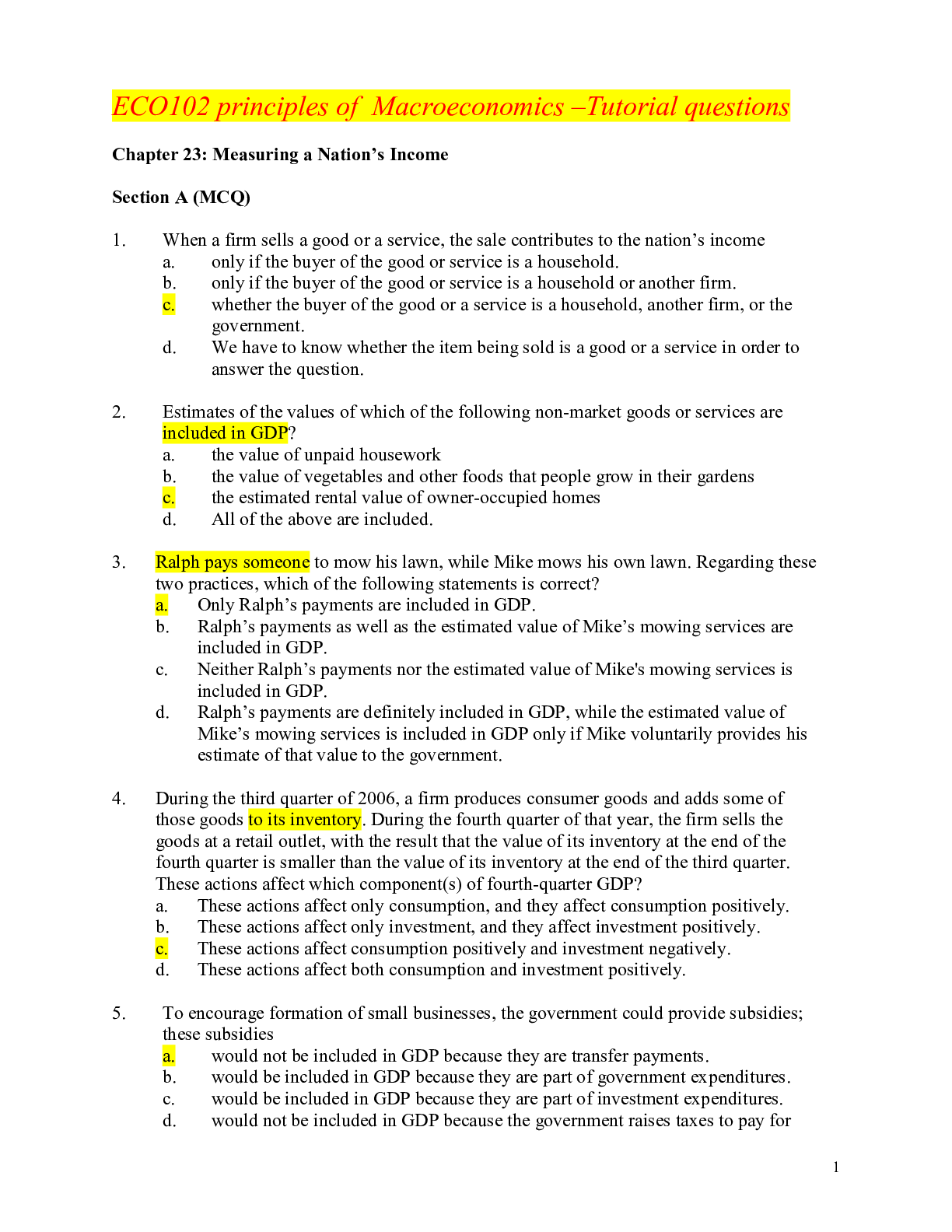

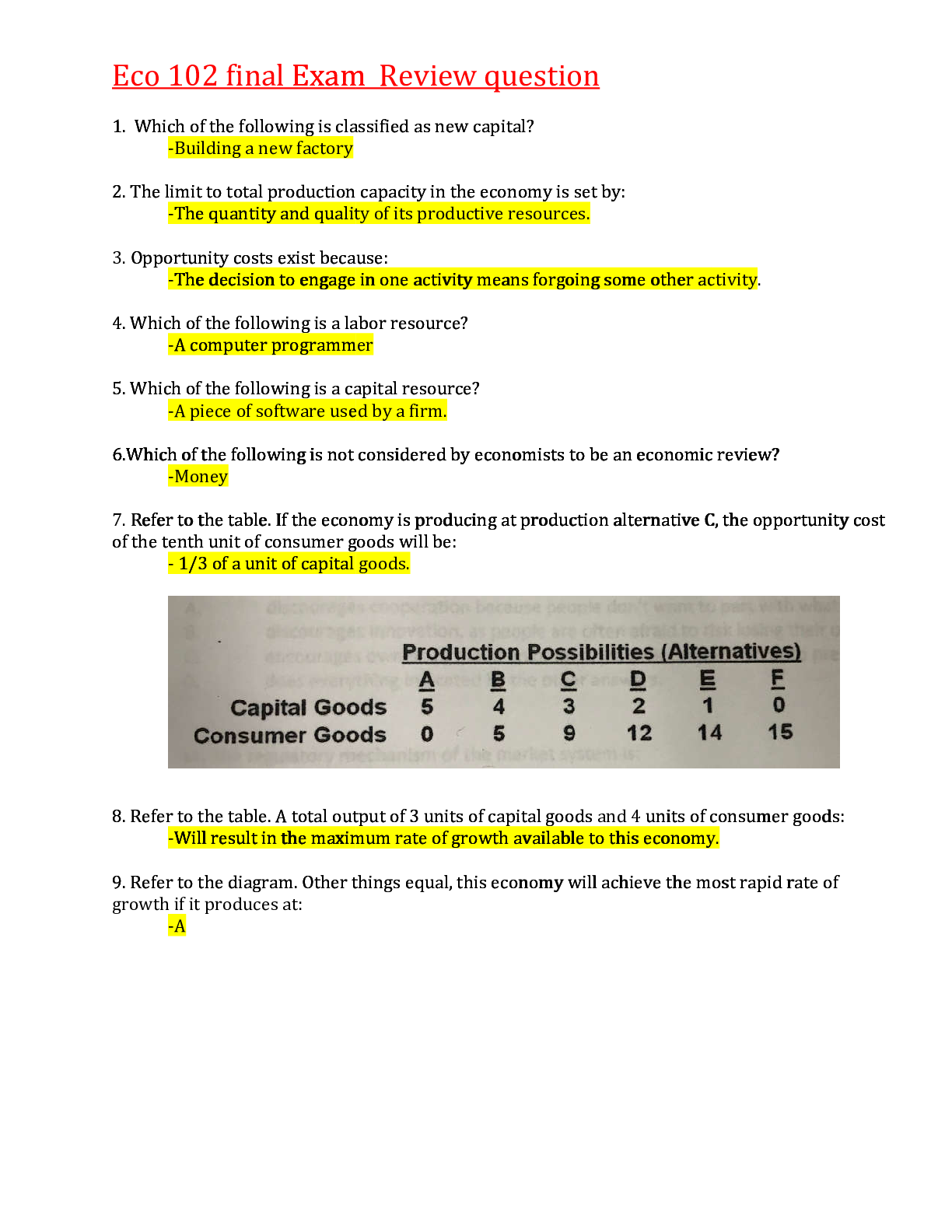



.png)
.png)
.png)