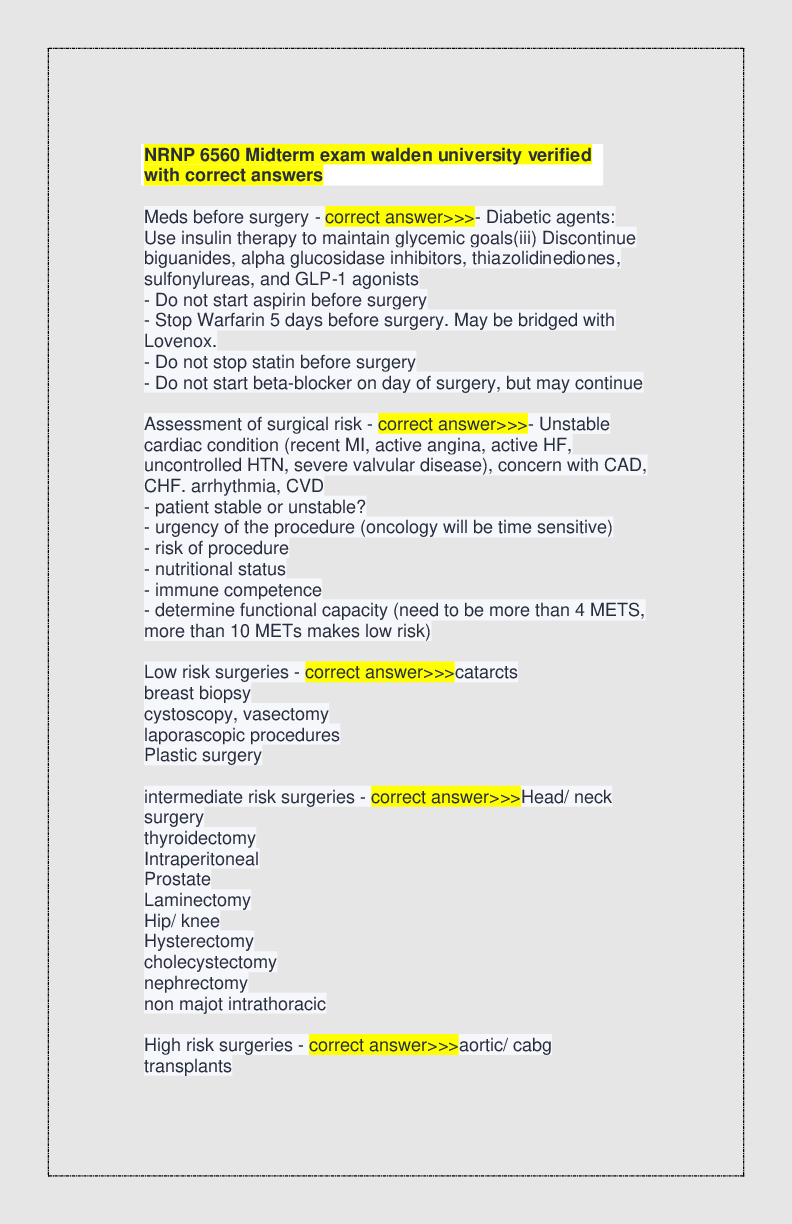
NRNP 6560 Midterm Exam Review Latest 2022 Already graded A+
Document Content and Description Below
Surgery risk classes -----Class 1: benefits outweigh risk, should be done
Class 2a: reasonable to perform
Class 2b: should be considered
Class 3: rarely appropriate
General rules for surgery: testing -----ECG before
...
[Show More]
Last updated: 3 years ago
Preview 1 out of 67 pages
Instant download

Buy this Document to get the Full Access Instantly
Provided by Students Who Aced it
We Verify Document Content to Gurantee Accuracy
Reviews( 0 )
Document information
Connected school, study & course
About the document
Uploaded On
May 12, 2022
Number of pages
67
Written in
All

Additional information
This document has been written for:
Uploaded
May 12, 2022
Downloads
0
Views
250
Topic Tags
Recommended For You
Get more on EXAM »
$16
30 Pages
ATI PEDS PROCTORED EXAM | A nurse is preparing to assess a 4-...



$30
478 Pages
ATI-RN-FUNDAMENTALS-PROCTORED-EXAM-22-VERSIONS-LATEST-2022/202...
$16.5
39 Pages
ATI Pediatric Test Bank 2, Latest 2022 Complete Answers PROCTO...


$14
34 Pages
STRATFORD UNIVERSITY – NSG 325 / NSG325 COMPLEX FINAL EXAM LAT...
$45.5
37 Pages
{NGN}ATI RN Comprehensive 2023!!!! ATI COMPREHENSIVE PREDICTOR...
$26
444 Pages
MED SURG HESI EXIT EXAM QUESTIONS AND ANSWERS CORRECT/VERIFIED...
$16
223 Pages
MED SURG HESI EXIT EXAM Compilation of highly tested Questions...

$25
277 Pages
SAUNDERS COMPREHENSIVE REVIEW FOR NCLEX TEST BANK latest 2022/...

$14
34 Pages
AGNP BOARD EXAM QUESTIONS PRESCRIPTION GASTROENTEROLOGY (85 QU...
More related documents below