HESI A2 critical thinking questions.
VARIOUS SCENARIOS, WITH
RATIONALE ANSWERS. GRADED A+
The patient: A 65 yr old male
The situation: the family brings the patient to the emergency room because he just took an entir
...
HESI A2 critical thinking questions.
VARIOUS SCENARIOS, WITH
RATIONALE ANSWERS. GRADED A+
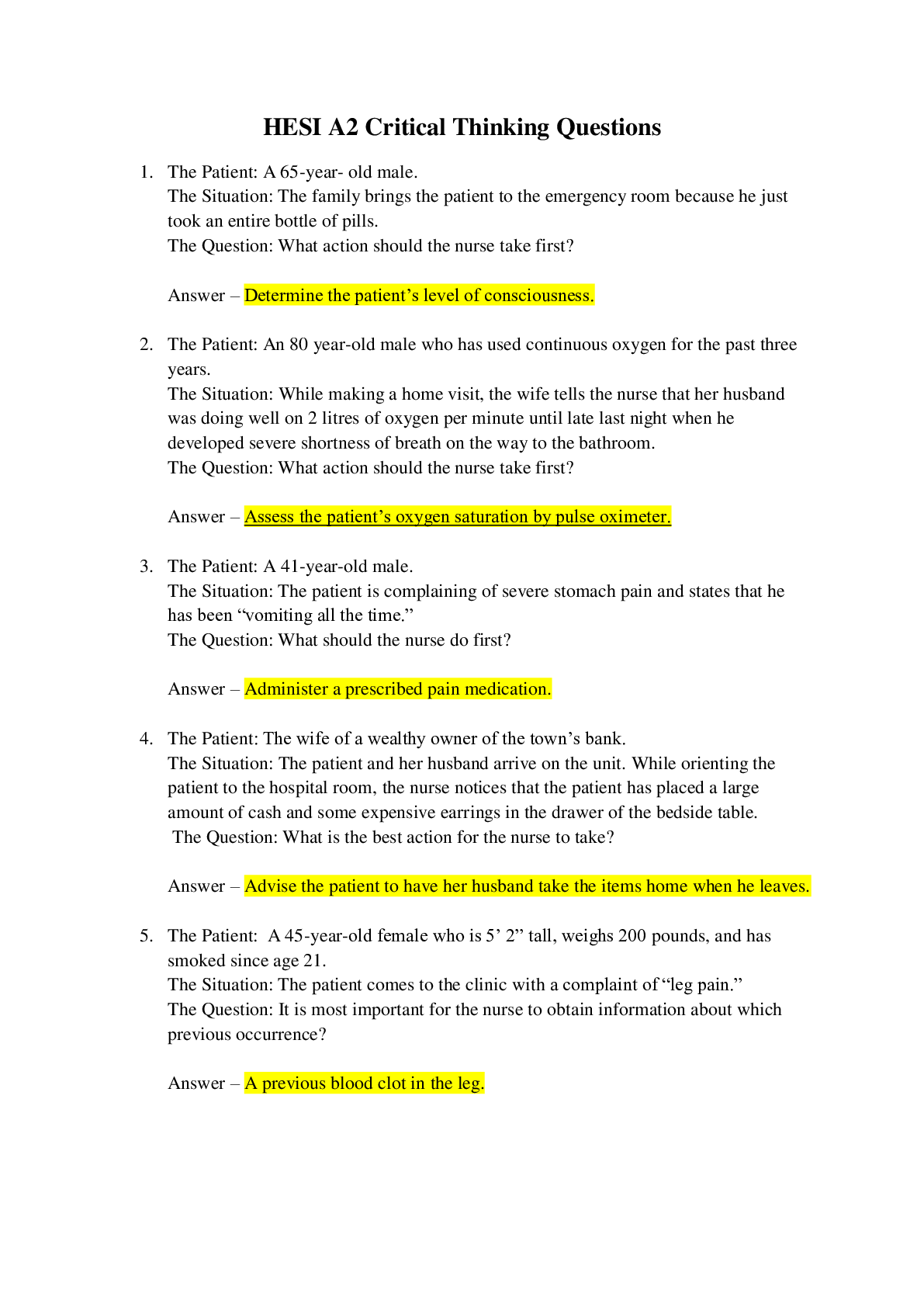
The patient: A 65 yr old male
The situation: the family brings the patient to the emergency room because he just took an entire bottle
of pills.
The question: what action should the nurse take first? - determine the patients level of consciousness
The patient: an 80 yr old male who has used continuous oxygen for the past 3 years.
The situation: while making a home visit, the wife tells the nurse that her husband was doing well on 2
liters of oxygen per min until late last night when he developed severe shortness of breath on the way to
the bathroom.
The question: what action should the nurse take first? - assess the patients oxygen saturation by pulse
oximeter
The patient: 41 y/o male
The situation: the patient is complaining of severe stomach pain and states that he has been "vomiting
all the time".
The question: what should the nurse do first? - administer a prescribed pain medication
The patient: the wife of a wealthy owner of towns bank.
The situation: the patient and her husband arrive on the unit. While orienting the patient to the hospital
room, the nurse notices that the patient has places a large amount of cash and some expensive earrings
in the drawer of the bedside table.
The question: what is the best action for the nurse to take? - advise the patient to have her husband
take the items home when he leaves
The patient: A 45 y/o female who is 5`2`` tall, weighs 200 lbs and has smoked since age 21The situation: the patient comes to the clinic with a complaint of "leg pain"
The question: it is most important for the nurse to obtain information about which pervious occurrence?
- a pervious blood clot in the leg
The patient: 61 y/o female
situation: the patient has a fever of unknown origin. The nurse administered a fever-reducing
medication 30 mins ago. At this time there has been no decrease in the patients fever.
The question: what action would be best for the nurse to take? - sponge the patient with cool water
The patient: 70 y/o make who is relatively healthy
The situation: a liquid medication is prescribed for this patient
The question: prior to administering the prescribed medication, what intervention has the highest
priority? - determine if the patient is allergic to the medication
the patient: 58 y/o female
the situation: while the nurse is offering the patient her morning medication, she tells the nurse she
does not recall ever taking a pill that was pink colored.
The question: what should the nurse do in response to the patients comment? - withhold the
medication until the prescription is verified
The patients:
1. 63 y/o with burn on the left lower leg who is complaining of pain.
2. a 45 y/o with pneumonia, complaining of shortness of breath
3. 31 y/o with abdominal pain who has just vomited blood.
4. 88 y/o who has right sided paralysis and wants to be helped to the bathroom immediately
Situation: the nurse is caring for these patients
The questions: who should the nurse see 1st? - 45 y/o with pneumonia, complaining of shortness of
breath
(ABCs- Airway, Breathing, Circulation)
The patients1. a 13 y/o female with a kidney infection who reports that there is "lots of blood in her urine".
2. 18 y/o male with acute alcohol poisoning who is seeing "bugs on the walls"
3. a 21 y/o female with inflammatory bowel disease who has soaked dressing 3 hrs after surgery
4. a 25 y/o male who is sobbing in his room after being told that he has testicular cancer
Situation: the nurse is caring for these 4 patients
Question: who should the nurse see first? - the 21 y/o who is 3 hrs postoperative and has a soaked
dressing
Patients:
1. a 42 y/o with diabetes who is blind and is asking to get up and moved to a chair
2. a 88 y/o with lower body paralysis who wants to be turned in bed
3. a 17 y/o with asthma who smokes and has been in the bathroom for 30 mins
4. 55 y/o with cardiac disease who tells the nurse " get the tv fixed or i am leaving this place"
Situation: the nurse is caring for these 4 patients
The questions: which patient should the nurse see 1st? - 17 y/o with asthma and smokes and has been
in the bathroom for 30 mins
Patient: an elderly female accompanied by her middle aged son.
Situation: the patient is being discharged after 15 day stay on medical unit, and the son offers a box of
candy as a gesture of thanks for caring for his mother.
Questions: what should the nurse do in response to the offer of this gift? - sincerely thank the son, and
share the candy with all staff members on the unit
Patient: 25 y/o female who has smoked since the age 12
Situation: the patient is complaint of "skipped heart beats".
The question: which instruction is most important for the nurse to provide this patient? - call for
assistance if she feels weak or dizzy when getting out of bed
Patient: a frail 88 y/o male who has recently become slightly confused.
The situation: the nurse is making a home visit and assesses the safety features of the home
environment.The questions: which suggestion would be most important for the nurse to provide the family? -
eliminate any throw rugs from the floor
The patient: 55 y/o female with a family history of hypertension
Situation: the patient is concerned about her health and states " i have have severe headaches for the
last six month. I think I might have high blood pressure" The nurse determines the woman's bp is 138/86
(high normal).
Question: what action would be best for the nurse to take? - ask the patient about the frequency, timing
and quality of her headaches
The Patient: A 35-year-old female with a history of asthma. The Situation: The patient has been using a
steroid inhaler because she is short of breath. However, she states that her shortness of breath is "no
better." The Question: What is the most important information for the nurse to obtain? - method of
using inhaler
The Patient: An older confused male.
The Situation: At 3 a.m. the patient, who thinks he is in the bathroom, defecates in the bed. The bed
needs to be changed. However, there are no bed sheets on the nursing unit. The Question: What action
should the nurse take first? - ask a nursing assistant to go to another unit and borrow linen
The Patient: A 25-year-old female hospitalized for anorexia.
The Situation: The charge nurse denies the patient permission to pass dinner trays.
The Question: What is the most important reason for the nurse to deny this anorexic patient permission
to pass the dinner trays? - treatment protocol for anorexics mandates that they avoid preoccupation
with food.
The Patient: A 75-year-old male who had a heart attack four years ago.
The Situation: The patient tells the nurse, "Even though I stopped smoking 10 years ago, I have a terrible
cough."
The Question: What action should the nurse take first? - auscultate all lung fields
. The Patient: A 70-year-old man dying of prostate cancer.The Situation: Nurse "A," who is charge of a medical unit, notices that a dying patient continues to moan
in pain after receiving intravenous injections of morphins whenever Nurse "B" is caring for him. Nurse
"A" suspects that Nurse "B" may be diluting the patient's dose and taking the morphine to feed an
addiction.
The Question: What should Nurse "A" do in this situation? - Notify the shift supervisor and unit director
of the circumstances before taking action
The Patient: A 29-year-old male. The Situation: A lower leg cast was applied yesterday to a fractured leg.
Today the patient tells the nurse that he is in "terrible pain."
The Question: Which action is most important for the nurse to take? - check the patients toes for
adequate circulation
The Patient: A 54-year-old male who weighs 275 pounds. He is 5' 10" tall and has many family members
who have died of heart disease.
The Situation: He comes to the clinic stating that he has had several episodes of "chest pain" in the last
week.
The Question: What is the most important action for the nurse to take? - ask the patient to describe
chest pain
The Patient: A 7-year-old child. The Situation: A nurse arrives with an injection containing preoperative
sedation that must be given to the child now. The child asks the nurse if the shot will hurt.
The Question: What response should the nurse offer to this child? - "Yes, but it won't last very long and
soon you will be sleepy"
The Patient: A 35-year-old female.
The Situation: The patient is admitted with a diagnosis of abdominal pain and diarrhea. The Question:
Which action should the nurse take first? - Initiate Intravenous fluids.
The Patient: A 51-year-old male. The Situation: The patient is pale, has dark circles under his eyes, and
responds to questions with a soft, low voice. He tells the nurse that he has not slept well for months, but
denies any type of pain.
The Question: What information is most important for the nurse to obtain? - The existence of a
significant life in the last year that has caused anxiety.The Patient: A 19-year-old male who has previously been healthy.
The Situation: The patient complains that he is losing weight despite "eating all the time."
The Question: Considering this patient's age and complaint, which diagnostic test is likely to provide the
most important information? - A fingerstick for blood sugar level.
[Show More]








.png)




.png)