Hesi A2 Chemistry, questions with
accurate answers. Graded A+
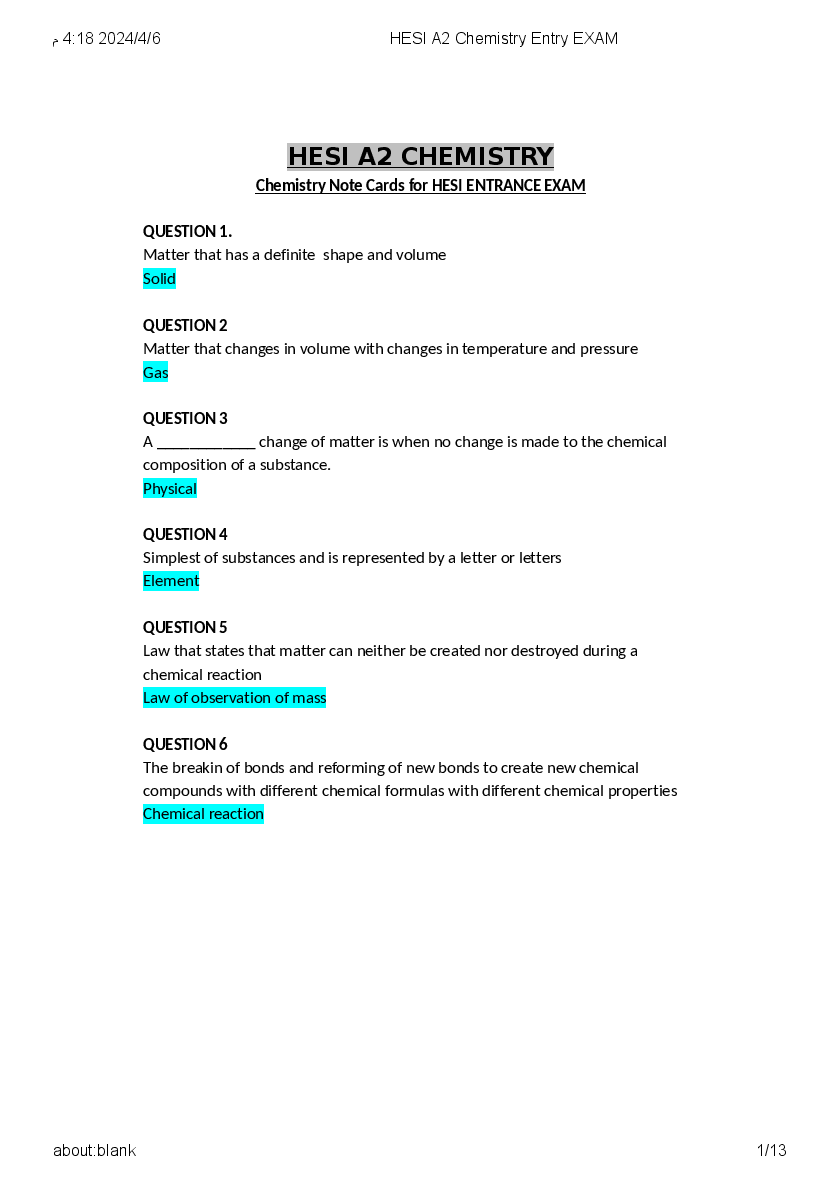
Mixture with uniform density throughout and no distinguishable coponents. - Homogeneous Mixture
Mixture in which the components are readily distinguished.
...
Hesi A2 Chemistry, questions with
accurate answers. Graded A+
Mixture with uniform density throughout and no distinguishable coponents. - Homogeneous Mixture
Mixture in which the components are readily distinguished. - Heterogeneous Mixture
A change in which the checmical composition of a substance remains the same. - Physical Change
A change in which the chemical bonds are broken and reformed to create a new and different
substance. - Chemical Change
The simplest of substances and is represented by a specific letter or combinations of letters. - Element
Combinations of eleements in whole number ratios. - Compounds
Mass cannot be created or destroyed during a chemical reaction. - Law of Conservation of Mass
The breaking of bonds and the reforming of new bonds to create new chemical compounds with
different chemical forumulas and different chemical properties. - Chemical Reaction
syntehesis, decomposition, combusion, single replacement, double replacement - Five main types of
chemical reactions.
Two elements combine to form a product. - Syntehsis Reaction
The breaking of a compound into component parts. - Decomposition ReactionThe reaction of a compound or element with oxygen. In the combusiton of a hydrocarbon carbon
dioxide and water are produced. - Combustion Reaction
Reaction involoving ionic compounds. The reactivity of the ionic compounds determines whether the
reaction will take place or not. Can be single replacement or double replacement reaction. -
Replacement Reactions
Reaction between a more active metal reacting with an ionic compound containing a less active metal to
produce a new compound ex. copper wire reacting with aqueous silver nitrate. - Single Replacement
Reaction
Reaction involving two ionic compounds where the positive ion from one compound combines with the
negative ion of the other compound. The result it two new ionic compounds that have switches
partners. - Double Replacement Reaction
The number of protons in a given element. - Atomic Number
An average of the masses of each of the iostopes of an element as they occur in mature. (Represents the
number of protons and the number of neutrons in an element because electrons essentially have no
mass). - Atomic Weight/ Atomic mass number
What group has a +1 charge - IA
What group has a +2 charge - IIA
What group has a +3 charge - IIIA
Density of an object realtive to water - Specific Gravity
Energy of motion - Kinetic Energy
Stored energy - Potential EnergyForm of energy, measured in calories - Heat
The amount of heat necessary to raise the temperature of 1g of water by 1 degree celsius. - Calorie
Combination of two or more pure substances. - Mixture
Atoms with the same number of protons but different numbers of neutrons. - Isotope
Elements in group 8A of the periodic table. Have no charge and are gases under normal conditions.
(Helium, Neon, Argon, Krypton, Xenon, Radon) - Noble Gases
How many electrons fit in shells 1, 2, 3 & 4? - 2,8,18,32
Elements of group 7A. Have a charge of -1. Fluorine, Chlorine, Bromine, Iodine. Form compounds with
sodium in the form NaX. - Halogens
[Show More]