TRUE/FALSE
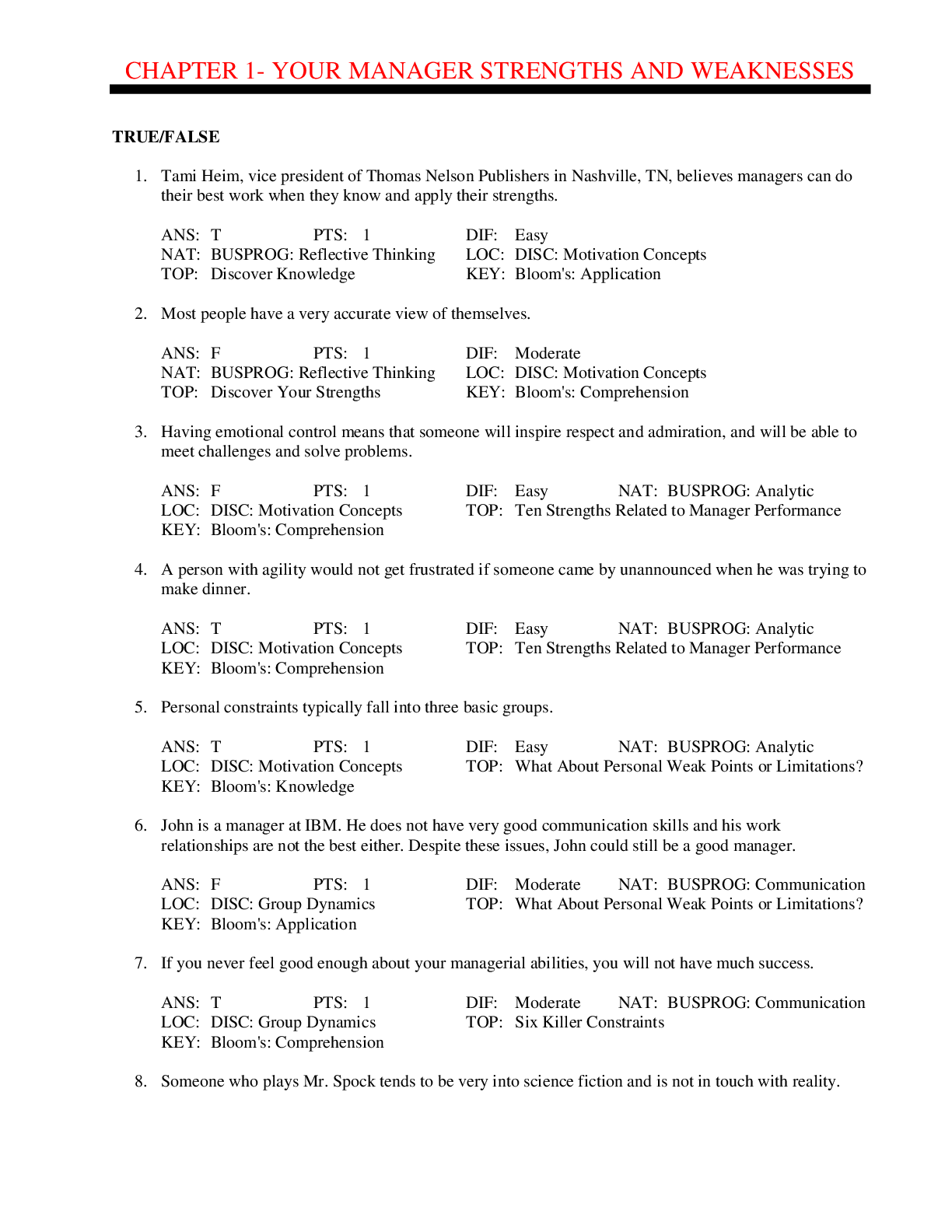
1. Tami Heim, vice president of Thomas Nelson Publishers in Nashville, TN, believes managers can do their best work when they know and apply their strengths.
T PTS: 1 DIF: Easy
NAT: BUSPROG: Reflecti
...
TRUE/FALSE
1. Tami Heim, vice president of Thomas Nelson Publishers in Nashville, TN, believes managers can do their best work when they know and apply their strengths.
T PTS: 1 DIF: Easy
NAT: BUSPROG: Reflective Thinking LOC: DISC: Motivation Concepts
TOP: Discover Knowledge KEY: Bloom's: Application
2. Most people have a very accurate view of themselves.
F PTS: 1 DIF: Moderate
NAT: BUSPROG: Reflective Thinking LOC: DISC: Motivation Concepts
TOP: Discover Your Strengths KEY: Bloom's: Comprehension
3. Having emotional control means that someone will inspire respect and admiration, and will be able to meet challenges and solve problems.
F PTS: 1 DIF: Easy NAT: BUSPROG: Analytic
LOC: DISC: Motivation Concepts TOP: Ten Strengths Related to Manager Performance
KEY: Bloom's: Comprehension
4. A person with agility would not get frustrated if someone came by unannounced when he was trying to make dinner.
T PTS: 1 DIF: Easy NAT: BUSPROG: Analytic
LOC: DISC: Motivation Concepts TOP: Ten Strengths Related to Manager Performance
KEY: Bloom's: Comprehension
5. Personal constraints typically fall into three basic groups.
T PTS: 1 DIF: Easy NAT: BUSPROG: Analytic
LOC: DISC: Motivation Concepts TOP: What About Personal Weak Points or Limitations?
KEY: Bloom's: Knowledge
6. John is a manager at IBM. He does not have very good communication skills and his work relationships are not the best either. Despite these issues, John could still be a good manager.
F PTS: 1 DIF: Moderate NAT: BUSPROG: Communication
LOC: DISC: Group Dynamics TOP: What About Personal Weak Points or Limitations?
KEY: Bloom's: Application
7. If you never feel good enough about your managerial abilities, you will not have much success.
T PTS: 1 DIF: Moderate NAT: BUSPROG: Communication
LOC: DISC: Group Dynamics TOP: Six Killer Constraints
KEY: Bloom's: Comprehension
8. Someone who plays Mr. Spock tends to be very into science fiction and is not in touch with reality.
F PTS: 1 DIF: Easy
NAT: BUSPROG: Reflective Thinking LOC: DISC: Group Dynamics
TOP: Six Killer Constraints KEY: Bloom's: Knowledge
9. An example of self-management is when someone can resist the urge to spend their paycheck immediately in order to save for something they really want, such as a new car.
T PTS: 1 DIF: Moderate
NAT: BUSPROG: Reflective Thinking LOC: DISC: Leadership Principles
TOP: Use Emotional Intelligence to Avoid the Killer Constraints
KEY: Bloom's: Application
10. An example of emotional contagion means that if you have a smile on your face, other people will see that and it will improve their mood.
T PTS: 1 DIF: Moderate
NAT: BUSPROG: Reflective Thinking LOC: DISC: Leadership Principles
TOP: Use Emotional Intelligence to Avoid the Killer Constraints
KEY: Bloom's: Application
MULTIPLE CHOICE
1. You will develop into an effective manager more quickly if you ____.
a. discover your strengths and learn to apply them
b. listen more
c. discover your weaknesses and apply them
d. work more hours
A PTS: 1 DIF: Easy NAT: BUSPROG: Communication
LOC: DISC: Leadership Principles TOP: Discover Knowledge
KEY: Bloom's: Knowledge
2. Warren Buffet finds ____ so fun he would do it for free.
a. making money c. Working
b. investing d. giving speeches
B PTS: 1 DIF: Easy
NAT: BUSPROG: Reflective Thinking LOC: DISC: Leadership Principles
TOP: Discover Knowledge KEY: Bloom's: Knowledge
3. ____ are your naturally recurring patterns of thought, feeling, or behavior.
a. Abilities c. Skills
b. Interests d. Talents
D PTS: 1 DIF: Easy
NAT: BUSPROG: Reflective Thinking LOC: DISC: Leadership Principles
TOP: Discover Knowledge KEY: Bloom's: Knowledge
4. How do you turn facts and information into knowledge?
a. use your talents
b. focus on them and think about them
c. link them to experience and apply them
d. study them
C PTS: 1 DIF: Moderate
NAT: BUSPROG: Reflective Thinking LOC: DISC: Leadership Principles
TOP: Discover Knowledge KEY: Bloom's: Analysis
5. What term refers to accumulated knowledge that has been formalized into behavior steps needed to adequately perform an activity?
a. skills c. Knowledge
b. talents d. Strengths
A PTS: 1 DIF: Easy
NAT: BUSPROG: Reflective Thinking LOC: DISC: Leadership Principles
TOP: Discover Knowledge KEY: Bloom's: Comprehension
6. Why is it important to discover your strengths?
a. people tend to know their strengths accurately
b. people tend to be in a form of denial about themselves
c. people tend to focus on the negative
d. people tend to underachieve
B PTS: 1 DIF: Challenging
NAT: BUSPROG: Reflective Thinking LOC: DISC: Leadership Principles
TOP: Discover Knowledge KEY: Bloom's: Synthesis
7. Which term describes the shift in psychology from negative aspects to people’s strengths?
a. improvement psychology c. strength psychology
b. Seligman psychology d. positive psychology
D PTS: 1 DIF: Easy
NAT: BUSPROG: Reflective Thinking LOC: DISC: Leadership Principles
TOP: Discover Knowledge KEY: Bloom's: Knowledge
8. How many personal strengths exist according to Martin Seligman?
a. 6 c. 48
b. 24 d. 12
B PTS: 1 DIF: Easy
NAT: BUSPROG: Reflective Thinking LOC: DISC: Leadership Principles
TOP: Discover Knowledge KEY: Bloom's: Knowledge
9. Which of the following criteria would be included in a person’s signature strength?
a. sense of ownership of the strength
b. rapid learning curve when using the strength
c. feeling of excitement about the strength
d. all of these
D PTS: 1 DIF: Moderate
NAT: BUSPROG: Reflective Thinking LOC: DISC: Leadership Principles
TOP: Discover Knowledge KEY: Bloom's: Analysis
10. Alan likes work where he has human interaction, as he has good people skills. However, his current job is data entry and has almost no human interaction. What should Alan do to improve his situation?
a. change to a job that has human interaction
b. learn to like data entry
c. improve at data entry
d. none of these actions would help Alan
A PTS: 1 DIF: Moderate
NAT: BUSPROG: Reflective Thinking LOC: DISC: Leadership Principles
TOP: Discover Knowledge KEY: Bloom's: Application
11. ____ means that people feel they are being effective and making a positive contribution.
a. Positive-efficacy c. Self-efficacy
b. Self-control d. Self-confidence
C PTS: 1 DIF: Easy
NAT: BUSPROG: Reflective Thinking LOC: DISC: Leadership Principles
TOP: Discover Knowledge KEY: Bloom's: Comprehension
12. No one can be good at everything, but everyone has ____.
a. some area of strength c. self-control
b. some efficacy d. self-confidence
A PTS: 1 DIF: Easy
NAT: BUSPROG: Reflective Thinking LOC: DISC: Leadership Principles
TOP: Ten Strengths Related to Manager Performance KEY: Bloom's: Knowledge
13. ____ is the foundation for many important manager behaviors.
a. Objectivity c. Focus
b. Emotional control d. Self-confidence
D PTS: 1 DIF: Easy
NAT: BUSPROG: Reflective Thinking LOC: DISC: Leadership Principles
TOP: Ten Strengths Related to Manager Performance KEY: Bloom's: Knowledge
14. Managers who are low on _____ may be easily hurt by criticism.
a. objectivity c. Focus
b. emotional control d. self-confidence
B PTS: 1 DIF: Moderate
NAT: BUSPROG: Reflective Thinking LOC: DISC: Leadership Principles
TOP: Ten Strengths Related to Manager Performance KEY: Bloom's: Analysis
15. Sean has a paper due on Tuesday. It is Monday evening and Sean has stopped working on his paper because a TV show he likes is on. Which attribute does Sean need to improve?
a. objectivity c. focus
b. self-restraint d. self-confidence
C PTS: 1 DIF: Moderate
NAT: BUSPROG: Reflective Thinking LOC: DISC: Leadership Principles
TOP: Ten Strengths Related to Manager Performance KEY: Bloom's: Application
16. A manager low on ____ may be insensitive to the needs of other people or stay isolated while working on tasks of personal importance.
a. objectivity c. Initiative
b. relationship building d. self-confidence
B PTS: 1 DIF: Easy
NAT: BUSPROG: Reflective Thinking LOC: DISC: Leadership Principles
TOP: Ten Strengths Related to Manager Performance KEY: Bloom's: Knowledge
17. _____ refers to the ability to look forward and define a goal or vision for the future.
a. A goal-directed mindset c. Initiative
b. Relationship building d. Ability to organize
A PTS: 1 DIF: Easy
NAT: BUSPROG: Reflective Thinking LOC: DISC: Leadership Principles
TOP: Ten Strengths Related to Manager Performance KEY: Bloom's: Comprehension
18. People with a high ____ can clearly identify the activities and arrange the resources needed to accomplish plans and goals.
a. goal-directed mindset c. Initiative
b. relationship building attitude d. ability to organize
D PTS: 1 DIF: Easy
NAT: BUSPROG: Reflective Thinking LOC: DISC: Leadership Principles
TOP: Ten Strengths Related to Manager Performance KEY: Bloom's: Comprehension
19. Which strength describes someone who is almost always on time for appointments?
a. goal-directed mindset c. agility
b. time management skill d. ability to organize
B PTS: 1 DIF: Easy
NAT: BUSPROG: Reflective Thinking LOC: DISC: Leadership Principles
TOP: Ten Strengths Related to Manager Performance KEY: Bloom's: Knowledge
20. What trait would best suit a manager in a situation where an unexpected event occurs?
a. goal-directed mindset c. agility
b. time management d. ability to organize
C PTS: 1 DIF: Challenging
NAT: BUSPROG: Reflective Thinking LOC: DISC: Leadership Principles
TOP: Ten Strengths Related to Manager Performance KEY: Bloom's: Synthesis
21. It is important to recognize your ___ in addition to your strengths.
a. threats c. scores
b. opportunities d. weaknesses
w
D PTS: 1 DIF: Easy
NAT: BUSPROG: Reflective Thinking LOC: DISC: Leadership Principles
TOP: What About Personal Weak Points or Limitations? KEY: Bloom's: Comprehension
22. What says that every system or process has at least one weakness that prevents it from achieving maximum performance?
a. theory of constraints c. theory of management
b. theory of opportunities d. theory of weaknesses
A PTS: 1 DIF: Easy
NAT: BUSPROG: Reflective Thinking LOC: DISC: Leadership Principles
TOP: What About Personal Weak Points or Limitations? KEY: Bloom's: Comprehension
23. Imagine the following situation: You have to bake a cake. You have milk, eggs, and sugar. You are missing one ingredient, flour. Which ingredient is the constraint?
a. eggs c. Flour
b. sugar d. Milk
C PTS: 1 DIF: Moderate
NAT: BUSPROG: Reflective Thinking LOC: DISC: Leadership Principles
TOP: What About Personal Weak Points or Limitations? KEY: Bloom's: Application
24. In which of the following categories do personal constraints belong?
a. minor constraints that don’t affect work
b. constraints that managers can hire someone else to do for them
c. major constraints that can prevent a manager from performing as needed
d. all of these
D PTS: 1 DIF: Moderate
NAT: BUSPROG: Reflective Thinking LOC: DISC: Leadership Principles
TOP: What About Personal Weak Points or Limitations? KEY: Bloom's: Analysis
25. What is a good way to mitigate a managerial weakness?
a. recognize and admit the weakness
b. pretend the weakness doesn’t exist
c. get help from a therapist
d. all of these
A PTS: 1 DIF: Moderate
NAT: BUSPROG: Reflective Thinking LOC: DISC: Leadership Principles
TOP: What About Personal Weak Points or Limitations? KEY: Bloom's: Comprehension
26. What is one of the most important constraints on being an effective manager?
a. being on time c. not wasting resources
b. lack of people skills d. not being agile enough
B PTS: 1 DIF: Easy
NAT: BUSPROG: Reflective Thinking LOC: DISC: Leadership Principles
TOP: What About Personal Weak Points or Limitations? KEY: Bloom's: Knowledge
27. Which term would most likely describe an unsuccessful manager?
a. good communication skills c. good with people
b. good work relationship d. Arrogant
D PTS: 1 DIF: Easy
NAT: BUSPROG: Reflective Thinking LOC: DISC: Leadership Principles
TOP: What About Personal Weak Points or Limitations? KEY: Bloom's: Knowledge
28. Which term means that the manager did not have sufficient training or was in over her head?
a. delegation and empowerment breakdown
b. person-job mismatch
c. poor planning practices
d. unable to develop teamwork
B PTS: 1 DIF: Easy
NAT: BUSPROG: Reflective Thinking LOC: DISC: Leadership Principles
TOP: What About Personal Weak Points or Limitations? KEY: Bloom's: Knowledge
29. Why did Ruth and Gary Namie found the Workplace Bullying Institute?
a. managers who have delegation and empowerment breakdown
b. to bring awareness to what bullying is and isn’t
c. they know first hand how damaging it can be to work for a boss who is a bully
d. they go to schools to talk about bullying
C PTS: 1 DIF: Easy NAT: BUSPROG: Analytic
LOC: DISC: Group Dynamics TOP: Six Killer Constraints
KEY: Bloom's: Comprehension
30. The ____ are more than a poorly developed skill or weakness in a key managerial area.
a. killer constraints c. both of these
b. fatal flaws d. neither of these
C PTS: 1 DIF: Easy NAT: BUSPROG: Analytic
LOC: DISC: Group Dynamics TOP: Six Killer Constraints
KEY: Bloom's: Knowledge
31. Which constraint would belong to a manager who sabotages his own career?
a. never feeling good enough c. running roughshod over others
b. being a marshmallow d. playing Mr. Spock
A PTS: 1 DIF: Easy NAT: BUSPROG: Analytic
LOC: DISC: Group Dynamics TOP: Six Killer Constraints
KEY: Bloom's: Knowledge
32. Which constraint would describe a manager who is too nice?
a. never feeling good enough c. running roughshod over others
b. being a marshmallow d. playing Mr. Spock
B PTS: 1 DIF: Easy NAT: BUSPROG: Analytic
LOC: DISC: Group Dynamics TOP: Six Killer Constraints
KEY: Bloom's: Knowledge
33. A manager who ____ might walk through the hallways of the office literally carrying a baseball bat to symbolize his toughness.
a. never feels good enough c. runs roughshod over others
b. is a marshmallow d. plays Mr. Spock
C PTS: 1 DIF: Moderate NAT: BUSPROG: Analytic
LOC: DISC: Group Dynamics TOP: Six Killer Constraints
KEY: Bloom's: Application
34. People who are ____ are not able to recognize the role of human feelings in an organization.
a. playing Mr. Spock c. running roughshod over others
b. being a marshmallow d. never feeling good enough
A PTS: 1 DIF: Easy NAT: BUSPROG: Analytic
LOC: DISC: Group Dynamics TOP: Six Killer Constraints
KEY: Bloom's: Knowledge
35. Which of the following characteristics describe someone who has low self-control?
a. able to focus on long term goals c. does not switch jobs often
b. does not make impulse purchases d. none of these
D PTS: 1 DIF: Challenging
NAT: BUSPROG: Reflective Thinking LOC: DISC: Group Dynamics
TOP: Six Killer Constraints KEY: Bloom's: Synthesis
36. Which of the following describes someone who is overly critical?
a. not bothered by someone’s lack of reason
b. doesn’t worry too much about other’s appearance
c. commonly finds the faults in someone
d. thinks that people are generally straightforward with what they mean
C PTS: 1 DIF: Challenging
NAT: BUSPROG: Reflective Thinking LOC: DISC: Group Dynamics
TOP: Six Killer Constraints KEY: Bloom's: Synthesis
37. ____ refers to a person’s ability to perceive, identify, understand and successfully manage emotions in self and others.
a. Relationship intelligence c. Emotional intelligence
b. Self-control d. Emotional control
C PTS: 1 DIF: Easy
NAT: BUSPROG: Reflective Thinking LOC: DISC: Group Dynamics
TOP: Use Emotional Intelligence to Avoid the Killer Constraints
KEY: Bloom's: Knowledge
38. How many fundamental categories of emotional intelligence are there?
a. 4 c. 5
b. 3 d. 6
A PTS: 1 DIF: Easy
NAT: BUSPROG: Reflective Thinking LOC: DISC: Group Dynamics
TOP: Use Emotional Intelligence to Avoid the Killer Constraints
KEY: Bloom's: Knowledge
39. Aware of own feelings, believes in self, and welcomes criticisms describes which emotional intelligence category?
a. self-awareness c. self-management
b. social awareness d. relationship management
A PTS: 1 DIF: Moderate
NAT: BUSPROG: Reflective Thinking LOC: DISC: Group Dynamics
TOP: Use Emotional Intelligence to Avoid the Killer Constraints
KEY: Bloom's: Analysis
40. ____ is the basis of all other competencies.
a. Self-awareness c. Self-management
b. Social awareness d. Relationship management
A PTS: 1 DIF: Easy
NAT: BUSPROG: Reflective Thinking LOC: DISC: Group Dynamics
TOP: Use Emotional Intelligence to Avoid the Killer Constraints
KEY: Bloom's: Knowledge
41. Managers with a high level of _____ learn to trust their “gut feelings.”
a. self-awareness c. self-management
b. social awareness d. relationship management
A PTS: 1 DIF: Easy
NAT: BUSPROG: Reflective Thinking LOC: DISC: Group Dynamics
TOP: Use Emotional Intelligence to Avoid the Killer Constraints
KEY: Bloom's: Knowledge
42. _____ includes the ability to control disruptive, unproductive, or harmful emotions.
a. Self-awareness c. Self-management
b. Social awareness d. Relationship management
C PTS: 1 DIF: Easy
NAT: BUSPROG: Reflective Thinking LOC: DISC: Group Dynamics
TOP: Use Emotional Intelligence to Avoid the Killer Constraints
KEY: Bloom's: Comprehension
43. Self-management is best learned at what age?
a. middle age c. Elderly
b. adolescence d. young children
D PTS: 1 DIF: Easy
NAT: BUSPROG: Reflective Thinking LOC: DISC: Group Dynamics
TOP: Use Emotional Intelligence to Avoid the Killer Constraints
KEY: Bloom's: Knowledge
44. What characteristics are included in self-management?
a. conscientiousness c. Persistence
b. desire d. all of these
A PTS: 1 DIF: Moderate
NAT: BUSPROG: Reflective Thinking LOC: DISC: Group Dynamics
TOP: Use Emotional Intelligence to Avoid the Killer Constraints
KEY: Bloom's: Analysis
45. _____ relates to one’s ability to understand others.
a. Self-awareness c. Self-management
b. Social awareness d. Relationship management
B PTS: 1 DIF: Easy
NAT: BUSPROG: Reflective Thinking LOC: DISC: Group Dynamics
TOP: Use Emotional Intelligence to Avoid the Killer Constraints
KEY: Bloom's: Knowledge
46. Which of the following characteristics describe someone who is socially aware?
a. practices empathy c. understands other’s perspectives
b. senses other’s emotions d. all of these
D PTS: 1 DIF: Moderate
NAT: BUSPROG: Reflective Thinking LOC: DISC: Group Dynamics
TOP: Use Emotional Intelligence to Avoid the Killer Constraints
KEY: Bloom's: Analysis
47. Managers should engage in ____, which is displaying compassion, concern and a helpful attitude toward others without becoming so wrapped up in other’s emotions that it clouds their judgement.
a. professional intimacy c. social management
b. emotional contagion d. all of these
A PTS: 1 DIF: Easy
NAT: BUSPROG: Reflective Thinking LOC: DISC: Group Dynamics
TOP: Use Emotional Intelligence to Avoid the Killer Constraints
KEY: Bloom's: Knowledge
48. _____ refers to the ability to connect with others and build positive relationships.
a. Self-awareness c. Self-management
b. Social awareness d. Relationship management
D PTS: 1 DIF: Easy
NAT: BUSPROG: Reflective Thinking LOC: DISC: Group Dynamics
TOP: Use Emotional Intelligence to Avoid the Killer Constraints
KEY: Bloom's: Knowledge
49. _____ makes up two-thirds of what is different between an average and top performing manager.
a. Social pattern recognition c. Emotional competence
b. Social awareness d. Relationship management
C PTS: 1 DIF: Moderate
NAT: BUSPROG: Reflective Thinking LOC: DISC: Group Dynamics
TOP: Use Emotional Intelligence to Avoid the Killer Constraints
KEY: Bloom's: Knowledge
50. ____ means that managers who are able to maintain balance and keep themselves motivated can serve as positive role models to help motivate and inspire those around them.
a. Social pattern recognition c. Emotional competence
b. Emotional contagion d. Relationship management
B PTS: 1 DIF: Easy
NAT: BUSPROG: Reflective Thinking LOC: DISC: Group Dynamics
TOP: Use Emotional Intelligence to Avoid the Killer Constraints
KEY: Bloom's: Knowledge
SHORT ANSWER
1. How is a talent turned into a strength?
2. What does the term emotional control mean?
3. What is the theory of constraints?
4. List and describe the fundamental categories of emotional intelligence.
ESSAY
1. List and explain three of the ten strengths related to manager performance.
2. Explain the three basic groups of personal constraints.Give an example of each one.
Three groups are:
1. Minor constraints that don’t affect work or management ability. An introverted college professor is common so introversion is not a key constraint on performance.
2. Constraints that a manager can hire someone else to do. If a manager is disorganized, he can hire an assistant to organize his calendar.
3. Major constraints that prevent a manager from performing as needed. Dishonesty would be considered a major constraint.
3. Why is never feeling good enough detrimental to a manager’s career?
[Show More]



![Preview of Comprehensive Stress Management, 15th Edition By Jerrold S. Greenberg | [eBook][PDF]](https://browseimages.nyc3.digitaloceanspaces.com/paper-images/2023/Jul/25/f6jJmm9G2023-07-25-06-5964bf4899d5598.png)