1.Adrenergic bronchodilators mimic the actions of
a.cAMP.
b.acetylcholine.
c.penicillin.
d.epinephrine.
ANS: D
Penicillin is an antibiotic, not a bronchodilator. All adrenergic (sympathomimetic) bronchodilators are
...
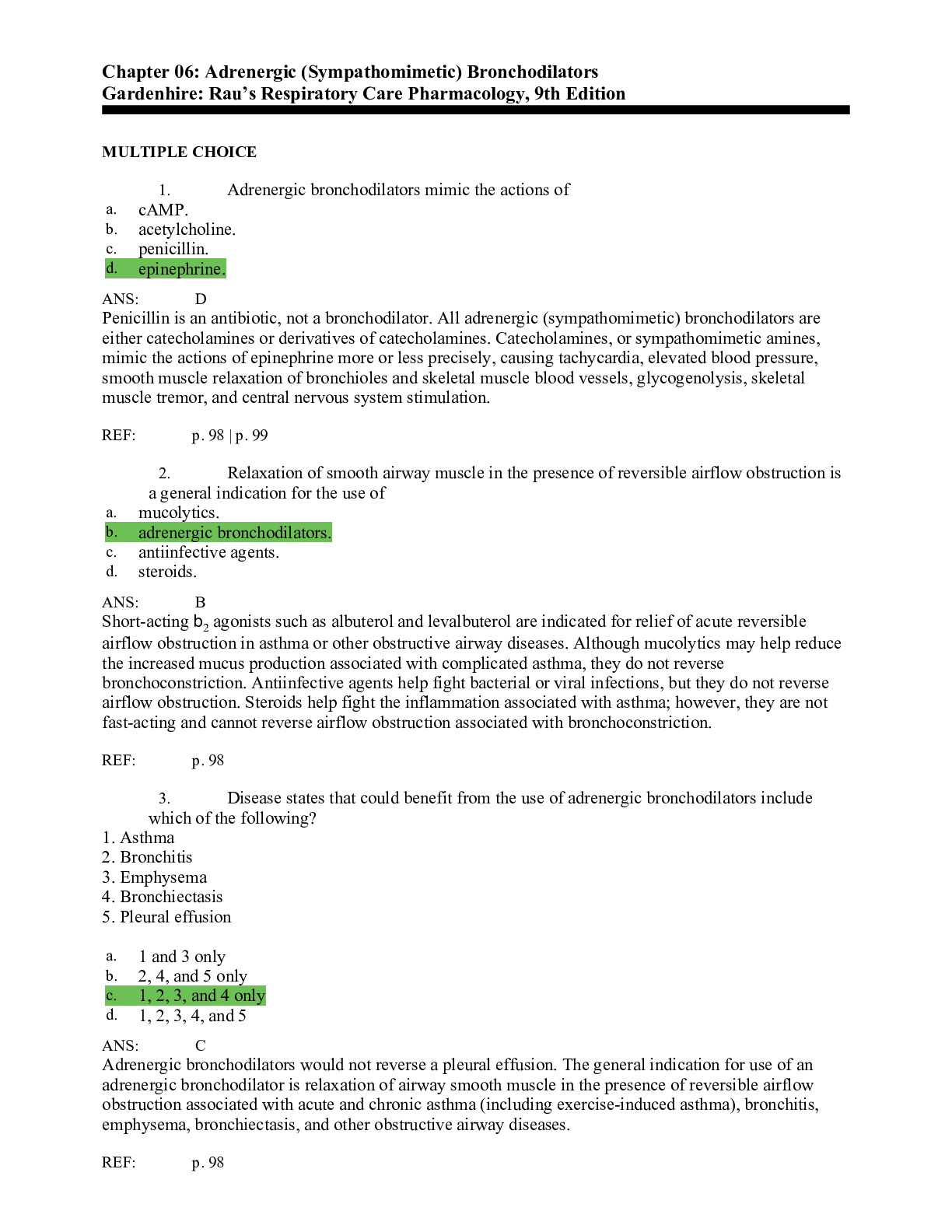
1.Adrenergic bronchodilators mimic the actions of
a.cAMP.
b.acetylcholine.
c.penicillin.
d.epinephrine.
ANS: D
Penicillin is an antibiotic, not a bronchodilator. All adrenergic (sympathomimetic) bronchodilators are either catecholamines or derivatives of catecholamines. Catecholamines, or sympathomimetic amines, mimic the actions of epinephrine more or less precisely, causing tachycardia, elevated blood pressure, smooth muscle relaxation of bronchioles and skeletal muscle blood vessels, glycogenolysis, skeletal muscle tremor, and central nervous system stimulation.
REF: p. 98 | p. 99
2.Relaxation of smooth airway muscle in the presence of reversible airflow obstruction is a general indication for the use of
a.mucolytics.
b.adrenergic bronchodilators.
c.antiinfective agents.
d.steroids.
ANS: B
Short-acting b2 agonists such as albuterol and levalbuterol are indicated for relief of acute reversible airflow obstruction in asthma or other obstructive airway diseases. Although mucolytics may help reduce the increased mucus production associated with complicated asthma, they do not reverse bronchoconstriction. Antiinfective agents help fight bacterial or viral infections, but they do not reverse airflow obstruction. Steroids help fight the inflammation associated with asthma; however, they are not fast-acting and cannot reverse airflow obstruction associated with bronchoconstriction.
REF: p. 98
3.Disease states that could benefit from the use of adrenergic bronchodilators include which of the following?
1.Asthma
2.Bronchitis
3.Emphysema
4.Bronchiectasis
5.Pleural effusion
a.1 and 3 only
b.2, 4, and 5 only
c.1, 2, 3, and 4 only
d. 1, 2, 3, 4, and 5
ANS: C
Adrenergic bronchodilators would not reverse a pleural effusion. The general indication for use of an adrenergic bronchodilator is relaxation of airway smooth muscle in the presence of reversible airflow obstruction associated with acute and chronic asthma (including exercise-induced asthma), bronchitis, emphysema, bronchiectasis, and other obstructive airway diseases.
REF: p. 98
4.Short-acting b2 agonists are indicated for
a.reduction of airway edema.
b.relief of acute reversible airflow obstruction.
c.maintenance of bronchodilation.
d.thinning of secretions.
ANS: B
Steroids, not b agonists, are useful in reducing airway swelling. Short-acting b2 agonists such as albuterol and levalbuterol are indicated for relief of acute reversible airflow obstruction in asthma or other obstructive airway diseases. Long-acting b agonists are used for maintenance bronchodilation. b agonists are not mucus-controlling agents.
[Show More]















.png)
.png)
.png)


.png)

