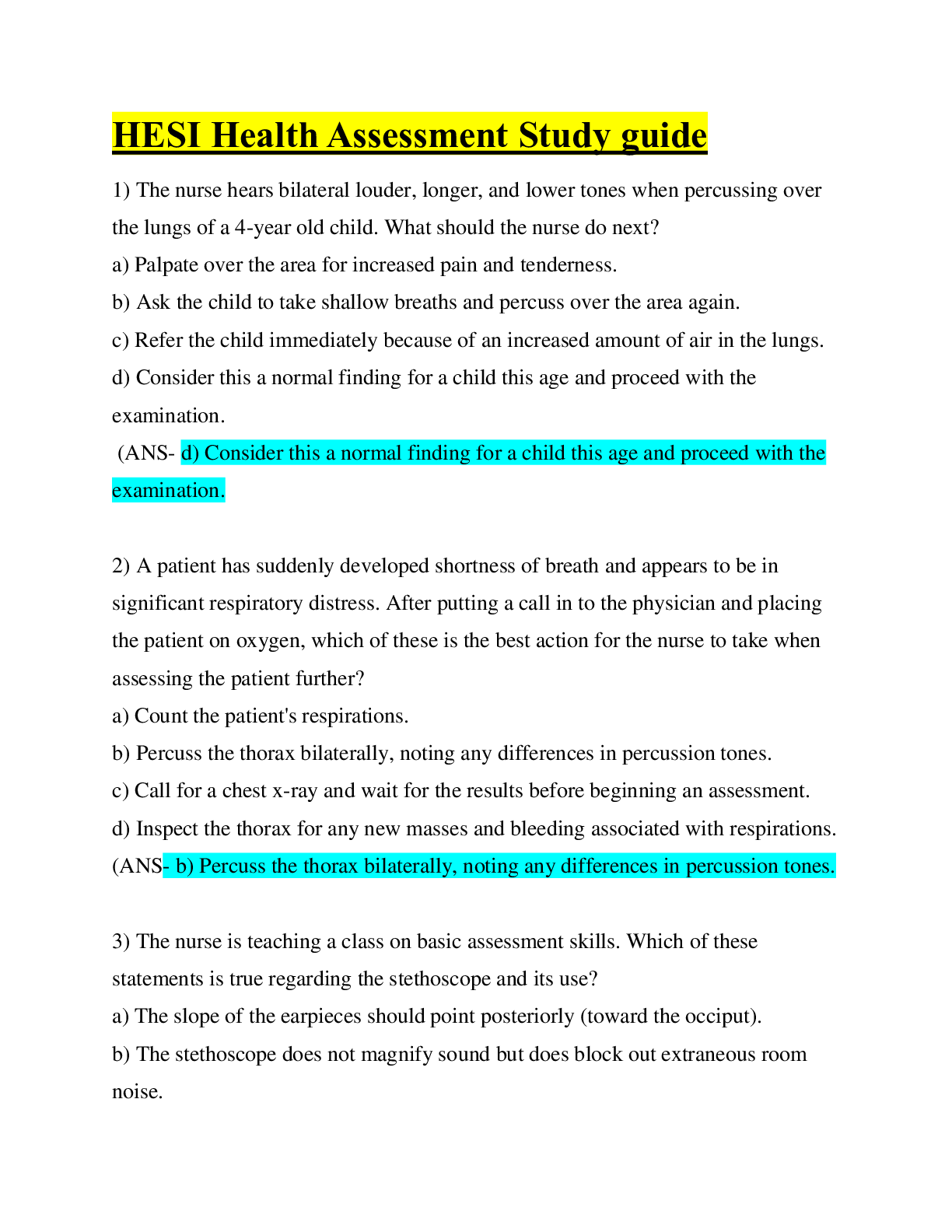
A 35y/o client with cancer refuses to allow a nurse to insert an IV for scheduled chemo & states that she's ready to go home to die. What intervention should the nurse initiate? (ANS - Evaluate the client's mental status
...
A 35y/o client with cancer refuses to allow a nurse to insert an IV for scheduled chemo & states that she's ready to go home to die. What intervention should the nurse initiate? (ANS - Evaluate the client's mental status for competence to refuse treatment
Rationale:
Competent clients have the right to refuse treatment. The nurse cannot document until the HCP is notified of the patient's wishes & a d/c RX is obtained. Advance directives & DNR are not necessary for competent client to refuse care.
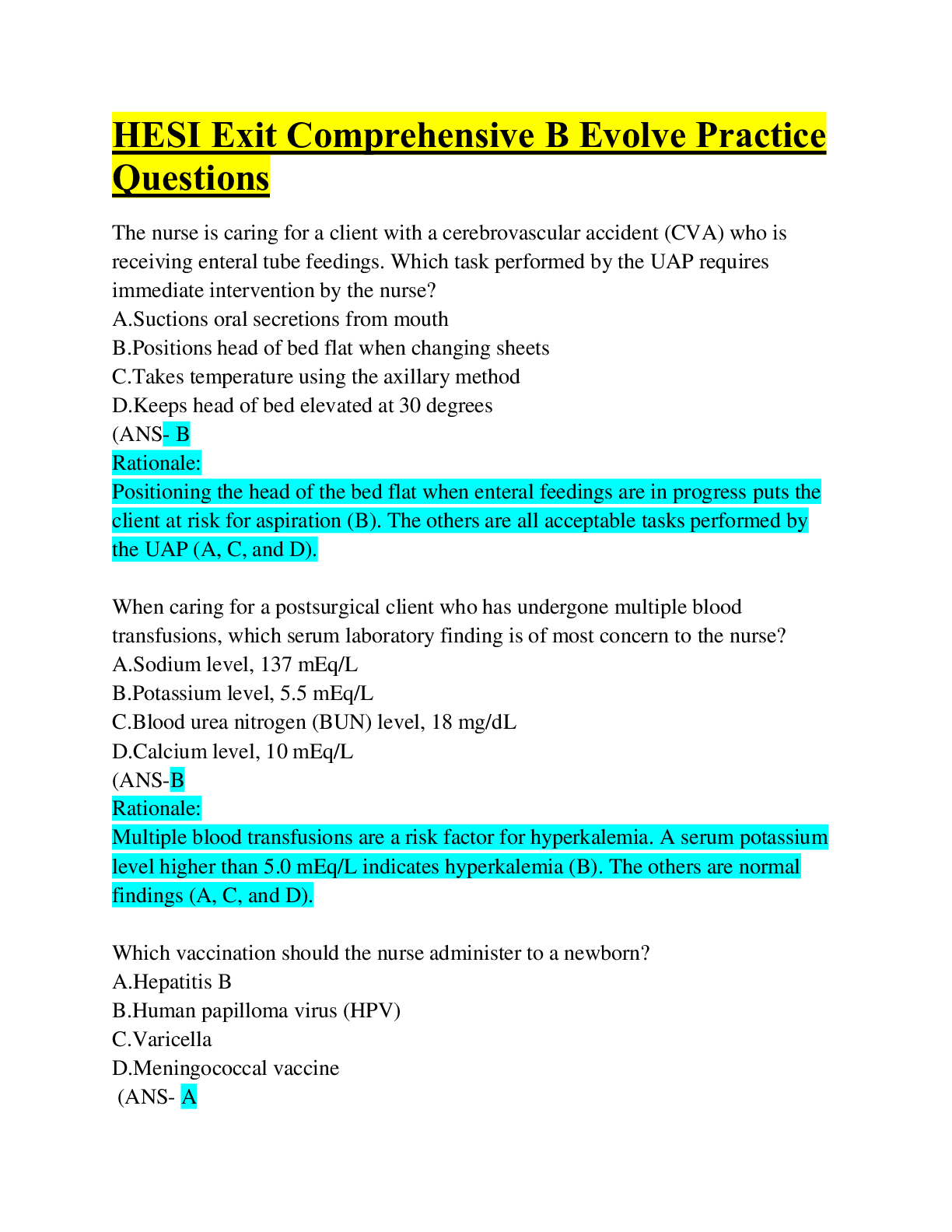
A client with chronic renal disease is admitted to the hospital for evaluation prior to a surgical procedure. Which laboratory test indicates client's protein status for the longest length of time? (ANS - Serum albumin
Rationale: Serum albumin has a long half-life.
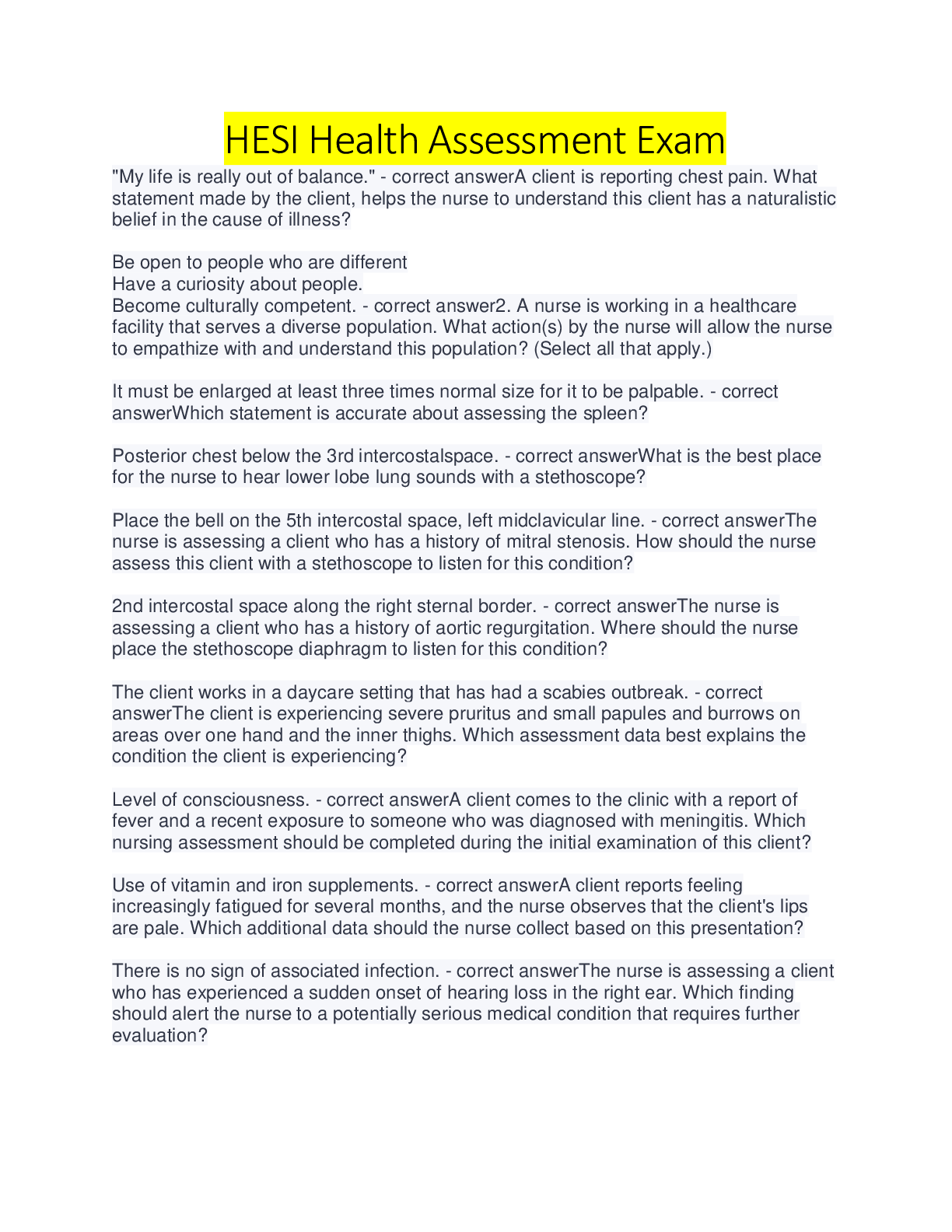
What client statement indicates to the nurse that the client requires assistance with bathing? (ANS - "I don't understand why I'm so weak & tired."
How should the nurse handle linens that are soiled with incontinent feces? (ANS - Place the soiled linens in a pillow case & deposit them in the dirty linen hamper
When caring for an immobile client, what nursing diagnosis has the highest priority? (ANS - Impaired gas exchange
The nurse assesses an immobile, elderly male client & determines that his blood pressure is 138/60, his temperature is 95.8F & his output is 100 mL of concentrated urine during the last hour. He has wet sounding lungs & increased respiratory secretions. Based on these assessment findings , what nursing action is most important for the nurse to implement? (ANS - Turn the client q2h
Rationale: It will help move & drain respiratory secretions & prevent pneumonia from occurring.
The home health nurse visits an elderly female client who had a brain attack 3 months ago & is now able to ambulate with the assistance of a quad cane. Which assessment finding has the greatest implications for this client's care? (ANS - The nurse notes there are numerous scatter rugs throughout the house
The nurse removes the dressing on a client's heel that is cover a pressure sore 1" in diameter & finds that there is straw-colored drainage seeping from the wound. What description of this finding should the nurse include in the client's record? (ANS - One-inch pressure sore draining serous fluid
Medication is prescribed to be given QID. What schedule should the nurse use to administer this Rx? (ANS - 0800, 1200, 1600, 2000
The nurse working in the ED is assessing 4 clients' ability to tolerate pain. Which client is likely to tolerate a higher level of pain? (ANS - 1 55y/o woman who has had moderate low back pain for 3 months
Rationale: Experiences with the same type of pain that has successfully been relieved makes it easier for the client to interpret the pain sensation and, as a result, the client is better prepared to take steps to relieve the pain. All other clients are having new experiences with pain.
A 4y/o boy who is scheduled for a tonsillectomy & adenoidectomy asks the nurse, "Will it hurt to have my tonsils & adenoids taken out?" Which response is best for the nurse to provide? (ANS - "It may hurt, but we'll give you medicine to help you feel better."
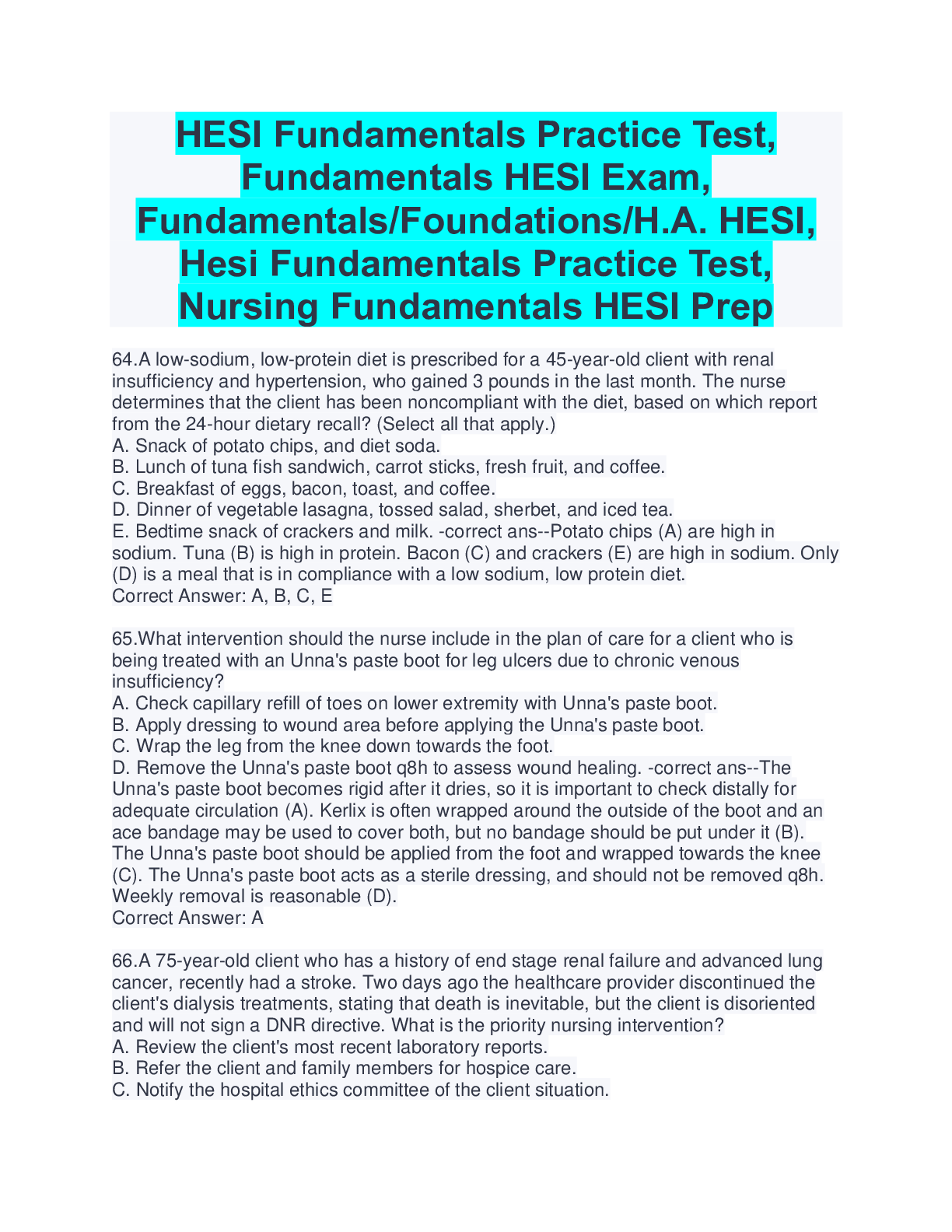
A low-sodium, low-protein diet is prescribed for a 45y/o client with renal insufficiency & HTN, who gained 3lbs in the last month. The nurse determines that the client has been noncompliant with the diet, based on which report from the 24hr diet recall?
(ANS – 1. Snack of potato chips & diet soda
2. Lunch of tuna, carrots, fruit & coffee
3. Breakfast of eggs, bacon, toast & coffee
4. Bedtime snack of crackers & milk
What intervention should the nurse include in the care plan for a client who is being treated with an Unna's paste boot for leg ulcers due to chronic venous insufficiency? (ANS - Check capillary refill of toes on lower extremity with Unna's paste boot
Rationale: Boot becomes rigid after it dries, so it is important to check distally for adequate circulation. No bandage should be put under it. Should be applied from foot & wrapped towards knee. Acts as a sterile dressing & should not be removed q8h. Weekly removal is reasonable.
[Show More]







![Preview of HESI Critical Care TEST BANK RN 2021 [50 Questions /Answers]](https://scholarfriends.com/storage/Critical_Care_HESI_notes___.png)