A client with deep partial-thickness and full-thickness burns of the face and chest is receiving wound care using the open method. The plan of care includes the Nsg Dx, "Risk for infection R/T impaired tissue integrity."
...
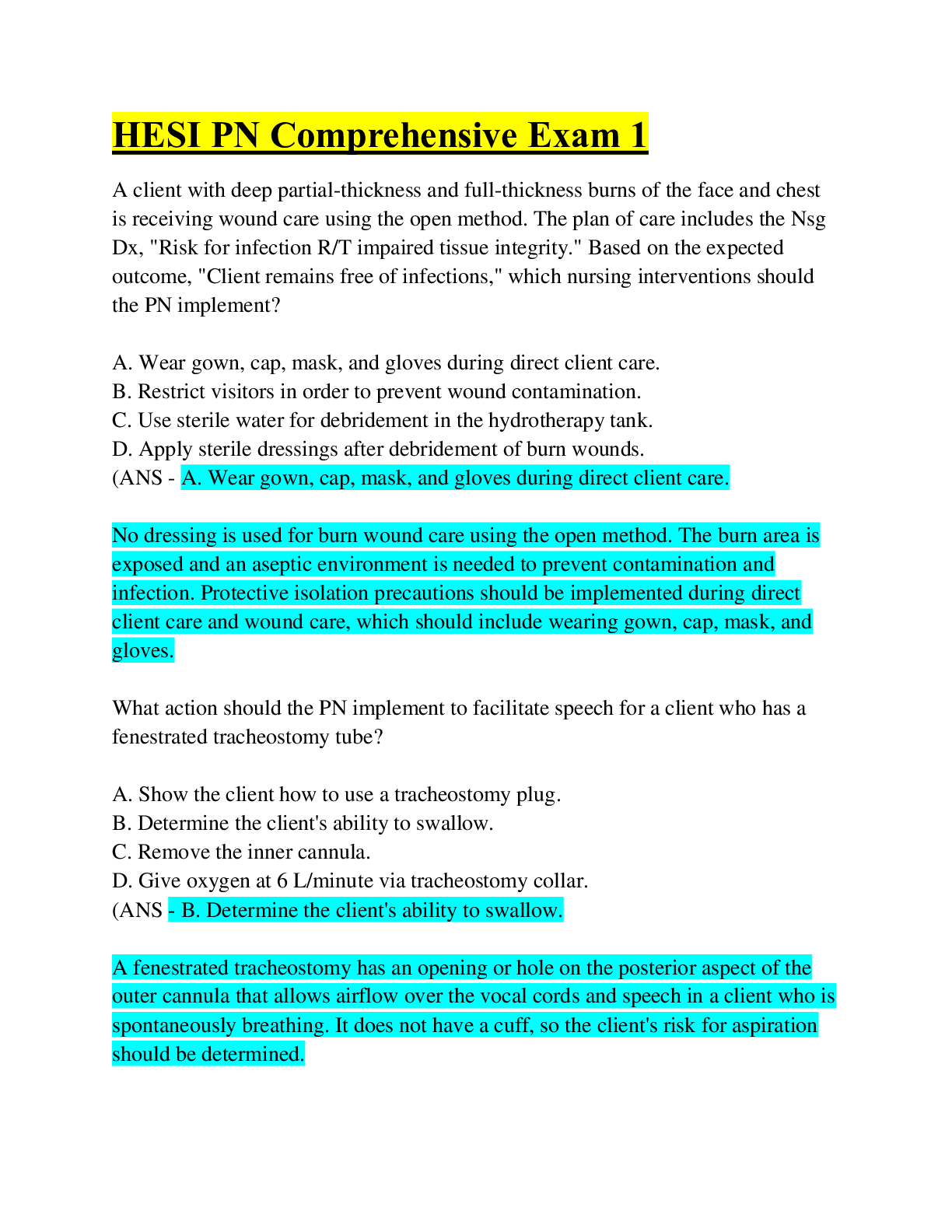
A client with deep partial-thickness and full-thickness burns of the face and chest is receiving wound care using the open method. The plan of care includes the Nsg Dx, "Risk for infection R/T impaired tissue integrity." Based on the expected outcome, "Client remains free of infections," which nursing interventions should the PN implement?
A. Wear gown, cap, mask, and gloves during direct client care.
B. Restrict visitors in order to prevent wound contamination.
C. Use sterile water for debridement in the hydrotherapy tank.
D. Apply sterile dressings after debridement of burn wounds.
(ANS - A. Wear gown, cap, mask, and gloves during direct client care.
No dressing is used for burn wound care using the open method. The burn area is exposed and an aseptic environment is needed to prevent contamination and infection. Protective isolation precautions should be implemented during direct client care and wound care, which should include wearing gown, cap, mask, and gloves.
What action should the PN implement to facilitate speech for a client who has a fenestrated tracheostomy tube?
A. Show the client how to use a tracheostomy plug.
B. Determine the client's ability to swallow.
C. Remove the inner cannula.
D. Give oxygen at 6 L/minute via tracheostomy collar.
(ANS - B. Determine the client's ability to swallow.
A fenestrated tracheostomy has an opening or hole on the posterior aspect of the outer cannula that allows airflow over the vocal cords and speech in a client who is spontaneously breathing. It does not have a cuff, so the client's risk for aspiration should be determined.
A male client scheduled for a total laryngectomy and radical neck dissection for cancer of the larynx asks the PN if he will ever be able to speak. Which response is bets for the PN to provide?
A. Breathing occurs through a permanent neck opening which prevents normal speech.
B. Permanent removal of the voice box requires rehabilitation for esophageal speech.
C. Due to removal of the vocal cords, communication requires the use of sign language.
D. Once the breathing hole in the neck heals, the ability to speak requires a device.
(ANS - B. Permanent removal of the voice box requires rehabilitation for esophageal speech.
A total laryngectomy includes removal of the larynx and pre-epiglottis region resulting in a permanent tracheostomy and loss of normal speech abilities. Rehab is required to learn to speak using a prosthesis, esophageal speech, or an electrolarynx.
A client is wearing a continuous 24-hour Holter monitor for elevation of heart rhythm disturbances. What info should the PN reinforce with this client?
A. Remove the electrodes to shower or bathe
B. Keep a diary of activities as long as the monitor is worn.
C. Exercise as much as possible while the monitor is in place.
D. Call the assigned number if an episode of irregular heartbeats occurs.
(ANS - B. Keep a diary of activities as long as the monitor is worn.
Nursing care for a client with a Holter monitor includes preparation of the skin, placement of the electrodes and leads, and activities of daily living, so the client should be informed of the importance of keeping an accurate record of activities and symptoms
The PN is caring for a client who is receiving a therapeutic dose of warfarin (Coumadin). The client asks the PN to explain the effect of eating green leafy vegetables. What info should the PN provide?
A. The high content of vitamin K in green leafy vegetables decreases Coumadin's action.
B. Green vegetables are high in fiber and cellulose that decrease the absorption of Coumadin.
C. These foods have a natural anticoagulant effect that potentiates the effect of Coumadin.
D. Dietary intake of green leafy vegetables alters the bowel bacteria's production of vitamin K.
(ANS - A. The high content of vitamin K in green leafy vegetables decreases Coumadin's action.
Coumadin works as an anticoagulant by blocking hepatic utilization of vitamin K in the production of prothrombin, which is a component of the blood clotting cascade. Green leafy vegetables are high in vitamin K, which counteracts the anticoagulant effect of Coumadin.
The PN is reviewing the effects of NSAIDs (nonsteroidal anti-inflammatory drugs) with a client who has acute gastritis. What info is correct about the action of NSAIDs?
A. Causes histamine receptor stimulation that increases the release of hydrochloric acid.
B. Inhibits the synthesis of prostaglandins that normally protect the stomach lining.
C. Activates an inflammatory response which increases the drug's absorption.
C.
D. Stimulates parietal cells to release pepsin leading to digestion of ingested foods.
(ANS - B. Inhibits the synthesis of prostaglandins that normally protect the stomach lining
NSAIDs inhibit the synthesis of prostaglandins which protect the stomach lining.
After undergoing exploratory laparotomy and bowel resection, a client with an NG tube to suction complains of nausea and stomach distention. The PN irrigates the tube, but the irrigating fluid does not return. What action should the PN implement?
A. Notify the healthcare provider.
B. Auscultate for bowel sounds.
C. Reposition the tube and check for placement.
D. Remove the tube and replace it with a new one.
(ANS - C. Reposition the tube and check for placement.
Patency and position of a NGT are checked frequently to evaluate for dislodgement or NGT obstruction with mucous, sediment, or blood clots. The placement should be verified and repositioned in the stomach to obtain a return of the normal saline used to irrigate the NGT.
A client with advanced cirrhosis is prescribed lactulose (Cephulac) 30 ml QID. The client complains that the medicine is causing diarrhea. Which therapeutic response of the medication should the PN provide the client?
A. Promotes fluid loss.
B. Prevents constipation.
C. Excretes ammonia to improve cerebral function.
D. Reduces the risk for gastrointestinal bleeding.
(ANS - C. Excretes ammonia to improve cerebral function.
To treat portal-systemic encephalopathy, lactulose causes the movement of serum ammonia, which accumulates due to hepatic dysfunction in cirrhosis, into the gut and results in diarrhea due to the osmotic movement of water.
The PN is reinforcing the discharge instructions for a female client with cystitis. Which statement indicates to the PN that the client understands measures to prevent urinary tract infections (UTI)?
A. "I will limit my fluid intake to 1000 ml/day to prevent symptoms of frequency and urgency."
B. "Every 2 to 3 hours during waking hours, I will drink a glass of water and empty my bladder."
C. "I will use an antiseptic vaginal deodorant spray to reduce perineal bacterial growth."
D. After each bowel movement, I will wash my perineal area with soap and water.
(ANS - B. "Every 2 to 3 hours during waking hours, I will drink a glass of water and empty my bladder."
Measures to reduce the risk of UTI include liberal fluid intake, frequent bladder emptying, and hygienic measures to prevent ascending bacterial contamination of the bladder. The client's statement that best indicates understanding includes maintaining a regular and frequent fluid intake and urination every 2 to 3 hours during the day.
The PN is caring for a client with chronic kidney disease (CKD). What info should the PN reinforce about medication management?
A. Oral iron supplements reverse chronic anemia in CKD.
B. Calcium supplements are needed to maintain serum levels.
C. Nonsteroidal antiinflammatories are safe to use for pain.
D. Antihypertensive drugs should always be used as directed.
(ANS - D. Antihypertensive drugs should always be used as directed.
Blood pressure control is essential for a client with CKD because hypertension and cardiovascular disease occur with the progression of CKD.
A female client who is newly diagnosed with Type 2 diabetes tells the PN that she hates to exercise and asks whether just following her 1000-calorie diet will control her diabetes. Which response should the PN provide that offers the best information?
A. To ensure an increased energy and a sense of well-being, diet and exercise should be balanced.
B. Exercise facilitates weight loss and decreases peripheral insulin resistance.
C. To improve cardiovascular and respiratory fitness, a regular routine for exercise should be practiced.
D. A routine pattern for meal scheduling is needed for tight glucose control.
(ANS - B. Exercise facilitates weight loss and decreases peripheral insulin resistance.
Exercise increases insulin sensitivity and has a direct effect on lowering the blood glucose levels. Dietary compliance and regular exercise contribute to weight loss, which also decreases insulin resistance.
Which information related to a client's history of benign prostatic hypertrophy (BPH) should the practical nurse (PN) report to the healthcare provider?
A. Change in bowel movements.
B. Persistent lower back pain.
C. White penile discharge.
D. Difficulty with urination.
(ANS - D. Difficulty with urination.
The prostate gland lies below the bladder neck and surrounds the urethra. An increase in the size of the prostate gland caused by BPH compresses the urethra, resulting in difficulty initiating the urinary stream.
What action should the practical nurse (PN) implement first for a client with a head injury and clear nasal drainage?
A. Obtain a specimen of the fluid for culture and sensitivity.
B. Check the nasal drainage with a glucose test strip.
C. Assess the client's temperature every 2 to 4 hours.
D. Inspect the nares bilaterally for signs of inflammation.
(ANS - B. Check the nasal drainage with a glucose test strip.
If the client is exhibiting clear nasal drainage after a head injury, the first action is to determine if the fluid is cerebrospinal fluid (CSF). Glucose is present in CSF.
At the scene of a motor vehicle collision, the practical nurse (PN) stops to render assistance to a victim who has bleeding injuries of the face and neck. Which action should the PN implement after establishing that the victim is unresponsive?
A. Deliver two mouth-to-mouth breaths.
B. Immobilize the head and neck.
C. Open the airway using jaw thrust method.
D. Clear the airway using a finger sweep.Open the airway using jaw thrust method.
(ANS - B. Immobilize the head and neck.
Cervical spine trauma should be suspected in any client with significant upper torso, face, head, or neck trauma, so cervical immobilization should be applied prior to opening the airway using the jaw thrust, instead of the head tilt method.
The practical nurse (PN) is monitoring a client who is admitted in active labor. After reviewing the nursing admission assessment, the PN determines the client's membranes have been ruptured for 36 hours. The PN should monitor the client for which risk factor?
A. Excessive bleeding.
B. Precipitous labor.
C. Supine hypotension.
D. Intrauterine infection.
(ANS - D. Intrauterine infection.
When a client is in active labor with spontaneous rupture of membranes (SROM) longer than 24 hours, microorganisms from the vagina can ascend into the amniotic sac and cause chorioamnionitis and placentitis.
Which statement by the mother of a newborn should alert the practical nurse (PN) to offer further information about the care of the umbilical cord?
A. "I will use warm water to wash my baby's diaper area with each change."
B. "I am going to sponge bathe my baby for the first couple of weeks."
C. "I can't wait to bathe my baby in the new baby tub as soon as I get home."
D. "I should keep the cord area dry and use an alcohol wipe until the cord falls off.
(ANS - C. "I can't wait to bathe my baby in the new baby tub as soon as I get home."
The infant should not be submerged in a tub bath until the umbilical cord dries and falls off.
During a prenatal visit, expectant parents ask the practical nurse (PN) how to safely transport a newborn home in a car seat. What information should the PN provide?
A. The car seat should be secured in the front seat using the seatbelt.
B. The chest harness should slide over the newborn's abdomen.
C. A car seat should be in the rear facing position in the back seat.
D. An infant should be elevated at a 60 degree angle while in the car seat.
(ANS - C. A car seat should be in the rear facing position in the back seat.
Infants should travel only in federally approved, rear-facing safety seats secured in the rear seat from birth to 20 pounds and to 1 year of age.
Which finding in a newborn is most important for the practical nurse (PN) to report?
A. Clinical jaundice evident on the forehead within 24 hours of birth.
B. Icterus color of blanched skin on the thorax at day 3 after birth.
C. Serum bilirubin concentrations less than 2 mg/dl in cord blood.
D. Bilirubin level of 4 mg/dl using a transcutaneous bilirubinometry.
(ANS - A. Clinical jaundice evident on the forehead within 24 hours of birth.
Jaundice is clinically visible when bilirubin levels reach 5 to 7 mg/dl and appears in a cephalocaudal manner, first noticed in the head, and then progresses gradually to the thorax, abdomen, and extremities. Clinical jaundice that is evident within 24 hours of birth warrants immediate attention and is pathological. Although additional assessments of physiological jaundice should be made, jaundice in the first 24 hours is life threatening and requires immediate intervention.
[Show More]