This patient was admitted for chemotherapy due to a primary hepatocellular carcinoma of the
transplanted liver. What codes are assigned?
a. Z51.11, C22.0
b. Z51.11, C22.0, C80.2
c. Z51.11, T86.49, C80.2, C22.0
d. T8
...
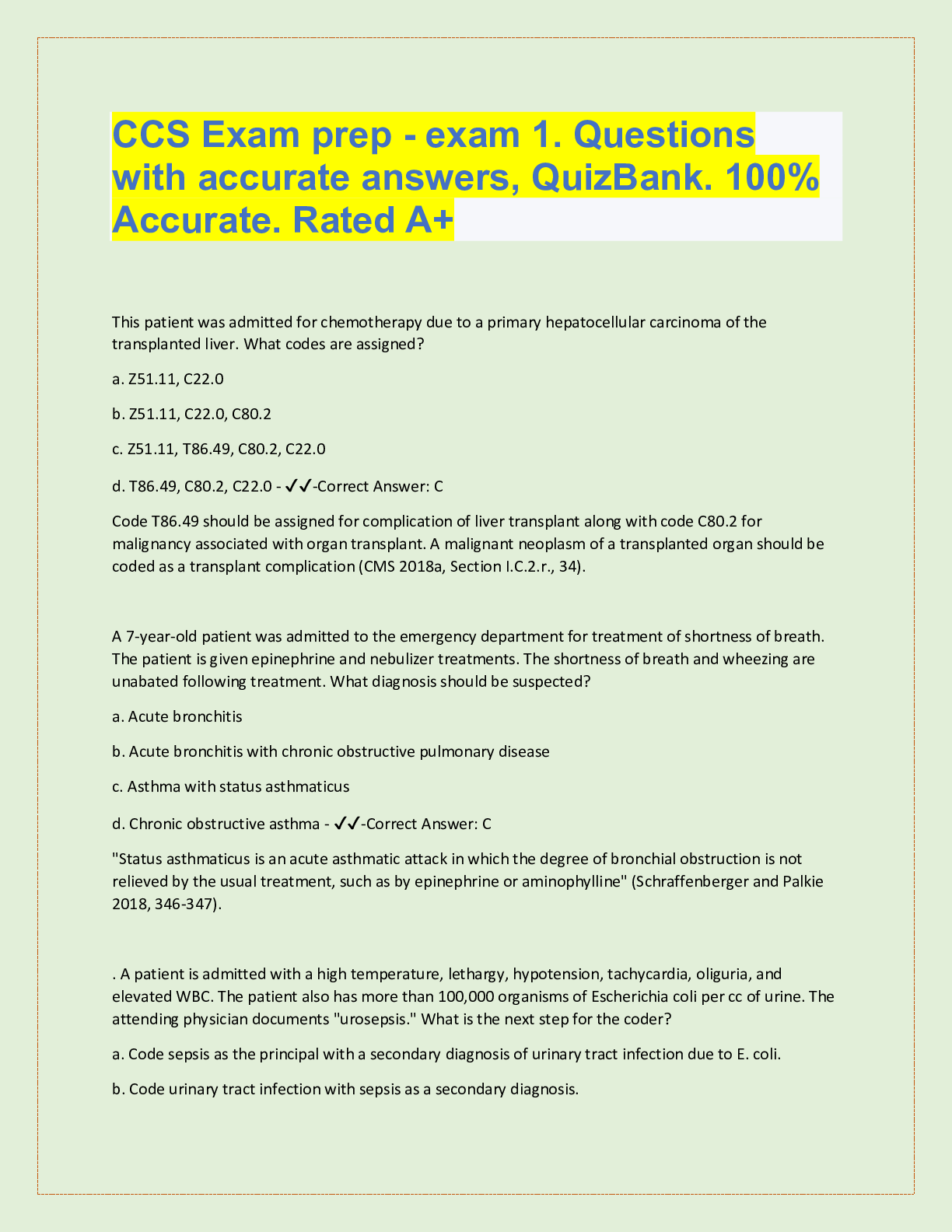
This patient was admitted for chemotherapy due to a primary hepatocellular carcinoma of the
transplanted liver. What codes are assigned?
a. Z51.11, C22.0
b. Z51.11, C22.0, C80.2
c. Z51.11, T86.49, C80.2, C22.0
d. T86.49, C80.2, C22.0 - ✔✔Correct Answer: C
Code T86.49 should be assigned for complication of liver transplant along with code C80.2 for
malignancy associated with organ transplant. A malignant neoplasm of a transplanted organ should be
coded as a transplant complication (CMS 2018a, Section I.C.2.r., 34).
A 7-year-old patient was admitted to the emergency department for treatment of shortness of breath.
The patient is given epinephrine and nebulizer treatments. The shortness of breath and wheezing are
unabated following treatment. What diagnosis should be suspected?
a. Acute bronchitis
b. Acute bronchitis with chronic obstructive pulmonary disease
c. Asthma with status asthmaticus
d. Chronic obstructive asthma - ✔✔Correct Answer: C
"Status asthmaticus is an acute asthmatic attack in which the degree of bronchial obstruction is not
relieved by the usual treatment, such as by epinephrine or aminophylline" (Schraffenberger and Palkie
2018, 346-347).
. A patient is admitted with a high temperature, lethargy, hypotension, tachycardia, oliguria, and
elevated WBC. The patient also has more than 100,000 organisms of Escherichia coli per cc of urine. The
attending physician documents "urosepsis." What is the next step for the coder?
a. Code sepsis as the principal with a secondary diagnosis of urinary tract infection due to E. coli.
b. Code urinary tract infection with sepsis as a secondary diagnosis.c. Query the physician to determine if the patient is being treated for sepsis, highlighting the clinical
signs and symptoms.
d. Ask the physician whether the patient had septic shock so that this may be used as the principal
diagnosis. - ✔✔Correct Answer: C
The term urosepsis is a nonspecific term. It has no default code in the Alphabetic Index. Should
providers use this term, they must be queried for clarification (CMS 2018a, Section I.C.1.d., 22).
During a coronary artery bypass surgery, the patient underwent saphenous bypass grafts; from the aorta
to the left anterior descending branch of the left main coronary artery, and the left posterior descending
of the left main coronary artery. The patient also underwent a repositioning of the mammary artery to
the right coronary artery. Choose the best description for this procedure.
a. Three aortocoronary grafts
b. Two aortocoronary grafts and one mammary-coronary graft
c. Two aortocoronary grafts and two saphenous bypass grafts
d. Three aortocoronary grafts and one mammary-coronary graft - ✔✔Correct Answer: B
It is rare for only one coronary artery to be bypassed, and it is also fairly common to perform both an
internal mammary-coronary artery bypass and an aortocoronary bypass at the same operative episode
(Schraffenberger and Palkie 2018, 324-326).
According to CPT, an endoscopy that is undertaken to the level of the midtransverse colon would be
coded as a:
a. Proctosigmoidoscopy
b. Sigmoidoscopy
c. Colonoscopy
d. Proctoscopy - ✔✔orrect Answer: C
A colonoscopy is an examination of the entire colon, from the rectum to the cecum that may include the
terminal ileum. In general, a colonoscopy examines the colon to a level of 60 cm or higher (Smith 2018,
135-136).
Infusion of Herceptin, a monoclonal antibody used for treatment of breast cancer in patients carrying a
certain mutation of the HER2 gene, is classified as:
a. Chemotherapy
b. Radiotherapyc. Molecular Targets
d. Immunotherapy - ✔✔Correct Answer: C
Targeted cancer therapies are drugs or other substances that block the growth and spread of cancer by
interfering with specific molecules involved in tumor growth and progression. Herceptin is a type of
targeted cancer therapy also referred to as a monoclonal antibody (National Cancer Institute 2018).
A patient has findings suggestive of chronic obstructive pulmonary disease (COPD) on chest x-ray. The
attending physician mentions the x-ray finding in one progress note but no medication, treatment, or
further evaluation is provided. The coder should:
a. Query the attending physician regarding the x-ray finding
b. Code the condition because the documentation reflects it
c. Question the radiologist regarding whether to code this condition
d. Use a code from abnormal findings to reflect the condition - ✔✔Correct Answer: A
Query the attending physician regarding the clinical significance of the findings and request that
appropriate documentation be provided. This is an example of a circumstance where the chronic
condition must be verified. All secondary conditions must meet the UHDDS definitions; it is not clear if
COPD does (CMS 2018a, Section III, 105-106).
If a patient undergoes an inpatient procedure and the final summary diagnosis is different from the
diagnosis on the pathology report, the coder should:
a. Code only from the discharge diagnoses
b. Code the diagnosis reflected on the pathology report
c. Code the most severe symptom
d. Query the attending physician as to the final diagnosis - ✔✔Correct Answer: D
Coding strictly from the pathology report is not appropriate as the coder is assigning a diagnosis without
the attending physician's corroboration. It is therefore appropriate to query the physician (CMS 2018a,
Section III, 105-106).
A 56-year-old woman is admitted to an acute-care facility from a skilled nursing facility. The patient has
multiple sclerosis and hypertension. During the course of hospitalization, a decubitus ulcer is found and
debrided at the bedside by a physician. There is no typed operative report and no pathology report. The
coder should:a. Use an excisional debridement code as these charts are rarely reviewed to verify the excisional
debridement
b. Code with a nonexcisional debridement procedure code
c. Query the healthcare provider who performed the procedure to determine if the debridement was
excisional
d. Eliminate the procedure code all together - ✔✔Correct Answer: C
Excisional debridement can be performed in the operating room, the emergency department, or at the
bedside. Coders are encouraged to work with the physician and other healthcare providers to ensure
that the documentation in the health record is very specific regarding the type of debridement
performed. If there is any question as to whether the debridement is excisional or nonexcisional, the
provider should be queried for clarification (Schraffenberger and Palkie 2018, 402).
A 23-year-old female is admitted for shock following treatment of a miscarriage. The pathology report
from the previous admission reveals that the patient had no decidua or products of conception in the
tissue removed. This encounter would be coded as:
a. O03.81, Spontaneous abortion complicated by shock
b. O08.9, Complication following abortion and ectopic and molar pregnancies
c. R57.9, Shock NOS
d. T81.10XA, Postoperative shock - ✔✔Correct Answer: B
When a patient is readmitted because a complication has developed following discharge for a treated
miscarriage, a code from category O08 is assigned as the principal diagnosis. Code O08.9 is used because
the miscarriage (spontaneous abortion) was dealt with in a prior episode of care (Leon-Chisen 2018,
347-348).
Most hospitals require a medical record is completed within:
a. 5 days
b. 10 days
c. 7 days
d. 30 days - ✔✔Correct Answer: D
The Medicare Conditions of Participation and the Joint Commission require that the medical record is
completed no later than 30 days following discharge of the patient (Brickner 2016, 84).
To correct an entry in the medical record, the provider should:a. Draw a single line through the error, add a note explaining the error, initial and date, add the correct
information in chronological order
b. Draw a double line through the error, initial and date, add the reason for the correction
c. Draw a single line through the error, and add the correct information in chronological order
d. Draw several lines through the error, obliterate the documentation as much as possible, initial and
date, add the correct information in chronological order
[Show More]