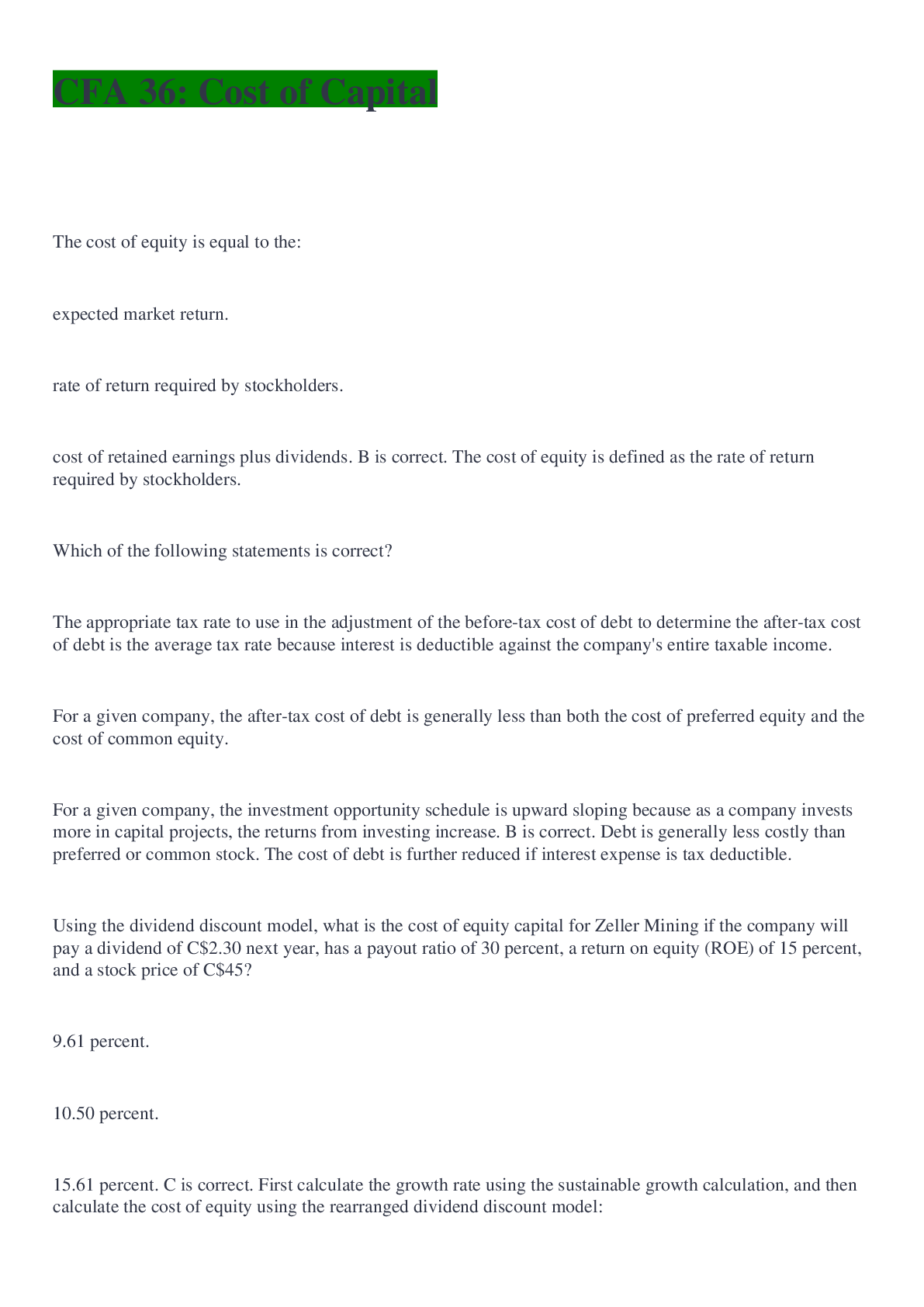
CFA 36: Cost of Capital
The cost of equity is equal to the:
expected market return.
rate of return required by stockholders.
cost of retained earnings plus dividends. B is correct. The cost of equity is d
...
CFA 36: Cost of Capital
The cost of equity is equal to the:
expected market return.
rate of return required by stockholders.
cost of retained earnings plus dividends. B is correct. The cost of equity is defined as the rate of return required by stockholders.
Which of the following statements is correct?
The appropriate tax rate to use in the adjustment of the before-tax cost of debt to determine the after-tax cost of debt is the average tax rate because interest is deductible against the company's entire taxable income.
For a given company, the after-tax cost of debt is generally less than both the cost of preferred equity and the cost of common equity.
For a given company, the investment opportunity schedule is upward sloping because as a company invests more in capital projects, the returns from investing increase. B is correct. Debt is generally less costly than preferred or common stock. The cost of debt is further reduced if interest expense is tax deductible.
Using the dividend discount model, what is the cost of equity capital for Zeller Mining if the company will pay a dividend of C$2.30 next year, has a payout ratio of 30 percent, a return on equity (ROE) of 15 percent, and a stock price of C$45?
9.61 percent.
10.50 percent.
15.61 percent. C is correct. First calculate the growth rate using the sustainable growth calculation, and then calculate the cost of equity using the rearranged dividend discount model:
g = (1 - Dividend payout ratio)(Return on equity) = (1 - 0.30)(15%) = 10.5%
re = (D1 / P0) + g = ($2.30 / $45) + 10.50% = 15.61%
Dot.Com has determined that it could issue $1,000 face value bonds with an 8 percent coupon paid semi-annually and a five-year maturity at $900 per bond. If Dot.Com's marginal tax rate is 38 percent, its after-tax cost of debt is closest to:
6.2 percent.
6.4 percent.
6.6 percent. C is correct. FV = $1,000; PMT = $40; N = 10; PV = $900
Solve for i. The six-month yield, i, is 5.3149%
YTM = 5.3149% × 2 = 10.62985%
rd(1 − t) = 10.62985%(1 − 0.38) = 6.5905%
The cost of debt can be determined using the yield-to-maturity and the bond rating approaches. If the bond rating approach is used, the:
coupon is the yield.
yield is based on the interest coverage ratio.
company is rated and the rating can be used to assess the credit default spread of the company's debt. C is correct. The bond rating approach depends on knowledge of the company's rating and can be compared with yields on bonds in the public market.
Morgan Insurance Ltd. issued a fixed-rate perpetual preferred stock three years ago and placed it privately with institutional investors. The stock was issued at $25 per share with a $1.75 dividend. If the company were to issue preferred stock today, the yield would be 6.5 percent. The stock's current value is:
$25.00.
$26.92.
$37.31. B is correct. The company can issue preferred stock at 6.5%.
Pp = $1.75/0.065 = $26.92
A financial analyst at Buckco Ltd. wants to compute the company's weighted average cost of capital (WACC) using the dividend discount model. The analyst has gathered the following data:
Before-tax cost of new debt 8 percent
Tax rate 40 percent
Target debt-to-equity ratio 0.8033
Stock price $30
Next year's dividend $1.50
Estimated growth rate 7 percent
Buckco's WACC is closest to:
8 percent.
9 percent.
12 percent. B is correct.
Cost of equity = D1/P0 + g = $1.50 / $30 + 7% = 5% + 7% = 12%
D / (D + E) = 0.8033 / 1.8033 = 0.445
WACC = [(0.445) (0.08)(1 − 0.4)] + [(0.555)(0.12)] = 8.8%
The Gearing Company has an after-tax cost of debt capital of 4 percent, a cost of preferred stock of 8 percent, a cost of equity capital of 10 percent, and a weighted average cost of capital of 7 percent. Gearing intends to maintain its current capital structure as it raises additional capital. In making its capital-budgeting decisions for the average-risk project, the relevant cost of capital is:
4 percent.
7 percent.
8 percent. B is correct. The weighted average cost of capital, using weights derived from the current capital structure, is the best estimate of the cost of capital for the average-risk project of a company.
Fran McClure of Alba Advisers is estimating the cost of capital of Frontier Corporation as part of her valuation analysis of Frontier. McClure will be using this estimate, along with projected cash flows from Frontier's new projects, to estimate the effect of these new projects on the value of Frontier. McClure has gathered the following information on Frontier Corporation:
Current Year ($) Forecasted for Next Year ($)
Book value of debt 50 50
Market value of debt 62 63
Book value of shareholders' equity 55 58
Market value of shareholders' equity 210 220
The weights that McClure should apply in estimating Frontier's cost of capital for debt and equity are, respectively:
wd = 0.200; we = 0.800.
wd = 0.185; we = 0.815.
wd = 0.223; we = 0.777. C is correct.
wd = $63/($220 + 63) = 0.223
we = $220/($220 + 63) = 0.777
Wang Securities had a long-term stable debt-to-equity ratio of 0.65. Recent bank borrowing for expansion into South America raised the ratio to 0.75. The increased leverage has what effect on the asset beta and equity beta of the company?
The asset beta and the equity beta will both rise.
The asset beta will remain the same and the equity beta will rise.
The asset beta will remain the same and the equity beta will decline. B is correct. Asset risk does not change with a higher debt-to-equity ratio. Equity risk rises with higher debt.
Brandon Wiene is a financial analyst covering the beverage industry. He is evaluating the impact of DEF Beverage's new product line of flavored waters. DEF currently has a debt-to-equity ratio of 0.6. The new product line would be financed with $50 million of debt and $100 million of equity. In estimating the valuation impact of this new product line on DEF's value, Wiene has estimated the equity beta and asset beta of comparable companies. In calculating the equity beta for the product line, Wiene is intending to use DEF's existing capital structure when converting the asset beta into a project beta. Which of the following statements is correct?
Using DEF's debt-to-equity ratio of 0.6 is appropriate in calculating the new product line's equity beta.
Using DEF's debt-to-equity ratio of 0.6 is not appropriate, but rather the debt-to-equity ratio of the new product, 0.5, is appropriate to use in calculating the new product line's equity beta.
Wiene should use the new debt-to-equity ratio of DEF that would result from the additional $50 million debt and $100 million equity in calculating the new product line's equity beta. B is correct. The debt-to-equity ratio of the new product should be used when making the adjustment from the asset beta, derived from the comparables, to the equity beta of the new product.
Trumpit Resorts Company currently has 1.2 million common shares of stock outstanding and the stock has a beta of 2.2. It also has $10 million face value of bonds that have five years remaining to maturity and 8 percent coupon with semi-annual payments, and are priced to yield 13.65 percent. If Trumpit issues up to $2.5 million of new bonds, the bonds will be priced at par and have a yield of 13.65 percent; if it issues bonds beyond $2.5 million, the expected yield on the entire issuance will be 16 percent. Trumpit has learned that it can issue new common stock at $10 a share. The current risk-free rate of interest is 3 percent and the expected market return is 10 percent. Trumpit's marginal tax rate is 30 percent. If Trumpit raises $7.5 million of new capital while maintaining the same debt-to-equity ratio, its weighted average cost of capital is closest to:
14.5 percent.
15.5 percent.
16.5 percent. B is correct.
Capital structure:
Market value of debt: FV = $10,000,000, PMT = $400,000, N = 10,
I/YR = 13.65%. Solving for PV gives the answer $7,999,688.
Market value of equity: 1.2 million shares outstanding at $10 = $12,000,000
Market value of debt $7,999,688 40%
Market value of equity 12,000,000 60%
Total capital $19,999,688 100%
To raise $7.5 million of new capital while maintaining the same capital structure, the company would issue $7.5 million × 40% = $3.0 million in bonds, which results in a before-tax rate of 16 percent.
rd(1 − t) = 0.16(1 − 0.3) = 0.112 or 11.2%
re = 0.03 + 2.2 (0.10 − 0.03) = 0.184 or 18.4%
WACC = [0.40(0.112)] + [0.6(0.184)] = 0.0448 + 0.1104 = 0.1552 or 15.52%
Jurgen Knudsen has been hired to provide industry expertise to Henrik Sandell, CFA, an analyst for a pension plan managing a global large-cap fund internally. Sandell is concerned about one of the fund's larger holdings, auto parts manufacturer Kruspa AB. Kruspa currently operates in 80 countries, with the previous year's global revenues at €5.6 billion. Recently, Kruspa's CFO announced plans for expansion into China. Sandell worries that this expansion will change the company's risk profile and wonders if he should recommend a sale of the position.
Sandell provides Knudsen with the basic information. Kruspa's global annual free cash flow to the firm is €500 million and earnings are €400 million. Sandell estimates that cash flow will level off at a 2 percent rate of growth. Sandell also estimates that Kruspa's after-tax free cash flow to the firm on the China project for next three years is, respectively, €48 million, €52 million, and €54.4 million. Kruspa recently announced a dividend of €4.00 per share of stock. For the initial analysis, Sandell requests that Knudsen ignore possible currency fluctuations. He expects the Chinese plant to sell only to customers within China for the first three years. Knudsen is asked to evaluate Kruspa's planned financing of the required €100 million with a €80 public offering of 10-year debt in Sweden and the remainder with an equity offering.
Additional information:
[Show More]




 1e Gail Fayerman.png)
.png)
![Preview of Advanced Accounting 5th Edition By Susan Hamlen - TEST BANK [All Chapters 1-16]](https://scholarfriends.com/storage/TB 5e Susan Hamlen_Updated.png)