Medical-Surgical RN A
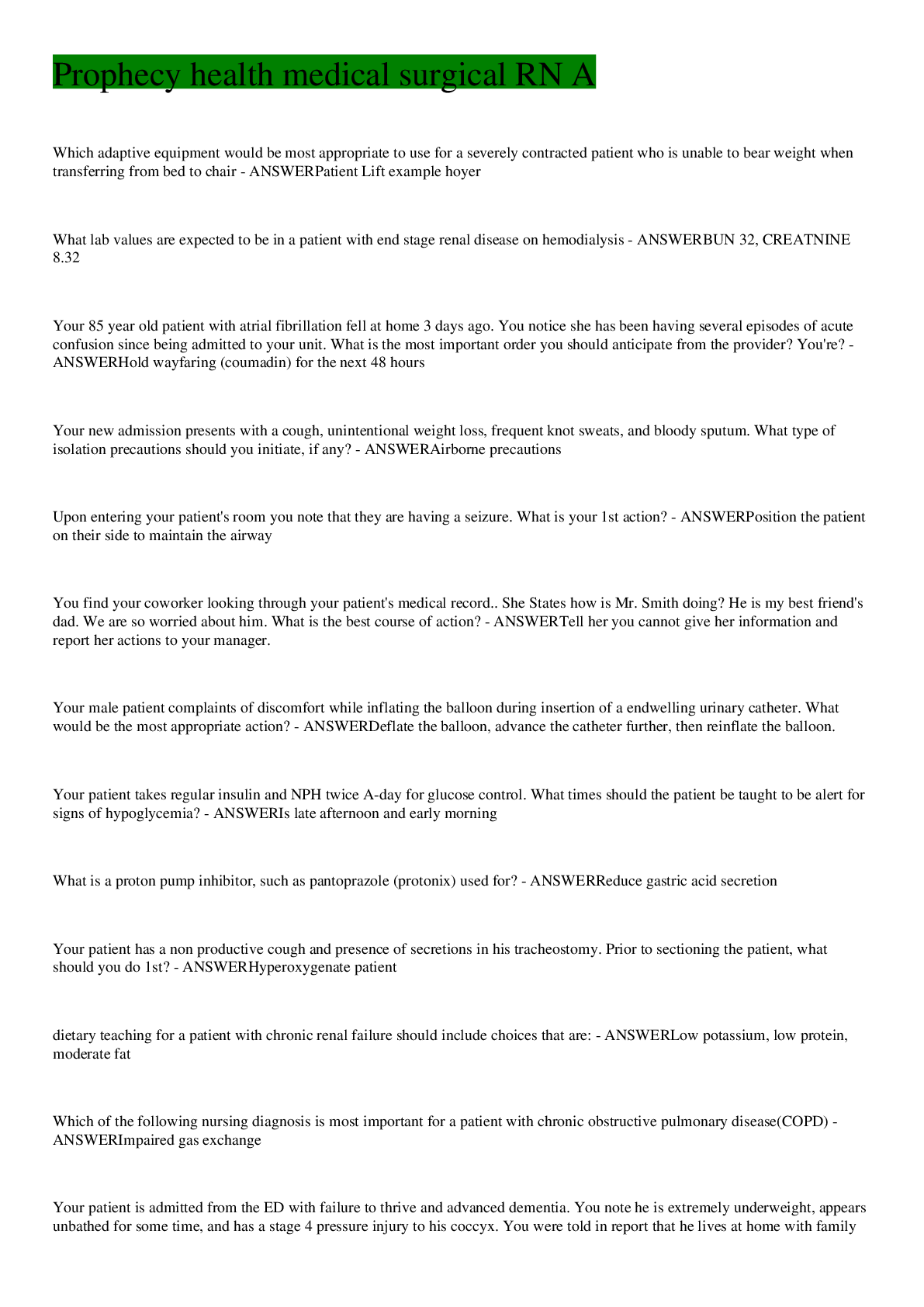
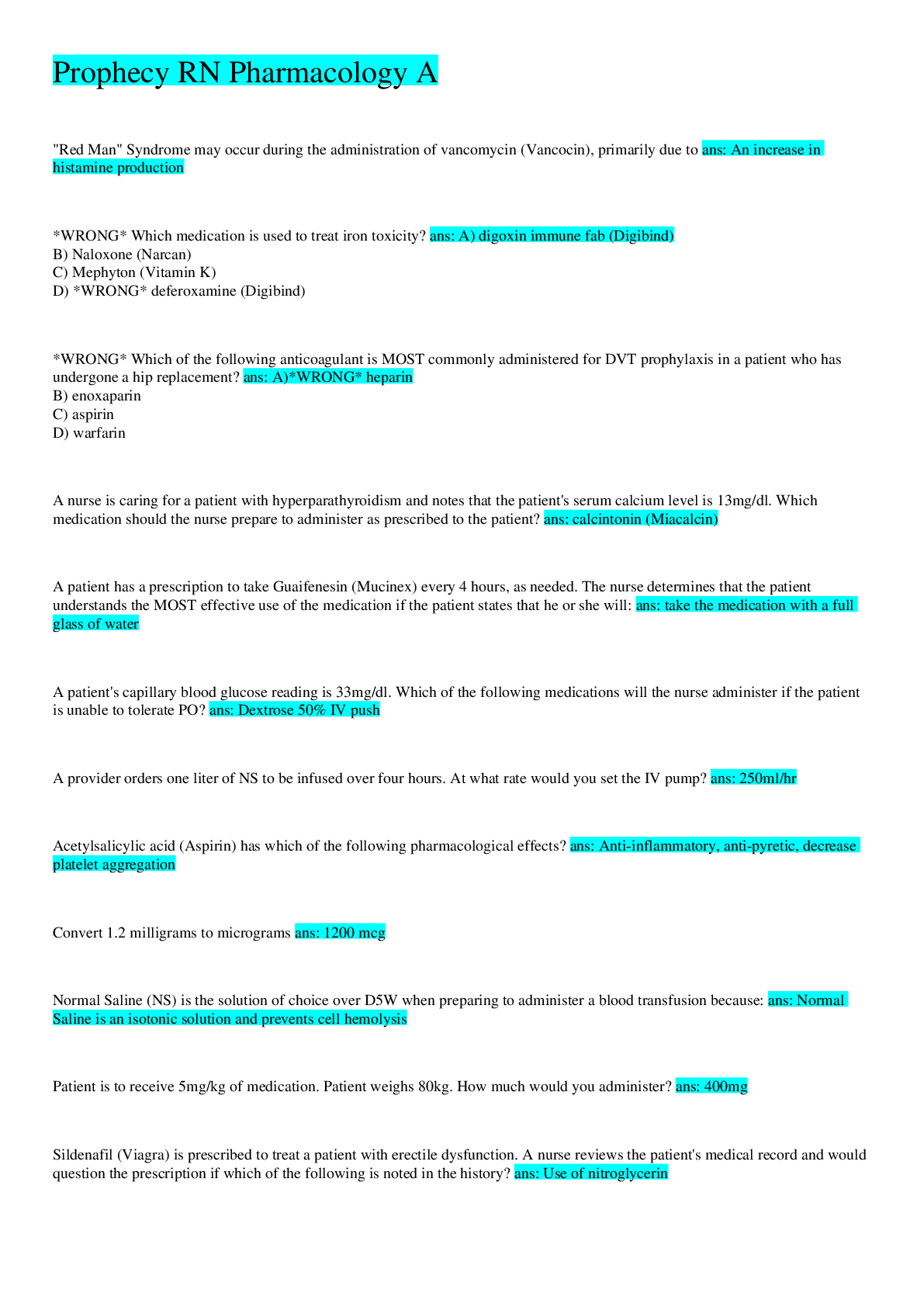
1.2 milligrams is equal to how many micrograms? ans: 1200 mcg
A female patient requests a female nurse to provide care for her based on her religious beliefs. What is the MOST appropriate acti
...
Medical-Surgical RN A
1.2 milligrams is equal to how many micrograms? ans: 1200 mcg
A female patient requests a female nurse to provide care for her based on her religious beliefs. What is the MOST appropriate action to take? ans: Accommodate her request if possible.
A patient has recently been diagnosed with terminal cancer. Her responses are caustic and abrasive. What is the BEST way to respond? ans: Acknowledge her feelings, understanding this is expected in the grieving process.
A patient on warfarin (Coumadin/Jantoven) has an INR of 6. Which medication would you anticipate administering? ans: Vitamin K
A patient with acute diverticulitis is MOST likely to complain of abdominal pain with what quadrant? ans: Left lower quadrant
A patient with peritonitis presents with tachycardia, hypotension, and dehydration. What other assessment finding would you anticipate as part of your physical assessment? ans: Severe abdominal pain or rebound tenderness
An older adult patient arrives on the unit looking emaciated, disheveled, and with soiled clothes. The patient claims that his daughter cares for him at home. What would you suspect? ans: Neglect
As you are walking down the hallway you overhear your colleague discussing her personal family issues with a patient. What would be the MOST appropriate response? ans: Remind her later of her responsibility for establishing and maintaining professional boundaries with patients.
Black and tarry colored stools are CLASSIC symptoms of what condition? ans: Bleeding gastric ulcer
Central Telemetry calls and tells you your patient is experiencing bradycardia. What is the first thing you should do after entering the room? ans: Assess the patient and take vital signs.
Digoxin (Lanoxin) 125 mcg is equivalent to how many mg? ans: 0.125mg
Fifteen minutes after starting a blood transfusion, the patient complains of lower back pain, shortness of breath, and chills. What is your FIRST action? ans: Stop the tranfusion.
If your patient with a known history of diabetes is displaying symptoms of diaphoresis, cool skin, lethargy, and shakiness. What is your first action? ans: Check the patient's blood glucose level.
In addition to pain, pallor, and pulselessness, a neurovascular assessment also includes checking for: ans: Paresthesia and paralysis
Insulin lispro (Humalog) is orders via sliding scale a.c. for your patient with diabetes. When is the best time to administer insulin lispro (Humalog)? ans: 15 min before the meal arrives
Patients with diabetes are at high risk for complications from damage to what body areas? ans: Nerve and kidney damage
The dosage of which drug must be tapered down slowly to prevent acute adrenal insufficiency? ans: Prednisone
The patient has diltiazem HCl (Cardizem CD) ordered and is requesting the capsule be mixed into her morning yogurt. How should you respond? ans: "Sorry, it is a slow-release medication that cannot be opened or crushed."
The provider gives you a telephone order to explain a surgical procedure to your patient and obtain surgical consent. How should you respond? ans: Inform the provider that explaining the procedure is outside the nurse's scope of practice.
The provider orders a Heparin infusion of 900 units/hr. Your IV medication on hand has 25,000 units of Heparin in 500 mL of D5W. How many mL/hr will you infuse? ans: 18 mL/hr
The provider orders and IV infusion of D5W 1000 mL to infuse over the next 6 hours. How many mLs per hour should the IV pump be set to? ans: 167 mL/hr
The provider orders Heparin 4 units/kg SQ. Your patient weighs 176 pounds. How many units should you administer? ans: 320 units
To reduce the risk of infection and phlebitis in an adult patient with a peripheral IV, what is the MINIMUM duration the catheter should remain in place before ROUTINE replacement? ans: 72 hours
Two days after surgery, your 72-year-old patient is showing signs of agitation and confusion, which is not his baseline. The severity fluctuates throughout the day. His medications include hydromorphone (Dilaudid), amlodipine (Norvasc), alprazolam (Xanax), and carbidopa-levodopa (Sinemet). What condition do you MOST likely suspect? ans: Delirium
Upon entering your patient's room, you note that they are having a seizure. What is your FIRST action? ans: Position the patient on their side to maintain the airway.
Upon entry to your patient's room, you find her sitting in High Fowler's position and complaining of shortness of breath. Her respiratory rate is 34 breaths/min and O2 sat is 84%. Which mode of oxygen delivery would MOST likely reverse these symptoms? ans: Non-rebreather mask
What condition (not medication related) might cause an elevation in the patients PT/INR level? ans: Liver disease
What diagnostic finding would support a diagnosis of deep vein thrombosis? ans: Positive D-dimer
What is a proton pump inhibitor, such as pantoprazole (Protonix) used for? ans: Coat the lining of the stomach
What is an early symptom that the patient is developing a complication of heart failure? ans: Edema in the legs and feet
What is clubbing of the fingers MOST likely associated with? ans: Chronic oxygen deficiency
What is the BEST indication of an acute neurological problem? ans: Change in level of consciousness
What is the EARLIEST sign indicating increased intracranial pressure (ICP)? ans: Level of consciousness
What is the proper technique when suctioning a tracheostomy? ans: Suction in a circular motion while the catheter is being pulled out.
What medication would you anticipate to be ordered for a patient who has a LDL > 200 mg/dL? ans: Statin
What patient population is the pneumococcal vaccine, PPSV23 indicated for? ans: Adults aged 65 years and older
What type of personal protective equipment (PPE) is applied prior to entering a room for a patient with C. diff? ans: Gown and gloves
When would sucralfate (Carafate) 4 times daily be scheduled for? ans: 1 hour before meals and at bedtime
Which adaptive equipment would be MOST appropriate to use for a severely contracted patient who is unable to bear weight when transferring from the bed to the chair? ans: Patient lift (e.g., Hoyer)
Which of the following is MOST important in preventing a catheter associated urinary tract infection (CAUTI)? ans: Using sterile technique when inserting the catheter
Which of the following nursing diagnoses is MOST important for a patient with chronic obstructive pulmonary disease (COPD)? ans: Impaired gas exchange
Which of the following would be used as part of the preop procedure to prevent infection? ans: Prophylactic antibiotics
Which tool should you use to assess pain in you 80-year-old patient with severe dementia? ans: PAINAD scale
While in a supine position your patient states, "I'm tired and cannot catch my breath." Physical assessment reveals jugular vein distention and a third heart sound (S3). These symptoms are indicative of what condition? ans: Heart failure
You are assigned a new admission and note a Braden score of 11 after completing your assessment. Which interventions would be MOST appropriate based on your assessment? ans: Turn q 2hours, request nutrition consult, request low airloss mattress.
You are caring for a combative 85-year-old male with a history
[Show More]