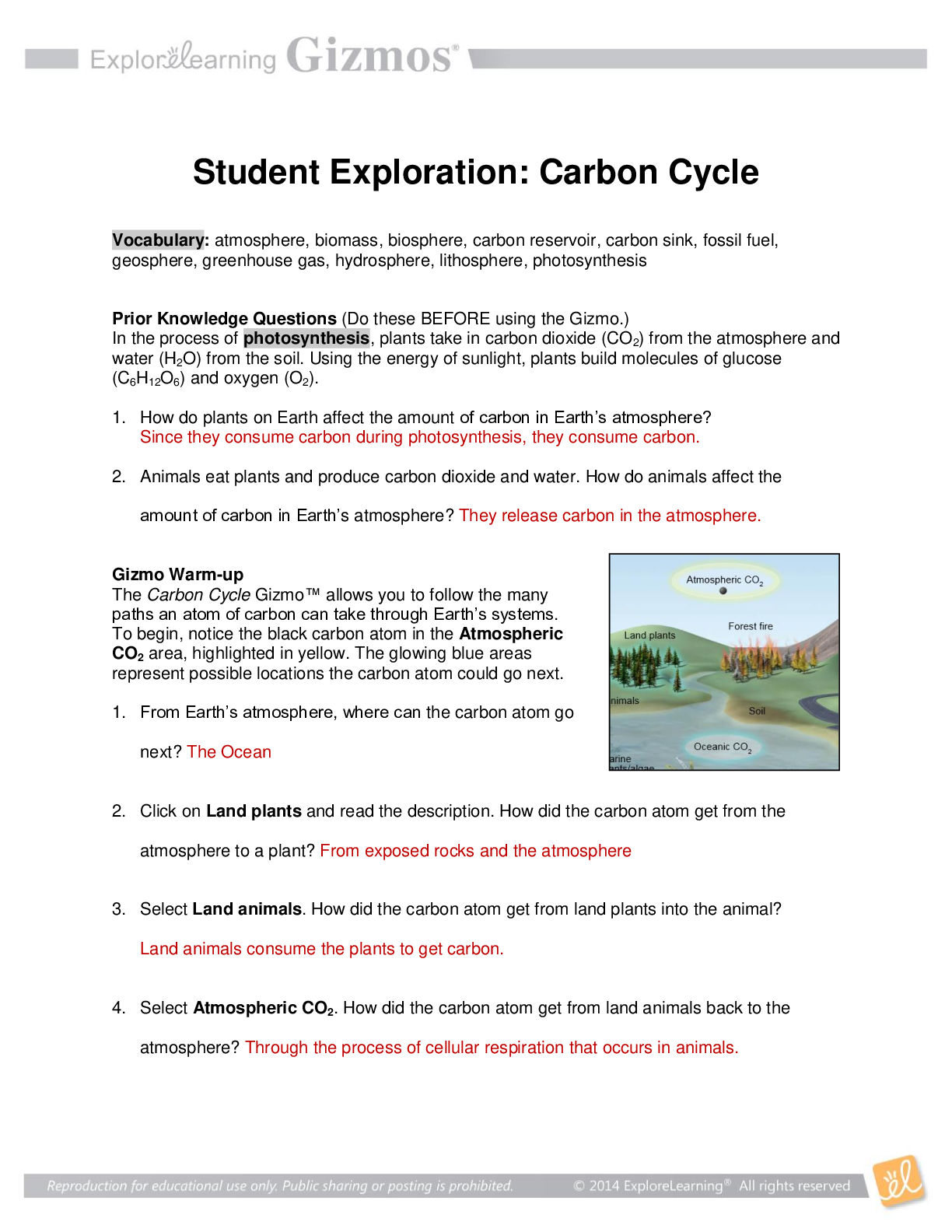
Student Exploration: Carbon Cycle
Directions: Type your responses in red.
Vocabulary: atmosphere, biomass, biosphere, carbon reservoir, carbon sink, fossil fuel, geosphere, greenhouse gas, hydrosphere, lithosphere, p
...
Student Exploration: Carbon Cycle
Directions: Type your responses in red.
Vocabulary: atmosphere, biomass, biosphere, carbon reservoir, carbon sink, fossil fuel, geosphere, greenhouse gas, hydrosphere, lithosphere, photosynthesis
Prior Knowledge Questions (Do these BEFORE using the Gizmo.)
In the process of photosynthesis, plants take in carbon dioxide (CO2) from the atmosphere and water (H2O) from the soil. Using the energy of sunlight, plants build molecules of glucose (C6H12O6) and oxygen (O2).
1. How do plants on Earth affect the amount of carbon in Earth’s atmosphere?
Plants take carbon from the atmosphere to photosynthesis
2. Animals eat plants and produce carbon dioxide and water. How do animals affect the
amount of carbon in Earth’s atmosphere?
Through food chains, the carbon that is in plants moves to the animals that eat them. Animals that eat other
animals get the carbon from their food too.
Gizmo Warm-up
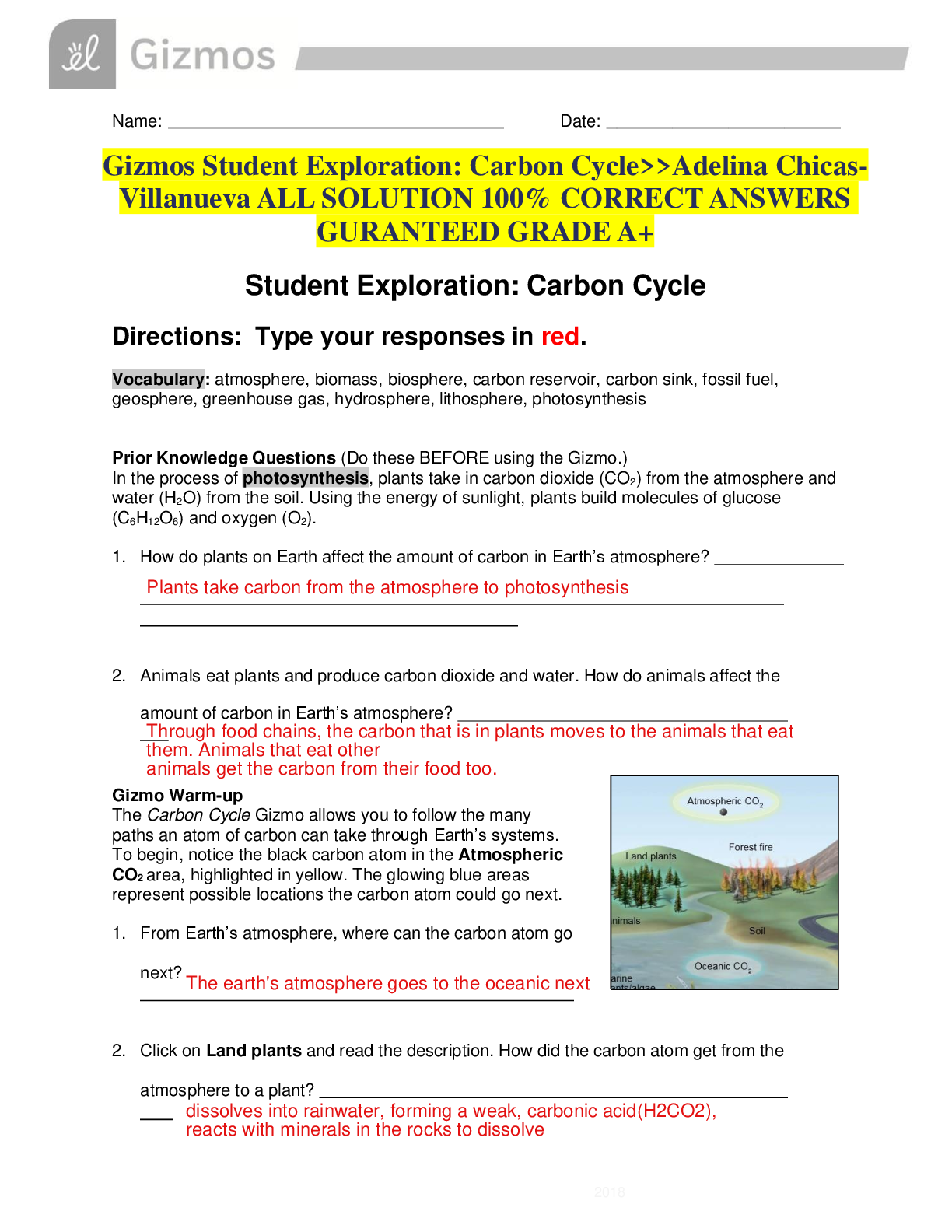
The Carbon Cycle Gizmo allows you to follow the many paths an atom of carbon can take through Earth’s systems. To begin, notice the black carbon atom in the Atmospheric CO2 area, highlighted in yellow. The glowing blue areas represent possible locations the carbon atom could go next.
1. From Earth’s atmosphere, where can the carbon atom go
next? The earth's atmosphere goes to the oceanic next
2. Click on Land plants and read the description. How did the carbon atom get from the
atmosphere to a plant?
dissolves into rainwater, forming a weak, carbonic acid(H2CO2), reacts with minerals in the rocks to dissolve
3. Select Land animals. How did the carbon atom get from land plants into the animal?
Carbon atom gets from land plants into the animal because land animals consume plants for enegry
4. Select Atmospheric CO2. How did the carbon atom get from land animals back to the
atmosphere?
The carbon atom gets back to the atmosphere from the land animals by cellular respiration
Introduction: Earth can be divided into four systems. The atmosphere is the air above Earth’s surface. The hydrosphere is composed of all of Earth’s water. The geosphere is the rocky, non-living part of Earth. The biosphere consists of all living things, including people. Some scientists use the term “anthroposphere” to describe everything made or modified by humans.
Question: How does carbon move between the atmosphere, hydrosphere, biosphere, and geosphere?
1. Explore: Use the Gizmo to create a path for carbon that begins and ends in the atmosphere. Fill in the steps in the path below. Then, label each location with the system it represents. Finally, summarize very briefly how the carbon atom got to that location.
Carbon path System How it got there
Atmospheric CO2 Atmosphere Atmospheric CO2 comes from volcanoes,
burning fossil fuels, and other sources.
Oceanic CO
2
Dissolves in cold ocean surface waters. the colder the water more CO2 can be dissolved
dissolved oceanic CO2 as a source for their calcium carbonate
shells, coral , other calcium carbonate
Limestone Geosphere
structures pile up on the ocean floor. compresses into limestone
Cement plant Geosphere Cement, most consumed substance on earth.
Atmosphere The calcium oxide is used to make cement, while the carbon dioxide is released to the atmosphere.
2. Create: Click Reset. Use the Gizmo to create a path in which the carbon atom goes from the atmosphere to the hydrosphere, biosphere and geosphere. Describe each transition briefly.
Atmosphere Hydrosphere Biosphere Geosphere
Atmospheric CO2 Oceanic CO2 Marine plants/algae Sediments
[Show More]