Physics > QUESTIONS & ANSWERS > MSE 2034CES_EduPack_Design_Problem_2_CHERO (All)
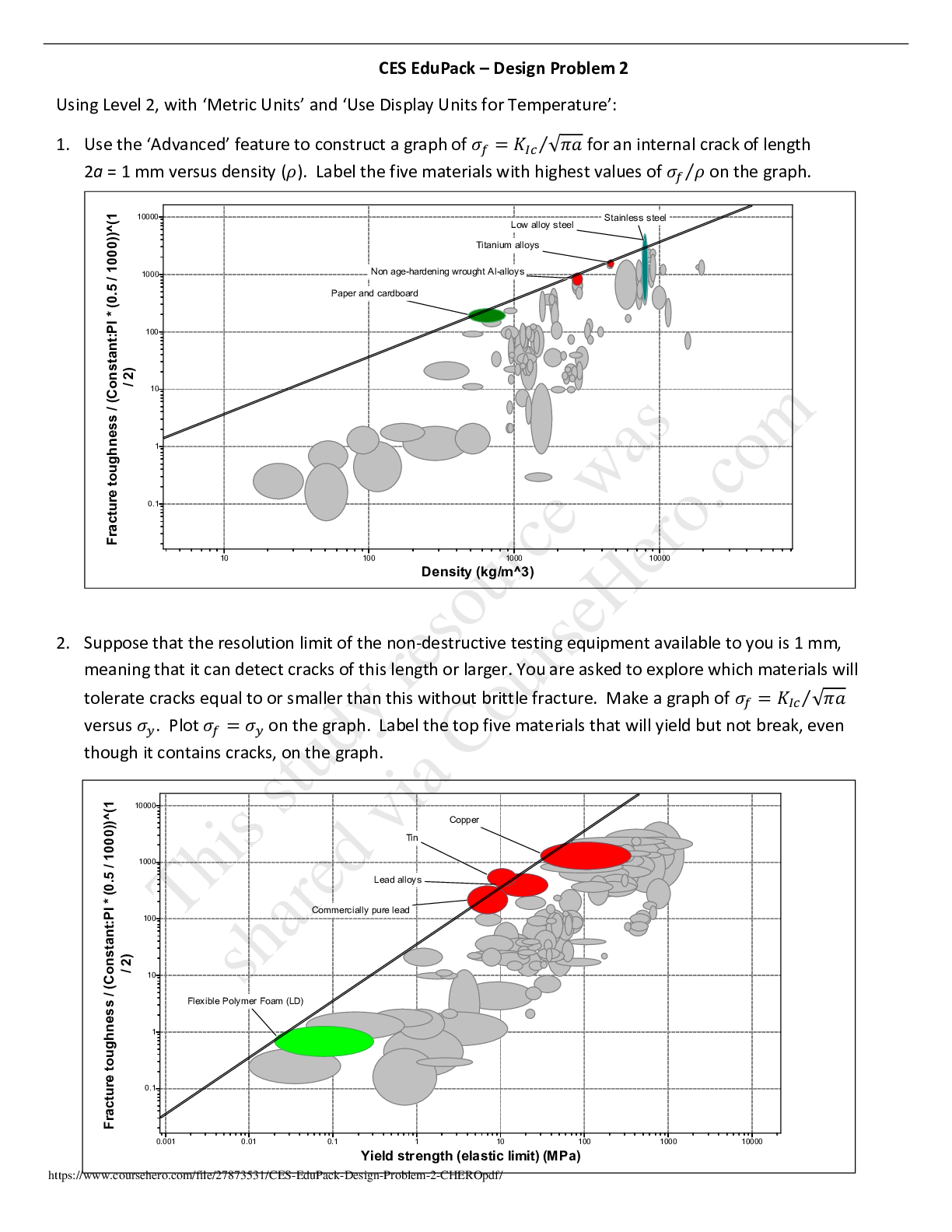
CES EduPack – Design Problem 2 Using Level 2, with ‘Metric Units’ and ‘Use Display Units for Temperature’: 1. Use the ‘Advanced’ feature to construct a graph of ? = ?ூ⁄√?? ... for an internal crack of length 2a = 1 mm versus density (?). Label the five materials with highest values of ?⁄? on the graph. 2. Suppose that the resolution limit of the non-destructive testing equipment available to you is 1 mm, meaning that it can detect cracks of this length or larger. You are asked to explore which materials will tolerate cracks equal to or smaller than this without brittle fracture. Make a graph of ? = ?ூ⁄√?? versus ? ௬. Plot ? = ?௬ on the graph. Label the top five materials that will yield but not break, even though it contains cracks, on the graph. Density (kg/m^3) 10 100 1000 10000 Fracture toughness / (Constant:PI * (0.5 / 1000))^(1 / 2) 0.1 1 10 100 1000 10000 Paper and cardboard Non age-hardening wrought Al-alloys Titanium alloys Low alloy steel Stainless steel Yield strength (elastic limit) (MPa) 0.001 0.01 0.1 1 10 100 1000 10000 Fracture toughness / (Constant:PI * (0.5 / 1000))^(1 Flexible Polymer Foam (LD) Copper Commercially pure lead Tin Lead alloys This study resource was shared via CourseHero.com3. Create a Yield Strength v. Density graph. Apply the following Limits: Yield Strength greater than 300 MPa, minimum elongation of 5%, and Density less than 3,000 kg/m3. Then use the ‘Properties’ button to modify the axes so that the x-axis has a range of 1,000 – 10,000 kg/m3 and the y-axis has a range of 10 – 1,000 MPa. Finally, label the remaining materials on the graph. 4. Valve springs for high performance automobile engines must be light to minimize inertial loads, since part of their mass moves with the valves. At high engine speeds the valves, if heavy, bounce out of contact with the valve itself (‘valve bounce’), impeding the flow of gas into and out of the combustion chamber. The energy stored per unit volume is equivalent to modulus of resilience of a material, i.e., ? = ?௬ଶ⁄(2?). The energy stored per unit weight is then, ? = ?௬ଶ⁄(2??). So the best choices are materials with the highest value of ? = ? ଶ௬ ⁄(2??). Make a bar graph with this quantity on the y-axis, and label the top five ‘best’ materials on the graph. NOTE: In order for the material to be stiff enough, it must have E > 20 GPa. In addition, engine operation temperatures can reach 200°C. Therefore, use a Limit of E > GPa, and a Limit of Maximum Service Temperature minimum of 200°C. Density (kg/m^3) 1000 2000 5000 10000 Yield strength (elastic limit) (MPa) 10 100 1000 Cast Al-alloys Wrought magnesium alloys Age-hardening wrought Al-alloys Aluminum/Silicon carbide composite (Yield strength (elastic limit)^2) / (2 * Density * Young's modulus) CFRP, epoxy matrix (isotropic) Titanium alloys Wrought magnesium alloys Age-hardening wrought Al-alloys Nickel-based superalloys [Show More]
Last updated: 3 years ago
Preview 1 out of 2 pages
Buy this document to get the full access instantly
Instant Download Access after purchase
Buy NowInstant download
We Accept:
Can't find what you want? Try our AI powered Search
Connected school, study & course
About the document
Uploaded On
Nov 11, 2020
Number of pages
2
Written in
All
This document has been written for:
Uploaded
Nov 11, 2020
Downloads
1
Views
195
Scholarfriends.com Online Platform by Browsegrades Inc. 651N South Broad St, Middletown DE. United States.
We're available through e-mail, Twitter, Facebook, and live chat.
FAQ
Questions? Leave a message!
Copyright © Scholarfriends · High quality services·