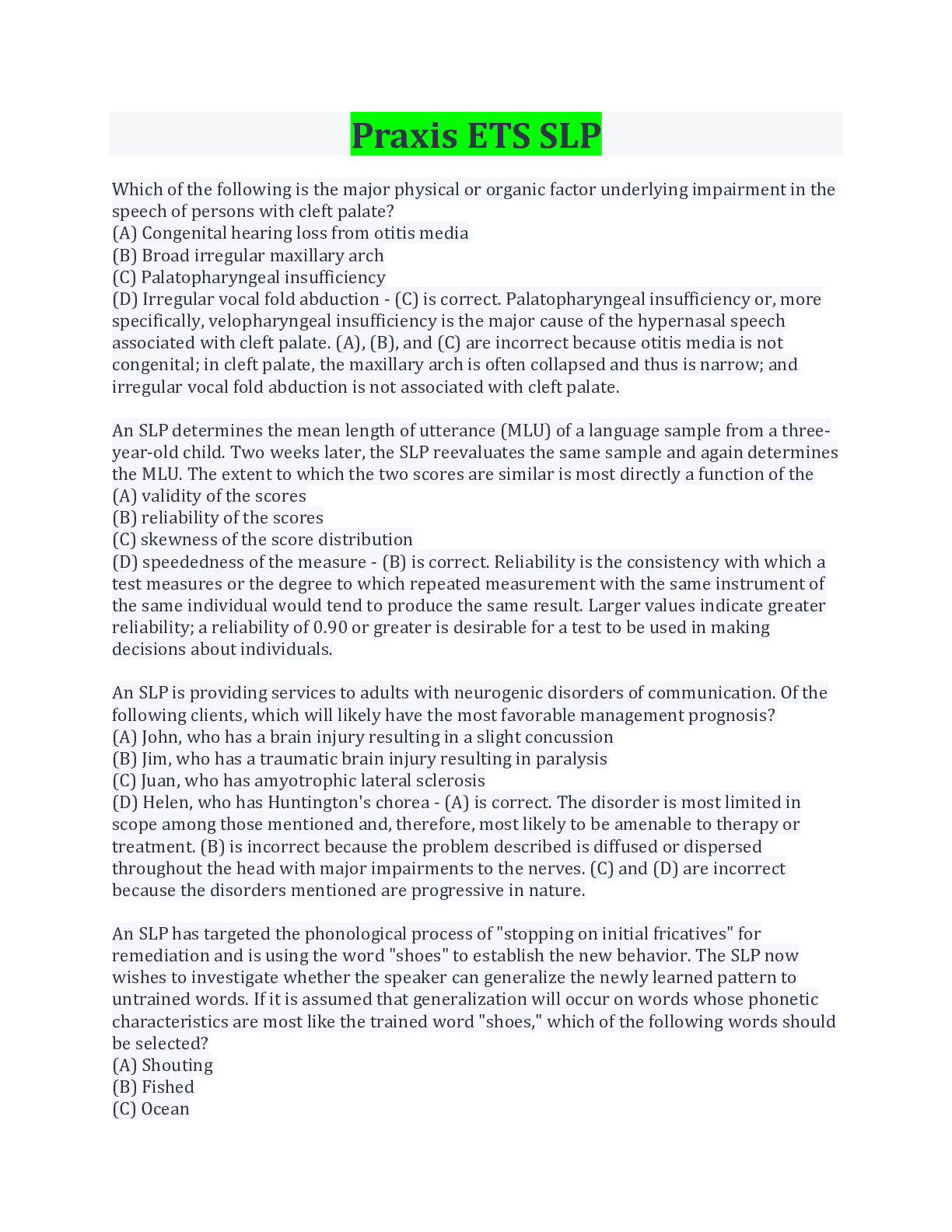
Which of the following is the major physical or organic factor underlying impairment in the speech of
persons with cleft palate?
(A) Congenital hearing loss from otitis media
(B) Broad irregular maxillary arch
(C) Pa
...
Which of the following is the major physical or organic factor underlying impairment in the speech of
persons with cleft palate?
(A) Congenital hearing loss from otitis media
(B) Broad irregular maxillary arch
(C) Palatopharyngeal insufficiency
(D) Irregular vocal fold abduction - ✔✔(C) is correct. Palatopharyngeal insufficiency or, more specifically,
velopharyngeal insufficiency is the major cause of the hypernasal speech associated with cleft palate.
(A), (B), and (C) are incorrect because otitis media is not congenital; in cleft palate, the maxillary arch is
often collapsed and thus is narrow; and irregular vocal fold abduction is not associated with cleft palate.
An SLP determines the mean length of utterance (MLU) of a language sample from a three-year-old
child. Two weeks later, the SLP reevaluates the same sample and again determines the MLU. The extent
to which the two scores are similar is most directly a function of the
(A) validity of the scores
(B) reliability of the scores
(C) skewness of the score distribution
(D) speededness of the measure - ✔✔(B) is correct. Reliability is the consistency with which a test
measures or the degree to which repeated measurement with the same instrument of the same
individual would tend to produce the same result. Larger values indicate greater reliability; a reliability
of 0.90 or greater is desirable for a test to be used in making decisions about individuals.
An SLP is providing services to adults with neurogenic disorders of communication. Of the following
clients, which will likely have the most favorable management prognosis?
(A) John, who has a brain injury resulting in a slight concussion
(B) Jim, who has a traumatic brain injury resulting in paralysis
(C) Juan, who has amyotrophic lateral sclerosis
(D) Helen, who has Huntington's chorea - ✔✔(A) is correct. The disorder is most limited in scope among
those mentioned and, therefore, most likely to be amenable to therapy or treatment. (B) is incorrect
because the problem described is diffused or dispersed throughout the head with major impairments to
the nerves. (C) and (D) are incorrect because the disorders mentioned are progressive in nature
[Show More]




![Preview of AORN PERIOP 101 FINAL EXAM 2026 QUESTIONS AND VERIFIED ANSWERS [LATEST UPDATE]](https://browseimages.nyc3.digitaloceanspaces.com/paper-images/2026/04/07/sGJvJ3aH2026-04-07-04-5869d464cbba16f.png)