SOCS 185N Week 7 Assignment: Team Project
$ 13

OTL Practice Exam A | 95 Questions And Answers
Biology > QUESTIONS & ANSWERS > NRP 7TH EDITION(answered) (All)
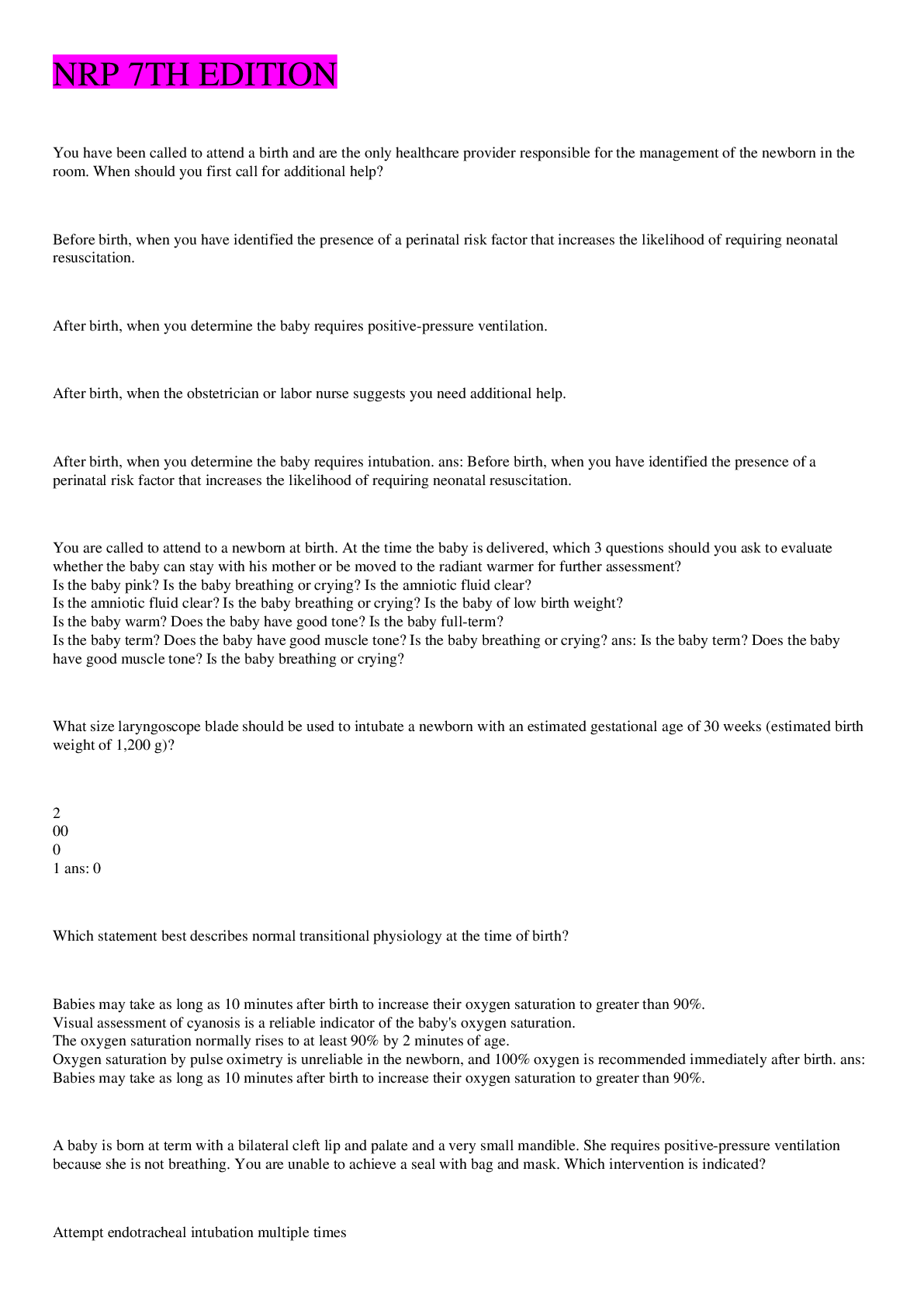
You are called to attend to a newborn at birth. At the time the baby is delivered, which 3 questions should you ask to evaluate whether the baby can stay with his mother or be moved to the radiant war ... mer for further assessment?NRP 7TH EDITION You have been called to attend a birth and are the only healthcare provider responsible for the management of the newborn in the room. When should you first call for additional help? Before birth, when you have identified the presence of a perinatal risk factor that increases the likelihood of requiring neonatal resuscitation. After birth, when you determine the baby requires positive-pressure ventilation. After birth, when the obstetrician or labor nurse suggests you need additional help. After birth, when you determine the baby requires intubation. ans: Before birth, when you have identified the presence of a perinatal risk factor that increases the likelihood of requiring neonatal resuscitation. You are called to attend to a newborn at birth. At the time the baby is delivered, which 3 questions should you ask to evaluate whether the baby can stay with his mother or be moved to the radiant warmer for further assessment? Is the baby pink? Is the baby breathing or crying? Is the amniotic fluid clear? Is the amniotic fluid clear? Is the baby breathing or crying? Is the baby of low birth weight? Is the baby warm? Does the baby have good tone? Is the baby full-term? Is the baby term? Does the baby have good muscle tone? Is the baby breathing or crying? ans: Is the baby term? Does the baby have good muscle tone? Is the baby breathing or crying? What size laryngoscope blade should be used to intubate a newborn with an estimated gestational age of 30 weeks (estimated birth weight of 1,200 g)? 2 00 0 1 ans: 0 Which statement best describes normal transitional physiology at the time of birth? Babies may take as long as 10 minutes after birth to increase their oxygen saturation to greater than 90%. Visual assessment of cyanosis is a reliable indicator of the baby's oxygen saturation. The oxygen saturation normally rises to at least 90% by 2 minutes of age. Oxygen saturation by pulse oximetry is unreliable in the newborn, and 100% oxygen is recommended immediately after birth. ans: Babies may take as long as 10 minutes after birth to increase their oxygen saturation to greater than 90%. A baby is born at term with a bilateral cleft lip and palate and a very small mandible. She requires positive-pressure ventilation because she is not breathing. You are unable to achieve a seal with bag and mask. Which intervention is indicated? Attempt endotracheal intubation multiple times Insert a laryngeal mask Administer CPAP Place an orogastic tube ans: Insert a laryngeal mask Four pre-birth questions should be asked to assess perinatal risk and determine who should be present at the birth. Which is one of the questions? Is this her first baby? Are membranes ruptured? What is the estimated fetal weight? What is the gestational age? ans: What is the gestational age? You are at the resuscitation of a newborn who is gasping and has a heart rate of 60 beats per minute. What is the most important action you can take? Provide positive-pressure ventilation Provide free-flow oxygen Provide chest compressions Apply CPAP ans: Provide positive-pressure ventilation What is the most effective maneuver to establish spontaneous breathing in a baby that is apneic after initial steps? Continued rubbing of the back Administration of positive-pressure ventilation that inflates the lungs Administration of free-flow oxygen Application of CPAP ans: Administration of positive-pressure ventilation that inflates the lungs During the resuscitation of a newborn, you auscultate the apical pulse and count 10 beats over a 6 second period. What heart rate do you report to your team? 60 beats per minute 30 beats per minute 100 beats per minute 120 beats per minute ans: 100 beats per minute Your team attends an emergency cesarean delivery of a term baby because of chorioamnionitis, meconium-stained amniotic fluid, and fetal heart rate decelerations. At delivery, the newborn is term as expected, with very poor tone and he is not breathing (apneic). You quickly perform initial steps, but the newborn is still not breathing. What is the most appropriate next step of resuscitation? Immediately intubate and suction the trachea Start positive-pressure ventilation and check heart rate response after 15 seconds [Show More]
Last updated: 3 years ago
Preview 1 out of 11 pages
Buy this document to get the full access instantly
Instant Download Access after purchase
Buy NowInstant download
We Accept:

Can't find what you want? Try our AI powered Search
Connected school, study & course
About the document
Uploaded On
May 23, 2022
Number of pages
11
Written in
All
This document has been written for:
Uploaded
May 23, 2022
Downloads
0
Views
82
Scholarfriends.com Online Platform by Browsegrades Inc. 651N South Broad St, Middletown DE. United States.
We're available through e-mail, Twitter, Facebook, and live chat.
FAQ
Questions? Leave a message!
Copyright © Scholarfriends · High quality services·