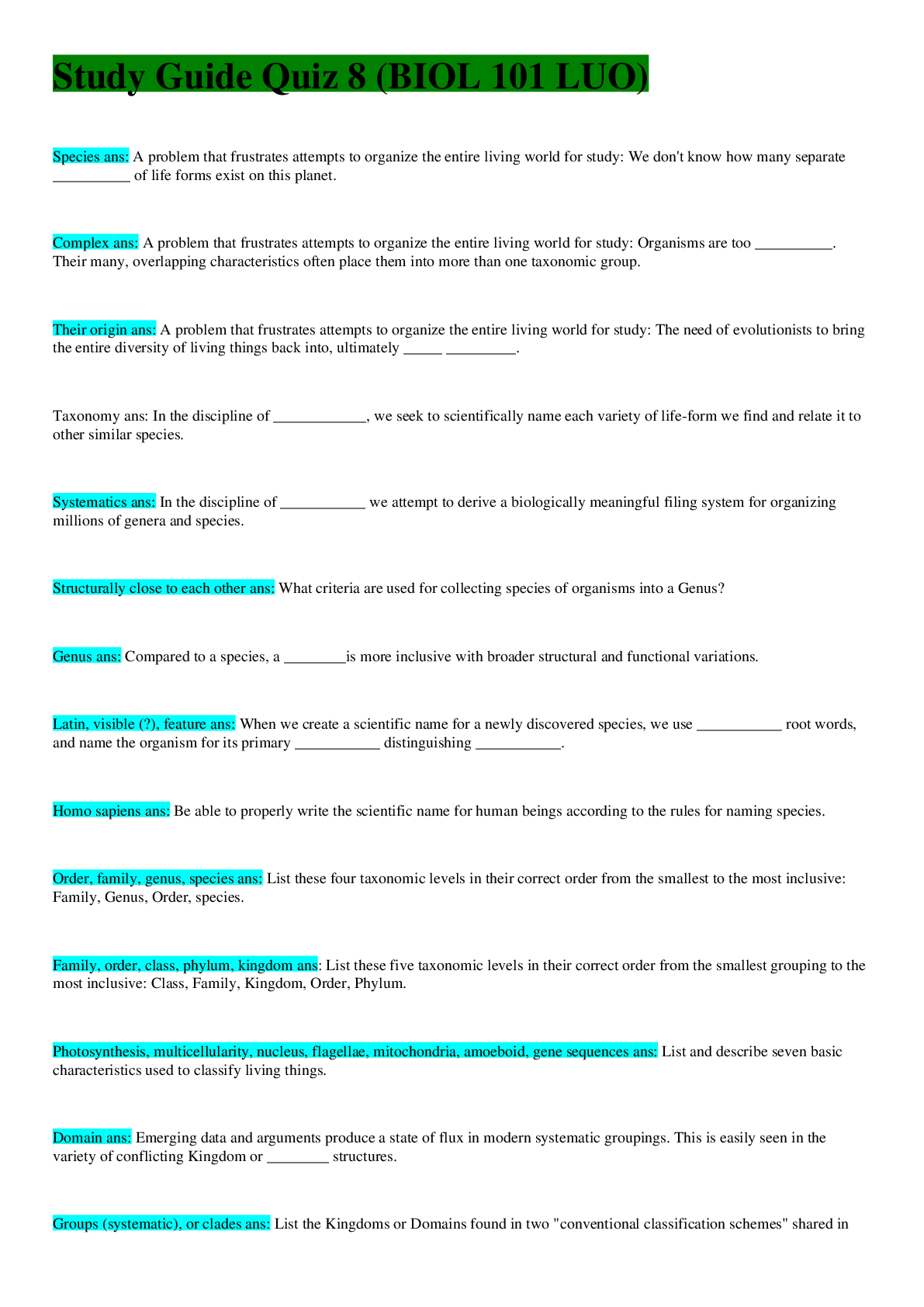
Study Guide Quiz 8 (BIOL 101 LUO)
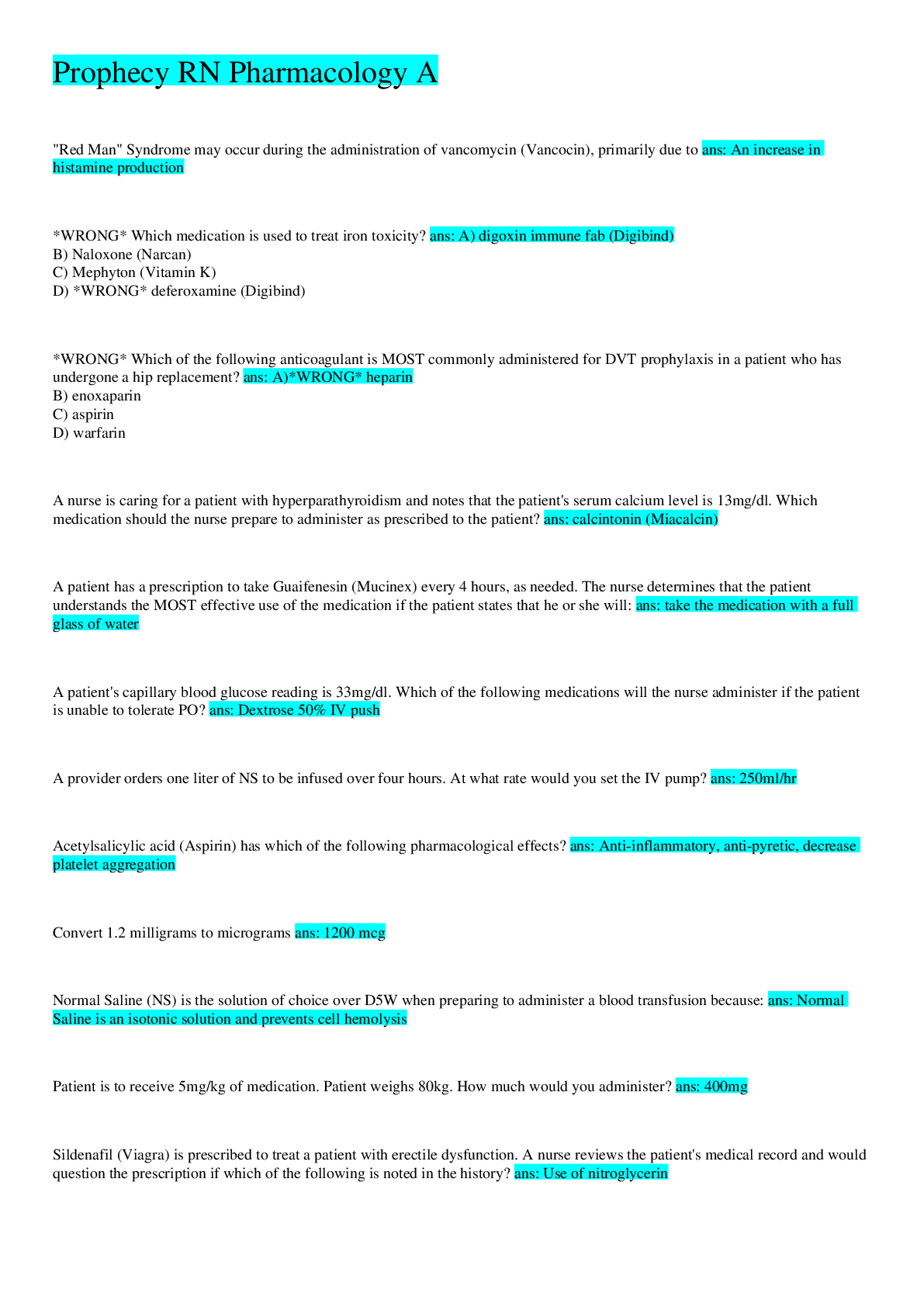
Species ans: A problem that frustrates attempts to organize the entire living world for study: We don't know how many separate __________ of life forms exist on this planet.
Comple
...
Study Guide Quiz 8 (BIOL 101 LUO)
Species ans: A problem that frustrates attempts to organize the entire living world for study: We don't know how many separate __________ of life forms exist on this planet.
Complex ans: A problem that frustrates attempts to organize the entire living world for study: Organisms are too __________. Their many, overlapping characteristics often place them into more than one taxonomic group.
Their origin ans: A problem that frustrates attempts to organize the entire living world for study: The need of evolutionists to bring the entire diversity of living things back into, ultimately _____ _________.
Taxonomy ans: In the discipline of ____________, we seek to scientifically name each variety of life-form we find and relate it to other similar species.
Systematics ans: In the discipline of ___________ we attempt to derive a biologically meaningful filing system for organizing millions of genera and species.
Structurally close to each other ans: What criteria are used for collecting species of organisms into a Genus?
Genus ans: Compared to a species, a ________is more inclusive with broader structural and functional variations.
Latin, visible (?), feature ans: When we create a scientific name for a newly discovered species, we use ___________ root words, and name the organism for its primary ___________ distinguishing ___________.
Homo sapiens ans: Be able to properly write the scientific name for human beings according to the rules for naming species.
Order, family, genus, species ans: List these four taxonomic levels in their correct order from the smallest to the most inclusive: Family, Genus, Order, species.
Family, order, class, phylum, kingdom ans: List these five taxonomic levels in their correct order from the smallest grouping to the most inclusive: Class, Family, Kingdom, Order, Phylum.
Photosynthesis, multicellularity, nucleus, flagellae, mitochondria, amoeboid, gene sequences ans: List and describe seven basic characteristics used to classify living things.
Domain ans: Emerging data and arguments produce a state of flux in modern systematic groupings. This is easily seen in the variety of conflicting Kingdom or ________ structures.
Groups (systematic), or clades ans: List the Kingdoms or Domains found in two "conventional classification schemes" shared in your text. Each scheme attempts to take in all known organisms.
Ancestors ans: Evolutionary theorists believe that all the species within a clade (large group of organisms) derive from a single common __________.
Concepts ans: In the minds of design theorists, separate clades (large groups) represent separate _________ in the Mind of a Designer.
Bacteria (species) ans: Eschenchia coli
Archaea (species) ans: Pyrodictium occultum
Excavata (species) ans: Trichomonas vaginalis
Rhizana (species) ans: Globigenna bulloides
Disicristates (species) ans: Euglena gracilis
Alveolata (species) ans: Paramecium
Stramenopiles (species) ans: Stephanodiscus niagarae
Amobozoa (species) ans: Amobea proteus
Plants (species) ans: Pisum sativum
Opisthokonta (species) ans: Zonotrichia leucophrys
Bacteria (characteristics) ans: A large group of prokaryotic, mostly unicellular
organisms; those with cell walls contain the polymer
peptidoglycan in those walls.
Archaea (characteristics) ans: A large group of prokaryotic, mostly unicellular
organisms that tend to inhabit extremes of environment such as high-temperature, high-pressure, or high-salt environments.
Excavata (characteristics) ans: A large group of unicellular eukaryotic organisms
with mitochondria that are highly modified or absent; usually possessing two, four, or more flagellae.
Rhizaria (characteristics) ans: A large group of unicellular eukaryotes that
includes ameboid cells as well as foraminerans and
radiolarians; most have mitochondria with tubular cristae.
Discicristates (characteristics) ans: A large group of unicellular eukaryotes whose
mitochondrial cristae are disc-like in shape; includes many euglenoid forms such as genus Euglena.
Alveolata (characteristics) ans: A large group of unicellular eukaryotic forms that
includes those possessing cilia and the sporozoan cells that cause malaria; possess mitochondria with tubular cristae.
[Show More]




.png)
.png)
.png)