1. A behavior analyst has implemented a behavior support plan that includes extinction, DRA, and a mild punisher (firmly saying "no"). The behavior support plan is effective in reducing the child's aggressive behavior. T
...
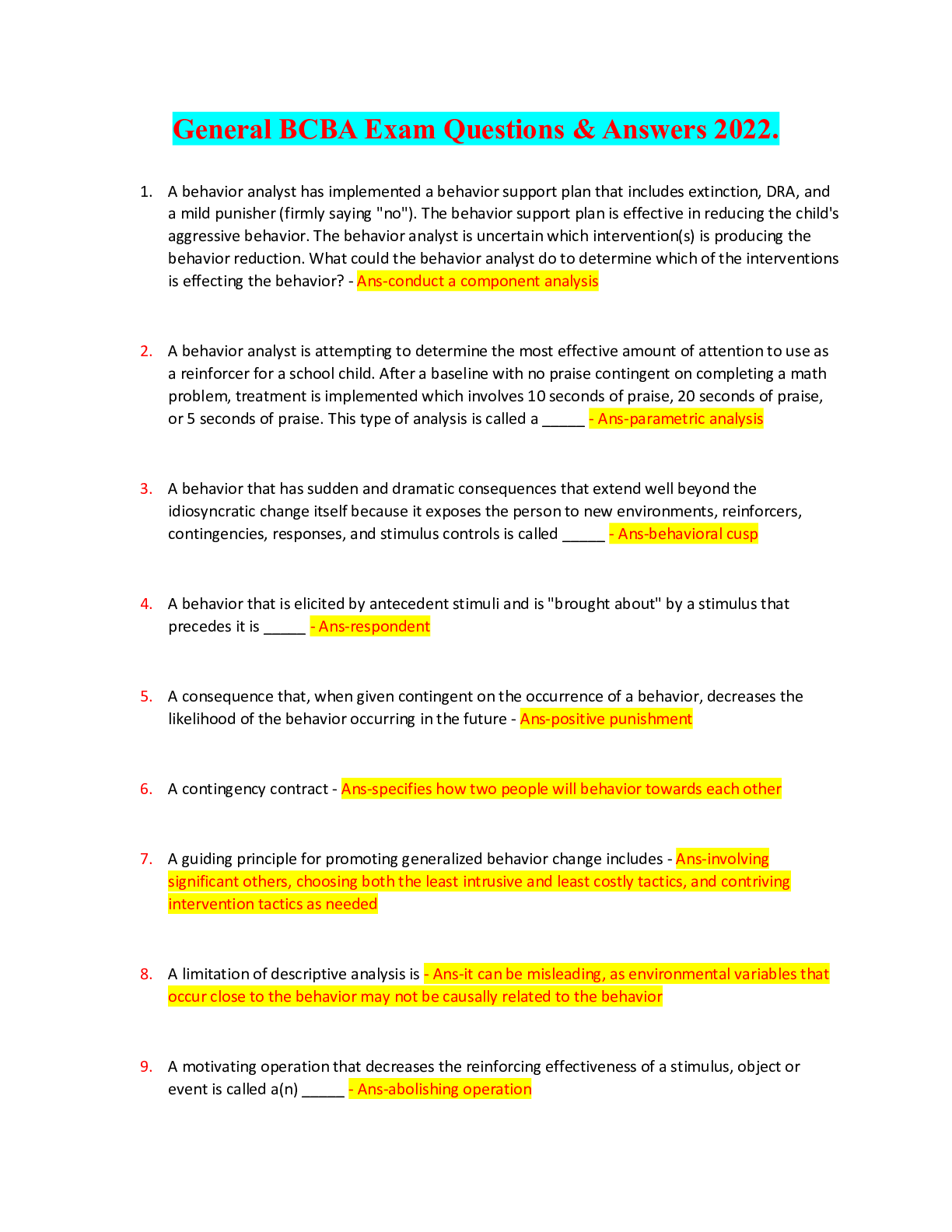
1. A behavior analyst has implemented a behavior support plan that includes extinction, DRA, and a mild punisher (firmly saying "no"). The behavior support plan is effective in reducing the child's aggressive behavior. The behavior analyst is uncertain which intervention(s) is producing the behavior reduction. What could the behavior analyst do to determine which of the interventions is effecting the behavior? - Ans-conduct a component analysis
2. A behavior analyst is attempting to determine the most effective amount of attention to use as a reinforcer for a school child. After a baseline with no praise contingent on completing a math problem, treatment is implemented which involves 10 seconds of praise, 20 seconds of praise, or 5 seconds of praise. This type of analysis is called a _____ - Ans-parametric analysis
3. A behavior that has sudden and dramatic consequences that extend well beyond the idiosyncratic change itself because it exposes the person to new environments, reinforcers, contingencies, responses, and stimulus controls is called _____ - Ans-behavioral cusp
4. A behavior that is elicited by antecedent stimuli and is "brought about" by a stimulus that precedes it is _____ - Ans-respondent
5. A consequence that, when given contingent on the occurrence of a behavior, decreases the likelihood of the behavior occurring in the future - Ans-positive punishment
6. A contingency contract - Ans-specifies how two people will behavior towards each other
7. A guiding principle for promoting generalized behavior change includes - Ans-involving significant others, choosing both the least intrusive and least costly tactics, and contriving intervention tactics as needed
8. A limitation of descriptive analysis is - Ans-it can be misleading, as environmental variables that occur close to the behavior may not be causally related to the behavior
9. A motivating operation that decreases the reinforcing effectiveness of a stimulus, object or event is called a(n) _____ - Ans-abolishing operation
10. A motivating operation whose value-altering effect does not depend on a learning history is called a(n) _____ - Ans-unconditioned motivating operation
11. A philosophical position that views behavioral events that cannot be publicly observed as outside of the realm of science is called _____ - Ans-methodological behaviorism
12. A previously neutral stimulus that now functions as a punisher because of prior pairing with one or more punishers is called a _____ - Ans-conditioned punisher
13. A relation between the stimulus and response or response product that occurs when the beginning, middle, and end for the verbal stimulus matches the beginning, middle, and end of the verbal response is called - Ans-point-to-point correspondence
14. A situation in which the frequency, latency, duration or amplitude of a behavior is altered by the presence or absence of an antecedent stimulus is called _____ - Ans-stimulus control
15. A stimulus change that does not elicit respondent behavior
[Show More]