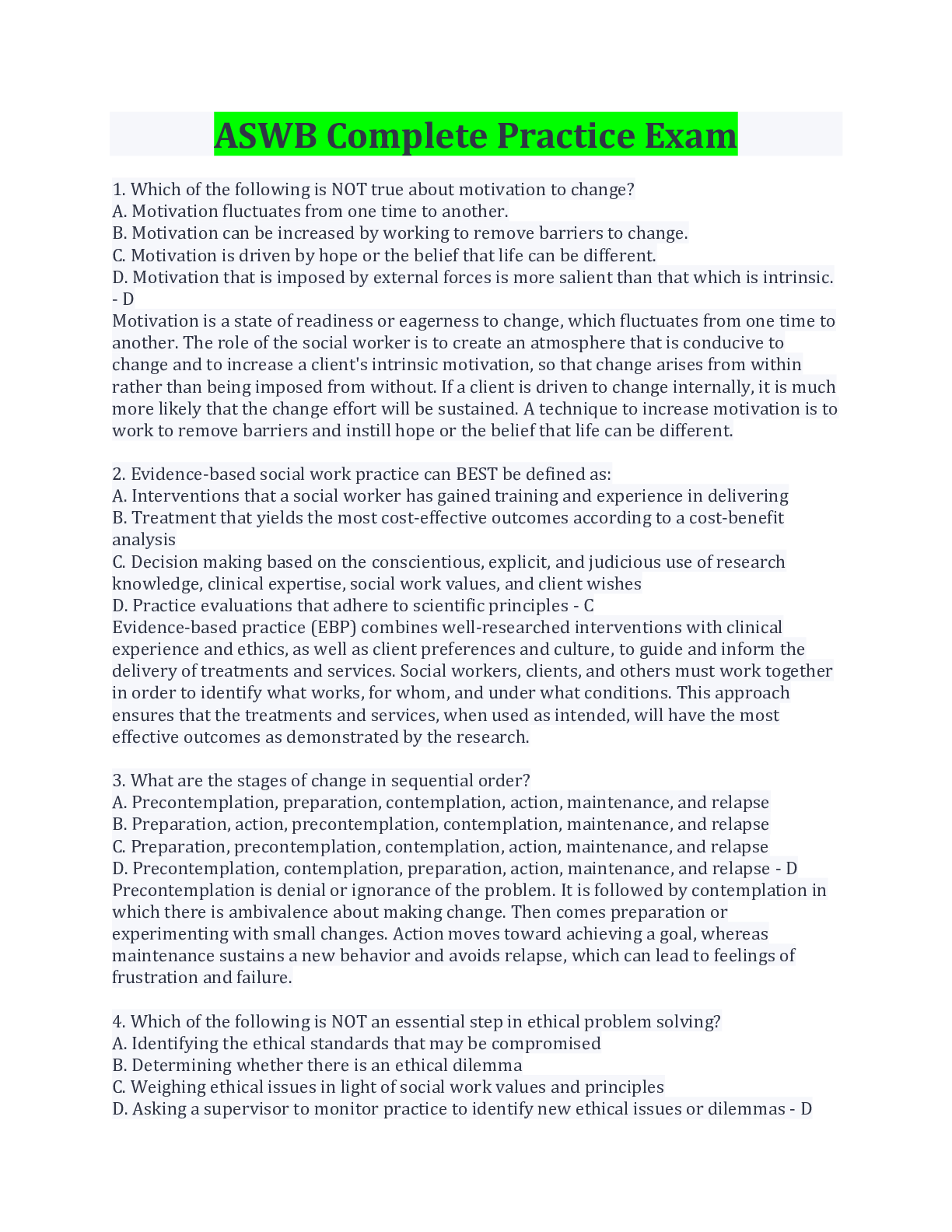
1. Which of the following is NOT true about motivation to change?
A. Motivation fluctuates from one time to another.
B. Motivation can be increased by working to remove barriers to change.
C. Motivation is driven by h
...
1. Which of the following is NOT true about motivation to change?
A. Motivation fluctuates from one time to another.
B. Motivation can be increased by working to remove barriers to change.
C. Motivation is driven by hope or the belief that life can be different.
D. Motivation that is imposed by external forces is more salient than that which is intrinsic. -
✔✔D
Motivation is a state of readiness or eagerness to change, which fluctuates from one time to
another. The role of the social worker is to create an atmosphere that is conducive to change and
to increase a client's intrinsic motivation, so that change arises from within rather than being
imposed from without. If a client is driven to change internally, it is much more likely that the
change effort will be sustained. A technique to increase motivation is to work to remove barriers
and instill hope or the belief that life can be different.
2. Evidence-based social work practice can BEST be defined as:
A. Interventions that a social worker has gained training and experience in delivering
B. Treatment that yields the most cost-effective outcomes according to a cost-benefit analysis
C. Decision making based on the conscientious, explicit, and judicious use of research
knowledge, clinical expertise, social work values, and client wishes
D. Practice evaluations that adhere to scientific principles - ✔✔C
Evidence-based practice (EBP) combines well-researched interventions with clinical experience
and ethics, as well as client preferences and culture, to guide and inform the delivery of
treatments and services. Social workers, clients, and others must work together in order to
identify what works, for whom, and under what conditions. This approach ensures that the
treatments and services, when used as intended, will have the most effective outcomes as
demonstrated by the research.
3. What are the stages of change in sequential order?
A. Precontemplation, preparation, contemplation, action, maintenance, and relapse
B. Preparation, action, precontemplation, contemplation, maintenance, and relapse
C. Preparation, precontemplation, contemplation, action, maintenance, and relapseD. Precontemplation, contemplation, preparation, action, maintenance, and relapse - ✔✔D
Precontemplation is denial or ignorance of the problem. It is followed by contemplation in which
there is ambivalence about making change. Then comes preparation or experimenting with small
changes. Action moves toward achieving a goal, whereas maintenance sustains a new behavior
and avoids relapse, which can lead to feelings of frustration and failure.
4. Which of the following is NOT an essential step in ethical problem solving?
A. Identifying the ethical standards that may be compromised
B. Determining whether there is an ethical dilemma
C. Weighing ethical issues in light of social work values and principles
D. Asking a supervisor to monitor practice to identify new ethical issues or dilemmas
[Show More]