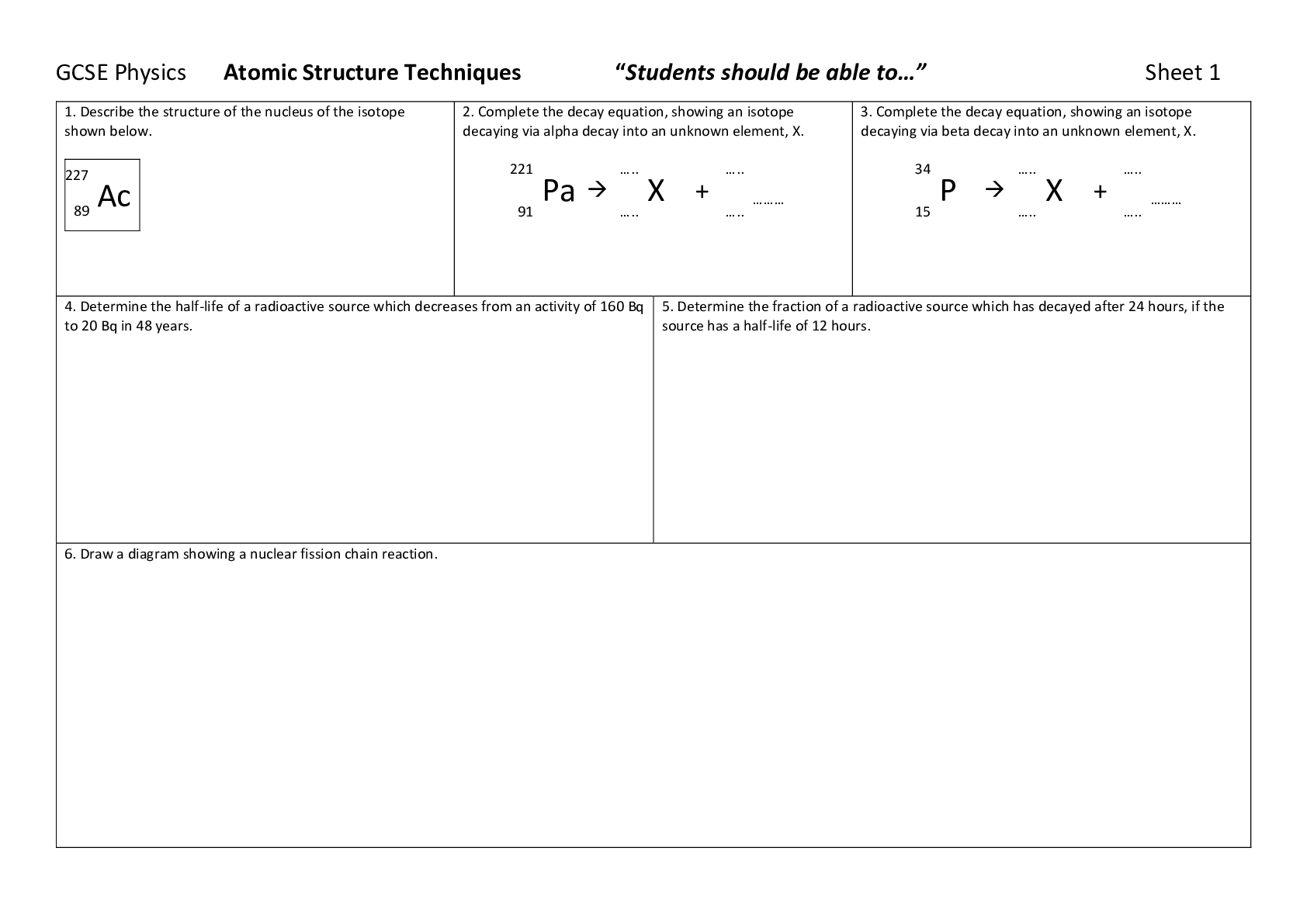
In the early part of the 20th century, scientists used the ‘plum pudding’ model to explain the
structure of the atom.
Following work by Rutherford and Marsden, a new model of the atom, called the ‘nuclear’ model,
was
...
In the early part of the 20th century, scientists used the ‘plum pudding’ model to explain the
structure of the atom.
Following work by Rutherford and Marsden, a new model of the atom, called the ‘nuclear’ model,
was suggested.
Describe the differences between the two models of the atom.
_______________________________________________________________________
_______________________________________________________________________
_______________________________________________________________________
_______________________________________________________________________
_______________________________________________________________________
_______________________________________________________________________
_______________________________________________________________________
_______________________________________________________________________
(Total 4 marks)
1
Aston Academy Page 2 of 57There are many different isotopes of gold. The isotope, gold-198, is radioactive.
An atom of gold-198 decays by emitting a beta particle.
(a) Complete the following sentences.
All atoms of gold have the same number of ________________________________
and the same number of __________________________________ .
The atoms from different isotopes of gold have different numbers of ____________ .
A beta particle is an __________________________________ emitted
from the __________________________________ of an atom.
(3)
2
(b) The graph shows how the count rate from a sample of gold-198 changes with time.
Time in days
Use the graph to calculate the half-life of gold-198.
Show clearly on the graph how you obtain your answer.
___________________________________________________________________
___________________________________________________________________
Half-life = ________________ days
(2)
Aston Academy Page 3 of 57(c) The diagram shows a map of a river and the river estuary.
Environmental scientists have found that water flowing into one part of the river estuary is
polluted. To find where the pollution is coming from, the scientists use a radioactive isotope,
gold-198.
The gold-198 is used to find where the pollution is coming from.
Explain how.
___________________________________________________________________
___________________________________________________________________
___________________________________________________________________
___________________________________________________________________
(2)
(Total 7 marks)
In 2011 an earthquake caused severe damage to a nuclear power station in Japan.
The damage led to the release of large amounts of radioactive iodine-131 into the
atmosphere.
(a) The table gives some information about an atom of iodine-131 .
Complete the table.
mass number 131
number of protons 53
number of neutrons
(1)
3
Aston Academy Page 4 of 57(b) Complete the sentence.
The number of protons in an atom is called the proton number or
the _______________ number.
(1)
(c) An atom of iodine-131 decays into an atom of xenon (Xe) by emitting a beta particle.
(i) The decay of iodine-131 can be represented by the equation below.
Complete the equation by writing the correct number in each of the two boxes.
(2)
(ii) A sample of rainwater contaminated with iodine-131 gives a count rate of 1200
counts per second.
Calculate how many days it will take for the count rate from the sample of rainwater
to fall to 75 counts per second.
Half-life of iodine-131 = 8 days
Show clearly how you work out your answer.
______________________________________________________________
______________________________________________________________
_______________ days
(2)
Aston Academy Page 5 of 57(iii) If people drink water contaminated with iodine-131, the iodine-131 builds up in the
thyroid gland. This continues until the thyroid is saturated with iodine-131 and cannot
absorb any more. The radiation emitted from the iodine-131 could cause cancer of
the thyroid.
In Japan, people likely to be drinking water contaminated with iodine-131 were
advised to take tablets containing a non-radioactive isotope of iodine.
Suggest why this advice was given.
______________________________________________________________
______________________________________________________________
______________________________________________________________
______________________________________________________________
(2)
(Total 8 marks)
A teacher used the equipment shown in the diagram to measure the count rate at different
distances from a radioactive source.
Metre rule
4
Aston Academy Page 6 of 57(a) Her results are shown in Table 1.
Table 1
Distance in metres Count rate in counts
per minute
Corrected count rate in
counts per minute
0.4 143 125
0.6 74 56
0.8 49 31
1.0 38 20
1.2 32 14
1.4 28 10
1.6 18 0
1.8 18 0
2.0 18 0
The background count rate has been used to calculate the corrected count rate.
(i) What is the value of the background count rate?
Background count rate = _______________ counts per minute
(1)
(ii) What information does the corrected count rate give?
______________________________________________________________
______________________________________________________________
(1)
(iii) The radioactive source used in the demonstration emits only one type of radiation.
The radioactive source is not an alpha emitter.
How can you tell from the data in the table?
______________________________________________________________
______________________________________________________________
(1)
Aston Academy Page 7 of 57(iv) Plot a graph of corrected count rate against distance for distances between 0.4 m and
1.4 m.
Draw a line of best fit to complete the graph.
Distance in metres
(3)
Aston Academy Page 8 of 57(v) The ‘half-distance’ is the distance a detector has to be moved away from a
radioactive source for the corrected count rate to halve.
A student has the hypothesis:
A radioactive source has a constant ‘half-distance’.
Table 1 has been repeated for your information.
Table 1
Distance in metres Count rate in counts
per minute
Corrected count rate in
counts per minute
0.4 143 125
0.6 74 56
0.8 49 31
1.0 38 20
1.2 32 14
1.4 28 10
1.6 18 0
1.8 18 0
2.0 18 0
Use Table 1 to determine if the hypothesis is correct for this radioactive source.
You should use calculations in your answer.
______________________________________________________________
______________________________________________________________
______________________________________________________________
______________________________________________________________
______________________________________________________________
______________________________________________________________
______________________________________________________________
(3)
Aston Academy Page 9 of 57(b) A teacher places a beta source and a detector in a magnetic field.
The arrangement of the magnetic field is shown.
The teacher repeated the experiment with the magnetic field in a different direction.
A set of results is shown in Table 2.
Table 2
Distance
between source
and detector in
metres
Count rate in
counts per
minute without
magnetic field
Count rate in
counts per
minute in
Experiment 1
Count rate in
counts per
minute in
Experiment 2
0.8 48 48 32
(i) Describe and explain the effect of the magnetic field on the count rate detected by
the detector.
______________________________________________________________
______________________________________________________________
______________________________________________________________
______________________________________________________________
______________________________________________________________
______________________________________________________________
(2)
Aston Academy Page 10 of 57(ii) The experiment is repeated with a different distance between the source and the
detector.
Table 3 shows the repeated results.
Table 3
Distance between
source and
detector
in metres
Count rate
in counts per
minute without
magnetic field
Count rate
in counts per
minute in
Experiment 1
Count rate
in counts per
minute in
Experiment 2
1.8 19 18 20
Explain these results.
______________________________________________________________
______________________________________________________________
______________________________________________________________
______________________________________________________________
______________________________________________________________
______________________________________________________________
(2)
(Total 13 marks)
(a) A teacher used a Geiger-Műller (GM) tube and counter to measure the background
radiation in her laboratory.
The teacher reset the counter to zero, waited one minute and then took the count reading.
The teacher repeated the procedure two more times.
5
(i) Background radiation can be either from natural sources or from man-made sources.
Name one man-made source of background radiation.
______________________________________________________________
(1)
Aston Academy Page 11 of 57(ii) The three readings taken by the teacher are given in the table.
Count after
one minute
15
24
18
The readings given in the table are correct.
Why are the readings different?
______________________________________________________________
______________________________________________________________
(1)
(b) Some scientists say they have found evidence to show that people living in areas of high
natural background radiation are less likely to develop cancer than people living in similar
areas with lower background radiation.
The evidence these scientists found does not definitely mean that the level of background
radiation determines whether a person will develop cancer.
Suggest a reason why.
___________________________________________________________________
___________________________________________________________________
(1)
(c) An atom of the isotope radon-222 emits an alpha particle and decays into an atom of
polonium.
An alpha particle is the same as a helium nucleus. The symbol below represents an alpha
particle.
(i) How many protons and how many neutrons are there in an alpha particle?
Number of protons = ________
Number of neutrons = ________
(2)
Aston Academy Page 12 of 57(ii) The decay of radon-222 can be represented by the equation below.
Complete the equation by writing the correct number in each of the two boxes.
(2)
(d) The graph shows how, in a sample of air, the number of radon-222 nuclei changes with
time.
Time in days
Use the graph to find the half-life of radon-222.
Show clearly on the graph how you obtain your answer.
Half-life = _________________________ days
(2)
(Total 9 marks)
(a) Nuclear power stations generate about 14% of the world’s electricity.
(i) Uranium-235 is used as a fuel in some nuclear reactors.
Name one other substance used as a fuel in some nuclear reactors.
______________________________________________________________
(1)
6
Aston Academy Page 13 of 57(ii) Energy is released from nuclear fuels by the process of nuclear fission.
This energy is used to generate electricity.
Describe how this energy is used to generate electricity.
Do not explain the nuclear fission process.
______________________________________________________________
______________________________________________________________
______________________________________________________________
______________________________________________________________
______________________________________________________________
______________________________________________________________
(3)
(b) The diagram shows the nuclear fission process for an atom of uranium-235.
Complete the diagram to show how the fission process starts a chain reaction.
(2)
Aston Academy Page 14 of 57(c) The diagram shows the cross-section through a nuclear reactor.
The control rods, made from boron, are used to control the chain reaction. Boron atoms
absorb neutrons without undergoing nuclear fission.
Why does lowering the control rods reduce the amount of energy released each second
from the nuclear fuel?
___________________________________________________________________
___________________________________________________________________
___________________________________________________________________
___________________________________________________________________
(2)
(Total 8 marks)
Aston Academy Page 15 of 57Atoms are different sizes.
One of the heaviest naturally occurring stable elements is lead.
Two of its isotopes are lead-206 ( ) and lead-208 ( ).
(a) (i) What is meant by ‘isotopes’?
[Show More]




![Preview of eBook [PDF] Introductory Chemistry Foundation Cengage 10th International Edition By Blue K](https://browseimages.nyc3.digitaloceanspaces.com/paper-images/2026/04/08/mdKqwuQ22026-04-08-10-3869d6060250652.png)
![Preview of eBook [PDF] Introductory Chemistry An Active Learning Approach, 7th Edition By Mark S. Cra](https://browseimages.nyc3.digitaloceanspaces.com/paper-images/2026/04/08/pEzcXRbf2026-04-08-10-3669d60563d56ef.png)