Question 1.Question : Which substance has been shown to increase the risk of cancer
when used in combination with tobacco smoking?
Student
Answer: Alcohol
Steroids
Antihistamines
Antidepressants
Instructor
Explan
...
Question 1.Question : Which substance has been shown to increase the risk of cancer
when used in combination with tobacco smoking?
Student
Answer: Alcohol
Steroids
Antihistamines
Antidepressants
Instructor
Explanation:
Alcohol interacts with smoke, increasing the risk of malignant tumors, possibly
by acting as a solvent for the carcinogenic chemicals in smoke products. No
current research supports the remaining options as having an increased effect on
the incidence of cancer when used in combination with tobacco smoking.
Points Received: 2 of 2
Comments:
Question 2.Question : Which term is used to describe a muscle cell showing a reduced
ability to form new muscle while appearing highly disorganized?
Student
Answer: Dysplasia
Hyperplasia
Myoplasia
Anaplasia
Instructor
Explanation:
Anaplasia is defined as the loss of cellular differentiation, irregularities of the
size and shape of the nucleus, and the loss of normal tissue structure. In clinical
specimens, anaplasia is recognized by a loss of organization and a significant
increase in nuclear size with evidence of ongoing proliferation. The remaining
options refer to specific changes in the cell.
Points Received: 2 of 2
Comments:
Question 3.Question : What is the final stage of the infectious process?
Student
Answer: Colonization
Invasion
Multiplication
Spread
Instructor
Explanation:
From the perspective of the microorganisms that cause disease, the infectious
process undergoes four separate stages of progression: (1) colonization, (2)
invasion, (3) multiplication, and (4) spread.
Points Received: 2 of 2
Comments:
Question 4.Question : What is the most common cause of insufficient erythropoiesis in
children?
Student
Answer: Folic acid deficiency
Iron deficiency
Hemoglobin abnormality
Erythrocyte abnormality
Instructor
Explanation:
Similar to the anemias of adulthood, ineffective erythropoiesis or premature
destruction of erythrocytes causes the anemias of childhood. The most
common cause of insufficient erythropoiesis is iron deficiency. The other
options may be causes but are not common ones.
Points Received: 2 of 2
Comments:
Question 5.Question : Which statement is true concerning the IgM?
Student Answer: IgM is the first antibody produced during the initial response
to an antigen.
IgM mediates many common allergic responses.
IgM is the most abundant class of immunoglobulins.
IgM is capable of crossing the human placenta.
Instructor
Explanation:
Typically, IgM is produced first (primary immune response), followed
by IgG against the same antigen. The other options are not true
statements regarding IgM.
Points Received: 2 of 2
Comments:
Question 6.Question : Where in the respiratory tract do the majority of foreign objects
aspirated by children finally lodge?
Student
Answer: Trachea
Left lung
Bronchus
Bronchioles
Instructor
Explanation:
Approximately 75% of aspirated foreign bodies lodge in a bronchus. The other
options are not locations where children aspirate the majority of foreign
objects.
Points Received: 2 of 2
Comments:
Question 7.Question : What is the role of caretaker genes?
Student Answer: Maintenance of genomic integrity
Proliferation of cancer cells
Secretion of growth factors
Restoration of normal tissue structure
Instructor
Explanation:
Caretaker genes are responsible for the maintenance of genomic integrity.
The other options are not roles assumed by caretaker genes.
Points Received: 2 of 2
Comments:
Question 8.Question : During an IgE-mediated hypersensitivity reaction, which leukocyte
is activated?
Student Answer: Neutrophils
Monocytes
Eosinophils
T lymphocytes
Instructor
Explanation:
Of the options provided, only eosinophils are activated during IgE-mediated
hypersensitivity reactions.
Points Received: 2 of 2
Comments:
Question 9.Question : When a patient has small, vesicular lesions that last between 10 and
20 days, which sexually transmitted infection is suspected?
Student
Answer: Genital herpes
Chancroid
Syphilis
Chlamydia
Instructor
Explanation:
If symptoms occur, the individual may have small (1 to 2 mm), multiple,
vesicular lesions that are generally located on the labia minora, fourchette, or
penis. They may also appear on the cervix, buttocks, and thighs and are often
painful and pruritic. These lesions usually last approximately 10 to 20 days. The
other options do not demonstrate these symptoms.
Points Received: 2 of 2
Comments:
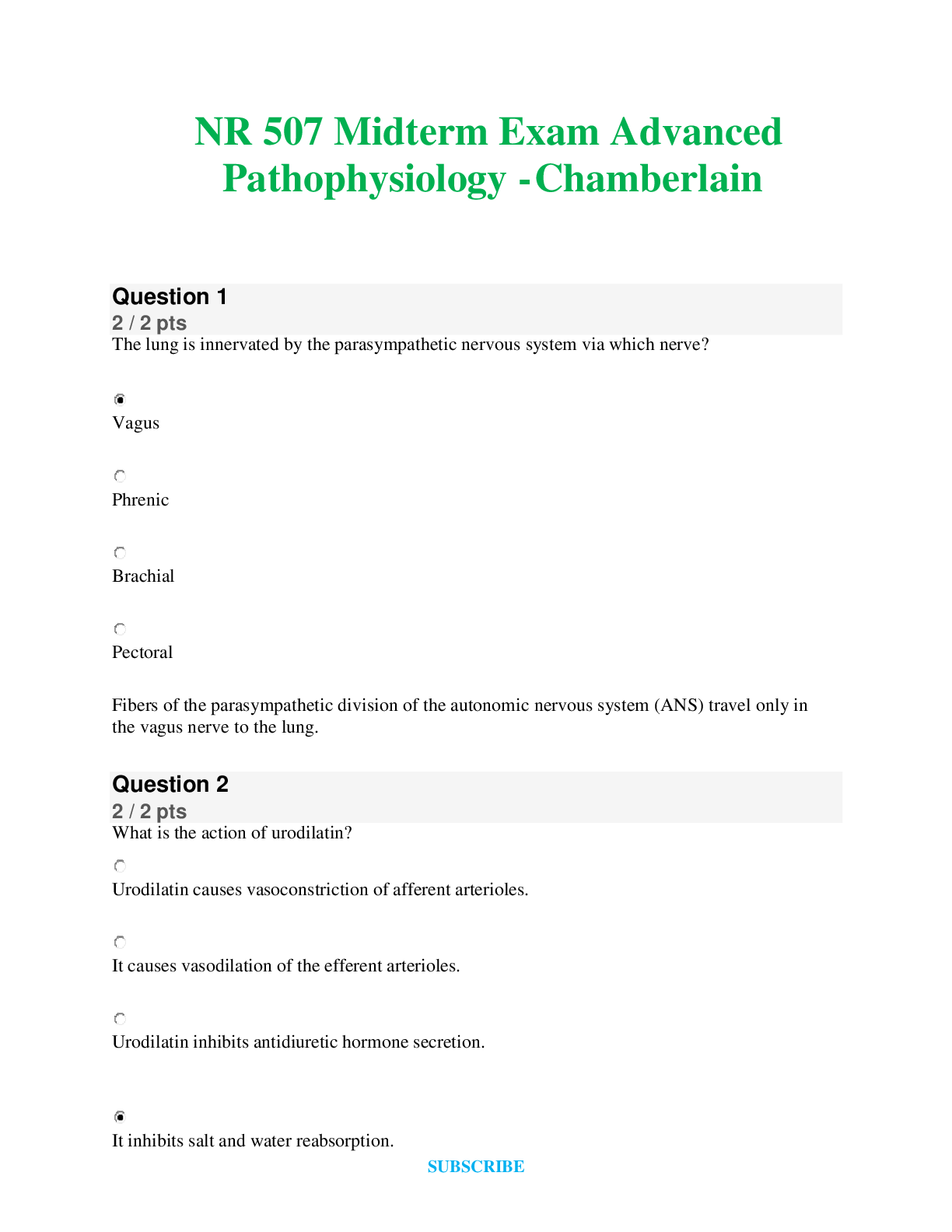
Question 10.Question : What is the action of urodilatin?
Student Answer: Urodilatin causes vasoconstriction of afferent arterioles.
It causes vasodilation of the efferent arterioles.
Urodilatin inhibits antidiuretic hormone secretion.
It inhibits salt and water reabsorption.
Instructor
Explanation:
Urodilatin (a natriuretic peptide) inhibits sodium and water reabsorption
from the medullary part of collecting duct, thereby producing diuresis. It is
not involved in the actions described by the other options.
Points Received: 2 of 2
[Show More]