NURS 190 PA FINAL Exam Study Guide, Latest 2020.________________________________________
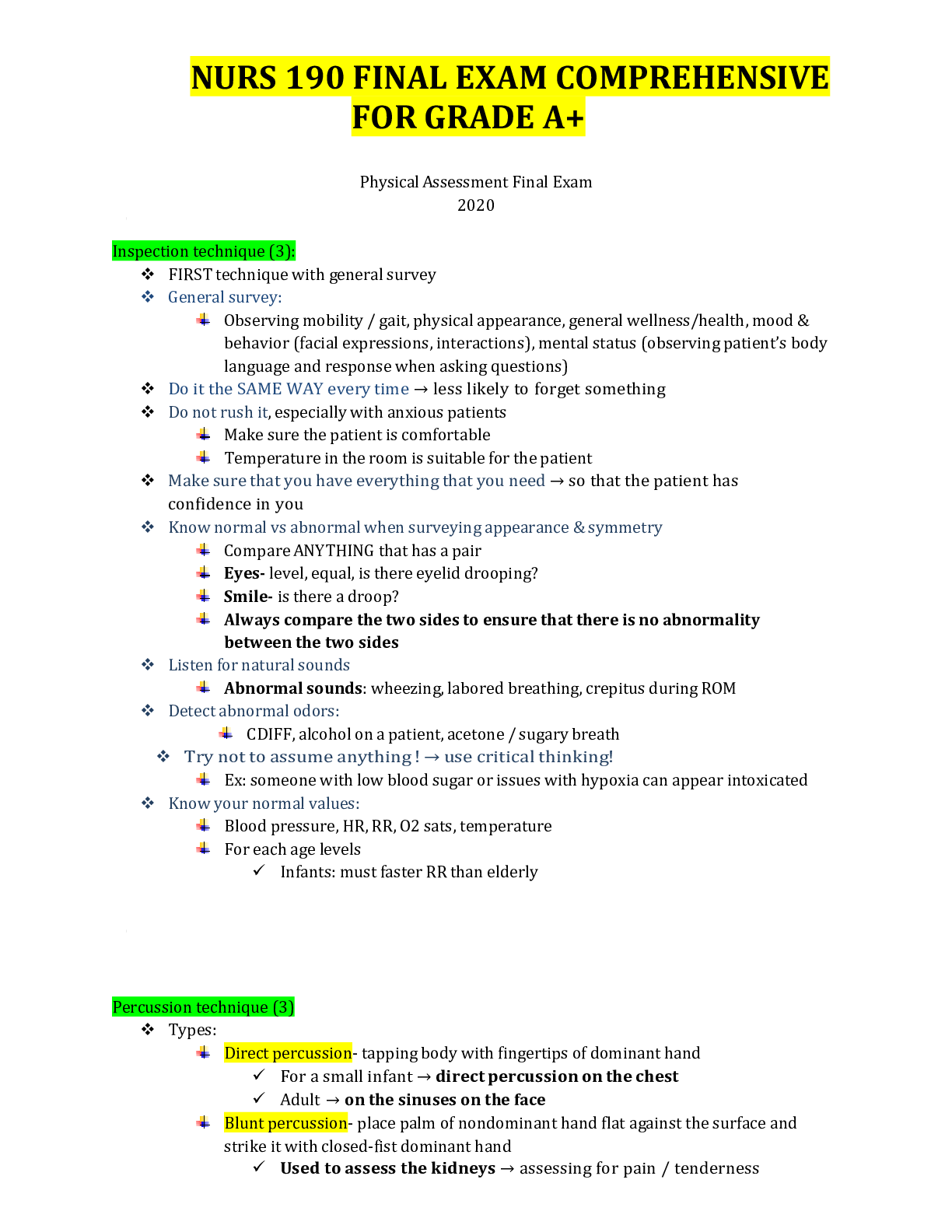
Inspection technique (3):
● FIRST technique with general survey
● General survey:
○ Observing mobility / gait, physical appea
...
NURS 190 PA FINAL Exam Study Guide, Latest 2020.________________________________________
Inspection technique (3):
● FIRST technique with general survey
● General survey:
○ Observing mobility / gait, physical appearance, general wellness/health, mood & behavior (facial expressions, interactions), mental status (observing patient’s body language and response when asking questions)
● Do it the SAME WAY every time → less likely to forget something
● Do not rush it, especially with anxious patients
○ Make sure the patient is comfortable
○ Temperature in the room is suitable for the patient
● Make sure that you have everything that you need → so that the patient has confidence in you
● Know normal vs abnormal when surveying appearance & symmetry
○ Compare ANYTHING that has a pair
○ Eyes- level, equal, is there eyelid drooping?
○ Smile- is there a droop?
○ Always compare the two sides to ensure that there is no abnormality between the two sides
● Listen for natural sounds
○ Abnormal sounds: wheezing, labored breathing, crepitus during ROM
● Detect abnormal odors:
○ CDIFF, alcohol on a patient, acetone / sugary breath
● Try not to assume anything ! → use critical thinking!
○ Ex: someone with low blood sugar or issues with hypoxia can appear intoxicated
● Know your normal values:
○ Blood pressure, HR, RR, O2 sats, temperature
○ For each age levels
■ Infants: must faster RR than elderly
________________________________________
Percussion technique (3)
● Types:
○ Direct percussion- tapping body with fingertips of dominant hand
■ For a small infant → direct percussion on the chest
■ Adult → on the sinuses on the face
○ Blunt percussion- place palm of nondominant hand flat against the surface and strike it with closed-fist dominant hand
■ Used to assess the kidneys → assessing for pain / tenderness (UTI)
○ Indirect percussion- most commonly used
■ Plexor = hammer or tapping finger
■ Pleximeter = device or surface that accepts the tap
● Sounds:
○ Intensity of amplitude: softness or loudness
○ Pitch or frequency: high or low (vibrations per second)
○ Duration: length of time
○ Quality: recognizable overtones or drumlike sounds
● Tympany- sound heard over stomach or intestines
○ Loud, high-pitched, drum-like tone
● Resonance- normal sound heard over lungs
○ Loud, low-pitched, hollow tone
● Hyperresonance- air trapped in lungs
○ Abnormally loud, low tone of longer duration than resonance
■ COPD, trauma or lung collapse
● Dullness- over solid body organs (liver)
○ High-pitched tone, soft and short
● Flatness- over solid tissue, muscle, or bone
○ High-pitched tone, very soft & shorter than dullness
■ Ex: ribs
[Show More]