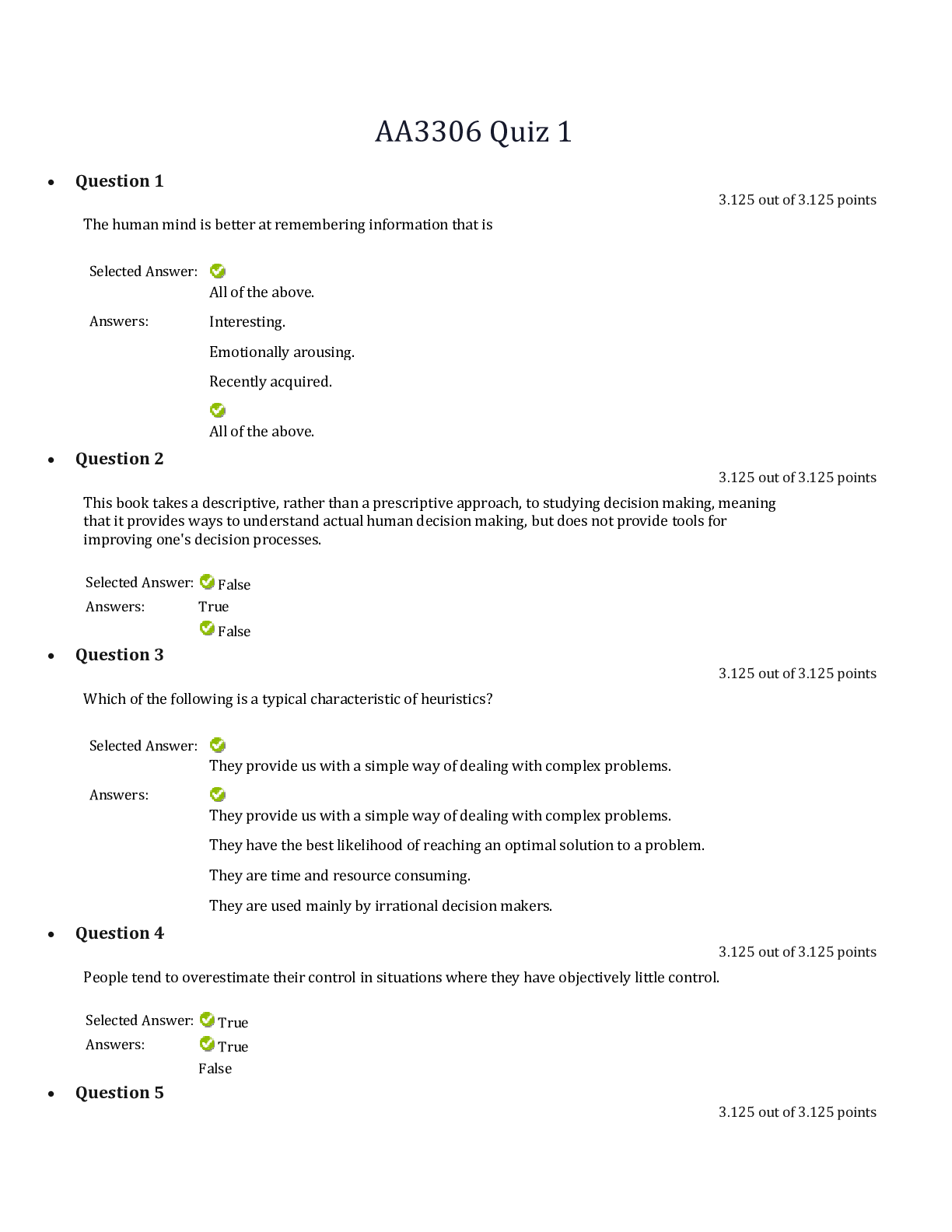
• Question 1
3.125 out of 3.125 points
The human mind is better at remembering information that is
• Question 2
3.125 out of 3.125 points
This book takes a descriptive, rather than a prescriptive ap
...
• Question 1
3.125 out of 3.125 points
The human mind is better at remembering information that is
• Question 2
3.125 out of 3.125 points
This book takes a descriptive, rather than a prescriptive approach, to studying decision making, meaning that it provides ways to understand actual human decision making, but does not provide tools for improving one's decision processes.
• Question 3
3.125 out of 3.125 points
Which of the following is a typical characteristic of heuristics?
• Question 4
3.125 out of 3.125 points
People tend to overestimate their control in situations where they have objectively little control.
• Question 5
3.125 out of 3.125 points
What is the name given to the tendency to falsely think we rank higher than others on certain dimensions?
• Question 6
3.125 out of 3.125 points
A search for alternatives may be too short to find the best possible alternative, but still be considered rational and optimal.
• Question 7
3.125 out of 3.125 points
Drake is a department manager in a company which has recently decided to hire a new analyst. After interviewing all candidates, Drake recommended the company hire Anne, but senior management preferred to hire Beth. Drake argued that Beth is an inferior choice, but agreed to accept her for a trial period of six months. At the end of the trial period, Drake evaluated Beth's performance as poor. Although this evaluation may have been fair, it is also possible that it was biased by:
• Question 8
3.125 out of 3.125 points
Which of the following can serve as a cognitive explanation for misconceptions of chance?
• Question 9
3.125 out of 3.125 points
Overconfidence is so robust that research has failed to identify situations in which we are likely to be underconfident.
• Question 10
3.125 out of 3.125 points
Rating alternatives on each of the decision criteria is considered the most difficult stage of the decision-making process, because:
• Question 11
3.125 out of 3.125 points
Which of the following is a common mistake made by investors?
• Question 12
3.125 out of 3.125 points
When are we the most likely to overplace our performance relative to others?
• Question 13
3.125 out of 3.125 points
The fact that heavy advertising of a company's or a product's name on billboards and in the media makes that name stick in people's memory as bearing high quality is an example of what bias?
• Question 14
3.125 out of 3.125 points
An optimal search for alternatives should last:
• Question 15
3.125 out of 3.125 points
Experience helps countervail the anchoring bias, such that anchoring effects are rarely observable in expert judgments.
• Question 16
3.125 out of 3.125 points
Inner city crime in the U.S. gets considerable media coverage, such that every homicide is reported in the news. In contrast, a story of a person who died from a heart attack rarely makes the news. This leads people to overestimate the frequency of deaths due to homicides relative to those due to heart failure.
• Question 17
3.125 out of 3.125 points
After reading about the positive effect chocolate has on student performance, a teacher gives each student in a class a chocolate bar before taking an exam. 15 out of 22 students in that class get an A on the exam. The teacher therefore concludes that chocolate enhances performance.
• Question 18
3.125 out of 3.125 points
What is the name given to the tendency to think we are better than we actually are?
• Question 19
3.125 out of 3.125 points
In what ways is it beneficial to outwardly express confidence?
• Question 20
3.125 out of 3.125 points
Succumbing to heuristics is inevitable, and there is no way to make judgment less prone them. Rather, one can only be aware of the biasing effect heuristics have on one's judgment.
• Question 21
3.125 out of 3.125 points
In order to avoid falling prey to ease of recall bias, a manager must discount the number of successful and unsuccessful actions taken by employees situated closer to the manager, relative to those of employees who are farther away.
• Question 22
3.125 out of 3.125 points
What is the name given to the tendency to be too sure that our judgments and decisions are accurate?
• Question 23
3.125 out of 3.125 points
John is over seven feet tall. When asked whether John is a professional basketball player or a software programmer, many people predict the former, even though there are many more software programmers, even very tall ones, than professional basketball players.
• Question 24
3.125 out of 3.125 points
Which bias occurs only after the true outcome of an event is known?
• Question 25
3.125 out of 3.125 points
When do people use base-rate data correctly?
• Question 26
3.125 out of 3.125 points
The main disadvantage of system 2 thinking is its high resource consumption.
• Question 27
3.125 out of 3.125 points
A common wisdom in politics is that the more an argument is repeated, the more it will be considered by the public as reliable and true.
• Question 28
3.125 out of 3.125 points
In the interplay between system 1 and system 2 thinking, the key goal for managers is:
• Question 29
3.125 out of 3.125 points
There are advantages to having positive illusions.
• Question 30
3.125 out of 3.125 points
The anchoring bias affects our value estimates, but not our ability to retrieve information from memory.
• Question 31
3.125 out of 3.125 points
A survey among tenants of shared apartments asked each tenant what percentage of the cleaning around the apartment he or she does. The survey found that aggregating the percentages for each apartment produces an average of much more than 100%. This result may be due to what bias?
• Question 32
3.125 out of 3.125 points
The affect heuristic can explain why
[Show More]




.png)