Question 1 See full question
A client on a surgical unit provided consent for a liver biopsy. The nurse is in the process of taking the client to the operating room when the client states, “I’ve changed my mind.” Which
...
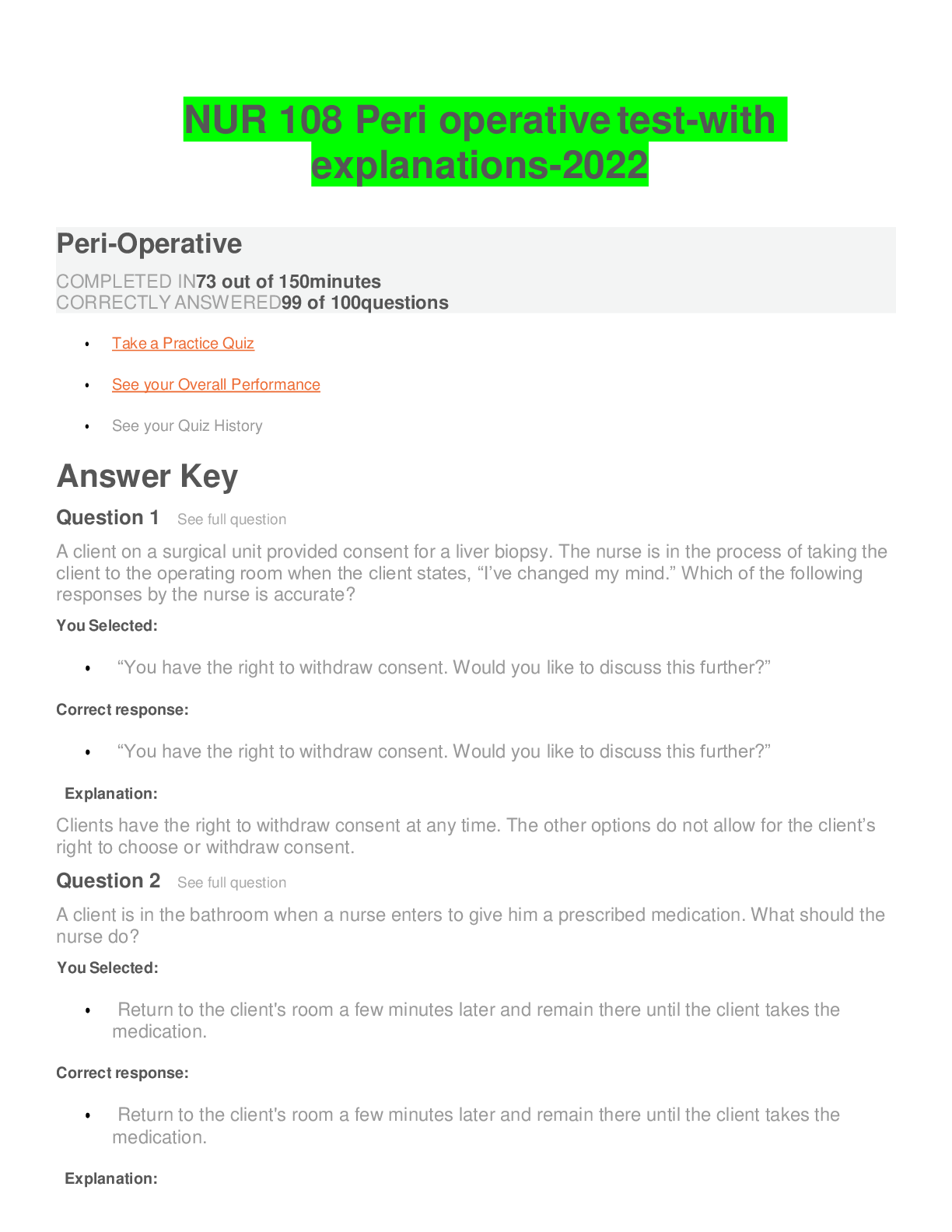
Question 1 See full question
A client on a surgical unit provided consent for a liver biopsy. The nurse is in the process of taking the client to the operating room when the client states, “I’ve changed my mind.” Which of the following responses by the nurse is accurate?
You Selected:
• “You have the right to withdraw consent. Would you like to discuss this further?”
Correct response:
• “You have the right to withdraw consent. Would you like to discuss this further?”
Explanation:
Clients have the right to withdraw consent at any time. The other options do not allow for the client’s right to choose or withdraw consent.
Question 2 See full question
A client is in the bathroom when a nurse enters to give him a prescribed medication. What should the nurse do?
You Selected:
• Return to the client's room a few minutes later and remain there until the client takes the medication.
Correct response:
• Return to the client's room a few minutes later and remain there until the client takes the medication.
Explanation:
The nurse should return to the client's room a few minutes later and remain there until she can verify that the client has taken the medication as directed. A nurse should never leave medication at the client's bedside.
Question 3 See full question
A client says, “I hate the idea of being an invalid after they cut off my leg.” Which response by the nurse would be the most therapeutic?
You Selected:
• "Tell me more about how you are feeling."
Correct response:
• "Tell me more about how you are feeling."
Explanation:
Encouraging the client who will be undergoing amputation to verbalize his feelings is the most therapeutic response. Asking the client to tell more about how he is feeling helps to elicit information, providing insight into his view of the situation and also providing the nurse with ideas to help him cope. The nurse should avoid value-laden responses, such as, “At least you will still have one good leg to use,” that may make the client feel guilty or hostile, thereby blocking further communication.
Furthermore, stating that the client still has one good leg ignores his expressed concerns. The client has verbalized feelings of helplessness by using the term “invalid.” The nurse needs to focus on this concern and not try to complete the teaching first before discussing what is on the client’s mind. The client’s needs, not the nurse’s needs, must be met first. It is inappropriate for the nurse to assume to know the relationship between the client and his wife or the roles they now must assume as dependent client and caregiver. Additionally, the response about the client’s wife caring for him may reinforce the client’s feelings of helplessness as an invalid.
Question 4 See full question
A nurse is performing discharge teaching for an elderly client diagnosed with osteoporosis. Which statement about home safety should the nurse include?
CONTINUED.....................
[Show More]