AQA A Level Biology Unit 4. All Questions & Answers.
Document Content and Description Below
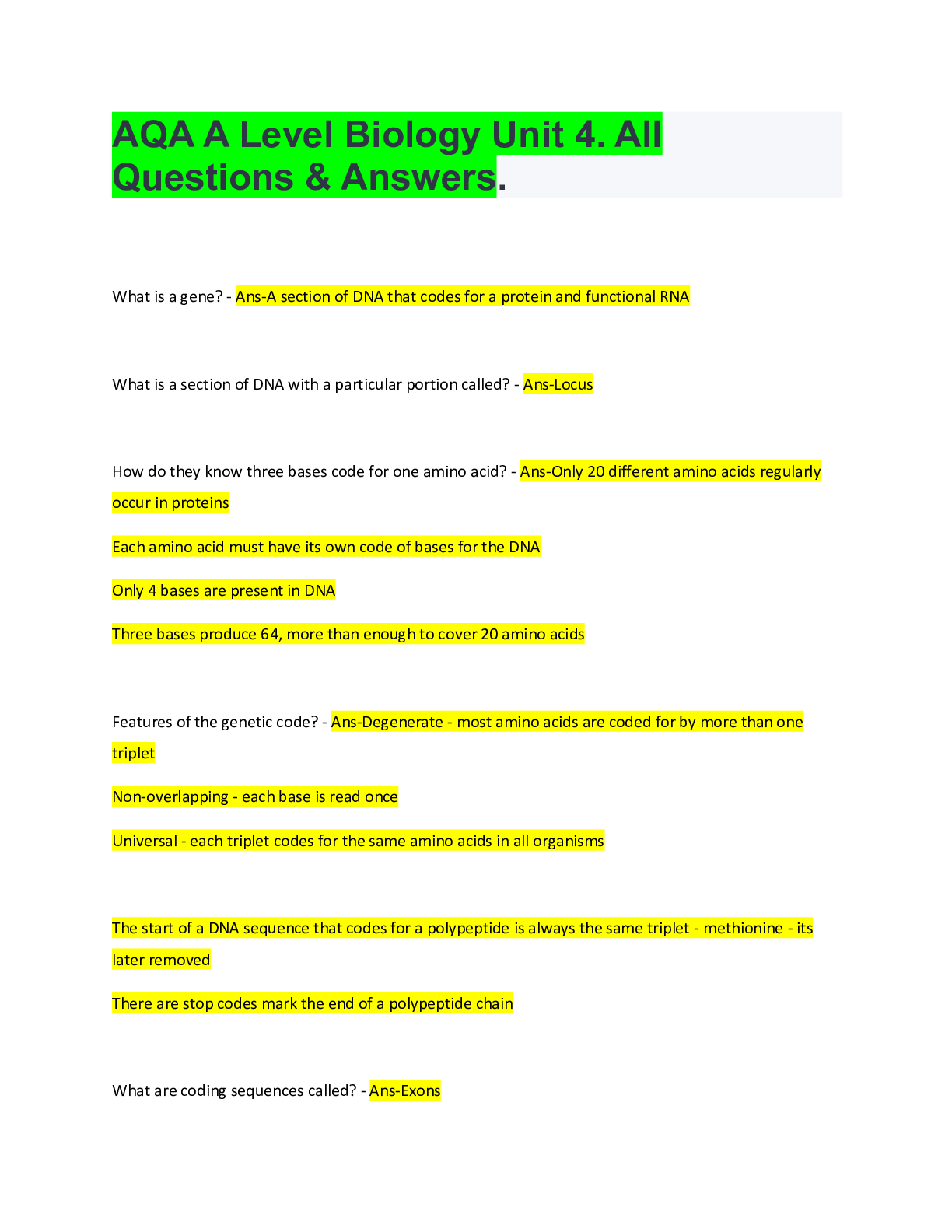
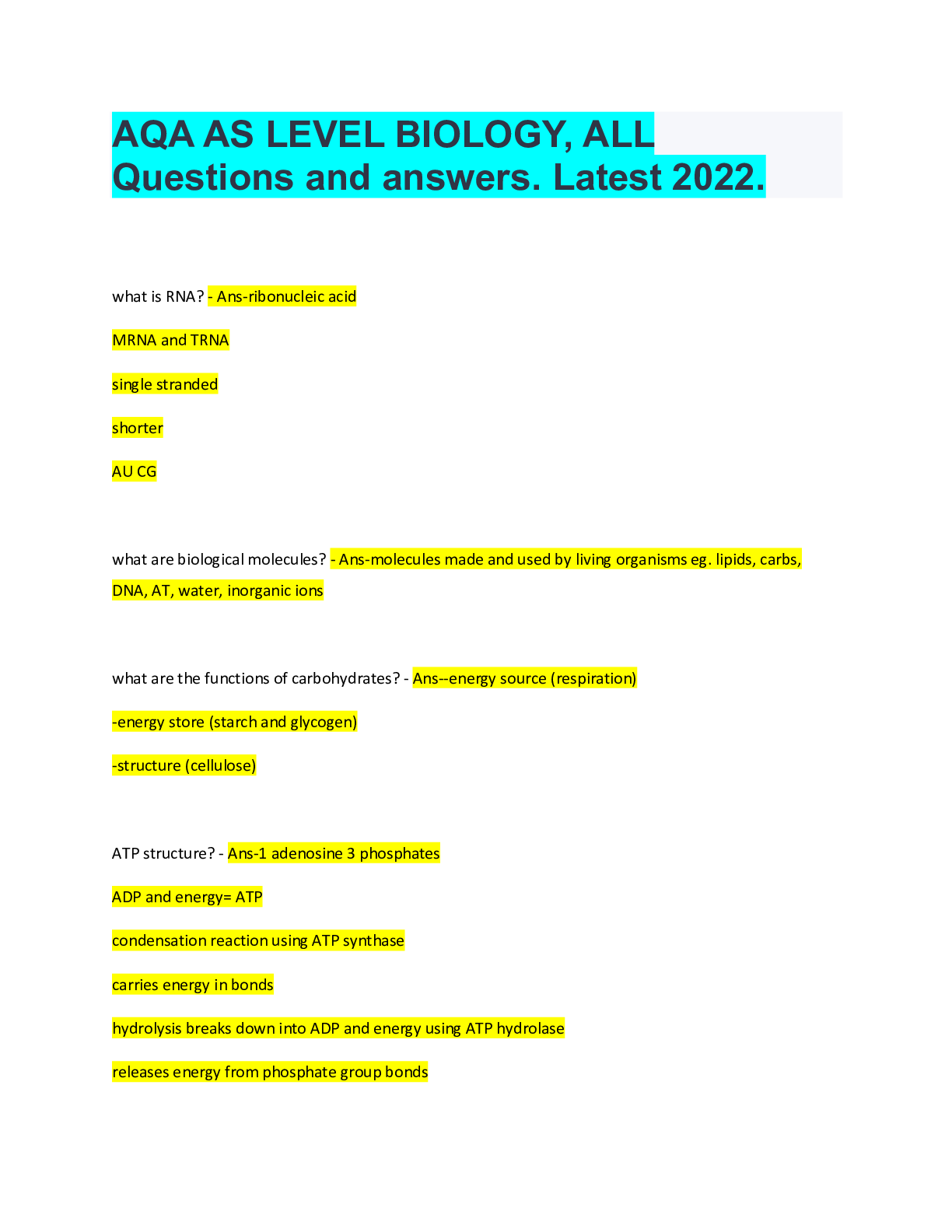
What is a gene? - Ans-A section of DNA that codes for a protein and functional RNA What is a section of DNA with a particular portion called? - Ans-Locus How do they know three bases code for on ... e amino acid? - Ans-Only 20 different amino acids regularly occur in proteins Each amino acid must have its own code of bases for the DNA Only 4 bases are present in DNA Three bases produce 64, more than enough to cover 20 amino acids Features of the genetic code? - Ans-Degenerate - most amino acids are coded for by more than one triplet Non-overlapping - each base is read once Universal - each triplet codes for the same amino acids in all organisms The start of a DNA sequence that codes for a polypeptide is always the same triplet - methionine - its later removed There are stop codes mark the end of a polypeptide chain What are coding sequences called? - Ans-Exons What are non-coding sequences called? - Ans-Introns How does DNA differ in prokaryotes and eukaryotes? - Ans-Prokaryotes - DNA molecules shorter and form a circle. Don't have chromosomes Eukaryotes - DNA longer and form a line rather than circle and occur in association with proteins called histones to form structures called chromosomes What are homologous chromosomes? - Ans-One chromosome of each homologous pair comes from the mother (called a maternal chromosome) and one comes from the father (paternal chromsosome). Homologous chromosomes are similiar but not identical. Each carries the same genes in the same order, but the alleles for each trait may not be the same. What is an allele? - Ans-One of a number of alternative forms of a gene What is a change in the base sequence of amino acids? - Ans-Mutation - this leads to the production af a different polypeptide and therefore a different protein, the new shape may not fit the enzyme and it may not function How is coded information transfered? - Ans-The sections of DNA code are transcribed onto a single stranded molecule called ribonucleic acid The one that transfers the DNA code from the nucleus to the cytoplasm is messenger RNA What is a codon? - Ans-Sequence of three bases on mRNA that codes for a single amino acid What is a genome? - Ans-The complete complement of an organism's genes What is a proteome? - Ans-The full range of proteins produced by the genome What is the RNA structure? - Ans-A polymer of repeating mono nucleotide sub units Each nucleotide is made up of pentose sugar ribose, one organic base and a phosphate group What are the two types of RNA? - Ans-mRNA and tRNA What does mRNA do? - Ans-It passes through the nuclear pores and goes to the ribosomes to give the sequence of codons to determine the amino acid sequence of a specific polypeptide What does tRNA do? - Ans-tRNA has a very specific purpose: to bring protein subunits, known as amino acids, to the ribosome where proteins are constructed What occurs during transcription? - Ans-An enzyme called RNA helices acts on a specific region of the DNA causing two strands to separate and expose the nucleotide bases in that region The nucleotide bases on one of the two DNA strands, known as a template strand, pair with the complementary nucleotides from the pool which is present in the nucleus The enzyme RNA polymerase then moves along the strand and joins the nucleotides together to form a pre-mRNA molecule When the RNA polymerase reaches a parti [Show More]
Last updated: 3 years ago
Preview 1 out of 12 pages
Buy this document to get the full access instantly
Instant Download Access after purchase
Buy NowInstant download
We Accept:

Reviews( 0 )
$8.00
Can't find what you want? Try our AI powered Search
Document information
Connected school, study & course
About the document
Uploaded On
Jun 15, 2022
Number of pages
12
Written in
All
Seller

Reviews Received
Additional information
This document has been written for:
Uploaded
Jun 15, 2022
Downloads
0
Views
167
.png)
.png)
.png)