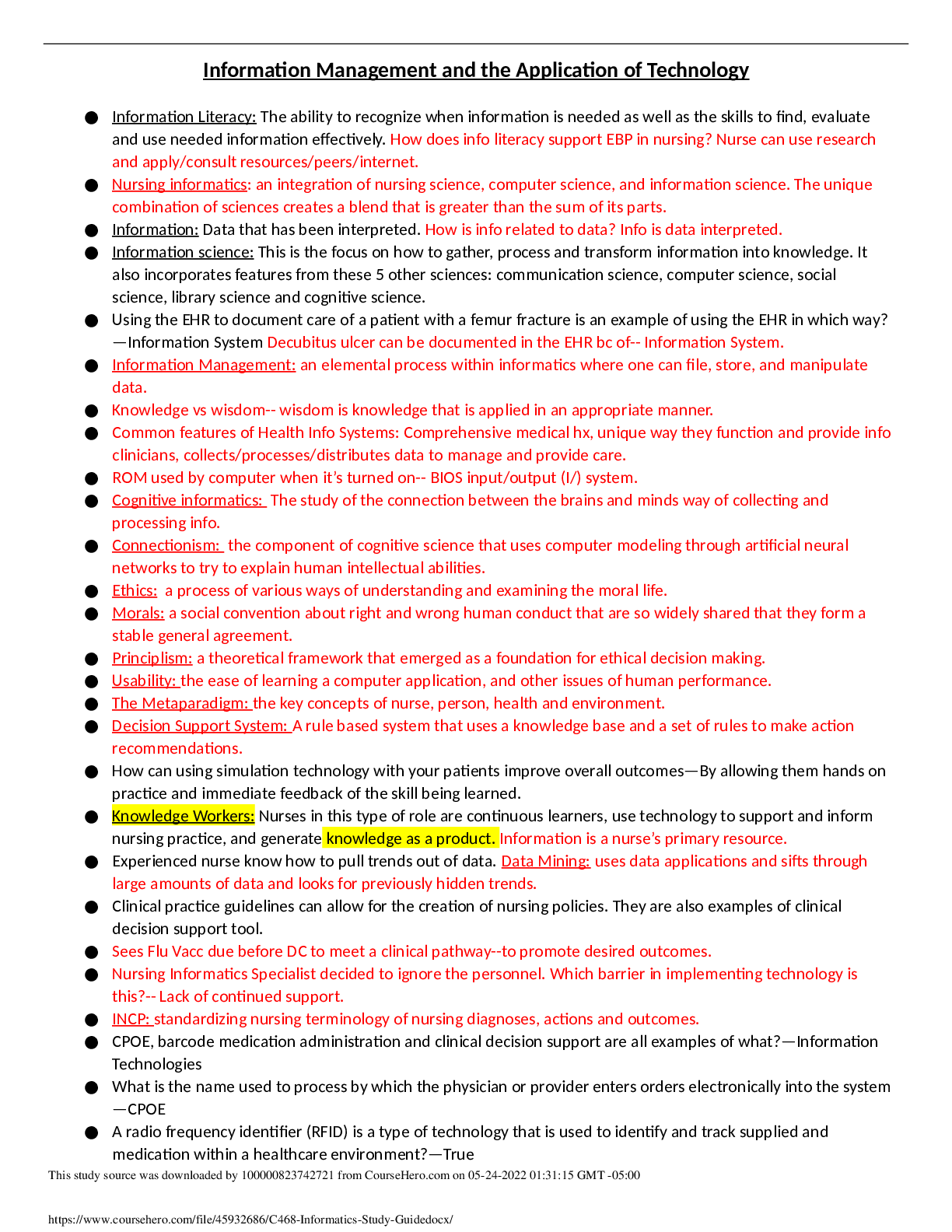
Information Management and the Application of Technology
Notes
Information Management 17% of assessment 10 questions
-The graduate analyzes the role of info management in the delivery of timely, high-quality, patient-
...
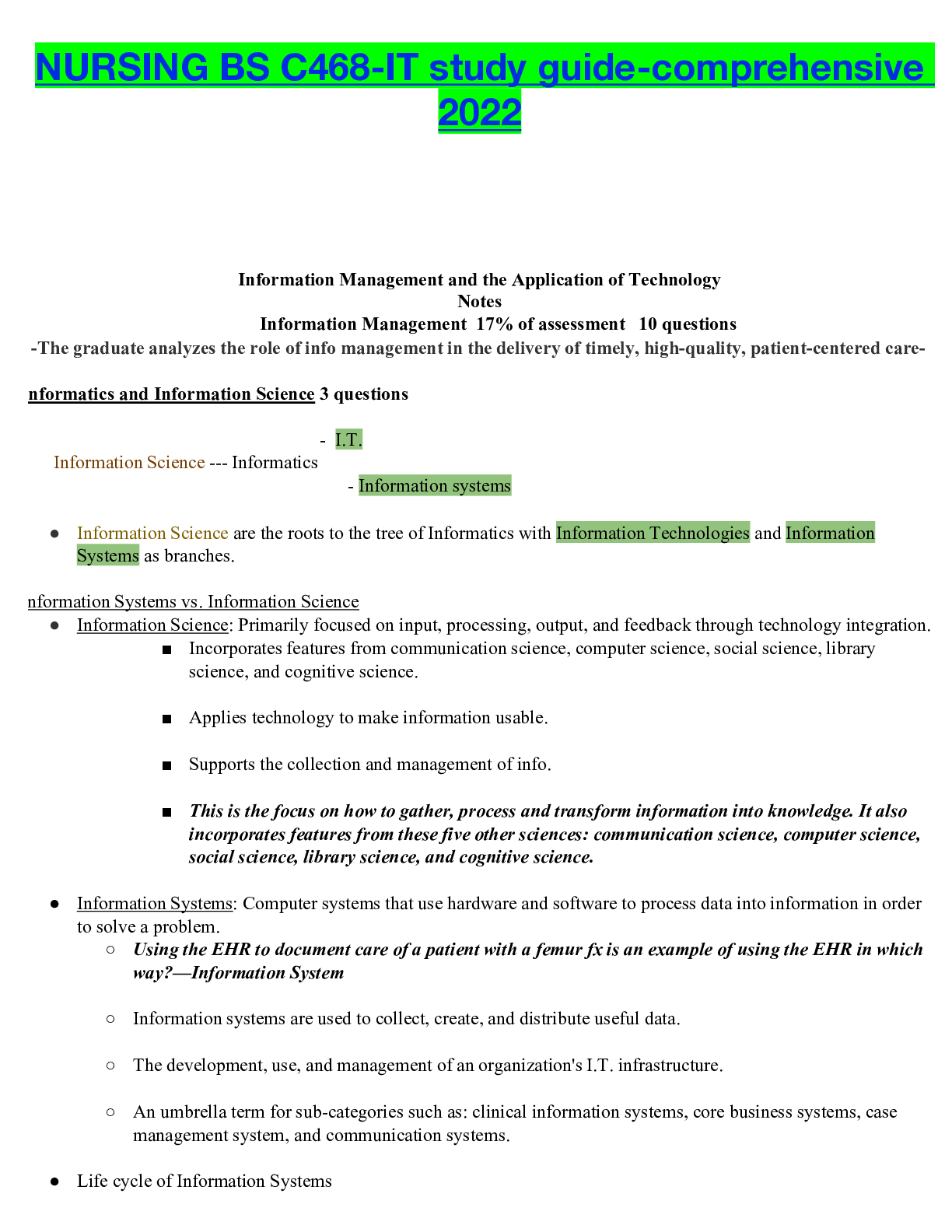
Information Management and the Application of Technology
Notes
Information Management 17% of assessment 10 questions
-The graduate analyzes the role of info management in the delivery of timely, high-quality, patient-centered careInformatics and Information Science 3 questions
- I.T.
Information Science --- Informatics
- Information systems
● Information Science are the roots to the tree of Informatics with Information Technologies and Information
Systems as branches.
Information Systems vs. Information Science
● Information Science: Primarily focused on input, processing, output, and feedback through technology integration.
■ Incorporates features from communication science, computer science, social science, library
science, and cognitive science.
■ Applies technology to make information usable.
■ Supports the collection and management of info.
■ This is the focus on how to gather, process and transform information into knowledge. It also
incorporates features from these five other sciences: communication science, computer science,
social science, library science, and cognitive science.
● Information Systems: Computer systems that use hardware and software to process data into information in order
to solve a problem.
○ Using the EHR to document care of a patient with a femur fx is an example of using the EHR in which
way?—Information System
○ Information systems are used to collect, create, and distribute useful data.
○ The development, use, and management of an organization's I.T. infrastructure.
○ An umbrella term for sub-categories such as: clinical information systems, core business systems, case
management system, and communication systems.
● Life cycle of Information Systems
○ Needs Assessment Phase: *determine needs and wants in an information system*, gap analysis
○ System Selection Phase: The organization seeks out a vendor company that provides a system that best fits
the needs. There are three documents that are used:
■ 1) Request for information document: (RFI) Initial contact with the vendor. Get essential
information about the *company’s history* (How many other organizations have used them?)
■ 2) Request for Proposal document: (RFP) Organization prioritizes or rates their needs and wants.
Sends the outline to the vendor and asks if they can meet this need.
■ 3)Request for Quote document: (RFQ) Pricing, finances, and contract terms.■ It’s not important that selection committee board members understand software and electronic
processes. *They aren’t the end users who need to be trained* in the system. They just have to
have a general understanding of it.
○ System Implementation Phase: Go live planning→ Train staff (including end users)→ Analyst starts
building screens and templates according to organization and its policies→ Apply any changes specific
to that organization→ Go live.
■ Presenting the system design to management is not the responsibility of the project
implementation team.
○ Maintenance Phase: Problem solving, any debugging, files backed up routinely and install any system
upgrades, make sure it’s working as intended.
● It is a continuous cycle.
● System Evaluation IS NOT a phase of the information system life cycle.
● Investigating current deficits and needs of the organization IS NOT a role in they system implementation
phase. It is a role in the Needs Assessment phase.
● ●
Informatics vs. Information Technology
○ Informatics: A combination of nursing science, computer science, and information science.
■ Specific information technologies that support nursing practice.
■ It is the science and art of turning data into information.
○ Information Technologies: A general term used to refer to the management and processing of information
with the assistance of computers, ex → EHR, barcode medication administration… (Uses computers to
transmit data.)
■ CPOE, barcode medication administration and clinical decision support are all examples of
Information Technologies.
○ Commonalities: Both aid in clinical decision making and are a major resource for many organizations.
● Discuss the relationship between the terms:
○ Data: A collection of numbers, characters, or facts that are gathered according to some perceived need for
analysis and possibly action at a later point in time.
■ A patient's height, weight, code status, and date of birth are all examples of data. Once data is
analyzed and interpreted, it then becomes information.
○ Information: Data that have been interpreted.
○ Knowledge: The synthesis of information derived from several sources to produce a single concept or idea.
It is based on a logical process of analysis and provides order to thoughts and ideas and decreases
uncertainty.
■ The Foundation of Knowledge Model: This is the basis for which knowledge is used to meet the
needs of the healthcare delivery system. It is derived from its three key elements of● 1) knowledge acquisition
● 2) knowledge processing
● 3) knowledge dissemination.
[Show More]



.png)
.png)



.png)
.png)



.png)

